




Ohio homeowners pay rates well below the national average. MoneyGeek analyzed premiums, J.D. Power satisfaction scores and coverage options from major insurers to find the best home insurance companies in Ohio.
Best Homeowners Insurance Companies in Ohio
Updated: October 7, 2026
Advertising & Editorial Disclosure
Ohio's Top Home Insurance Companies: Key Takeaways
Auto-Owners is the best home insurance provider in Ohio with a score of 4.6 out of 5 from our review team.
USAA, State Farm, American Family and Farmers rank high for homeowners insurance in Ohio based on affordable rates, strong customer service and reliable coverage.
The best insurer for your home depends on your coverage needs, budget and preferred features like claims service or discount availability.
What Are the Best Home Insurance Companies in Ohio?
Auto-Owners ranks first for Ohio homeowners insurance. It has the lowest premiums in the state and above-average customer satisfaction scores. USAA ranks second. It serves military members and their families. State Farm, American Family and Farmers complete the top five, each with a different strength. One has stronger coverage quality. Another has a larger local agent network.
Auto-Owners Insurance | 4.6 | $1,761 | Most Ohio homeowners |
USAA | 5.0 | $1,361 | Military families |
State Farm | 4.6 | $1,494 | Local agent network |
American Family | 4.6 | $2,018 | Digital tools |
Farmers | 4.5 | $1,263 | Cheapest rates |
*Our ratings consider various combinations of coverage levels, home features and homeowner details to identify the best overall options. Rankings may differ based on your profile.
**Although USAA earned the highest score, we didn't rank it No. 1 due to its eligibility requirements.

Auto-Owners
MoneyGeek Rating
4.6/ 5
4.9/5Affordability
4.5/5Customer Experience
4/5Coverage
J.D. Power Customer Satisfaction Score
621/1,000From the J.D. Power 2025 U.S. Home Insurance Study, which examines customer satisfaction based on responses from 14,511 homeowners and renters. The average score is 642/1,000.Average Annual Premium
$1,761Based on our methodology's base profile of a policy with $250K in dwelling coverage, $125K in personal property coverage and $200K in liability coverage with a $1,000 deductible

USAA
MoneyGeek Rating
5.0/ 5
5/5Affordability
5/5Customer Experience
5/5Coverage
J.D. Power Customer Satisfaction Score
737/1,000From the J.D. Power 2025 U.S. Home Insurance Study, which examines customer satisfaction based on responses from 14,511 homeowners and renters. The average score is 642/1,000.Average Annual Premium
$1,361Based on our methodology's base profile of a policy with $250K in dwelling coverage, $125K in personal property coverage and $200K in liability coverage with a $1,000 deductible

State Farm
MoneyGeek Rating
4.6/ 5
4.9/5Affordability
4/5Customer Experience
4.2/5Coverage
J.D. Power Customer Satisfaction Score
657/1,000From the J.D. Power 2025 U.S. Home Insurance Study, which examines customer satisfaction based on responses from 14,511 homeowners and renters. The average score is 642/1,000.Average Annual Premium
$1,494Based on our methodology's base profile of a policy with $250K in dwelling coverage, $125K in personal property coverage and $200K in liability coverage with a $1,000 deductible

American Family Insurance
MoneyGeek Rating
4.6/ 5
4.8/5Affordability
4.3/5Customer Experience
4.1/5Coverage
J.D. Power Customer Satisfaction Score
643/1,000From the J.D. Power 2025 U.S. Home Insurance Study, which examines customer satisfaction based on responses from 14,511 homeowners and renters. The average score is 642/1,000.Average Annual Premium
$2,018Based on our methodology's base profile of a policy with $250K in dwelling coverage, $125K in personal property coverage and $200K in liability coverage with a $1,000 deductible

Farmers
MoneyGeek Rating
4.5/ 5
5/5Affordability
4/5Customer Experience
3.6/5Coverage
J.D. Power Customer Satisfaction Score
631/1,000From the J.D. Power 2025 U.S. Home Insurance Study, which examines customer satisfaction based on responses from 14,511 homeowners and renters. The average score is 642/1,000.Average Annual Premium
$1,263Based on our methodology's base profile of a policy with $250K in dwelling coverage, $125K in personal property coverage and $200K in liability coverage with a $1,000 deductible
Best Ohio Home Insurance by City
Auto-Owners ranks first in nine Ohio cities. That list includes Cleveland, Columbus, Cincinnati, Akron, Toledo, Dayton, Grove City, Bolivar and Dillonvale. Annual premiums run $1,643 to $1,972 depending on location, the widest city-level spread among providers MoneyGeek analyzed.
| Akron | Auto-Owners Insurance | $1,643 |
| Bolivar | Auto-Owners Insurance | $1,685 |
| Cincinnati | Auto-Owners Insurance | $1,719 |
| Cleveland | Auto-Owners Insurance | $1,714 |
| Columbus | Auto-Owners Insurance | $1,761 |
| Dayton | Auto-Owners Insurance | $1,972 |
| Dillonvale | Auto-Owners Insurance | $1,712 |
| Grove City | Auto-Owners Insurance | $1,776 |
| Toledo | Auto-Owners Insurance | $1,852 |
Cheapest Ohio Home Insurance Companies
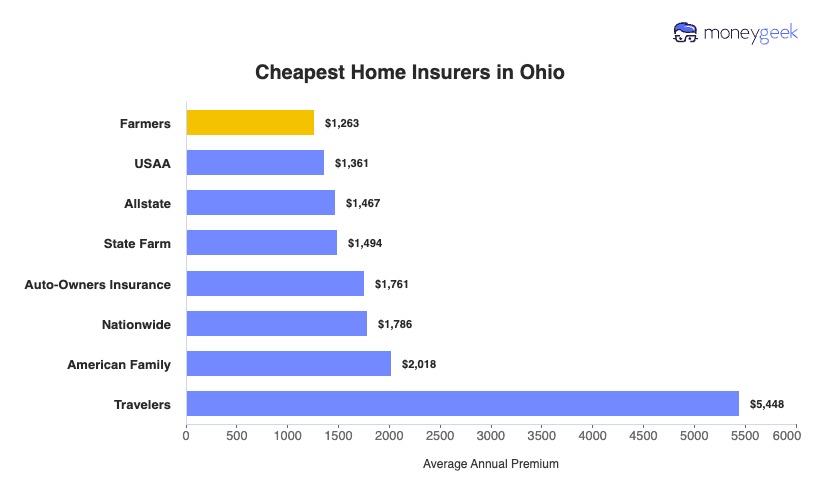
Ohio homeowners pay $2,075 annually for home insurance, 40% less than the national average of $3,467. Farmers offers the state's most affordable home insurance at $1,263 annually, 39% below the state average. USAA provides the second-lowest rates at $1,361 per year, though it restricts coverage to military members, veterans and their families. Premiums vary among insurers, with Travelers charging 57% more than the national benchmark.
Guide to Finding the Best Ohio Home Insurance Company
Compare multiple providers based on your coverage needs, budget and service preferences.
 Compare Quotes Strategically
Get quotes from at least three to five insurers. Premiums among top Ohio providers run $1,263 to $2,018 a year. Price alone doesn't tell the full story. A cheap policy can leave coverage gaps that surface only when you file a claim after severe weather or another covered loss.
 Check Customer Satisfaction Metrics
The Ohio Department of Insurance tracks complaint ratios worth checking first. J.D. Power scores among leading Ohio insurers run 621 to 737, against a 642 industry average. Recent customer reviews focused on claims handling during Ohio's tornado season carry more weight than reviews about the buying experience alone.
 Evaluate Coverage Needs
Calculate coverage based on replacement cost, not market value. That distinction matters in Ohio, where construction costs spike after tornadoes and flooding. Wind and hail protection, flood insurance and extended or guaranteed replacement cost options all deserve a look based on your home's specific risks.
 Match Service Preferences to Provider Strengths
Lemonade, Hippo and Root work best for homeowners who want to manage policies entirely online. State Farm, Nationwide and Allstate take a different approach, running extensive local agent networks for face-to-face support. Matching your service preferences to what each provider actually offers keeps you from paying for features you won't use.

OHIO HOME INSURANCE RISKS
From 2000 to 2020, Ohio experienced over 1,000 flood events, according to the National Oceanic and Atmospheric Administration. That makes flooding a leading cause of property damage in the state. Standard homeowners insurance covers many types of weather damage, but flood damage isn't one of them. Separate flood coverage, available through your insurer or the National Flood Insurance Program, protects against this major financial risk.
Top-Rated Home Insurance Companies in Ohio: FAQ
These frequently asked questions cover what to look for when choosing a home insurance provider in Ohio.
Ohio homeowners should prioritize wind/hail protection for tornado damage, water backup coverage for sewage and drain issues during heavy rainfall seasons, and separate flood insurance since standard policies exclude flood damage. These coverages address Ohio's most common weather-related property risks including tornadoes, heavy spring rains and winter freezes.
Yes, but expect restrictions. Some insurers charge higher premiums, require added liability coverage or won't cover trampoline and pool-related injuries at all. Safety features matter too: most companies want nets and padding on trampolines and fenced, gated pools. Carry at least $300,000 in liability coverage to protect yourself from claims.
Replacement cost coverage pays to rebuild your home or replace belongings at current prices without deducting for depreciation. Actual cash value coverage subtracts depreciation from claim payments. You receive less money based on your property's age and condition. Actual cash value policies cost less up front but leave you covering more expenses out of pocket after a loss.
No, standard homeowners insurance in Ohio doesn't cover flood damage. You'll need separate flood insurance through your insurer or the National Flood Insurance Program to protect against this major risk.
Our Methodology: Determining the Best Ohio Home Insurers
Ohio homeowners deal with tornado risks, hurricane exposure and fluctuating construction costs. Our ranking system weighs affordable premiums, quality coverage and reliable claims handling.
We scored insurers across three factors:
Affordability (55%): We compared rates for identical coverage across major providers and evaluated discount availability.
Customer satisfaction (30%): J.D. Power ratings, Trustpilot reviews and app feedback reveal how insurers handle claims after storms damage your home.
Coverage options (15%): We assessed add-on availability, including water backup protection and inland flood options for Ohio's risks.
Our Sample Profile
Rates reflect a homeowner aged 41-60 with good credit and no prior claims insuring a 2,500-square-foot home built in 2000. Coverage includes $250,000 dwelling coverage, $125,000 personal property coverage, $200,000 personal liability coverage and a $1,000 deductible.
Your rates will vary based on your home's age, location, claims history and credit score.
About Mark Fitzpatrick

Mark Fitzpatrick is a licensed Property and Casualty (P&C) Insurance Producer and MoneyGeek's resident expert in insurance and economics. In nearly a decade covering the insurance market at LendingTree and MoneyGeek, he's analyzed hundreds of carriers and millions of rates across auto, home, renters, health and life insurance.
His work has appeared in The Washington Post, The New York Times and NPR. He draws on independent cost and consumer experience data, and no insurance company partnerships affect his recommendations.
Mark studied at Boston College and later earned a master's in economics and international relations from Johns Hopkins University. He worked in financial risk management at State Street before joining MoneyGeek. He's also a five-time “Jeopardy!” champion.
Sources
- NOAA. "National Oceanic and Atmospheric Administration." Accessed October 23, 2026.