

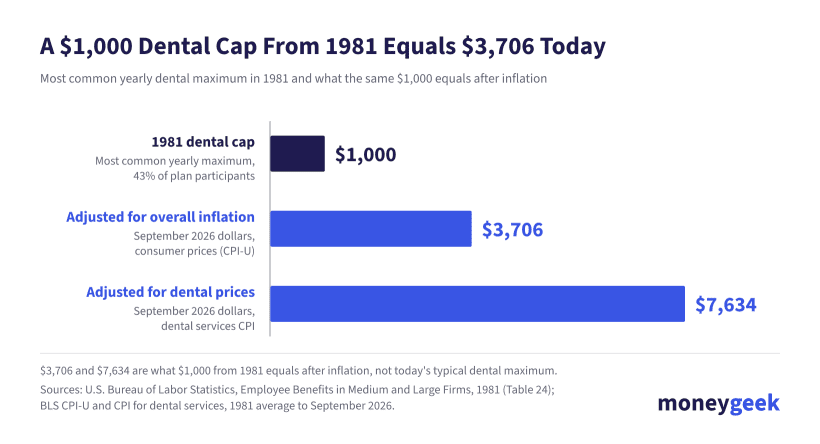
Many dental plans stop paying once you reach a yearly dollar limit, called the annual maximum, and you pay the rest. In 1981, the most common limit at medium and large private employers was $1,000, the U.S. Bureau of Labor Statistics (BLS) reports. If it had kept pace with inflation, it would be $3,706 today.
A $1,000 Dental Cap From 1981 Equals $3,706 Today
Updated: November 3, 2026
Advertising & Editorial Disclosure
Measured against that $3,706 mark, most state employee plans MoneyGeek reviewed fall short. In 41 of the 42 states MoneyGeek ranked, the lowest-cost capped plan that covers crowns pays less than $3,706 a year, and in 24 it pays less than half that. Delta Dental puts the out-of-network cost of a crown at $1,100 to $2,000. On a plan that pays half the cost of crowns, two $1,500 crowns would use up a $1,500 annual maximum.
Dental prices have risen even faster than prices overall. Measured against dental prices, the 1981 cap would be worth $7,634 today.
The National Association of Dental Plans (NADP) reports that 73% of dental preferred provider organization (PPO) enrollees had an annual maximum of $1,500 or more in 2024. A $1,500 cap equals about 40% of the 1981 cap's inflation-adjusted value, or about 20% measured against dental prices. The BLS and NADP surveys cover different groups. These figures compare today's caps with a 1981 reference point and don't follow one set of plans over time.
Before choosing a plan during your employer's enrollment period, check which services count toward its annual maximum and when that maximum resets.

MAIN FINDINGS
- The most common 1981 dental cap is worth $3,706 today. In 1981, 43% of dental plan participants at medium and large private firms had a $1,000 yearly cap, the most common amount. Measured against dental service prices instead of all prices, that cap equals $7,634.
- Most dental PPO enrollees had a cap of $1,500 or more in 2024. NADP reports 73%, up from 67% a year earlier. A $1,500 cap equals about 40% of the 1981 cap's value in September 2026 dollars.
- About 3% of group dental PPO enrollees reached the cap in 2024. NADP reports that 2.9% of group dental PPO enrollees reached their maximum in 2024. In a CareQuest Institute survey, 12% of insured adults said they reached or exceeded their maximum in the past year, and 46% of that group said it prevented them from seeking additional dental treatment. The two studies cover different groups and use different methods.
- Among 42 states with confirmed plans, the median selected plan caps benefits at $1,750. That median equals 47% of the 1981 cap's value in today's dollars. In 24 of the 42 ranked states, the selected plan's cap is less than half of $3,706.
- AlaskaCare Economy has the lowest cap among the 42 ranked plans, at $500. Georgia's and West Virginia's selected plans pay up to $750. Connecticut's only capped plan pays up to $5,000 in network, and its cheaper Basic PPO has no annual maximum.
- ACA annual-limit rules permit caps on qualifying adult dental coverage. Stand-alone dental coverage can qualify as an excepted benefit under federal rules, and in May 2026, the Centers for Medicare & Medicaid Services (CMS) reinstated its ban on treating routine adult dental care as an essential health benefit.

How Much Has the Dental Annual Maximum Lost to Inflation?
A $1,000 dental annual maximum from 1981 would need to be $3,706 in September 2026 to buy the same amount of goods and services, based on the BLS Consumer Price Index for All Urban Consumers (CPI-U). Consumer prices rose about 271% from the 1981 average to September 2026.
Dental care prices rose faster than prices overall. Adjusted with the BLS CPI for dental services, the same $1,000 cap from 1981 equals $7,634 in September 2026. Dental service prices in September 2026 were about 16.8 times their 1970 level, the BLS dental services index shows.
The BLS repeated its survey in 1986. That year, 42% of dental plan participants had a $1,000 cap, again the most common amount. A $1,000 cap from 1986 equals $3,074 in September 2026 dollars, or $5,470 measured against dental prices. Both BLS surveys counted full-time workers at medium and large private firms, and 12% of dental plan participants in each year had no yearly maximum.
All prices (CPI-U) | $3,706 | $3,074 |
Dental service prices (CPI dental services) | $7,634 | $5,470 |
Most common cap that year | $1,000 (43% of participants) | $1,000 (42% of participants) |
$500 | 12% | 4% |
$750 | 22% | 19% |
$1,000 | 43% | 42% |
$1,500 | 3% | 10% |
No maximum | 12% | 12% |
Full-time dental plan participants at medium and large private firms. The table shows the single amounts BLS reported in both years; ranges and other amounts aren't shown. BLS reports some cells as less than 0.5%, and rounded figures may not sum to 100%.
What Does 2024 Data Show About Dental Annual Maximums?
In 2024, 73% of dental PPO enrollees had an annual maximum of $1,500 or more, up from 67% the year before, NADP's 2025 Plan Design report found. NADP's public summary gives that threshold share but not the share of enrollees at each cap amount. It doesn't show the most common cap today. NADP also says that even as annual maximums rise, they may not be keeping pace with the growing number of services enrollees receive and the higher payments dentists receive for them.
A $1,500 dental annual maximum equals about 40% of the 1981 cap's value in all prices and about 20% measured against dental prices. MoneyGeek uses $1,500 as a comparison point because it's the threshold NADP reports. NADP doesn't publish a national average cap. In the 1981 BLS survey of private-firm workers, 5% of dental plan participants had a cap of $1,500 or higher. The two surveys cover different groups, and the two shares don't form a trend.
Dental HMO (DHMO) plans work differently. NADP reports that 88% of DHMO enrollees had no annual maximum in 2024, because those plans limit costs through set copays and a closed network of dentists. NADP also reports that 42% of PPO enrollees have rollover benefits, which add unused benefits to the next year's maximum.
How Many People Hit Their Dental Annual Maximum?
NADP reports that 2.9% of group dental PPO enrollees reached their annual maximum in 2024, up from 1.7% the year before. NADP calls that the highest share in six years. Those figures cover group dental PPO plans, not individual or DHMO coverage.
A CareQuest Institute survey shows a larger share. Among adults with dental insurance, 12% said they reached or exceeded their annual maximum in the past year. Of that group, 46% said reaching the maximum prevented them from seeking additional dental treatment. The survey of 9,450 adults was fielded in January and February 2025, and CareQuest published the results in February 2026.
NADP's 2.9% figure and CareQuest's 12% figure measure different people in different ways. NADP's figure comes from plan-reported data on group dental PPO enrollees, while CareQuest asked adults with any type of dental coverage to recall the past year. Neither study explains why the two numbers differ.
How Do Selected State Employee Dental Caps Compare?
In 42 states with confirmed plan documents, the lowest-cost state employee dental plan with a dollar cap that covers crowns has a median annual maximum of $1,750. That median equals 47% of the 1981 private-firm cap's value in today's dollars. State employee dental plans are a form of employer-sponsored coverage, and these results cover one named program per state. Because uncapped options are excluded, the ranking doesn't identify each state's cheapest dental coverage or its most generous plan.
AlaskaCare Economy has the lowest cap among the 42 ranked plans. It pays 10% of crown costs, up to $500 a year (13% of $3,706), with no employee-only premium. Georgia's Dental Select plan (Cigna network) and West Virginia's PEIA Assistance plan (insured by Sun Life) both cap in-network benefits at $750, and the West Virginia plan pays 25% of in-network crown costs. Eight states set their selected plan's cap at $1,000: Arkansas, Florida, Kentucky, Nebraska, North Dakota, South Carolina, South Dakota and Wisconsin.
Connecticut has the highest cap among ranked plans. Its Cigna Enhanced dental PPO, the state's only capped option, pays up to $5,000 in network, or 135% of $3,706. New Jersey and New York follow at $3,000, or 81%. Twelve states set the selected plan's cap at $2,000.
Alaska | AlaskaCare Economy | $500 | 13% | 1 |
Georgia | Dental Select (Cigna) | $750 | 20% | 2.5 |
West Virginia | PEIA Assistance (Sun Life) | $750 | 20% | 2.5 |
Arkansas | Delta Dental Base | $1,000 | 27% | 7.5 |
Florida | Humana Schedule B (any dentist) | $1,000 | 27% | 7.5 |
Kentucky | Anthem Silver | $1,000 | 27% | 7.5 |
Nebraska | Ameritas Basic | $1,000 | 27% | 7.5 |
North Dakota | NDPERS Delta Dental | $1,000 | 27% | 7.5 |
South Carolina | PEBA Basic Dental (any dentist) | $1,000 | 27% | 7.5 |
South Dakota | Delta Dental Base | $1,000 | 27% | 7.5 |
Wisconsin | Select supplemental (major services) | $1,000 | 27% | 7.5 |
Illinois | Quality Care Dental Plan | $2,500 | 67% | 38.5 |
Maryland | United Concordia DPPO | $2,500 | 67% | 38.5 |
New Jersey | Aetna or Horizon Dental Expense Plan | $3,000 | 81% | 40.5 |
New York | NYS Dental Plan | $3,000 | 81% | 40.5 |
Connecticut | Cigna Enhanced DPPO | $5,000 | 135% | 42 |
Eleven lowest and five highest of 42 ranked states; tied states share an average rank. Wisconsin's $1,000 is the limit on its Select supplemental plan, which pays for crowns. The state's Uniform Dental Benefit, which excludes crowns, also has a $1,000 limit.
Some programs cover only certain groups of state workers. AlaskaCare covers exempt employees and certain bargaining units, and New York's dental plan covers management and Public Employees Federation members. Ohio's figure comes from the Union Benefits Trust plan for bargaining-unit employees, and Massachusetts' figure comes from the Group Insurance Commission plan for staff without dental coverage through a union.
Florida's Humana Schedule B and South Carolina's Basic Dental are any-dentist indemnity plans. They pay a set amount or a lower allowed amount for each service instead of using a contracted network. Their $1,000 caps apply wherever members get care.
Cheaper plans that don't pay for crowns are left out of the ranking. Kentucky's Anthem Bronze plan caps benefits at $750 for about $14 a month but excludes major services, and North Carolina's MetLife Low plan caps benefits at $1,000 without crown coverage. Florida, Michigan, Utah, Virginia, Wisconsin and Wyoming also offer coverage limited to preventive or basic care.
Texas is shown separately because its cap isn't a hard ceiling. The Humana State of Texas Dental Choice PPO keeps paying 40% for in-network care after members reach the $2,000 maximum. Louisiana and Mississippi weren't ranked. MoneyGeek didn't find a central state dental plan in either state, where dental coverage is sold through payroll vendors.
Five states aren't ranked because MoneyGeek couldn't confirm current benefit details or the lowest-cost plan from published documents: Alabama, Maine, New Hampshire, Rhode Island and Vermont. Full State Results lists the best available figure for each and marks it unconfirmed.
How Does a Dental Annual Maximum Work?
A dental annual maximum limits what the plan pays for services counted toward that maximum. Once a hard maximum is used up, the plan stops paying for those services until the next benefit period. Many plans don't count preventive care against the cap, including the state plans in Arizona, Indiana and Minnesota, and a few plans keep paying after the threshold, as the Texas state plan does.
A dental maximum works the opposite way from a medical plan's out-of-pocket maximum, which caps what you pay rather than what the insurer pays. A worker who uses up a $1,500 hard dental maximum by October pays the full cost of services that count toward that cap for the rest of the benefit period.
Crowns show how fast the benefit can run out. Delta Dental puts the out-of-network cost of a permanent crown at $1,100 to $2,000, based on its 2023 data. In a hypothetical case, a crown with a $1,500 allowed fee on a plan that pays 50% of major services, with the deductible met and no earlier claims that year, leaves the plan paying $750 and the patient paying $750. That uses half of a $1,500 annual maximum. A hypothetical $3,000 treatment total at the same 50% rate would use all of it.
Why Are Dental Annual Maximums Still Legal?
The Affordable Care Act's ban on annual and lifetime dollar limits, set out at 45 CFR 147.126, covers essential health benefits. Pediatric dental care is an essential health benefit, but routine adult dental care is not.
Stand-alone employer dental plans can also fall under a separate exception. Federal rules at 45 CFR 146.145 treat limited-scope dental benefits as "excepted benefits" when they're offered under a separate policy, when employees can opt out of them, or when their claims are handled under a separate contract. The ACA's market reforms, including the annual-limit ban, don't apply to excepted benefits.
CMS closed one path to changing the essential health benefit rules in 2026. In 2024, CMS let states add routine adult dental care to their essential health benefit packages starting in 2027. The final 2027 Notice of Benefit and Payment Parameters, announced May 15, 2026, reversed that policy and again bars issuers from treating routine adult dental care as an essential health benefit in marketplace plans.
The American Dental Association (ADA) opposes the caps. A 2024 ADA policy says the group doesn't support annual or lifetime maximums in dental benefit programs, and that when plans use maximums, issuers should review them each year and raise them at least in line with the dental services CPI. In an August 2026 letter responding to a CMS request for information on the essential health benefit framework, the ADA asked CMS to rescind the ban on adult dental as an essential health benefit and said dental coverage "should not include dollar-value annual and lifetime maximums."
What It Means for You: Getting More From a Low Dental Cap
Check four parts of your dental plan before open enrollment closes: the cap, which services count against it, when it resets and whether unused benefits roll over. Those details change how much care a $1,000 or $1,500 annual maximum covers.
- 1Find the date your maximum resets.
Hawaii's and Nevada's state dental maximums reset with a July-to-June plan year. Colorado and New Mexico enroll workers on a July schedule, but their dental maximums run on the calendar year.
- 2Ask how to schedule multistep treatment.
Your dentist and insurer can tell you whether part of a treatment plan can happen after the reset date and which year's maximum it will count against.
- 3Price the buy-up plan against the extra coverage.
North Carolina's MetLife High plan costs about $21 more a month than the Classic plan, about $250 a year, and raises the cap from $1,500 to $5,000.
- 4Treat your enrollment choice as fixed for the year.
North Carolina's NCFlex guide doesn't allow switching dental options during the plan year, even after a qualifying life event. Your employer's rules decide what can change midyear.
- 5Ask about rollover.
Kentucky's Gold plan and Nebraska's Dental Rewards both let some unused benefits roll over to the next year.
- 6Use pretax accounts for eligible costs above the cap.
IRS Publication 502 lists dental treatment as a qualifying medical expense. You can pay unreimbursed dental costs from a health flexible spending account or health savings account, if you have one. IRS Publication 969 explains who can open an HSA.
A dental HMO is another option for workers whose employer offers one. Most DHMO plans have no annual maximum, but they limit you to in-network dentists and set copays by procedure. Georgia, Maryland, New Jersey, Tennessee and Washington all offer state workers a DHMO alongside a capped PPO.
Compare dental insurance costs with the extra annual benefit before choosing a higher-premium plan. In Arkansas, the state's Delta Dental Premium plan costs about $10 more a month than the Base plan for employee-only coverage and doubles the annual maximum from $1,000 to $2,000.
Full State Results
Connecticut has the highest ranked cap at $5,000 and Alaska has the lowest at $500. Texas is shown separately, and Louisiana and Mississippi aren't ranked. An asterisk marks the five states with unconfirmed figures, which aren't ranked. MoneyGeek's state data file, listed in Sources, gives the plan document and page behind each state's figure.
Alabama | SEIB Southland dental (Plan I)* | $1,250 | 34% | Unconfirmed | $1,500 | 2026 |
Alaska | AlaskaCare Economy | $500 | 13% | 1 | $1,500 | 2027 |
Arizona | ADOA Delta Dental PPO Plus Premier | $2,000 | 54% | 30.5 | $2,000 | 2026 |
Arkansas | ASE Delta Dental Base | $1,000 | 27% | 7.5 | $2,000 | 2026–27 |
California | CalHR PPO/indemnity plans | $2,000 | 54% | 30.5 | $2,000 | 2027 |
Colorado | Delta Dental Basic | $1,500 | 40% | 15.5 | $3,000 | 2026–27 |
Connecticut | Cigna Enhanced DPPO (only capped plan) | $5,000 | 135% | 42 | $5,000 | 2026–27 |
Delaware | Delta Dental PPO | $1,500 | 40% | 15.5 | $1,500 | 2026–27 |
Florida | Humana Schedule B (any dentist) | $1,000 | 27% | 7.5 | $2,000 | 2026 |
Georgia | Dental Select (Cigna) | $750 | 20% | 2.5 | $2,000 | 2027 |
Hawaii | EUTF HDS Dental | $2,000 | 54% | 30.5 | $2,000 | 2026–27 |
Idaho | Blue Cross of Idaho Dental PPO | $1,500 | 40% | 15.5 | $1,500 | 2026–27 |
Illinois | Quality Care Dental Plan | $2,500 | 67% | 38.5 | $2,500 | 2026–27 |
Indiana | Anthem Dental Complete | $2,000 | 54% | 30.5 | $2,000 | 2027 |
Iowa | Delta Dental (non-SPOC) | $1,500 | 40% | 15.5 | $1,500 | 2027 |
Kansas | SEHP Delta Dental | $2,000 | 54% | 30.5 | $2,000 | 2027 |
Kentucky | Anthem Silver | $1,000 | 27% | 7.5 | $1,500 | 2026 |
Louisiana | Not ranked | – | – | – | – | – |
Maine | Northeast Delta Dental* | $1,500 | 40% | Unconfirmed | $1,500 | 2025–26 |
Maryland | United Concordia DPPO | $2,500 | 67% | 38.5 | $2,500 | 2027 |
Massachusetts | GIC Altus Value PPO (non-union staff) | $1,750 | 47% | 21.5 | $1,750 | 2026–27 |
Michigan | State Dental Plan | $2,000 | 54% | 30.5 | $2,000 | 2026–27 |
Minnesota | State Dental Plan | $2,200 | 59% | 37 | $2,200 | 2026–27 |
Mississippi | Not ranked | – | – | – | – | – |
Missouri | MCHCP Delta Dental | $2,000 | 54% | 30.5 | $2,000 | 2026 |
Montana | State Plan dental | $1,800 | 49% | 24 | $1,800 | 2026 |
Nebraska | Ameritas Basic | $1,000 | 27% | 7.5 | $1,500 | 2026–27 |
Nevada | PEBP PPO dental | $2,000 | 54% | 30.5 | $2,000 | 2026–27 |
New Hampshire | State Delta Dental* | $2,000 | 54% | Unconfirmed | $2,000 | 2024–25 |
New Jersey | Aetna or Horizon DEP | $3,000 | 81% | 40.5 | $3,000 | 2027 |
New Mexico | Base plan | $1,750 | 47% | 21.5 | $2,000 | 2026–27 |
New York | NYS Dental Plan (M/C, PEF) | $3,000 | 81% | 40.5 | $3,000 | Current |
North Carolina | MetLife Classic | $1,500 | 40% | 15.5 | $5,000 | 2027 |
North Dakota | NDPERS Delta Dental | $1,000 | 27% | 7.5 | $1,000 | 2027 |
Ohio | Union Benefits Trust dental | $1,500 | 40% | 15.5 | $1,500 | 2026–27 |
Oklahoma | Delta Dental PPO Choice | $2,000 | 54% | 30.5 | $5,000 | 2027 |
Oregon | PEBB Delta Dental PPO | $1,750 | 47% | 21.5 | $1,750 | 2027 |
Pennsylvania | PEBTF dental | $2,000 | 54% | 30.5 | $2,000 | 2026 |
Rhode Island | Anchor Dental* | $1,500 | 40% | Unconfirmed | $2,500 | Undated |
South Carolina | PEBA Basic Dental (any dentist) | $1,000 | 27% | 7.5 | $2,000 | 2026 |
South Dakota | Delta Dental Base | $1,000 | 27% | 7.5 | $2,000 | 2026–27 |
Tennessee | MetLife DPPO | $1,500 | 40% | 15.5 | $1,500 | 2026 |
Texas | Dental Choice PPO (pays 40% after cap) | $2,000 (soft) | – | Not ranked | Same | 2026–27 |
Utah | PEHP Preferred Choice | $1,500 | 40% | 15.5 | $2,000 | 2026–27 |
Vermont | Northeast Delta Dental* | $2,000 | 54% | Unconfirmed | $2,000 | 2026–27 |
Virginia | COVA Expanded Dental | $2,000 | 54% | 30.5 | $2,000 | 2026–27 |
Washington | Uniform Dental Plan | $1,750 | 47% | 21.5 | $1,750 | 2026 |
West Virginia | PEIA Assistance (Sun Life) | $750 | 20% | 2.5 | $2,500 | 2026–27 |
Wisconsin | Select supplemental (major services) | $1,000 | 27% | 7.5 | $2,500 | 2026 |
Wyoming | Optional Dental Plan | $2,000 | 54% | 30.5 | $2,000 | 2026 |
*Unconfirmed: benefit details or lowest-cost plan selection couldn't be confirmed from a current, dated plan document. The figure shown is the best available and isn't ranked.
Methodology
Historical maximums come from the BLS Employee Benefits Survey for 1981 (Bulletin 2140, Table 24) and 1986 (Bulletin 2281, Table 39). Both tables report the share of full-time dental plan participants in medium and large private firms by yearly maximum, excluding orthodontic limits. The tables count participants, not plans.
MoneyGeek adjusted dollar amounts to September 2026 with the CPI-U (all items, U.S. city average, not seasonally adjusted, series CUUR0000SA0) and the CPI for dental services (series CUUR0000SEMC02). The 1981 and 1986 base values are the average of the 12 published monthly index values for each year. Using BLS's published 1981 annual averages instead (90.9 for all items and 86.5 for dental services) gives $3,707 and $7,628. The September 2026 comparison values are 336.940 (all items) and 659.834 (dental services).
Current national figures come from NADP's public summary of its 2025 Dental Benefits Report: Plan Design, which describes 2024 enrollment. The 1981 BLS figures and the 2024 NADP figures describe different populations, private-firm plan participants and dental PPO enrollees. MoneyGeek treats them as reference points and doesn't present them as a trend.
About Myryah Irby

Myryah Irby is a writer and data journalist at MoneyGeek. Her work spans original data studies and how-to guides covering auto, home and health insurance, consumer costs and transportation safety.
Research and Analysis
Since joining MoneyGeek in late 2025, Irby has produced data studies on insurance costs, consumer spending and transportation risk. Her published work includes a 50-state analysis of winter driving danger using fatality and weather severity data; research tracking the relationship between rhodium commodity prices and catalytic converter theft rates, including state-level theft trends and what those rates mean for insurance costs; a state-by-state comparison of winter home heating costs; and an analysis of the full cost of having a baby in America: hospital bills, insurance and out-of-pocket expenses.
Career
Irby has more than 20 years of editorial and writing experience. Since 2005, she has run Irby x Irby, her own editorial and copywriting practice, with clients including The New York Times, The San Francisco Chronicle, OpenAI and the National Park Service. From 2019 to 2023, she served as Senior Managing Editor and then Copywriting Manager at Callisto Media, a nonfiction publisher acquired by Penguin Random House in May 2023, where she led a team of writers and graphic designers.
Before that, she spent nearly 11 years at QuinStreet, a performance marketing company that runs content and comparison sites in insurance and personal finance. She rose from Managing Editor to Senior Managing Editor between 2010 and 2016. Earlier in her career, she edited at Collabrys for nearly four years and tutored doctoral candidates on dissertation writing at the University of San Francisco.
Sources
- American Dental Association. "Current Policies." Accessed November 3, 2026.
- ADA News. "ADA Urges CMS to Recognize Adult Dental Coverage as an Essential Health Benefit." Accessed November 3, 2026.
- CareQuest Institute for Oral Health. "Maxed Out." Accessed November 3, 2026.
- Centers for Medicare & Medicaid Services. "HHS Notice of Benefit and Payment Parameters for 2027 Final Rule." Accessed November 3, 2026.
- Centers for Medicare & Medicaid Services. "HHS Notice of Benefit and Payment Parameters for 2025 Final Rule." Accessed November 3, 2026.
- Delta Dental. "Dental Crowns: Treatment Cost." Accessed November 3, 2026.
- Electronic Code of Federal Regulations. "45 CFR 147.126: No Lifetime or Annual Limits." Accessed November 3, 2026.
- Electronic Code of Federal Regulations. "45 CFR 146.145: Special Rules Relating to Group Health Plans." Accessed November 3, 2026.
- Internal Revenue Service. "Publication 502: Medical and Dental Expenses." Accessed November 3, 2026.
- Internal Revenue Service. "Publication 969: Health Savings Accounts and Other Tax-Favored Health Plans." Accessed November 3, 2026.
- MoneyGeek. "State Employee Dental Caps by State, 2026." Accessed November 3, 2026.
- National Association of Dental Plans. "New Data Sheds Light on Dental Benefits and the Cost of Serving Enrollees." Accessed November 3, 2026.
- U.S. Bureau of Labor Statistics. "Employee Benefits in Medium and Large Firms, 1981." Accessed November 3, 2026.
- U.S. Bureau of Labor Statistics. "Employee Benefits in Medium and Large Firms, 1986." Accessed November 3, 2026.
- U.S. Bureau of Labor Statistics. "Consumer Price Index for All Urban Consumers: All Items (CUUR0000SA0)." Accessed November 3, 2026.
- U.S. Bureau of Labor Statistics. "Consumer Price Index for All Urban Consumers: Dental Services (CUUR0000SEMC02)." Accessed November 3, 2026.