



Jump to the section that meets your needs best below:
Average Towing Company Business Insurance Cost (2026 Report)
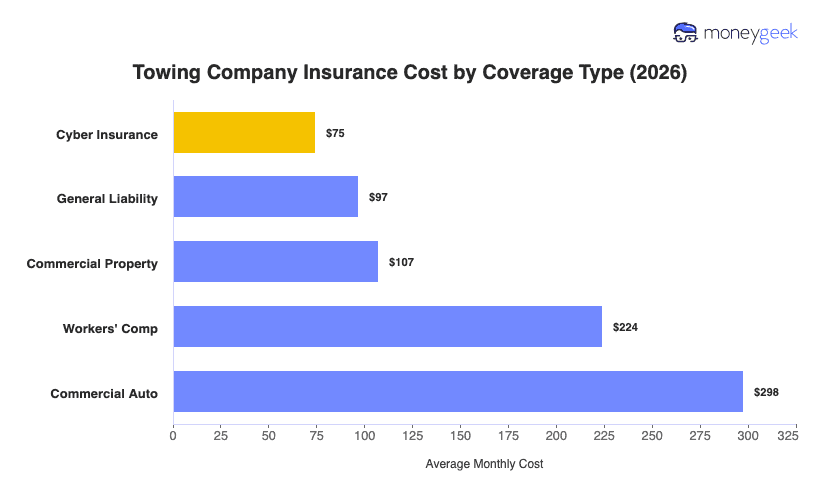
Towing company insurance costs $75 to $298 per month, with rates shaped by fleet size, haul type, your operating states and whether you employ drivers.
If you're ready to get a quote, our matching tool below connects you to the best towing company insurer for your business.
Select state
Updated: September 13, 2026
Advertising & Editorial Disclosure
How Much Does Towing Company Business Insurance Cost?
Towing company business insurance costs an average of $160 per month, or $1,920 per year, across five of the most common coverage types. MoneyGeek's analysis covers towing sub-industries across all 50 states plus DC, modeling businesses with one to four employees under standard policy limits of $1 million per occurrence and $2 million aggregate, except workers' comp, which follows state-mandated limits.
Your monthly cost for a single coverage type likely falls between $75 and $298 depending on what your operation needs. Cyber insurance sits at the lower end because your towing business carries limited digital exposure. Most of your revenue flows through dispatch calls, roadside transactions and physical assets rather than sensitive customer data. Commercial auto lands at the top because insurers price tow trucks as high-severity vehicles: your trucks operate in live traffic, hook up to disabled vehicles and log more roadway hours than most commercial fleets.
The table below breaks these figures down by coverage type, but treat them as benchmarks for setting expectations, not as quotes, since your actual premium depends on your fleet composition, payroll, location and claims history.
| Cyber Insurance | $75 | $895 | 10% | 210 |
| General Liability | $97 | $1,161 | -21% | 224 |
| Commercial Property | $107 | $1,287 | 14% | 269 |
| Workers' Comp | $224 | $2,686 | -98% | 340 |
| Commercial Auto | $298 | $3,573 | -82% | 366 |
We analyzed quote data from major U.S. commercial insurance providers and modeled standardized premium estimates across business profiles representing around 95% of the market. Results are designed to provide a consistent national benchmark showing how premiums vary by key baseline factors including business size, restaurant profession type, location and vehicle type for operations that use commercial vehicles.
Dataset Scope and Assumptions
Our cost modeling uses standardized inputs for consistent comparisons across businesses.
- Total estimates modeled: just over 6 million standardized pricing estimates
- Providers analyzed: 10 major insurance providers
- Geography: all U.S. states including Washington, D.C.
- Employee count bands: solo practitioners, one to four, five to nine, 10 to 19, and 20 to 49 employees
- Vehicle types studied: Sedans, SUVs, pickup trucks, vans, taxis, limousines, tractors, food trucks, semi-trucks (non-HAZMAT and HAZMAT), tanker trucks (non-HAZMAT and HAZMAT), buses, box trucks, dump trucks, flatbed trucks
- Policies studied: general liability, workers' comp, professional liability, commercial auto, commercial property, and cyber insurance
- General liability: $1 million per occurrence and $2 million aggregate
- Workers' comp: state required coverage
- Professional liability: $1 million per claim and $1 million aggregate
- Commercial auto: minimum coverage
- Commercial property: personal property coverage limits personalized to industry, business size and state
- Cyber insurance: $1 million per occurrence and $1 million aggregate
How We Calculated Average Towing Company Business Insurance Costs
Our published averages represent modeled premiums for standardized business profiles and were aggregated in two ways.
- National benchmark average: The national average cost reflects the modeled premium for a standardized one to four employee business across all and states included in our dataset for a standard policies
- Segment averages: To show how costs vary, we calculated average modeled premiums for our national base profile and isolated for variables, including:
- Employee count (business size ranges)
- Vehicle types (for commercial auto)
- States (including Washington, D.C.)
Segment averages were produced by aggregating modeled pricing trends across the full dataset so readers can compare how premiums shift across coverage types and regions.
See our full business insurance methodology.
Get Towing Company Business Insurance Cost Estimates
Our towing company business insurance cost calculator below gives you more personalized estimates so you can accurately compare rates.
Get Towing Company Insurance Cost Estimates
Select Coverage Type
Select State
Select Employee Count
Select Vehicle Type
Monthly Rate Estimate—
Select Coverage Type
Monthly Rate Estimate—
Select State
Select Employee Count
Select Vehicle Type
Factors Affecting Towing Company Business Insurance Costs
What you pay for towing company business insurance depends heavily on how your operation is set up. In our analysis, fleet composition and the nature of your work consistently emerged as the strongest predictors of where your premium lands relative to other towing operations.
 Fleet size and vehicle type
The number of trucks your operation runs and what those trucks are built to do both factor into your premium. If your fleet runs light-duty wreckers, you sit in a different risk tier than if you operate heavy rotators or semi-recovery units, and insurers price that distinction directly into what you pay.
 Services offered
Whether your operation focuses on local light-duty towing, long-distance transport, heavy recovery or roadside assistance changes your exposure in ways that matter to insurers. If your crews handle heavy recovery and accident scene work, you carry greater liability and equipment risk than if your business stays focused on routine lockout or jump-start calls, and your premium reflects that difference.
 Driver qualifications and records
Your drivers' licensing history, CDL status and motor vehicle records are among the most scrutinized underwriting inputs for towing operations. When your team carries clean records and appropriate credentials, your rates reflect that. A history of violations or at-fault incidents pushes them in the opposite direction.
 Operating territory and road conditions
Where your trucks run affects your risk profile beyond state-specific rate filings. If your operation concentrates in dense urban corridors, high-traffic interstates or severe-weather regions, you face higher exposure to accidents and equipment stress than operations working rural or low-volume routes.
 Storage and impound yard operations
If your business holds vehicles on-site for impound, repair staging or owner retrieval, that physical footprint adds property and liability exposure your operation wouldn't carry if you ran strictly mobile. The size of your yard, overnight vehicle counts and site security all factor into how insurers assess that risk.
How to Lower Towing Company Business Insurance Costs
Towing operations tend to carry higher commercial auto exposure than most small business categories, and in our analysis, the most effective cost reductions combined immediate coverage adjustments with longer-term risk profile changes. These five methods reflect both timelines and give you a practical path to affordable business insurance without sacrificing the protection your operation needs.
 Compare quotes using the same coverage limits
Because commercial auto rates vary more across insurers for towing than for most small businesses, comparing multiple business insurance quotes is worth your time. When you request them, hold the coverage limits and deductibles constant across every provider. A quote that looks cheaper on price may simply be thinner on coverage.
 Right-Size Your Coverage
Not every towing operation needs the same coverage structure. If your business runs a single truck without a storage yard, you may be paying for property coverage that doesn't match your actual footprint. Review each policy against what your operation actually owns, where you work and what your contracts require before your next renewal.
 Increase your deductible strategically
Raising your deductible lowers your premium, but the tradeoff matters more for towing operators than for lower-risk businesses. If your trucks run daily in high-traffic areas, set your deductible at a level your operation can cover without disrupting payroll or fleet availability after a minor collision.
 Bundle policies with the same provider
If your general liability, commercial auto and commercial property coverage sit with different insurers, consolidating them with one provider often unlocks a multi-policy discount. For your towing operation, which typically carries several coverage types, bundling can reduce your total premium without changing what you're covered for.
 Lower your risk profile
Your renewal pricing reflects the claim history and risk signals your operation has built up over time. Investing in driver screening, maintaining a vehicle inspection schedule and documenting safety training gives insurers concrete evidence that your fleet is actively managed, and that record compounds in your favor at each renewal cycle.
Towing Company Business Insurance Cost: Bottom Line
The five coverage types on this page average $160 per month for towing companies, which is a useful reference point, not a prediction of what your operation will pay. Your actual premium depends on factors specific to how your business runs, like the size and composition of your fleet, where your trucks operate and the services your crews handle.
The three questions below help you put that number in context for your specific situation:
- Where do you fall in the distribution? Use the benchmarks on this page to locate yourself by trade type, employee count and state. If your quotes sit outside the range for operations with a similar profile, that gap is worth understanding before you accept or reject any offer.
- Is your quote consistent with your risk profile? Treat your quote as a cross-check against your operation's actual risk signals. If the number sits far outside the benchmarks for your fleet type and territory, understanding what's driving it gives you a stronger basis for evaluating whether it reflects your actual exposure.
- Which cost drivers apply to your business? Not every factor on this page carries equal weight for every towing operation. If you run a single truck, your pricing inputs look different than if you manage a multi-unit recovery fleet. Identify which drivers actually reflect your setup rather than treating the full list as relevant across the board.
The benchmark on this page is a starting point, not a ceiling or a floor. In most cases, a small number of operation-specific factors account for the gap between the industry average and your actual quote, and understanding what those are gives you more useful information than simply knowing whether your quote lands above or below average.
About Mark Flores

Mark Flores is a Business Insurance Content Writer at MoneyGeek, where he focuses on commercial auto, commercial property, cyber and specialty business insurance coverage. His work simplifies coverage terms, gives business owners a strong baseline for expected costs, and narrows down policies and providers tailored to your operation, regardless of complexity.
Before joining MoneyGeek’s business insurance team, Mark worked as a Senior Content Writer at Clutch.co, where he produced structured B2B reviews and provider analyses based on client interviews, company research and service evaluation. That experience shaped his approach to business insurance content, especially when comparing insurers, explaining coverage differences and translating complex policy features into practical guidance for small business owners.
Mark also spent nearly 4 years as a digital marketing specialist serving small-business clients across industries such as home services, manufacturing and education. That background gives him practical context for how businesses evaluate vendors, manage operational needs and make purchasing decisions.
At MoneyGeek, he applies this research and evaluation experience to build guides that help transportation sectors, those with complex property-related risks (such as hotels and retail stores), and those most at risk of a cyberattack get the coverage they need at a reasonable price.
Linkedin: https://www.linkedin.com/in/mark-jason-flores-7844634a/
Contact Email: mark.flores@moneygeek.com