One Month of Tariffs Now Equals 14 Years of Small-Business Insurance Premiums

Advertising & Editorial Disclosure

Small businesses that import goods are paying an average of $25,000 more a month in tariff costs than they did a year ago, a March 2026 Center for American Progress report found. That's roughly 170 months, or more than 14 years, of the average monthly business owner's policy premium, based on MoneyGeek's analysis of BOP pricing across 10 national carriers and 79 industries. The smallest firms, those with fewer than 50 employees, paid roughly $175,000 in new tariff costs between March 2025 and February 2026, about $14,600 a month. And the small-business insurance policies most of these businesses carry won't cover a dollar of it.

Under a temporary import surcharge that took effect Feb. 24, 2026 (a 10% duty on most imports invoked under Section 122 of the Trade Act of 1974), a non-exempt $50,000 shipment of imported goods adds $5,000 in tariff costs before other duties and fees. For a small-business owner who calls their insurance broker after seeing that line item, the answer from most brokers is the same: standard policies don't cover it.

mglogo icon
KEY TAKEAWAYS
  • Small-business importers paid an average of $306,000 more in tariff costs from March 2025 through February 2026, the Center for American Progress found. For the smallest firms (under 50 employees), the increase was about $175,000, or roughly $14,600 a month.
  • Standard business owner's policies, business interruption coverage and contingent business interruption policies require covered physical damage to trigger a claim. Tariffs are a financial and regulatory cost, not physical damage, so these policies won't respond to tariff-related losses.
  • Specialty products like trade disruption insurance, trade credit insurance and political risk insurance may cover some tariff-related losses depending on policy wording, but they're more expensive and require a specialty broker to access.
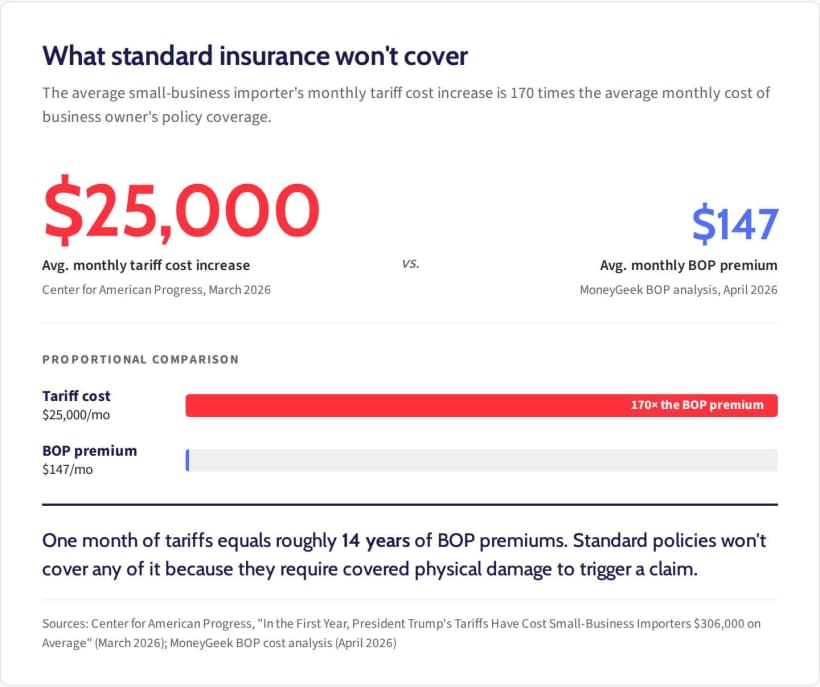
  • The average small-business importer's monthly tariff increase equals about 170 months, or more than 14 years, of the average $147 monthly BOP premium.
Comparison showing the $25,000 average monthly tariff cost increase is 170 times the $147 average monthly business owner's policy premium, equal to about 14 years of BOP coverage.

General liability covers third-party injury and property-damage claims, not tariff bills. Tariff bills can behave like business interruption costs, but standard insurance contracts treat them as uncovered economic losses.

How Much Are Tariffs Costing Small-Business Importers?

Small-business importers paid an average of $306,000 more in tariff costs from March 2025 through February 2026, the Center for American Progress found in its March 2026 analysis. Roughly 90% of tariffs are paid by U.S. importers and consumers, not foreign producers. Monthly customs duty payments by small businesses more than tripled over the same period, from $8,400 in January 2025 to $27,200 in January 2026, according to a National Small Business Association tariff impact survey.

U.S. Census Bureau data shows there were 242,515 identified U.S. importers in 2023, and the Center for American Progress estimates about 236,000 of them are small-business importers, or roughly 97% of the total. The Yale Budget Lab estimated the U.S. effective tariff rate at 11.8% as of April 2026, the highest level since the early 1940s (excluding 2025, when rates briefly ran higher under tariffs the Supreme Court later struck down).

The cost hits the smallest companies hardest. Businesses with fewer than 50 employees paid about $175,000 in new tariff costs over that 12-month period, roughly $14,600 a month. Businesses with 50 to 499 employees paid more in total dollars. Their wider margins and larger supply chains gave them more capacity to absorb the increase. A Federal Reserve Small Business Credit Survey published in March 2026 found that more than four in 10 firms reported tariff-related cost increases as a financial concern, with the highest rates in retail (69%) and manufacturing (62%).

Small Business Majority's March 2026 Voice of Main Street poll found that 71% of small businesses reported tariffs had a negative impact on their operations. The same poll found that 65% of small-business owners raised prices, 37% delayed business investments, 20% froze hiring, and 8% laid off employees. Among firms with foreign inputs, the Federal Reserve found that 76% passed at least some higher costs on to customers; 60% absorbed at least some of the increase themselves.

A KPMG 2026 tariff survey of larger companies, those with $1 billion or more in annual revenue, found that 55% plan further price increases over the next six months. That pressure is likely to reach small-business customers and suppliers as larger companies push costs down the supply chain.

The American Action Forum estimated total direct tariff costs to U.S. small businesses at roughly $85 billion a year. That figure doesn't include the indirect costs of new trade compliance requirements, added regulatory hours and a weaker competitive standing against larger companies with more pricing power.

Are Section 122 Tariffs Still in Effect?

For most importers, yes. On May 7, 2026, the U.S. Court of International Trade ruled the Section 122 tariffs unlawful in a 2-1 decision, but immediate relief was limited to the named plaintiffs: Burlap & Barrel, Basic Fun and the State of Washington. The Department of Justice filed a notice of appeal with the Federal Circuit on May 8. For non-plaintiff importers, U.S. Customs and Border Protection continues to assess and collect the 10% surcharge, which is scheduled to remain in effect through July 24, 2026, unless Congress extends it.

Why Standard Business Insurance Won't Cover Tariff Costs

Tariffs are a financial and regulatory cost, not physical damage to property. Standard commercial policies require a covered peril (fire, storm or theft) to trigger a payout, and tariffs don't qualify.

Business interruption coverage, a common add-on to commercial property policies, pays out only when a covered peril stops a business from operating. A 10% surcharge on imported steel that raises a contractor's materials cost doesn't qualify. Neither does a supply chain slowdown caused by new trade restrictions. Without covered physical loss or damage, there's no valid claim.

Contingent business interruption (CBI) coverage, which protects against income loss when a supplier or customer has a disruption, comes with the same limitation. CBI policies require that the supplier's disruption result from covered physical damage to the supplier's property. If a business's parts supplier raises prices by 30% because of tariffs, or a major vendor stops shipping to the U.S. entirely because of retaliatory duties, CBI coverage won't respond. The National Association of Insurance Commissioners says CBI policies tie payouts to physical damage or other commercial property claims.

A May 2025 review of insurance options for tariff and trade risks published by the law firm Covington & Burling reached the same conclusion. Most standard property and casualty policies exclude government actions from their covered causes of loss. Some policies contain extensions for non-physical-damage business interruption, but these endorsements are rare in small-business policies and often come with sublimits too low to cover tariff-scale losses.

The COVID-19 pandemic offers a parallel. Thousands of businesses filed business interruption claims after government shutdown orders in 2020, and the vast majority were denied because the policies required covered physical property damage. Tariff losses fall into the same category: a government action creates a financial loss, but the insurance contract treats it as uncovered.

What a Business Owner's Policy Covers and Misses

A business owner's policy (BOP) bundles general liability, commercial property and basic business income coverage into a single package. It's the most common insurance product for small businesses with fewer than 100 employees and less than $5 million in annual revenue.

A standard BOP covers property damage from fires, storms and theft, plus liability for customer injuries on the premises. It also includes some business income protection if a covered event forces a temporary closure. MoneyGeek's analysis puts the industry average BOP cost at $147 a month across 10 national carriers and 79 industries. Some BOPs include contingent business income coverage as part of the standard package.

But a BOP won't cover tariff-related cost increases, supply chain price jumps or lost revenue from trade disruptions. It also excludes workers' compensation claims, professional liability, commercial auto losses, flood damage and earthquake damage. For a small retailer importing goods subject to new duties, a BOP provides no financial cushion for the added customs cost.

The Insurance Information Institute lists government actions and market-condition changes among the standard exclusions in most commercial property policies. That exclusion language applies whether the government action is a local zoning change or a federal tariff on imported goods.

Which Specialty Policies May Help With Tariff-Related Losses

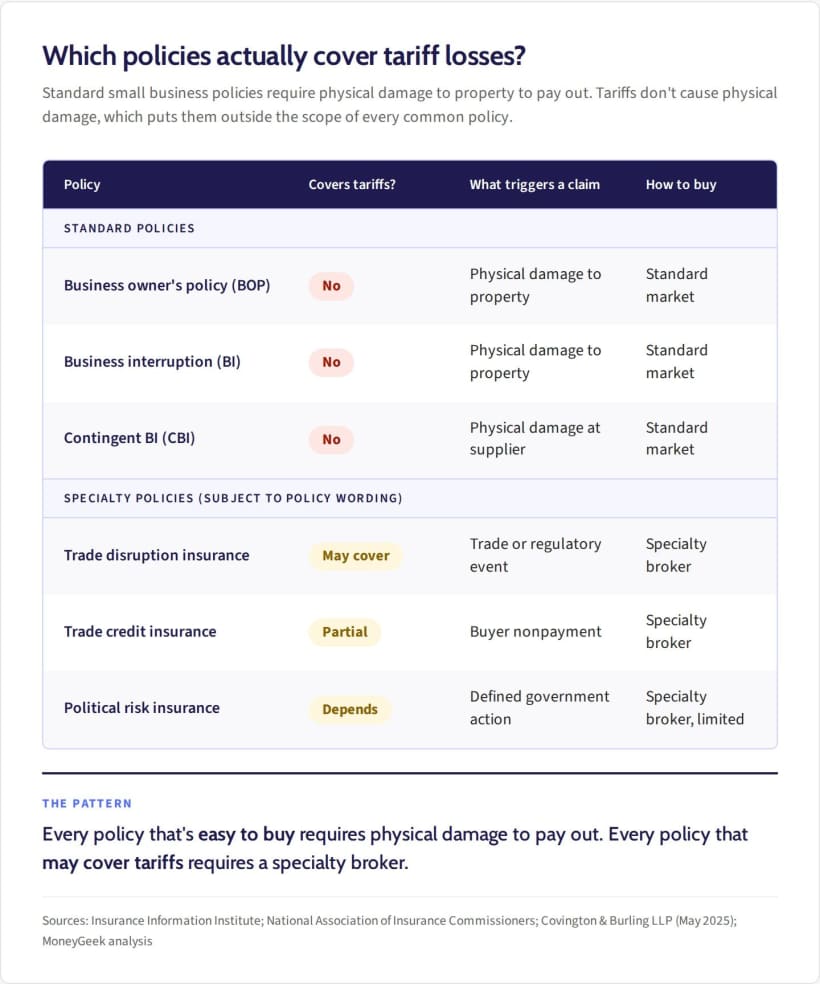
Three specialty insurance products may cover some tariff-related losses, depending on policy wording and the specific loss involved: trade disruption insurance, trade credit insurance and political risk insurance.

Table comparing six insurance policies showing that standard small-business policies don't cover tariff losses while specialty policies may cover them through a specialty broker.

How Tariffs Are Raising Existing Insurance Costs

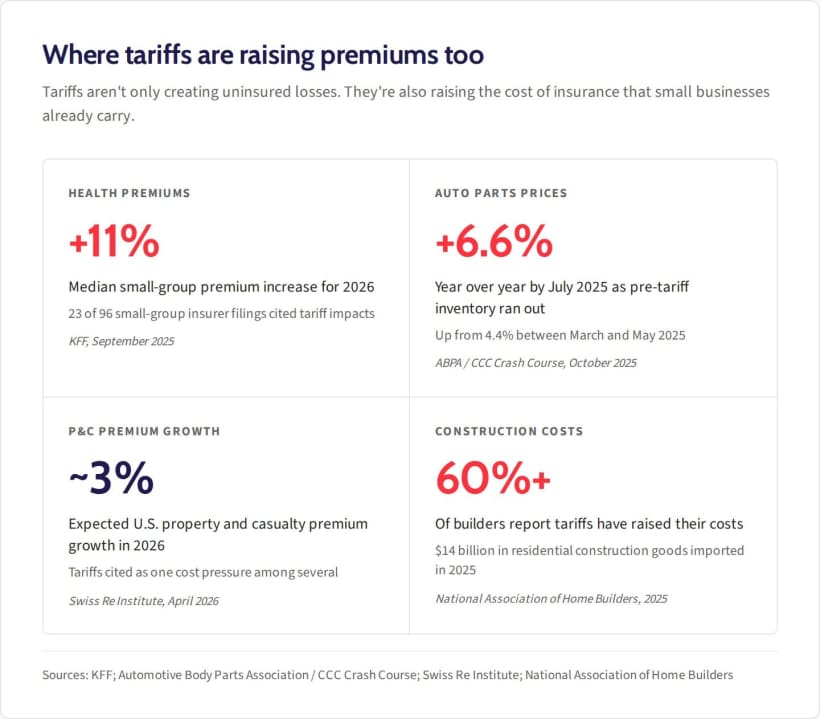
Beyond uninsured losses, tariffs are also raising the cost of coverage small businesses already carry.

Chart showing tariff-related increases across small-business insurance lines: health premiums +11%, auto parts prices +6.6%, P&C premium growth ~3%, and construction costs raised for more than 60% of builders.

Swiss Re Institute's April 2026 outlook expects U.S. property and casualty premium growth of around 3% in 2026, with tariffs cited as one cost pressure among several. Its 2025 outlook warned that tariffs could push up auto and construction claim costs. The 25% tariff on imported auto parts that took effect in 2025 can put upward pressure on commercial auto premiums at renewal. Data from CCC Crash Course, cited by the Automotive Body Parts Association (ABPA), showed average parts prices rose 4.4% year over year between March and May 2025 and 6.6% in July as pre-tariff inventory ran out.

Construction materials carry the heaviest tariff burden. The National Association of Home Builders estimates builders imported $14 billion in residential construction goods in 2025 and says tariffs have raised costs for more than 60% of builders. Steel, aluminum and electrical components all carry new tariff surcharges that raise the cost of rebuilding after a fire, storm or other covered loss. For small businesses that own their commercial space, the result is higher replacement cost valuations and higher property insurance premiums.

Health insurance costs are also rising. Small businesses with ACA-compliant health plans could see a median premium increase of 11% for 2026, a Kaiser Family Foundation (KFF) analysis found. That increase is fueled by rising drug costs (especially GLP-1 medications like Ozempic), labor shortages and tariffs on pharmaceutical ingredients and medical equipment. KFF found that 23 of 96 small-group insurer filings it reviewed specifically mentioned potential tariff impacts on pricing.

Why Tariffs Create Underinsurance Risk

Rising material costs from tariffs are creating a second, less obvious insurance problem: underinsurance. When a small business bought its commercial property policy in 2023 or 2024, the replacement cost estimate for its building and equipment reflected pre-tariff prices. Today, the cost to rebuild that same structure may be higher because of tariffs on steel, lumber, aluminum and electrical components. Industry estimates put tariff-related undervaluation of small-business property coverage at 10% to 20%.

If a fire destroys a small manufacturing shop in Michigan and the policy's replacement cost limit is $450,000 but the rebuild cost is now $600,000 because of tariff-inflated materials, the business owner is responsible for the $150,000 difference. Some policies include a coinsurance clause that reduces the payout proportionally if the coverage limit falls below 80% of the property's true replacement value.

Robertson Ryan Insurance, a Midwest brokerage, published guidance in 2025 urging commercial property owners to update their replacement cost valuations to account for tariff-related price increases. The firm warned that businesses renewing with outdated valuations risk paying out of pocket for a shortfall they didn't know existed.

What Small-Business Importers Can Do

Tariffs added $306,000 in new costs for the average small-business importer in the past year, or roughly $25,000 a month. Each month of those tariff costs equals about 170 months, more than 14 years, of BOP premiums at the $147 industry average. And the standard insurance products most small businesses carry won't cover any of it. Business owner's policies, business interruption coverage and contingent business interruption policies require covered physical damage to trigger a claim. Tariff-related cost increases, supply chain disruptions and trade-related revenue losses fall outside that scope.

Specialty products like trade disruption insurance, trade credit insurance and political risk insurance may cover some of the shortfall depending on policy wording. All three are more expensive than a standard BOP and require a specialty broker to access. Tariffs are also raising the cost of coverage businesses already carry: Swiss Re expects around 3% property and casualty premium growth in 2026, auto repair costs are climbing, and small-business health premiums are projected to rise 11%.

For small-business importers, the starting point is an insurance audit. That means reviewing current policy exclusions, updating replacement cost valuations and asking a broker whether specialty coverage fits their trade exposure.

About Myryah Irby


Myryah Irby headshot

Myryah Irby is a writer and data journalist at MoneyGeek. Her work spans original data studies and how-to guides covering auto, home and health insurance, consumer costs, and transportation safety.

Research and Analysis

Since joining MoneyGeek in late 2025, Irby has produced data studies on insurance costs, consumer spending and transportation risk. Her published work includes a 50-state analysis of winter driving danger using fatality and weather severity data; research tracking the relationship between rhodium commodity prices and catalytic converter theft rates, including state-level theft trends and what those rates mean for insurance costs; a state-by-state comparison of winter home heating costs; and an analysis of the full cost of having a baby in America: hospital bills, insurance and out-of-pocket expenses.

Career

Irby has more than 20 years of editorial and writing experience. Since 2005, she has run Irby x Irby, her own editorial and copywriting practice, with clients including The New York Times, The San Francisco Chronicle, OpenAI and the National Park Service. From 2019 to 2023, she served as Senior Managing Editor and then Copywriting Manager at Callisto Media, a nonfiction publisher acquired by Penguin Random House in May 2023, where she led a team of writers and graphic designers.

Before that, she spent nearly 11 years at QuinStreet, a performance marketing company that runs content and comparison sites in insurance and personal finance. She rose from Managing Editor to Senior Managing Editor between 2010 and 2016. Earlier in her career, she edited at Collabrys for nearly four years and tutored doctoral candidates on dissertation writing at the University of San Francisco.


Sources