
Best Business Insurance Companies For Software Developers

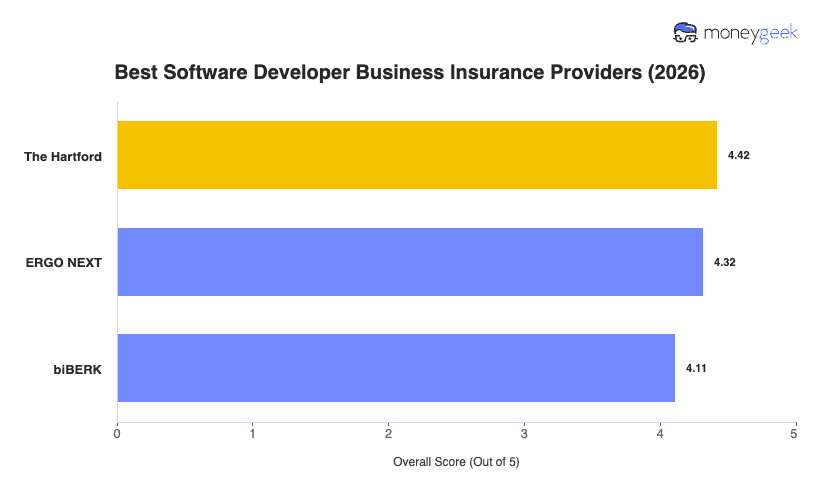
My analysis ranked these companies as the best small business insurers for software developers:

  • Choose if you need strong Tech E&O and cyber coverage in one policy: The Hartford
  • Choose if you want fully digital buying, COIs and policy management: ERGO NEXT
  • Choose if you're a freelancer prioritizing professional liability: Hiscox

My best software developer business insurance rankings are built on what you'll actually pay, how well the provider supports you during claims and whether the coverage holds up when a client dispute or data incident hits. I scored each provider across affordability (50%), customer experience (30%) and coverage options (20%), weighted that way because cost determines what you can sustain long-term, but it should never be the only factor in your decision.

This is what made up my analysis of popular insurers, which was assisted (not run) by AI:

  • Affordability: I pulled quotes isolating pricing factors for software development and adjacent tech sub-industries across all 50 states plus D.C., multiple employee count ranges from solo operators to teams of 49 and the most common coverage types, building over 500,000 rate estimates to capture the full pricing picture.
  • Customer Experience: Over 300,000 reviews, forum conversations and industry research were aggregated and manually reviewed to surface what actually makes customers satisfied or frustrated with each insurer. I also went through the full quoting experience and evaluated the policy management tools available for every provider analyzed.
  • Coverage Options: I read policy terms, identified exclusions and additional costs that aren't obvious at the quote stage and documented all options available for each provider to determine which gives software developers the best protection now and as their business scales.
The Hartford

The Hartford: Best Overall for Software Developers

On The Hartford's site
checkmarkpros
  • Bundled Tech E&O and cyber in one policy

  • Strongest coverage depth for enterprise contracts

  • Dedicated agent assigned to your business

closecons
  • Cannot complete purchase online

  • Solo developers pay more than average

  • Policy changes require calling your agent

COMPANY HIGHLIGHTS

I recommend The Hartford for most software development businesses because it leads on affordability and coverage at the same time. Their FailSafe Tech E&O policy wraps professional liability, data privacy and network security into a single form, which means a client claim involving both a code failure and a data exposure gets handled under one policy with one adjuster instead of two separate filings. Software developers save an average of 26% below the subindustry benchmark with The Hartford, and that gap widens further at 10 or more employees.

The friction is in the buying process. You cannot bind a policy online, and routine changes like adding an endorsement or updating limits go through your assigned agent rather than a self-service portal. If you value speed and independence in managing your coverage, that workflow will slow you down between projects.

Read Our Review: The Hartford Business Insurance Review

ERGO NEXT

ERGO NEXT: Best Digital Experience for Software Developers

On ERGO NEXT's site
checkmarkpros
  • Entire process handled online through app

  • Instant COI generation after purchase

  • Saves 8% versus software industry average

closecons
  • Claims support thinner than competitors

  • Chat-only guidance before purchasing

  • Mid-size teams pay above the benchmark

COMPANY HIGHLIGHTS

If you want to get insured, send a client a COI and adjust your coverage between projects without picking up the phone, ERGO NEXT is the only provider in this analysis built to handle all of that digitally. From initial quote to binding to pulling proof of coverage, I completed the entire process through their app in under six minutes during my evaluation. Software developers save an average of 8% compared to what firms in this subindustry typically pay, and the ability to update policy terms through the portal between engagements makes it practical for developers whose coverage needs shift from project to project.

Where ERGO NEXT falls short is on the claims side. Support routes to a general team rather than specialists familiar with tech professional liability disputes. If a client files a claim alleging your build caused a system failure or data loss, the quality of your defense counsel matters, and the support infrastructure behind your policy here is thinner than what The Hartford or Hiscox provide. Pre-purchase guidance is limited to chat as well, so if you are unsure what coverage you need before buying, you will not get a consultative conversation.

Read Our Review: ERGO NEXT Business Insurance Review

Hiscox

Hiscox: Best for Solo and Freelance Software Developers

checkmarkpros
  • Professional liability built for tech businesses

  • Global work coverage for cross-border clients

  • Online quoting and COI in under 20 minutes

closecons
  • No commercial auto available through Hiscox

  • Workers' comp routed through partner carrier

  • Complaints about claims speed and renewal pricing

COMPANY HIGHLIGHTS

Hiscox built its business around insuring professional services firms, and that specialization shows in how their policies are worded for technology work. Their professional liability coverage responds to the specific ways software engagements produce claims, including copyright infringement disputes over deliverables and failures to meet a contractual specification, not just generic negligence. Their policies also cover work performed globally as long as the claim is filed in the U.S. or Canada, which matters if you take on clients across borders or deploy into international environments. A standalone cyber policy adds ransomware response, business interruption and a breach response team that activates during an incident rather than after.

The limitations show up when your needs extend past professional liability and cyber. Hiscox does not write commercial auto at all, and workers' comp gets placed through a partner carrier with separate pricing and service. If you need multiple coverage types from one insurer with consistent claims handling across all of them, that fragmentation creates friction. Renewal pricing has also drawn complaints across review platforms, with some policyholders reporting increases that were not tied to claims activity.

Read Our Review: Hiscox Business Insurance Review

What Types of Insurance Do Software Developers Need?

The first policy most software developers should carry is errors and omissions insurance, since your professional accountability for delivered code begins with your first client contract and E&O is the coverage type clients require most often. Cyber insurance is the immediate second priority because your work touches client systems and data on nearly every engagement, and a vulnerability in your code that leads to a breach creates liability that E&O alone will not fully address. General liability rounds out the essential three if clients visit your office or you work on-site at theirs.

Beyond those core policies, workers' compensation becomes legally required in most states from your first hire, including remote employees. Commercial property makes sense if you lease office space or own equipment worth protecting.

Legal defense, settlements and judgments when a client claims your code, advice or deliverables caused them a financial loss
Every software developer needs this before signing a client contract, since professional accountability exists from your first engagement

The average tech E&O claim takes 18 to 24 months to resolve and costs $125,000 or more in defense costs alone before any settlement is reached.

Breach notification costs, forensic investigation, regulatory response, legal fees and business interruption after a cyberattack or data exposure tied to your work
You store, transmit or process client data, or your code connects to systems that hold sensitive information

Small business breach costs range from $120,000 to $1.24 million per incident according to Verizon's Data Breach Investigations Report, and software developers carry direct exposure on every engagement that touches client data.

Third-party bodily injury, property damage and associated legal costs unrelated to your professional services
Clients visit your office, you work on-site at a client's location or your contracts specify a GL minimum
Most software development contracts that specify an insurance requirement include a general liability minimum, and without it you may be disqualified from the engagement entirely.
Medical bills and partial lost wages for employees who suffer a work-related injury or illness, including repetitive stress injuries common in development work
You hire your first employee in most states, including remote developers, with requirements governed by where the employee works
Requirements are triggered by headcount and state law, not by the physical risk level of the work, and penalties for noncompliance can include fines and personal liability for the business owner.
Damage to or loss of business equipment, office contents and leased space from covered events like fire, theft or vandalism
You lease office space, own servers or workstations or keep equipment on-site worth replacing
A single office theft or fire that destroys development hardware and project backups can halt operations and trigger client delivery failures at the same time.
Combines general liability with business property coverage and often includes business interruption protection
You need both GL and commercial property and want to bundle them at a lower combined cost
A BOP protects against both third-party liability and first-party property losses in one policy, reducing the total premium compared to purchasing each coverage separately.
Additional liability protection that activates after an underlying policy reaches its limit
An enterprise contract requires combined liability limits higher than what your base GL or E&O policies provide
A severe professional liability or cyber claim can exceed primary limits and leave your business responsible for the difference, which is increasingly common as enterprise clients raise their contractual minimums.
mglogo icon

WHY GETTING SOFTWARE DEVELOPER INSURANCE IS IMPORTANT

Software development carries less physical risk than most industries, which makes it easy to underestimate what a single uninsured claim can cost. A client alleging that your code caused a system outage or data loss can generate legal defense costs well into six figures before you even reach a settlement, and a data breach tied to a vulnerability in your work can produce notification, regulatory and recovery expenses that a small firm cannot absorb out of pocket. For context, errors and omissions coverage for a solo developer runs roughly $74 per month. One contested E&O claim that costs $125,000 to defend would take over 14 years of premiums to equal.

How Much Does Software Developer Business Insurance Cost?

Software developer business insurance costs an average of $61 per month ($735 per year), though what you actually pay depends on which coverage types your business requires. Cyber insurance and errors and omissions drive the bulk of that cost, while general liability, commercial property and workers' comp each come in under $30 per month.

Your premium shifts based on how your software development business operates. Revenue is the primary underwriting factor for professional liability since E&O for consulting and development work is priced on revenue rather than payroll. The industries your clients operate in also move the number, with regulated and enterprise clients sitting at the higher end. On-site work at client facilities adds GL exposure that fully remote operations do not carry.

Here are the average cost of insurance by coverage type for software developers:

What Are These Costs Based On?

For a more specific estimate, use the business insurance calculator below. Once you have a sense of what coverage may cost, you can get matched to a provider by clicking Get Quotes.

Software Developer Insurance Cost Calculator

Select your state and industry to view average business insurance premiums in your area. Rates are calculated based on a business with 5 employees and $500,000 in annual revenue.

Select Coverage Type
Select Employee Count
Select Vehicle Type
Select State
Average Monthly Cost

How To Buy The Best Software Developer Insurance

Use the steps below to guide you through buying the best software developer insurance for your business. You can also download a companion worksheet to help you organize the information you collect from quotes and insurers.

  1. 1

    Identify Your Required Coverages

    Start with the two places requirements typically come from for software developers: client contracts and state employment law. Most enterprise and mid-market clients will specify minimum E&O and cyber limits in their master service agreements before you begin work. If a contract asks you to add the client as an additional insured, that language needs to go to your insurer for an endorsement. Handing the client a certificate of insurance (COI) only proves coverage exists. It does not extend that coverage to them. Workers' comp requirements trigger from your first hire in most states and are governed by where the employee works, not where your business is registered.

    Read More: Business Insurance Requirements

  2. 2

    Map Your Business Risks to Coverage Types

    Take each risk your software development work creates and identify which policy would respond if it became a claim. Suppose you deploy a payment integration for a client and a coding error causes incorrect transaction records for three weeks. The client sues for lost revenue. General liability will not cover this because the loss is financial, not physical. E&O is the policy that responds. Apply the same logic to data handling. If a vulnerability in your code exposes client records, cyber insurance covers notification and response costs while E&O addresses the professional negligence claim. Any scenario without a clear policy match is a coverage gap worth resolving before you buy.

  3. 3

    Set Appropriate Limits For Your Risk

    Your limits should reflect the financial exposure tied to your largest client engagement, not a generic industry minimum. If you build systems that process transactions or manage data for a client generating $5 million in annual revenue, a $500,000 E&O limit will not cover a disputed project where the client claims your work caused a fraction of that revenue to disappear. Size your Tech E&O and cyber limits to cover your worst-case combined exposure across professional error and data breach scenarios rather than each risk in isolation.

    Read More: How Much Business Insurance Do I Need?

  4. 4

    Research Providers Specific to Software Development

    Not every insurer writes Tech E&O for software development work, and carriers unfamiliar with the industry may use narrower definitions of covered services or exclude software-related claims from their cyber policies entirely. Before requesting quotes, verify that each provider specifically covers the type of development you perform, whether that is custom builds, SaaS products, managed services or consulting. Look at coverage structure, claims handling reputation and policy management tools together rather than evaluating on price alone.

  5. 5

    Compare Pricing and Quotes Apples to Apples

    Research what insurance typically costs for software developers with your business profile before you start collecting quotes. Then request quotes with identical coverage limits, deductibles and endorsements from each provider so the comparison is meaningful. A policy that looks cheaper but carries a higher deductible or excludes a coverage grant you need is not actually saving you money. Doing your research first gives you a measuring stick to evaluate each quote against.

  6. 6

    Review Your Policy Before Buying

    Confirm that coverage terms, limits and endorsements match what your contracts require before you bind. Pay close attention to whether your Tech E&O policy covers the specific services you perform, since some policies define covered technology services narrowly enough to exclude certain types of development or consulting. Verify that any contractual requirements like named insured status, waiver of subrogation or primary and noncontributory wording have been added to the policy itself, not just listed on the COI.

  7. 7

    Reassess Your Needs As Your Software Development Business Changes

    A coverage structure that fits your business today can become inadequate after a single change in how you operate. Hiring your first employee triggers workers' comp requirements. Landing a client in healthcare or financial services may introduce regulatory coverage expectations your current policy does not address. Launching a SaaS product shifts your risk from project-based E&O to ongoing product liability. Review your coverage annually and before any material change in your service mix, client base or firm structure rather than waiting for a contract requirement or a claim to prompt it.

Software Developer Insurance: FAQ

I have answered the following questions below to cover what this guide does not address directly, so you have everything you need before buying software developer insurance.

Best Software Developer Business Insurance: The Bottom Line

You now know which providers belong on your shortlist and what coverage your software development business actually needs from them. When you start comparing quotes, keep in mind that two policies at the same price can have very different definitions of covered technology services, different retroactive date terms and different approaches to handling a claim where a code error and a data breach overlap. Those details do not show up on a premium comparison. They show up when a client files a claim.

The best policy is the one that covers the work you actually deliver, at limits that reflect the financial exposure tied to your real client engagements, from a provider that understands how software disputes unfold. And as a reminder before you compare, these are my top picks overall for software developers.

Best Software Developer Business Insurance Chart

Get Software Developer Business Insurance Quotes

MoneyGeek can help connect you with tailored provider matches for your software development business. You can then get quotes and compare coverage on your match's website in just minutes.

About Angelique Palenzuela-Cruz


Angelique Palenzuela-Cruz, Business Insurance Writer, MoneyGeek

Angelique Palenzuela-Cruz is a Business Insurance Content Writer at MoneyGeek, where she specializes in general liability, workers’ compensation and professional liability insurance. Her work helps small business owners understand how these policies apply to coverage, including risks like customer injuries, employee injuries, professional mistakes, client contract terms and industry-specific coverage requirements.
She primarily covers service-based businesses where liability and employee coverage decisions are especially important, including cleaning, consulting, beauty and wellness, childcare, education, fitness, food service, pet care, repair and maintenance, and other professional services.
Before joining MoneyGeek, Angelique spent nearly 12 years at Guthrie-Jensen Consultants, one of Southeast Asia’s largest management training firms, where she advanced from Training Consultant to Managing Consultant. In that role, she worked with business clients to assess operational needs, develop training programs and present performance analyses to executive decision-makers. She also helped establish Gladwin Training Consultancy, where she served in learning solutions and client service roles.
Her background gives her practical context for writing about how businesses operate, manage client expectations, structure teams and make risk decisions. At MoneyGeek, she applies that experience to business insurance content, connecting coverage to actual business needs.

LinkedIn: linkedin.com/in/ma-angela-cruz

Email Contact: angelique.palenzuela@moneygeek.com


Sources