Key Takeaways
blueCheck icon

ERGO NEXT ranks first among best general liability insurance companies in Washington, leading the state in both affordability and customer experience.

blueCheck icon

ERGO NEXT also offers the lowest general liability insurance rates in Washington at $129 per month, 16% below average and $24 in monthly savings for businesses.

blueCheck icon

Rate stability, responsive service, and flexible coverage options all matter when choosing a general liability provider. The strongest companies deliver consistently across all three, not just one.

Best General Liability Insurance Companies for Small Businesses in Washington

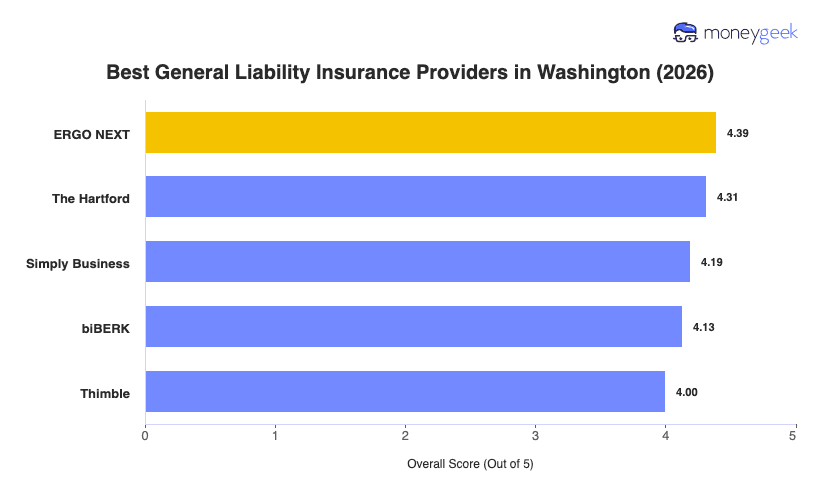
Washington small businesses don't share the same risks, budgets or coverage needs. To find the best and cheapest general liability insurers in the state, we analyzed 10 major providers across 25 general industries using the standard $1 million per occurrence/$2 million aggregate limits. These five topped our list:

  1. ERGO NEXT: Best Overall, Best for Hands-On and Service Industries
  2. The Hartford: Best for Professional and Knowledge Businesses
  3. Simply Business: Best for Comparing Coverage Options
  4. biBERK: Best for Solo and Independent Service Operators
  5. Thimble: Best for Short-Term and Project-Based Coverage

The table below shows how each provider ranks and what it charges. A Spokane event photographer and a Whatcom County berry farm will likely land on different providers. What you do and where you operate in Washington affects both price and the right fit. Use the table as your starting point.

ERGO NEXT4.39$12918
The Hartford4.31$13062
Simply Business4.19$15024
biBERK4.13$14387
Thimble4.00$139710
Coverdash3.99$15892
Progressive Commercial3.90$16359
Chubb3.84$17331
Hiscox3.82$17146
Nationwide3.76$173105

For our Washington general liability insurance ratings, we analyzed pricing, coverage options and customer experience across 408 industries within the state. Our analysis focuses on 1-to-4-person businesses, which represent a large share of Washington's small business market, while weighting results for broader industry and location representation across the Puget Sound corridor, Eastern Washington agricultural communities, the Olympic Peninsula and urban centers like Spokane and Tacoma. 

To do this, we evaluated over 20,000 business profiles, more than 2,000 customer experience data points and reviewed coverage contracts and endorsements to compare how insurers serve Washington businesses consistently across different industries and regions. We then rated each company across categories of affordability (50% of overall score), customer experience (30% of overall score) and coverage options and terms (20% of overall score) to form an overall rating. For a detailed breakdown of the metrics, scoring methodology and pricing analysis specific to Washington, see our full methodology.

95%
% of Small Businesses Covered
Over 20,000
Business Profiles Studied
2,342
Customer Experiences Analyzed

Find The Best General Liability Insurer For Your Washington Business

Select your industry and state to get a customized quote from your best general liability insurer match in WA.

Industry
State
Company Image
Best Overall, Best for Hands-On and Service Industries

ERGO NEXT

ERGO NEXT ranks first overall and first for affordability in Washington: the only provider in our analysis to lead on both overall quality and price. It's the most cost-effective option across 16 of 24 Washington industries, with the deepest savings in hospitality and manufacturing (36% below the Washington benchmark), food and beverage (32%), and repair and maintenance (35%).

A fully digital quote from ERGO NEXT takes under 10 minutes, and it delivers certificates of insurance at purchase, which is an advantage for Washington contractors needing immediate proof of coverage. You’ll also have access to digital tools, though live support responsiveness lags behind top options. Claims handling ranks lower since reviews show recurring complaints about adjuster access and dispute resolution. Coverage includes standard $1 million/$2 million limits with higher limits available with umbrella coverage, but its endorsement menu is narrower than traditional carriers, which could be a concern for businesses with specialty coverage needs.

Where ERGO NEXT performs best:

  • Solo operators and micro-businesses prioritizing low premiums
  • Trades and service businesses needing fast digital proof of coverage
  • Contractors and professional services with straightforward GL needs
  • Businesses comfortable managing policies without agent support

Where ERGO NEXT performs less competitively:

  • Hospitality and food & beverage businesses needing liquor liability
  • Healthcare, wholesale or fitness operations looking for affordable coverage
  • Businesses expecting hands-on claims support after filing

Learn More: ERGO NEXT Review

Company Image
Best for Professional and Knowledge Businesses

The Hartford

The Hartford ranks second overall in Washington because of its coverage depth, competitive general liability rates and post-purchase experience. Besides BOP bundling, you can also get endorsements like liquor liability, cyber and EPLI, giving Washington businesses with specialty needs more options to customize their policy.

The Hartford is most affordable for office-based industries: health care & medical save 27%, education save 26%, arts, media & entertainment save 23%, and financial services save 19%. This provider has an agent-assisted model that slows quote speed, and businesses in eastern Washington or rural areas may see longer timelines than those in the Seattle or Tacoma metro. Once you get a policy, however, reviews say you can expect responsive live support and billing flexibility. Users also praise consistent adjuster communication and fair settlement outcomes during claims.

Where The Hartford performs best:

  • Washington professional and knowledge businesses with specialty coverage needs
  • Healthcare, education and financial services prioritizing affordability
  • Growing businesses with 10 or more employees needing comprehensive GL
  • Businesses that value live support over self-service tools

Where The Hartford performs less competitively:

  • Hands-on, trade and service industries looking to save on premiums
  • Businesses prioritizing fast digital quotes over agent-assisted buying

Learn More: The Hartford Review

Company Image
Best for Comparing Coverage Options

Simply Business

Simply Business is the only aggregator in our analysis and ranks third overall in Washington for general liability. It connects Washington businesses with multiple carriers in a single quote session rather than underwriting policies directly. The aggregator model is a good fit for Washington's large independent contractor and gig economy population, where comparing carrier options quickly matters more than committing to one provider's underwriting process. Coverage depends on which carrier the business matches with, so limits and endorsements vary depending on your choice. Businesses with specialty needs like liquor liability or cyber may find a matching carrier, but coverage terms aren't guaranteed before buying.

Users see real carrier quotes, so pricing is accurate, but comparing policy terms across carriers makes coverage clarity and sales support weaker than single-carrier options. When it comes to rates, businesses in retail and product rental, repair and maintenance and beauty and wellness see the most savings, ranging from 16% to 19%.

Where Simply Business performs best:

  • Washington sole operators wanting to compare multiple carriers at once
  • Retail, repair and beauty businesses wanting to save on rates
  • Businesses with specialty needs that may not fit one carrier's appetite
  • Buyers comfortable navigating coverage options independently

Where Simply Business performs less competitively:

  • Professional services and knowledge businesses prioritizing affordability
  • Businesses needing guaranteed endorsement availability before buying
  • Buyers who want guided coverage advice during the purchase process

Learn More: Simply Business Review

Company Image
Best for Solo and Independent Service Operators

biBerk

biBerk ranks fourth overall in Washington, offering competitive premiums despite lower rankings for customer experience and coverage flexibility. Washington cleaning businesses save 19%, fitness services save 21%, and recreation and sports save 18%. It’s also the most affordable carrier for solopreneurs, saving them 10% on premiums.

biBerk’s digital-direct model backed by Berkshire Hathaway removes the need for an agent, and transparent underwriting and clear sales support follow from that. Post-sale reviews reflect recurring complaints about support access and slow endorsement processing, and claims ranks mid-pack. You can get standard limits of $1 million per occurrence/$ 2 million aggregate, but biBerk does not offer liquor liability, cyber or EPLI.

Where biBerk performs best:

  • Solo operators and cleaning, fitness and recreation businesses prioritizing low rates
  • Buyers who prefer a transparent digital-direct purchase process
  • Businesses that rarely need mid-term policy changes

Where biBerk performs less competitively:

  • Beauty, wellness and agriculture businesses wanting low-cost coverage
  • Businesses needing specialty endorsements like liquor liability or cyber coverage
  • Operations expecting responsive post-purchase support or claims handling

Learn More: biBERK Review

Company Image
Best for Short-Term and Project-Based Coverage

Thimble

Being the only provider in our analysis offering short-term general liability policies, Thimble ranks fifth overall in Washington. Business owners can purchase coverage by the job, day, week or month; a model that fits Washington's freelancers, seasonal contractors and gig workers who may not need year-round financial protection. Among the general industries in Washington, the two that see the most savings are construction (22%) and manufacturing (19%).

Thimble’s quote flow is designed for speed and clarity, letting contractors get covered quickly for a single job. Claims handling rank lower because of recurring complaints about initiation difficulty and slow resolution. Policies include standard $1 million/$2 million limits with higher amounts available for eligible businesses. Tools and equipment can be added, but other common endorsements like cyber liability and HNOA aren’t available..

Where Thimble performs best:

  • Washington freelancers and contractors needing project-based coverage
  • Construction and manufacturing businesses prioritizing competitive rates
  • Seasonal operators wanting coverage matched to actual work periods
  • Buyers who prioritize a fast, simple purchase over post-sale support

Where Thimble performs less competitively:

  • Hospitality, professional services and knowledge looking for savings
  • Businesses needing specialty endorsements or bundled coverage alongside GL
  • Operations with frequent claims exposure or complex coverage needs

Learn More: Thimble Review

Explore The Best General Liability Insurance in Washington By Industry

Not every Washington business carries the same risk, and general liability premiums reflect that directly. Insurers look at how often claims occur in your industry and what those claims typically cost. A Wenatchee orchard equipment installer will pay more than a Tri-Cities tax preparer who works from a single office. Scroll through the tables below to compare estimated monthly rates by provider and see which companies rank highest for your business type.

What Determines the Best General Liability Insurance for Washington Businesses

Choosing general liability insurance in Washington comes down to more than finding the lowest monthly rate. A Walla Walla wine tour operator and a Tacoma shipyard subcontractor both need coverage, but what makes a policy work for each of them looks very different. The right provider holds up across multiple areas not just at sign-up, but through renewal and beyond. 

Four factors separate insurers that perform well on paper from those that perform well when your business needs them most.

    coins2 icon
    Affordability without pricing volatility

    A predictable premium matters more than a low starting rate. A Grays Harbor logging contractor or a San Juan Islands whale watching operator can't absorb a $40 monthly rate jump at renewal when their revenue runs on a tight seasonal cycle. That kind of volatility forces real choices: drop coverage, reduce limits or pay more out of a budget that wasn't built for it. Over multiple policy cycles, those choices leave your business more exposed than when you started.

    talk icon
    Responsive service throughout your policy term

    nResponsive service matters most at the moments small business owners least expect to need it. A general liability insurer should be as easy to work with on day 300 of your policy as it was on day one. For Washington businesses, that means:

    • A Leavenworth innkeeper getting a certificate of insurance to a new vendor before the weekend tourist rush
    • A Skagit Valley tulip farm operator reaching someone quickly after a visitor injury during peak season
    • An Olympia government contractor getting clear answers about whether a worksite incident at a state agency building is covered
    • A Bellingham marine equipment supplier updating its policy without a multi-day back-and-forth when it adds a new commercial client

    Good service means the insurer stays responsive at every step, not just during the sale. When service breaks down, the cost isn't always financial. A Yakima orchard pest control operator who can't get a timely COI, for example, risks losing a seasonal contract that took months to secure.

    insurance2 icon
    Coverage options that fit common small business risks

    Many commercial landlords and municipal contracts in Washington require higher limits as a condition of doing business, so a Kennewick solar installation company taking on larger commercial contracts may need higher aggregate limits than the typical $2 million. The same goes for an Everett aerospace supply firm expanding its client roster.

    Add hired and non-owned auto coverage if employees drive personal vehicles to client locations or job sites as this is a common gap for Eastern Washington agricultural consultants and Western Washington home service contractors who rely on personal trucks for daily operations. Add tenant's legal liability if your business operates out of leased commercial space so it covers damage you cause to a rented premises.

    building icon
    Why consistency across all three areas matters most

    Price stability, service quality and coverage depth only deliver value when they work together. Consider a Spokane Valley irrigation contractor with an affordable policy and solid coverage who files a mid-season claim, only to wait five weeks for adjuster responses while a client relationship deteriorates. A lower price and good coverage means nothing when service breaks down at the moment it matters most. Evaluate providers across all three areas, not just the one that's easiest to compare.

How to Choose the Best General Liability Insurance in Washington

Narrowing down general liability providers takes more than comparing monthly rates. These six steps walk you through the decision in a logical order, so you're evaluating the right things at the right time.

  1. 1

    Optimize your payment and coverage structure

    How much general liability coverage you need varies based on where you work, who you work for and how concentrated your liability exposure is across the year.

    Ask yourself:

    • Do I work on client-owned property, public land or permitted job sites where Washington contractors, landscapers or trade workers typically face third-party liability exposure?
    • Have I reviewed whether my Washington business license, commercial lease or client contracts specify minimum general liability limits?
    • Does my work involve seasonal spikes? Harvest equipment operators in Eastern Washington, ski resort vendors on the slopes or fishing charter operators on Puget Sound concentrate most of their liability exposure into a single busy period.
    • Could one incident, like a slip at my retail space, damage to a client's irrigation system or a completed job dispute, realistically exceed what I could cover out of pocket?

    The typical GL policy limits could work for a Whidbey Island farm stand hosting weekend visitors or a Tacoma remodeling crew working occupied homes. In comparison, a Moses Lake agricultural equipment dealer or a Renton aerospace parts supplier taking on larger commercial contracts may need more coverage given client requirements and exposure volume. If cash flow allows, paying annually is the better value, and a higher deductible can lower your monthly cost, but only make that trade if your business can cover that amount out of pocket without disrupting operations.

  2. 2

    Choose your primary priority

    Your situation determines which lens matters most right now. The right priority shifts depending on where your business is financially, how complex your operations are and how much hands-on support you expect to need from an insurer. This choice becomes your tiebreaker when providers score similarly across the board.

    • Prioritize cost predictability if your business runs on tight or seasonal margins. A Wenatchee apple orchard equipment operator or a Methow Valley outdoor guide service with revenue concentrated in a few months can't absorb unpredictable renewal increases. Stable, predictable premiums matter more than finding the absolute lowest starting rate when your budget has limited flexibility.
    • Prioritize service quality if your work depends on quick documentation, fast policy changes or responsive claims handling. A Bellevue facilities management company juggling multiple client sites or a Tri-Cities event rental operator managing back-to-back bookings needs an insurer that turns around certificates and policy updates without delays that cost contracts.
    • Prioritize coverage depth if your business is growing, taking on larger clients or entering higher-risk work. Review your general liability limits if you're a Grays Harbor marine contractor expanding into commercial port work or a Spokane general contractor adding new service lines. Your current limits and endorsements may not keep pace with your actual exposure.
  3. 3

    Shortlist two to three providers

    Use your priority area as a first-level filter and narrow to providers that perform well on your chosen lens while meeting your baseline coverage needs. Washington's business market is varied: a Whatcom County raspberry grower, a South Seattle auto detailer and a Redmond SaaS startup carry different risk profiles, operate under different exposure conditions, and buy insurance differently.

    Washington general liability costs shift based on industry classification, payroll size and where in the state you operate. A provider that prices competitively for one type of operation may not for another. Before moving forward, confirm each shortlisted provider actively writes policies for businesses with your specific profile.

  4. 4

    Double check for dealbreakers before investing more time

    Before spending time on deeper comparisons, confirm that each shortlisted provider clears your non-negotiables.

    • Does the provider write policies for your industry in Washington? Insurers that cover standard retail or office businesses may decline or significantly surcharge marine contractors working Puget Sound, wildfire-adjacent timber operations in Eastern Washington or businesses handling pesticides and agricultural chemicals in the Yakima Valley
    • Does the provider write policies in Washington for businesses at your revenue and payroll size? Some insurers cap eligibility at thresholds that exclude growing trades businesses or multi-location operators common in the state's construction and agricultural sectors
    • Can the provider issue a same-day or next-day certificate of insurance? A Walla Walla event caterer finalizing a last-minute venue contract or a Lewis County logging subcontractor starting a new job site can't wait three days for documentation
    • Will it continue to provide financial protection if your business expands? If your work takes you across the Cascades or into multiple counties, does the provider cover statewide operations without restricting coverage to a single service area or rating territory?
  5. 5

    Compare your finalists using the same three lenses

    Once you have two or three providers, run each one through all three dimensions. A provider that performs well on price but stumbles on service or coverage can create problems at the worst possible time.

    • Look at pricing consistency across the full policy cycle. A Columbia River commercial fisherman whose catch volume shifts year to year or a Spokane contractor whose payroll grows mid-project needs an insurer that handles mid-term adjustments and renewal repricing transparently. Renewal increases should be explainable, not surprising.
    • Evaluate service across the moments that matter most. How fast does the provider issue certificates? How are policy changes handled when a Puget Sound marine surveyor adds a new vessel type or a Port Angeles hospitality operator takes on a new commercial venue contract? Claims responsiveness matters as much as the initial buying experience.
    • Assess whether coverage can grow with your operation. A Kennewick solar installer adding commercial rooftop contracts or an Olympia environmental consultant taking on state agency work will need higher per occurrence and aggregate limits and possibly new endorsements. Confirm the provider can accommodate those changes without requiring a full policy replacement.
  6. 6

    Use quotes as the final confirmation step

    A quote is the final check, not the starting point. Pull general liability insurance quotes from your shortlisted providers using your actual business details, your Washington location, operations and payroll, and verify that the pricing matches what you expected based on your earlier research. Read the policy terms carefully before binding, especially if your Washington businesses operates near waterways, on agricultural land or under state contracts. You might encounter general liability exclusions that aren't obvious until you review the full document.

Best Small Business General Liability Insurance in Washington: Bottom Line

ERGO NEXT, The Hartford and Simply Business lead the rankings for general liability insurance in Washington, though the right fit shifts based on what your business does, how it's structured and the coverage add-ons your operations may need as you grow. 

The strongest choice balances pricing stability over the full policy cycle, service quality across documentation and claims, and coverage depth rather than defaulting to the lowest quote at sign-up. This approach puts your policy in better alignment with your actual risk profile and how your business operates day to day in Washington.

Best General Liability Insurance For Small Business in Washington Chart

Best General Liability Insurance for Small Businesses in Washington: Next Steps

If you're ready to move forward, narrow your options to one or two providers and confirm pricing and availability using the same coverage assumptions across each. You'll avoid misleading comparisons this way and validate which insurer holds up on price, service and coverage depth for the way small businesses actually operate in Washington: whether you're running seasonal crews, leasing commercial space or taking on clients who require proof of coverage before work starts.

If cost is still your main deciding factor

If you’re unsure how much coverage you need

If you’re ready to check quotes now

Find The Best General Liability Insurer For Your Washington Business

Select your industry and state to get a customized quote from your top general liability insurance match in Washington.

Industry
State

How We Chose the Best General Liability Insurance Companies

To identify the best general liability insurance companies for Washington small businesses, we evaluated insurers across pricing, customer experience and coverage options using a standardized, data-driven approach. Our goal was not to identify the cheapest option in every scenario, but to determine which providers deliver the most consistent overall value across common Washington small business profiles.

Our best recommendations reflect insurers that perform well across multiple dimensions and remain competitive across industries and business sizes in Washington.

Data and Analysis Scope

Our analysis is based on standardized estimates designed to represent the majority of Washington small businesses:

  • Providers analyzed: 10 major insurers serving Washington
  • Industries covered: 408 industries
  • Employee counts: 0–49 employees
  • Policy baseline: $1M per occurrence / $2M aggregate general liability policy
  • Pricing modeled: Just over 20,000 standardized estimates for Washington businesses

Modeled average revenues and payrolls were incorporated to improve pricing accuracy for Washington's business landscape.

Our Scoring Model

Each insurer received a composite score based on the weighted categories below.

  • Affordability (50% of overall score): Affordability reflects how competitively and consistently an insurer prices general liability coverage across all Washington business profiles studied.
  • Customer experience (30% of overall score): Customer experience measures how well insurers support Washington businesses throughout the policy lifecycle from purchase to claims. We also studied at each level of buying, policy management and claims sub-parts of the process that make it easier and more reliable within each as well for accuracy and comprehensive understanding.
  • Coverage options (20%): Coverage options reflect how well insurers support common Washington small business risks and allow for flexibility as businesses grow or change.

Read our full business insurance methodology.

About Angelique Palenzuela-Cruz


Angelique Palenzuela-Cruz headshot

Angelique Palenzuela-Cruz is a Content Writer at MoneyGeek specializing in business insurance. She focuses on general liability, workers' compensation and professional liability coverage, helping small business owners cut through policy jargon and understand what they're actually buying.

Angelique has spent over five years reporting on personal finance, with deep experience in both insurance and lending markets. Her psychology background also gives her a unique understanding of how people actually process difficult financial decisions, allowing her to meet readers where they are, simplify complex concepts and build decision making frameworks that give them confidence. Whether you're learning about policies, comparing providers or trying to figure out requirements, Angelique does the legwork, digging into regulations, analyzing policy language and testing her explanations against agent-level standards so you get straight answers without fluff.