
Key Takeaways
blueCheck icon

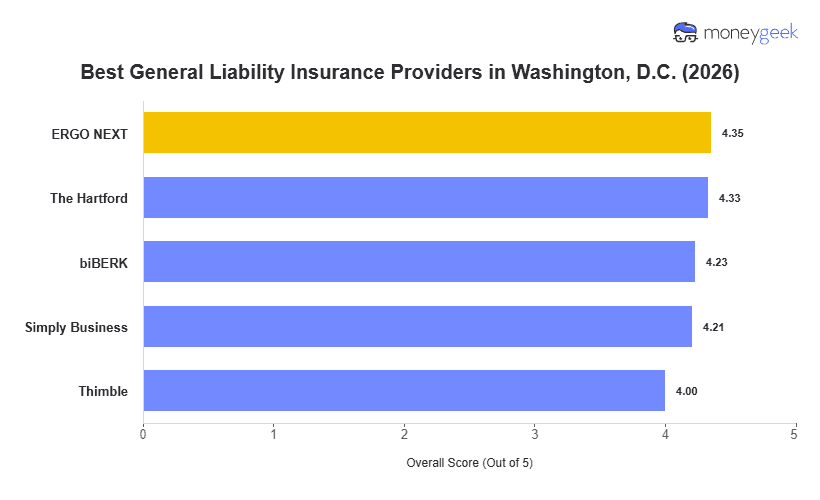
In Washington, D.C., ERGO NEXT tops our list of best general liability insurance providers, ranking first in both affordability and customer experience among 10 major insurers.

blueCheck icon

At $154 monthly, The Hartford offers the most affordable general liability insurance in D.C., saving businesses $30 per month, or 16% off the D.C. average.

blueCheck icon

Rate stability, responsive service, and flexible coverage options all matter when choosing a provider; the best fit holds up across all three, not just the area where it leads.

Best General Liability Insurance Companies for Small Businesses in Washington, D.C.

No single insurer is the right fit for every small business in Washington, D.C. These five ranked highest after we analyzed 10 major general liability insurers across 408 business types, using standard limits of $1 million per occurrence and $2 million aggregate. They represent the best and most affordable options operating in the district:

  1. ERGO NEXT: Best Overall, Best for Hands-On Service Businesses
  2. The Hartford: Best Cheap General Liability Insurance
  3. biBERK: Best for Solo and Micro Service Businesses
  4. Simply Business: Best for Multi-Carrier Quote Comparison
  5. Thimble: Best for On-Demand and Short-Term Coverage

A Capitol Hill lobbying firm and an Adams Morgan food and beverage operator both carry general liability policies, but what each needs from a provider looks considerably different. Federal contracting requirements, high foot traffic and a concentration of professional services all shape what coverage needs to do in this market. The table below breaks out monthly rates and rankings across all five so you can see where each one lands for your business.

ERGO NEXT4.35$15918
The Hartford4.33$15482
biBERK4.23$17047
Simply Business4.21$18124
Thimble4$169610
Coverdash3.99$19292
Progressive Commercial3.91$19579
Chubb3.86$20751
Hiscox3.84$20536
Nationwide3.76$206105

For our Washington, D.C. general liability insurance ratings, we analyzed pricing, coverage options and customer experience across 408 industries within the district. Our analysis focuses on 1-to-4-person businesses, which represent a large share of Washington, D.C.'s small business market, while weighting results for broader industry and location representation across the district's commercial corridors, including Downtown, Capitol Hill, NoMa and neighborhood business districts like Columbia Heights and Anacostia.

To do this, we evaluated over 20,000 business profiles, more than 200 customer experience data points and reviewed coverage contracts and endorsements to compare how insurers serve Washington, D.C. businesses consistently across different industries and areas of the district. We then rated each company across categories of affordability (50% of overall score), customer experience (30% of overall score) and coverage options and terms (20% of overall score) to form an overall rating. For a detailed breakdown of the metrics, scoring methodology and pricing analysis specific to Washington, D.C., see our full methodology.

95%
% of Small Businesses Covered
Over 20,000
Business Profiles Studied
200
Customer Experiences Analyzed

Find The Best General Liability Insurer For Your Washington, D.C. Business

Select your industry and state to get a customized quote from your best general liability insurer match in DC.

Industry
State
Company Image
Best Overall, Best for Hands-On Service Businesses

ERGO NEXT

ERGO NEXT is the best general liability insurer for Washington, D.C., with top scores in customer experience and affordability. Its fully digital quote flow binds a policy and issues a COI in under 10 minutes, which is a time saver for D.C. professional service firms and contractors where clients regularly require proof of insurance before work begins. Claims handling, however, is the tradeoff, since policyholders report slow updates and limited adjuster access. It’s worth checking before you buy if your D.C. work includes third-party property damage on active job sites.

Businesses in construction, hospitality, and food & beverage see the most savings, ranging from 21% to 35%. A $0 deductible and standard endorsements, such as additional insured, primary and non-contributory and waiver of subrogation, meet most D.C. contract requirements, and the AM Best A+ rating satisfies D.C.'s licensing rules for general contractors. ERGO NEXT’s per occurrence limit caps at $1 million, so businesses pursuing federal or government contracts requiring higher limits will need to look elsewhere.

Where ERGO NEXT performs best:

  • Micro and small service businesses looking for low-cost coverage
  • Contractors needing additional insured and waiver of subrogation
  • Operations prioritizing fast, self-service digital policy management
  • Consulting, marketing and professional services teams up to 19 employees

Where ERGO NEXT performs less competitively:

  • Businesses requiring limits above $1 million per occurrence
  • Restaurants and hospitality operators needing liquor liability
  • Higher-exposure operations where claims resolution quality matters most

Learn More: ERGO NEXT Review

Company Image
Best Cheap General Liability Insurance

The Hartford

Offering the most affordable general liability insurance in Washington, D.C. is The Hartford, ranking second overall. D.C.'s regulated and credentialed sectors, such as health care & medical, education and financial services see double-digit savings ranging from 21% to 31%. The Hartford is also the best option for those industries.

Beyond the buying process, where quotes require a call before binding, the agent-backed model offers advantages, such as responsive support and fast endorsement processing, which matters if you need to add project-specific additional insureds as contract requirements change. Reviews also point to clear adjuster communication and fair settlements during claims handling. Coverage limits reach $2 million per occurrence and $4 million aggregate, meeting D.C. federal and government contract thresholds that standard $1 million limits cannot.

Where The Hartford performs best:

  • Businesses in healthcare, education or financial services
  • Teams of five or more employees needing agent-backed support
  • Contractors requiring higher limits for government or federal work
  • Operations where claims quality and fair settlements matter most

Where The Hartford performs less competitively:

  • Solo operators and micro businesses prioritizing low-cost digital coverage
  • Hospitality and food service businesses with tighter margins
  • Buyers who need a fast, fully self-service quote and bind process

Learn More: The Hartford Review

Company Image
Best for Solo and Micro Service Businesses

biBerk

Ranking third overall among Washington, D.C. general liability providers is biBerk , offering a competitive buying experience. The platform generates quotes in minutes, activates coverage immediately and you can pull a COI on demand without calling anyone. Once covered, though, adding an additional insured can take up to two days, which counts in D.C.'s contracting market where COI turnaround is often tied directly to contract timelines. 

In D.C., biBerk is the best provider for cleaning, fitness, real estate and recreation businesses, saving 18% to 21%, but isn’t cost-effective for construction and wholesale. Its policies have the standard $1 million/$2 million limits that fit most low-exposure service businesses. D.C. restaurants and hospitality operators can find liquor liability as an add-on, though waiver of subrogation and primary/non-contributory status may not be available.

Where biBerk performs best:

  • Low-exposure service businesses wanting to save on premiums
  • Digital-first buyers who prioritize fast online coverage
  • D.C. hospitality and restaurant operators needing liquor liability
  • Solo operators prioritizing affordability

Where biBerk performs less competitively:

  • Contractors needing fast COI turnaround or waiver of subrogation
  • Construction and wholesale businesses looking for savings
  • Operations expecting responsive support after the policy is bound

Learn More: biBERK Review

Company Image
Best for Multi-Carrier Quote Comparison

Simply Business

Unlike other providers in our study, Simply Business, despite ranking fourth overall, doesn’t underwrite its policies. Instead, it acts as a marketplace, where one 10-minute form pulls quotes from partner-carriers like Travelers, Hiscox, Liberty Mutual and Markel simultaneously. Policy changes, additional insureds, and claims all route to whichever carrier you selected, not Simply Business directly.

That same model explains the top coverage rank. Aggregating across carriers gives D.C. businesses access to a wider range of endorsements than any single provider offers, including waiver of subrogation, primary and non-contributory, and add-ons such as liquor liability. Affordability is mid-pack as savings reach 24% in repair and maintenance and 17% in retail, but construction and marketing businesses pay above the state average. The platform doesn't show sublimit breakdowns during quoting, so businesses with specific coverage requirements need to verify terms with the matched carrier after purchase.

Where Simply Business performs best:

  • Buyers wanting to compare multiple carriers in one session
  • Childcare, retail and repair businesses looking for considerable savings
  • Operations needing broad endorsement access across carrier options

Where Simply Business performs less competitively:

  • Businesses needing guaranteed endorsement terms before buying
  • Construction and marketing businesses wanting affordable coverage
  • Operations expecting direct post-sale support from a single provider

Learn More: Simply Business Review

Company Image
Best for On-Demand and Short-Term Coverage

Thimble

Fifth overall among Washington, D.C. general liability providers, Thimble’s offerings set it apart: coverage by the hour, day or month. The buying experience features quotes generated in under a minute and COIs issue instantly, with one D.C. caterer saying that the app made getting covered an easy call. Phone support doesn't exist, though, and claims route entirely to third-party administrators, where reviewers consistently report slow timelines and poor communication.

Coverage has several gaps relevant specifically for D.C., such as the absence of umbrella insurance, waiver of subrogation and primary/non-contributory. D.C. businesses cannot add cyber coverage through Thimble either. Contractors on multi-party D.C. projects should check whether action over claims, where a third party seeks indemnification from your business, are excluded. In core sectors, Thimble is an affordable option: construction and manufacturing each save 19%, and beauty and wellness saves 10%.

Where Thimble performs best:

  • Project-based contractors needing coverage by the day or month
  • Construction and manufacturing businesses looking for savings
  • Freelancers who need instant COIs without calling anyone
  • Buyers prioritizing speed over depth of coverage options

Where Thimble performs less competitively:

  • D.C. businesses requiring waiver of subrogation or umbrella coverage
  • Hospitality and childcare operators waiting affordable rates
  • Operations expecting responsive support or reliable claims handling

Learn More: Thimble Review

Explore The Best General Liability Insurance in Washington, D.C. By Industry

Washington, D.C.'s economy runs on services: consulting, contracting, advocacy and hospitality. General liability premiums reflect the risk differences between them, with insurers pricing policies around claim frequency and cost by industry. A U Street corridor fitness studio and a Navy Yard area construction contractor operate with very different exposure profiles and pay accordingly. Compare estimated monthly rates and provider rankings for your business type in the tables below.

What Determines the Best General Liability Insurance for Washington, D.C. Businesses

Washington, D.C. small businesses, from Foggy Bottom hospitality operators to Capitol Hill policy consultants, need general liability insurance in Washington, D.C. that holds up under real operating conditions, not just on a quote sheet. The providers that look good in the rankings earn that position across four areas that matter when your business actually needs coverage to work.

    coins2 icon
    Affordability without pricing volatility

    A licensed general contractor working through D.C.'s steady pipeline of federal and municipal construction projects bids jobs months out. A surprise premium increase at renewal throws off project margins that were locked in long before the policy renewed. Rate volatility is one of the more disruptive and overlooked costs in small business insurance. When a policy renews at a materially higher rate without a corresponding change in your claims history or business profile, it forces budget adjustments that ripple into staffing, pricing and operations.

    talk icon
    Responsive service throughout your policy term

    For a D.C. business, the quality of an insurer's service shows up long before a claim is filed. It shows up when a Georgetown retail shop needs a certificate of insurance before a weekend pop-up event, when a Brookland-based nonprofit needs to adjust its coverage after adding a new program, or when a construction subcontractor near the Capitol needs documentation to satisfy a federal contract requirement, often on short notice.

    These scenarios tell you a provides responsive service to D.C. businesses:

    • A self-service COI portal that generates certificates on demand, without waiting on a representative: critical for contractors and vendors who face same-day documentation requests
    • Policy update turnaround measured in hours, not days, for businesses operating in D.C.'s fast-moving catering and private events sector, where bookings and staffing levels shift frequently
    • A claims process with a dedicated contact and clear timelines: particularly important when an incident at a government-adjacent worksite or high-profile venue draws outside scrutiny
    • Renewal notices issued early enough for Penn Quarter retailers or Anacostia service businesses to shop alternatives before auto-renewal locks in

    When service breaks down, the consequences aren't abstract. A D.C. event production company that can't produce a COI on time loses the venue booking and potentially the client relationship that came with it.

    insurance2 icon
    Coverage options that fit common small business risks

    General liability policies share a common structure, but the options around limits and endorsements vary by insurer. Those differences matter as a D.C. business scales. A boutique lobbying firm adding junior associates operates differently from a mid-size IT services firm managing contracts across multiple federal agencies, and their coverage needs reflect that gap.

    In D.C.'s business environment, two endorsements stand out. Hired and non-owned auto coverage matters for businesses whose staff regularly move between client sites, a common pattern for consulting firms and staffing agencies across the district. Additional insured endorsements come up just as often, routinely required of federal contractors and commercial tenants. An insurer that processes these slowly or limits who qualifies creates friction at exactly the wrong moment.

    building icon
    Why consistency across all three areas matters most

    An insurer that prices competitively but stumbles on service or offers limited coverage options creates a different kind of risk, one that only becomes visible under pressure. Consider a D.C.-based event staffing company that secures a contract to provide crew for a major conference on the National Mall. The premium looked right at purchase, but when an incident occurs on-site and the company needs to produce documentation quickly, coordinate with a venue's legal team and potentially adjust coverage mid-contract, an insurer that's slow on service and limited on policy flexibility becomes a serious concern.

    The providers that belong at the top of any ranking earn that position because they hold up across pricing, service, and coverage depth, not because they lead in one area while underperforming in the others. That consistency is what separates an insurer that works well on a quote sheet from one that works well when your business depends on it.

How to Choose the Best General Liability Insurance in Washington, D.C.

Picking the right provider takes more than comparing quotes. These six steps walk through the decision in a logical order, from scoping your actual needs to confirming that your top choice holds up when the details matter most.

  1. 1

    Optimize your payment and coverage structure

    Before comparing providers, get clear on what your business actually needs to carry. In Washington, D.C., that means thinking through your client contracts, worksite conditions and whether federal or municipal work triggers specific documentation requirements.

    Ask yourself:

    • Do your client contracts, commercial leases or D.C. business licenses specify minimum coverage limits or require additional insured status before you can operate or get paid?
    • Does your work take place on federal property, historic sites or high-foot-traffic D.C. corridors where a single incident could generate an outsized claim?
    • Would annual billing work for your cash flow, or does the project-based or seasonal nature of your D.C. work make monthly payments the more manageable option?
    • Would raising your deductible lower your premium enough to matter, without leaving you exposed if a claim comes in during a slower billing cycle?

    Most D.C. small businesses start with $1 million per occurrence and $2 million aggregate as a baseline, though businesses with federal contracts or higher foot traffic often carry more. Before locking in limits, review how much general liability coverage you need. On the payment side, monthly billing preserves cash flow for project-based or seasonal operations, while annual billing typically costs less overall, making it the better option when your budget can absorb the upfront cost.

  2. 2

    Choose your primary priority

    Not every D.C. business is shopping from the same position. A recently launched catering operation and an established federal contractor both need general liability coverage, but need different things from an insurer. Your primary priority becomes the deciding factor when two or three providers look comparable across the board.

    Identify which situation fits yours:

    • Prioritize affordability if your business operates on fixed or unpredictable margins where a rate increase at renewal creates real budget pressure. In D.C., this applies most to early-stage sole proprietors, independent tradespeople and food and beverage operators whose overhead is already compressed by the district's high operating costs.
    • Prioritize customer experience if your work depends on fast COI turnaround, frequent policy updates or responsive claims handling. D.C. businesses holding active commercial leases in high-demand corridors or managing event-based contracts in the district's hospitality sector can't afford an insurer that moves slowly when documentation is due.
    • Prioritize coverage options if you're scaling, adding service lines or bidding on contracts that require specific endorsements or higher general liability limits. This fits D.C. staffing firms, IT contractors and professional services businesses whose liability exposure changes as they take on larger or more complex engagements.
  3. 3

    Shortlist two to three providers

    Running a full evaluation on every insurer you researched adds time without improving the outcome since most won't meet your priority and baseline coverage needs. Start with providers that score well on your chosen priority, then verify they write policies for your type of work and can handle the scope of your operation.

    D.C.'s business mix spans nonprofit organizations, arts and culture operators, hospitality businesses, licensed trades and professional services firms, and that range creates real variation in what insurers will and won't cover at standard rates. Use Washington, D.C. general liability costs as a benchmark before you shortlist, so you're comparing providers against realistic price expectations for your business profile, not just the lowest number you've seen.

  4. 4

    Double check for dealbreakers before investing more time

    A provider that scores well overall can still fall short on a requirement specific to how your business operates in D.C. Confirm these before investing time in a deeper comparison.

    • Federal and municipal contracts in D.C. often require additional insured status with tight turnaround windows. Confirm the insurer offers this endorsement and can process it on your timeline.
    • Work on federally owned buildings, historic properties or D.C. government facilities may fall outside standard GL coverage. Verify your actual worksites are covered before assuming.
    • Businesses whose staff regularly travel between client sites across the district need hired and non-owned auto coverage. Check whether your GL policy includes it or requires a separate endorsement.
    • D.C. businesses that need same-day or next-day COI access, including event vendors, commercial tenants and licensed contractors, should confirm the insurer offers self-service certificate issuance.
  5. 5

    Compare your finalists using the same three lenses

    With two or three providers in contention, evaluate each one across all three dimensions, not just your primary priority. A provider that leads where you need it most but falls short elsewhere can still create real problems.

    • Look at pricing consistency over time, not just the opening rate. For D.C. businesses that bid on multi-year contracts or operate on annual budgets, review how the insurer communicates rate changes at renewal and how audits are handled if your payroll or revenue shifts mid-term.
    • Evaluate service responsiveness across the full policy lifecycle. D.C. retail and hospitality businesses managing active commercial leases need to know how quickly policy changes process and whether a dedicated contact handles their account or every request goes into a general queue.
    • Assess limit flexibility, endorsement availability and per occurrence and aggregate limits options. For D.C. nonprofit organizations and arts operators that take on venue partnerships or public programming, an insurer whose policy options don't extend beyond standard configurations may not cover the endorsements those arrangements require.
  6. 6

    Use quotes as the final confirmation step

    After doing the comparative work, general liability insurance quotes serve as the final check, confirming that pricing holds up when your actual business details go in and that coverage aligns with what you need. A D.C. restaurant operator expanding into private event bookings, for example, needs the quote to reflect updated exposure before the new service line launches. Review each policy's GL exclusions before committing. What a policy doesn't cover matters as much as what it does.

Best Small Business General Liability Insurance in Washington, D.C.: Bottom Line

ERGO NEXT, The Hartford and biBerk lead the rankings for small business general liability insurance in Washington, D.C., though the strongest match depends on your type of work, how your operation is structured and what you need from a provider when coverage changes or proof of insurance is due. The right approach weighs pricing stability, service responsiveness and coverage depth together rather than defaulting to the lowest quote. Weighing all three connects your policy to your actual risk exposure and how your business runs day to day.

Best General Liability Insurance For Small Business in Washington, D.C. Chart

Best General Liability Insurance for Small Businesses in Washington, D.C.: Next Steps

If you're ready to move forward, narrow your options to one or two providers and confirm pricing and availability using the same coverage assumptions across each quote. This way, you'll avoid skewed comparisons and confirm which insurer offers the best combination of affordability and policy features for your type of work, business structure and documentation needs in Washington, D.C.

If cost is still your main deciding factor

If you’re unsure how much coverage you need

If you’re ready to check quotes now

Find The Best General Liability Insurer For Your Washington, D.C. Business

Select your industry and state to get a customized quote from your top general liability insurance match in Washington, D.C..

Industry
State

How We Chose the Best General Liability Insurance Companies

To identify the best general liability insurance companies for Washington, D.C. small businesses, we evaluated insurers across pricing, customer experience and coverage options using a standardized, data-driven approach. Our goal was not to identify the cheapest option in every scenario, but to determine which providers deliver the most consistent overall value across common Washington, D.C. small business profiles.

Our best recommendations reflect insurers that perform well across multiple dimensions and remain competitive across industries and business sizes in Washington, D.C..

Data and Analysis Scope

Our analysis is based on standardized estimates designed to represent the majority of Washington, D.C. small businesses:

  • Providers analyzed: 10 major insurers serving Washington, D.C.
  • Industries covered: 408 industries
  • Employee counts: 0–49 employees
  • Policy baseline: $1M per occurrence / $2M aggregate general liability policy
  • Pricing modeled: Just over 20,000 standardized estimates for Washington, D.C. businesses

Modeled average revenues and payrolls were incorporated to improve pricing accuracy for Washington, D.C.'s business landscape.

Our Scoring Model

Each insurer received a composite score based on the weighted categories below.

  • Affordability (50% of overall score): Affordability reflects how competitively and consistently an insurer prices general liability coverage across all Washington, D.C. business profiles studied.
  • Customer experience (30% of overall score): Customer experience measures how well insurers support Washington, D.C. businesses throughout the policy lifecycle from purchase to claims. We also studied at each level of buying, policy management and claims sub-parts of the process that make it easier and more reliable within each as well for accuracy and comprehensive understanding.
  • Coverage options (20%): Coverage options reflect how well insurers support common Washington, D.C. small business risks and allow for flexibility as businesses grow or change.

Read our full business insurance methodology.

About Angelique Palenzuela-Cruz


Angelique Palenzuela-Cruz headshot

Angelique Palenzuela-Cruz is a Content Writer at MoneyGeek specializing in business insurance. She focuses on general liability, workers' compensation and professional liability coverage, helping small business owners cut through policy jargon and understand what they're actually buying.

Angelique has spent over five years reporting on personal finance, with deep experience in both insurance and lending markets. Her psychology background also gives her a unique understanding of how people actually process difficult financial decisions, allowing her to meet readers where they are, simplify complex concepts and build decision making frameworks that give them confidence. Whether you're learning about policies, comparing providers or trying to figure out requirements, Angelique does the legwork, digging into regulations, analyzing policy language and testing her explanations against agent-level standards so you get straight answers without fluff.