
How Much Does General Liability Insurance Cost in Illinois?

Small businesses with one to four employees, from Chicago marketing agencies to Peoria construction firms, pay $141 monthly or $1,690 annually for general liability coverage based on MoneyGeek's analysis of premium estimates across Illinois. Although the average cost of general liability insurance in Illinois falls 11% lower than the national average, it ranks 39th for affordability. The paradox reveals more about expensive coastal markets inflating the national average than it does about competitive pricing in the Prairie State.

Illinois holds the distinction of being the Midwest's most expensive market for general liability insurance. A Springfield restaurant and a comparable operation in St. Louis show a $36 monthly gap, as the Missouri business pays $105 while the Illinois owner budgets $141. Cross the border into Indiana or Wisconsin and the story stays consistent: Rockford manufacturers pay $33 to $35 more per month than their counterparts in Milwaukee or Fort Wayne. That 23% to 33% regional premium adds up quickly. Over three years, an Illinois landscaping company with four employees spends roughly $1,200 more than the same business operating just across the state line.

Small business owners should use this state average as an initial reference point. Industry claim patterns, your operational risk profile, and prior loss experience determine where you land relative to the $1,690 baseline, not just Illinois's position in regional or national rankings.

To estimate average general liability insurance costs in Illinois, we analyzed quote data from major U.S. small business insurance providers and modeled standardized premium estimates across common business profiles. These modeled results are designed to provide a consistent state benchmark and show how premiums vary by key baseline factors including business size, industry and location within Illinois.

Dataset Scope and Assumptions

Our cost modeling uses standardized inputs for consistent comparisons across Illinois businesses.

  • Providers analyzed: 10 major insurance providers
  • Industries covered: 25 general industry categories relevant to Illinois's business landscape
  • Employee count bands: zero, one to four, five to nine, 10 to 19 and 20 to 49 employees
  • Policy baseline: standard general liability policy with $1 million per occurrence / $2 million aggregate limits
  • Total estimates modeled: over 20,000 standardized pricing estimates across Illinois industry and employee count combinations

We also incorporated modeled average revenue and payroll personalized across all combinations of Illinois regions, industry and employee counts to improve the accuracy of pricing. To model these assumptions against our cost factors, we used data from these sources:

  • CBP (for employee size class density in Illinois by NAICS)
  • QCEW (for wage/payroll intensity by industry in Illinois)
  • Economic Census / SUSB (for receipts/output intensity by industry)
  • Calibrated against:
    • Private comp databases
    • IRS SOI totals

How We Calculated Average General Liability Costs in Illinois

Our published averages represent modeled premiums for standardized business profiles and were aggregated in two ways:

  • Illinois state average: The Illinois average cost reflects the modeled premium for a standardized one to four-employee small business across all industries included in our dataset for a standard general liability policy.
  • Segment averages: To show how costs vary within Illinois, we calculated average modeled premiums for our state base profile and isolated for variables, including:
    • Employee count (business size ranges)
    • General industry categories

Segment averages were produced by aggregating modeled pricing trends across the full dataset so readers can compare how premiums shift across business types and regions within Illinois.

What Factors Affect General Liability Insurance Costs Illinois?

General liability insurance in Illinois costs depend on two categories of factors. Business size and industry classification establish baseline pricing nationwide, while Illinois-specific conditions drive regional premium differences compared to neighboring Midwest states.

Illinois Agnostic General Liability Insurance Cost Factors

General liability pricing starts with two baseline questions: how many employees does your business have, and what industry do you operate in? These factors drive exposure regardless of location.

    smallBusiness icon
    Business size

    A business with 20 workers interacts with more customers, manages more contracts, and oversees more job sites than a solo operator and each interaction carries liability exposure. Illinois sole proprietors pay $878 annually, roughly half the cost of businesses employing one to four people. Operations with 20 to 49 employees average $32,570 annually, nearly 19 times that small-team baseline. A solo Naperville graphic designer fields fewer client disputes than a 30-person marketing agency managing dozens of campaigns.

    contractor icon
    Industry classification

    Insurers assess claim likelihood based on the work itself. Desk-based operations with minimal public interaction carry far less liability exposure than hands-on services at customer sites, physical installations or worksite management that increases injury and property damage risk.

    Tech and IT firms in Illinois pay 79% below the state average since digital work in controlled environments generates few third-party claims. Construction and contracting operations run 186% above that benchmark, driven by on-site physical risks, equipment use and potential for injury and damage across multiple active job locations.

Illinois-Specific General Liability Insurance Cost Factors

After accounting for business size and industry type, Illinois general liability costs still exceed neighboring Midwest states. Five state-specific factors explain why Illinois businesses pay regional premiums higher than other states in the region.

    tornado icon
    Illinois' Severe Weather Risk

    Illinois experienced 121 tornadoes in 2023 and 142 in 2024, reflecting intense severe weather that includes Mississippi River flooding and Lake Michigan winter storms. These conditions increase general liability exposure through slip-and-fall accidents on ice-covered walkways, customer injuries from wind-damaged property, and third-party claims when weather compromises premises safety. Insurers price policies higher in tornado-prone central and southern counties.

    congress icon
    Illinois' Litigation Climate

    Cook, Madison and St. Clair counties ranked seventh on the American Tort Reform Foundation's 2024-2025 "Judicial Hellholes" list, driven by nuclear verdict frequency and plaintiff-friendly juries. This concentrated litigation activity in key Illinois counties and elevated settlement values push general liability premiums higher as insurers price for increased claim costs and verdict unpredictability across the state.

    checkList icon
    Illinois' Modified Joint and Several Liability Law

    Illinois holds defendants with 25% or more fault jointly and severally liable for all damages, meaning one defendant may pay the full judgment if others cannot. Defendants below 25% fault remain jointly liable for medical expenses. This unpredictable exposure in multi-party claims drives insurers to price general liability policies higher to account for worst-case payment scenarios.

    firstAidKit icon
    Illinois' Medical Costs Compared to Regional Neighbors

    Illinois hospitals charge higher rates than neighboring Midwest states. Nonprofit hospitals. which handle most general liability bodily injury claims, cost $3,086 per inpatient day in Illinois compared to $1,884 in Iowa and $2,862 in Wisconsin. These elevated medical expenses translate directly to higher claim settlements under general liability policies, as hospital bills form the foundation of bodily injury damage calculations.

    driverLicense icon
    Illinois' Biometric Information Privacy Act (BIPA)

    Illinois' Biometric Information Privacy Act creates unique general liability exposure for businesses using fingerprint timeclocks, facial recognition systems or voice biometrics. BIPA violations trigger coverage under commercial general liability policies' personal injury provisions, driving more than 1,500 lawsuits since 2019 with settlements reaching $650 million. Insurers price Illinois GL policies higher to account for BIPA risk, particularly for businesses in retail, hospitality and manufacturing sectors that commonly use biometric timekeeping.

Average General Liability Insurance Costs in Illinois by Business Size

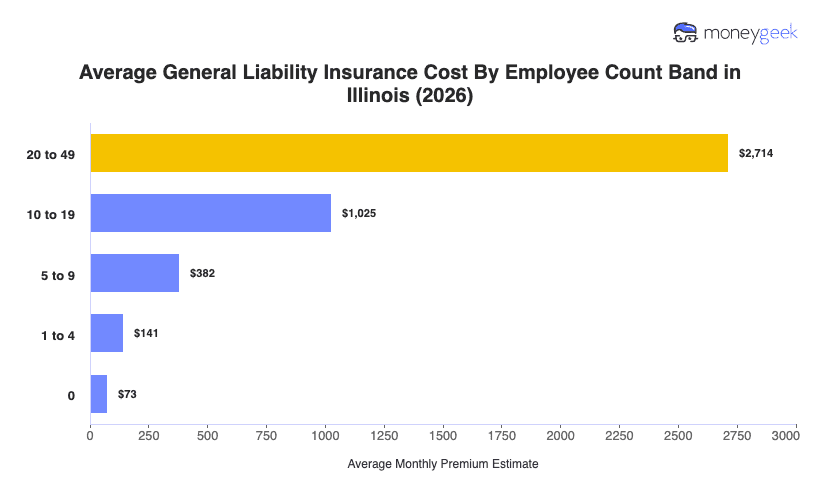
Sole proprietors in Illinois pay $73 monthly for general liability coverage. Adding the first employee pushes premiums to $141 monthly, a 93% jump as insurers shift from self-employment to employer liability pricing. The sharpest increase hits at five employees, where monthly costs leap 171% to $382. Businesses with 20 to 49 workers pay $2,714 monthly, roughly 37 times the sole proprietor rate, driven by expanded claim exposure across larger customer bases and operational footprints. Compare your current headcount against these tier benchmarks to estimate your Illinois premium.

Illinois General Liability Insurance Cost Chart

Average General Liability Insurance Costs in Illinois by Industry

Illinois general liability premiums fall into three pricing groups across 25 industries. Tech companies pay the lowest rates at $29 monthly. Construction contractors pay the highest at $402. Between these extremes, insurers price customer exposure, physical work and medical liability differently.

Illinois' industry pricing shows four clear patterns:

  • Common industries don't show typical pricing. Construction, restaurants, healthcare, retail, professional services, manufacturing and real estate employ the most workers in Illinois but spread across all three pricing groups. Three of these industries cost less than average, two cost about average, and two cost much more. Meanwhile, 60% of all Illinois industries (15 of 25) fall in the low-cost group. Most Illinois businesses face lower insurance costs than the state's biggest employment sectors suggest.
  • Low-cost industries split into two groups. Tech/IT leads at $29 monthly (79% below average), followed by consulting at $34 monthly. Eight office and digital businesses pay $29 to $56 monthly with little physical space risk. Manufacturing ($84), pet care ($80) and repair services ($92) form a second group at $65 to $92 monthly, about $20 to $30 more than desk jobs but well below businesses with walk-in customers. Working in controlled spaces keeps Illinois' manufacturing costs low despite heavy equipment and production risks.
  • Walk-in customer businesses pay higher premiums. Retail stores ($116), restaurants ($152), fitness centers ($119) and hotels ($130) handle unpredictable customer traffic all day, raising slip-and-fall risk and property liability. These industries cost $115 to $153 monthly. Businesses with scheduled appointments like real estate ($52), pet care ($80) and repair work ($92) control when customers visit, lowering risk. The $30 to $60 monthly difference shows how insurers price constant public contact versus appointment-only service.
  • Healthcare and construction cost far more than other industries. Childcare tops the mid-cost group at $153 monthly. Healthcare jumps to $247, a 62% increase driven by patient injury claims and medical procedure risks. Construction costs $402 monthly, 63% more than healthcare. Construction crews move between job sites with equipment dangers and property damage risks. The other 23 industries cost less than $153 monthly, with 17 below the state average. Compare your industry to these numbers to see where Illinois insurers price your business risk.
Data filtered by:
Select
Agriculture & Natural Resources$114$1,37319%
Arts, Media & Entertainment$43$52269%
Beauty, Body & Wellness Services$49$58565%
Childcare Services$153$1,831-8%
Cleaning Services$120$1,44015%
Construction & Contracting$402$4,827-186%
Consulting Services$34$40776%
Education$56$67660%
Financial Services$51$60864%
Fitness Services$119$1,42316%
Food & Beverage$152$1,823-8%
Healthcare & Medical$247$2,968-76%
Hospitality, Travel & Tourism$130$1,5598%
Manufacturing$84$1,00341%
Marketing & Communications$35$41775%
Nonprofit & Associations$65$78554%
Other Professional Services$88$1,05837%
Pet Care Services$80$96043%
Real Estate & Property Services$52$62763%
Recreation & Sports$75$89547%
Repair & Maintenance$92$1,09835%
Retail & Product Rental$116$1,39418%
Tech/IT$29$35079%
Transportation & Logistics$91$1,09135%
Wholesale & Distribution$127$1,5319%

Use these resources to explore costs for your industry.

How to Lower General Liability Insurance Costs Without Sacrificing Coverage

Finding cheaper general liability insurance in Illinois requires understanding how insurers price risk, not just requesting quotes. We have eight cost reduction methods split into two categories: six quick adjustments that lower premiums at your next renewal, and two long-term strategies that improve how carriers evaluate your business over 12 to 36 months.

Quick General Liability Cost Lowering Methods

Six quick methods lower your general liability premiums immediately through policy adjustments and insurer shopping. These changes require no business operations modifications and take effect at renewal.

    insurance2 icon
    Provide clean, accurate underwriting information

    Misreporting employee counts or annual revenue typically triggers mid-term premium recalculations that add retroactive charges. Cedar Rapids food processors carry different exposure profiles than machinery manufacturers despite both sitting in Illinois's manufacturing sector. Insurers use precise industry classifications to establish rating tiers since Illinois's manufacturing concentration spans petrochemical, equipment and agricultural processing operations with distinct liability patterns.

    shoppingCart icon
    Compare multiple insurers

    Request proposals from four to five insurers to identify competitive pricing in Illinois's market-driven environment. A Des Moines financial advisor might receive quotes ranging from $28 to $45 monthly for identical $1 million per occurrence coverage. Without state-mandated GL requirements, carriers compete aggressively on price, particularly in Des Moines where 7,000 finance and insurance companies create deep market competition.

    building icon
    Bundle general liability into business owner's policies (BOP)

    The cost of a Business Owners' Policy (BOP) is generally 15% to 25% cheaper than purchasing general liability and commercial property coverage separately. Davenport retailers gain dual protection for both customer slip-and-fall claims and building damage from Mississippi River flooding and severe storms. Illinois's weather event frequency jumped from 1.9 to 5.4 annually since 2020, making bundled property-liability coverage increasingly strategic for retailers.

    coins2 icon
    Pay annually instead of monthly

    When you can cover the full year's premium upfront, annual payment generally saves 5% to 10% by eliminating monthly billing fees and installment charges. Rural county farmers leverage fall harvest revenue to prepay the entire year's coverage in one lump sum. Timing the payment to coincide with seasonal cash inflows avoids spreading costs across lean winter months while capturing the discount.

    money2 icon
    Increase your deductible (if you can afford it)

    Weigh premium savings against out-of-pocket claim costs before raising deductibles from $500 to $2,500 or higher. Illinois City medical practices with strong cash reserves can absorb higher per-claim expenses while reducing monthly premiums by 15% to 30%. Rural healthcare clinics with tighter budgets and limited patient volume struggle more with unexpected claim payouts, making lower deductibles safer despite higher premiums.

    loanReview icon
    Adjust your coverage limits

    Construction contractors should evaluate whether $2 million aggregate limits justify the premium increase over standard $1 million coverage based on project size and contract requirements. Large commercial projects often mandate higher limits, while residential remodeling work rarely requires more than $1 million per occurrence. Review your typical contract values and client requirements annually since carrying excess coverage you don't need wastes premium dollars that could reduce costs elsewhere.

Long-Term General Liability Cost Lowering Methods

Two long-term methods reduce general liability premiums by changing how insurers evaluate your business. These require sustained effort over 12 to 36 months but deliver rate reductions as long as you maintain the improvements.

General Liability Insurance Cost in Illinois: Bottom Line

Your actual premium depends on risk factors insurers weigh differently: location exposure, claims history and operational controls. Understanding what drives these differences helps you evaluate whether your rate reflects your actual risk or just broad industry assumptions.

1. What location-specific risks affect your rate? Chicago businesses face Lake Michigan freeze-thaw slip-and-falls, while Quad Cities retailers handle Mississippi River flood liability and Champaign tech firms carry BIPA exposure after Facebook's $650 million settlement.

2. How does your claims history influence pricing? Springfield medical practices with zero claims over three years pay 15% to 20% less than identical practices that filed two recent slip-and-fall claims.

3. What creates the biggest premium differences within your industry? Two Rockford manufacturers with identical employee counts see 30% rate differences based on documented safety programs, equipment maintenance records and whether they've filed claims in three years.

Get quotes from at least Illinois carriers. Comparing quotes shows you which factors drive your rate up or down, helping you understand whether your premium reflects your actual location and claims history or just your industry classification.

General Liability Insurance Cost in Illinois: Next Steps

Use this cost analysis to set realistic premium expectations for your Illinois business before requesting quotes from insurers.

Start by identifying where your business falls within Illinois' cost framework based on employee count, industry and location. Request quotes using identical coverage limits from three to four insurers. Premium differences reflect how carriers weigh Illinois-specific risks and your claims history differently.

Get Personalized General Liability Insurance Quotes in Illinois

Select your industry and state to get a customized Illinois general liability quote.

Industry
State

About Angelique Palenzuela-Cruz


Angelique Palenzuela-Cruz headshot

Angelique Palenzuela-Cruz is a Content Writer at MoneyGeek specializing in business insurance. She focuses on general liability, workers' compensation and professional liability coverage, helping small business owners cut through policy jargon and understand what they're actually buying.

Angelique has spent over five years reporting on personal finance, with deep experience in both insurance and lending markets. Her psychology background also gives her a unique understanding of how people actually process difficult financial decisions, allowing her to meet readers where they are, simplify complex concepts and build decision making frameworks that give them confidence. Whether you're learning about policies, comparing providers or trying to figure out requirements, Angelique does the legwork, digging into regulations, analyzing policy language and testing her explanations against agent-level standards so you get straight answers without fluff.


sources
Copyright © 2026 MoneyGeek.com. All Rights Reserved