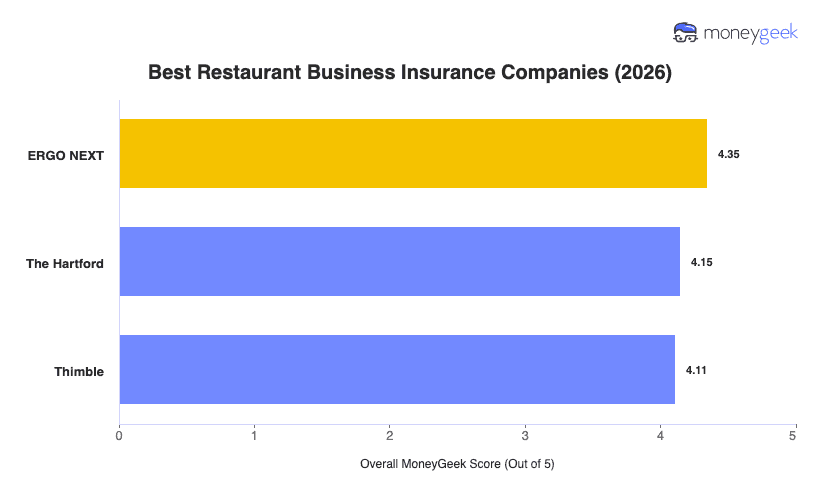

Restaurant owners face unique risks: foodborne illness claims, kitchen fires and employee injuries. You'll need several coverage types to protect your business, staff and customers. Here are the essential policies with recommended amounts.
What Insurance Do You Need for a Restaurant Business?
The types of insurance a restaurant business needs most include general liability, workers' compensation, commercial property and liquor liability.
Get matched to the best restaurant business insurer for your needs below.

Updated: May 29, 2026
Advertising & Editorial Disclosure
General liability is the top priority for restaurants due to high claim risk from customer injuries, foodborne illness and property damage (read more).
Restaurant insurance requirements commonly mandate workers' compensation, commercial auto and general liability through state law and contracts (read more).
Optional restaurant coverage includes business interruption, equipment breakdown and employment practices liability insurance.
Get COIs from your insurer, verify coverage meets requirements, add landlords as additional insured and send proof to required parties (read more).
What Insurance Types Are Needed for a Restaurant Business?
Customer injuries (slips, burns, foodborne illness). Most landlords and municipalities require this for licensing. | $1–2 million per occurrence or $2–3 million aggregate. High-traffic locations may need $3–5 million. | A customer slipped on a wet floor and broke her wrist. Medical bills and lost wages totaled $40,000, plus $8,000 in legal fees. General liability paid the full $48,000. | |
Kitchen staff injuries: burns, cuts, slips, lifting-related back injuries. Required by law in most states once you hire employees. | State-mandated minimums. Premiums based on payroll and risk classification. | A line cook suffered second-degree burns from a grease fire, requiring surgery and two months off. Workers' comp covered $34,000 in treatment and $9,000 in lost wages. | |
Building damage, kitchen equipment, furniture, inventory from fires, theft, weather. Landlords and lenders require this. | Match full replacement cost: $100,000–500,000, depending on restaurant size. | A kitchen fire caused $180,000 in equipment and ventilation damage. Property insurance covered repairs minus a $5,000 deductible. | |
Lawsuits from over-serving: on-premises fights, drunk driving accidents involving patrons. Required by liquor license authorities. | $1 million per occurrence. High-volume bars need $2–3 million. | An intoxicated patron caused a car accident after leaving. Injuries totaled $250,000. Liquor liability covered the settlement plus $45,000 in legal costs. | |
Lost income during closures from fires, equipment failures, health shutdowns. Critical for restaurants with thin margins. | Replace 3–6 months revenue: typically $50,000-200,000 based on monthly sales. | Refrigeration failure forced a two-week closure. Lost revenue ($42,000) and spoiled inventory ($8,000) were both covered during repairs. | |
Equipment breakdown | Repair or replacement of kitchen equipment (refrigerators, ovens, freezers, HVAC) and spoiled inventory from mechanical failures. Standard property policies exclude this. | $25,000–100,000 based on equipment value. Most restaurants need $50,000 minimum. | Walk-in freezer failure spoiled $12,000 in inventory and required $8,500 in emergency repairs. Equipment breakdown reimbursed all $20,500 within days. |
Restaurant Business Insurance Requirements
Restaurant insurance requirements fall into two categories: state-mandated coverage and contractual obligations from landlords, lenders and liquor licensing authorities. Workers' compensation and commercial auto are legally required in most states. General liability and property coverage are mandated by commercial leases and business licenses.
Workers' compensation | Most states mandate workers' comp as soon as you hire staff. Employers without coverage are liable for fines up to $10,000 per employee, criminal charges, license suspension and personal injury costs. Kitchen work carries high injury frequency, with burns, cuts and slips as the most common claims. | State-mandated minimums based on payroll and industry classification. Restaurants are classified as high-risk. |
General liability | Commercial landlords won't sign a lease without it. Municipalities require it for business licenses and health permits. High-traffic venues and premium locations set higher minimum limits than standard requirements. | Standard requirement: $1 million per occurrence, $2 million aggregate. High-value landlords may require $2–3 million. |
Commercial auto | 49 states require separate commercial auto coverage for any vehicle used in business operations, including deliveries, catering runs and supply transport. A personal auto policy doesn't satisfy this requirement. Penalties for noncompliance include fines, impoundment and personal liability for accident costs. | State minimums: 25/50/10 to 50/100/50 split limits. Delivery restaurants often need $1 million combined single limit. |
Liquor liability | State licensing boards won't issue or renew a license to serve alcohol without it. Dram shop statutes hold restaurants strictly liable for incidents tied to over-service, regardless of intent. | Most states require $1 million per occurrence minimum. High-volume bars may need $2–3 million. |
Commercial property | Commercial leases require it to cover the building owner's investment. Lenders require it on financed properties and are named as loss payee. The requirement runs for the full term of the lease or loan. | Must equal full replacement cost of building, equipment and inventory: $100,000–500,000 based on restaurant size. |
Shopping centers, hotel-adjacent venues and high-traffic retail locations set umbrella requirements above standard liability limits as a lease condition. Without it, many major landlords won't execute a lease. | High-value locations: $2–5 million total coverage. Luxury venues may mandate $5–10 million. | |
How to Meet Restaurant Business Insurance Requirements
Restaurant owners must maintain proof of insurance for landlords, liquor licensing authorities and municipal requirements. These steps cover how to document coverage and stay compliant:
- 1Request Certificates of Insurance (COIs) from your insurance provider
Request COIs from your agent immediately after purchasing coverage. Most providers deliver them via email within minutes to hours. You'll need COIs before signing leases, obtaining business licenses, securing liquor permits and partnering with delivery platforms like DoorDash or Uber Eats.
- 2Verify coverage amounts match lease and licensing requirements
Compare each COI against your lease agreement, liquor license requirements and business license. Confirm limits meet specified minimums. Your general liability should show $1 million/$2 million coverage, and liquor liability must satisfy state licensing authority minimums.
- 3Add your landlord as "Additional Insured" on general liability coverage
Commercial leases require adding the property owner as an additional insured on your general liability policy. This protects them from claims arising from your restaurant operations. Request this endorsement from your insurer (costs $25 to $100 annually) and get an updated COI showing the landlord's additional insured status.
- 4Submit COIs to landlords, licensing authorities and delivery partners
Provide certificates to your landlord before lease signing, to your state liquor authority when applying for alcohol licenses and to your health department for business permits. Restaurants offering delivery must also submit commercial auto COIs to third-party platforms before activating service.
- 5Set renewal reminders and distribute updated certificates proactively
Set calendar reminders 30 to 60 days before policy renewals to obtain updated COIs, especially if renewals align with liquor license or lease term dates. Send new certificates annually to your landlord, liquor authority, health department and delivery partners to avoid license suspensions or lease violations.
Get Business Insurance You Need for Your Restaurant Business
Compare quotes from insurers with restaurant experience. Evaluate each carrier's claims handling for food service operations, availability of liquor liability and equipment breakdown coverage, and familiarity with restaurant risk. Review premiums against coverage limits before committing.
About Connor Bolton

Connor Bolton is Senior SEO and Content Manager at MoneyGeek, where he leads the business and pet insurance editorial teams. He sets the research framework, data standards and content structure for his team. All content goes through his accuracy review before publication. Connor also writes in-depth guides and has spent more than four years covering insurance products across personal, commercial and specialty lines.
The research infrastructure Connor built covers auto, home, renters, life, health, business and pet insurance across pricing analysis, carrier research, customer experience and coverage evaluation. It includes over 6 million data points for business insurance across 408 industry areas, all 50 states and 16 vehicle types. The pet insurance side covers over 5 million profiles across 18 major providers, 100+ breeds and ages up to 20 years. Connor’s insurance research and his team's work has been cited by the U.S. Chamber of Commerce, Allstate, Liberty Mutual, CBS News, Forbes and LegalZoom.
Connor also talks with underwriters and carrier liaisons at Ethos, The Hartford, ERGO NEXT, Nationwide and State Farm, and monitors business and pet owner communities on Reddit. Those sources shape how his team evaluates carriers, structures rate analysis and writes for human buyers rather than search engines.
For questions about MoneyGeek's business and pet insurance content, contact him at connor@moneygeek.com or on LinkedIn.