How Much Does Florist Business Insurance Cost?

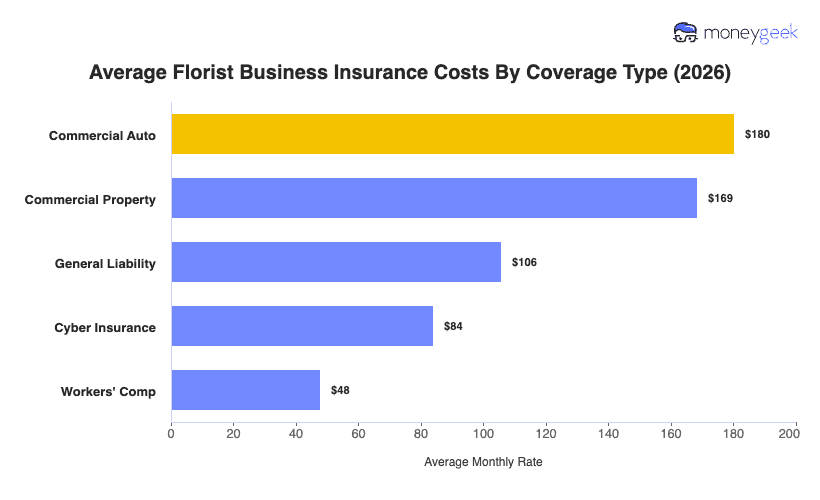
Retail business insurance costs for florists sits in the lower end of pricing at $117 per month, or $1,408 per year within its work sector at 15th in terms of affordability. Compared to the national average of $113/mo it is only slightly higher on average across the five coverage types most small flower shops will need. At the coverage level, the story gets clearer, and it clearly aligns with the industry's risk. 

Commercial property and auto policies lead as the most expensive due to risks involved with frequent delivery of floral arrangements, the cost of equipment that keep flowers alive and thriving, and the inherent risks of someone stealing goods or damaging property in any store environment (from delivery people or customers). While general liability is below the national average at $106/mo (versus $123/mo nationally), there are still common claims associated with someone slipping on water and getting injured due to your need to watering plants throughout the day. Workers' comp is not expensive at all since the work is not physically demanding and cyber is only modestly priced.

Workers' Comp$48$574174
Cyber Insurance$84$1,007240
General Liability$106$1,270243
Commercial Property$169$2,023300
Commercial Auto$180$2,164245

We analyzed quote data from major U.S. commercial insurance providers and modeled standardized premium estimates across business profiles representing around 95% of the market. Results are designed to provide a consistent national benchmark showing how premiums vary by key baseline factors including business size, profession type, location and vehicle type for operations that use commercial vehicles.

Dataset Scope and Assumptions

Our cost modeling uses standardized inputs for consistent comparisons across businesses.

  • Total estimates modeled: just over 6 million standardized pricing estimates
  • Providers analyzed: 10 major insurance providers
  • Geography: all U.S. states including Washington, D.C.
  • Employee count bands: solo practitioners, one to four, five to nine, 10 to 19, and 20 to 49 employees
  • Vehicle types studied: Sedans, SUVs, pickup trucks, vans, taxis, limousines, tractors, food trucks, semi-trucks (non-HAZMAT and HAZMAT), tanker trucks (non-HAZMAT and HAZMAT), buses, box trucks, dump trucks, flatbed trucks
  • Policies studied: general liability, workers' comp, professional liability, commercial auto, commercial property, and cyber insurance
    • General liability: $1 million per occurrence and $2 million aggregate
    • Workers' comp: state required coverage
    • Professional liability: $1 million per claim and $1 million aggregate
    • Commercial auto: minimum coverage
    • Commercial property: personal property coverage limits personalized to industry, business size and state
    • Cyber insurance: $1 million per occurrence and $1 million aggregate

How We Calculated Average Florist Business Insurance Costs

Our published averages represent modeled premiums for standardized business profiles and were aggregated in two ways.

  • National benchmark average: The national average cost reflects the modeled premium for a standardized one to four employee business across all profession categories and states included in our dataset for a standard professional liability policy
  • Segment averages: To show how costs vary, we calculated average modeled premiums for our national base profile and isolated for variables, including:
    • Employee count (business size ranges)
    • Profession / industry categories
    • Vehicle types (for commercial auto)
    • States (including Washington, D.C.)

Segment averages were produced by aggregating modeled pricing trends across the full dataset so readers can compare how premiums shift across profession types and regions.
See our full business insurance methodology.

The florist business insurance cost calculator below lets you get more personalized estimates to compare rates.

Estimate Florist Business Insurance Costs

This tool I've built allows you to get personalized florist business insurance cost estimates by coverage type based on your state employee count range and vehicle type (if you're looking for commercial auto coverage). Rates for workers' comp are provided on a per employee basis, and you will receive no phone calls, spam or will have your personal information collected. This calculator is meant to give you a baseline only and will not reflect actual quotes, but you can click Get Quotes to get matched to your top provider, according to my research, and get real prices.

Select Coverage Type
Select State
Select Employee Count
Select Vehicle Type
Monthly Rate Estimate

How Much Does General Liability Insurance Cost for Florist Businesses?

For general liability insurance costs, Florists average $106 per month ($1,271 per year) nationally. More notably, the gap between the cheapest and most expensive states runs just 32%, from $95 per month in Louisiana to $126 in California. That's the tightest state spread of any industry in this dataset by a large margin with many being closer to 70% or higher.

This is primarily due to underwriters valuing operational factors much more and the most influential for florists are event and wedding work, delivery scope, and product liability exposure from specialty items. A shop doing full venue installations, running daily deliveries, and working with exotic flowers or scented products will pay more than a straightforward retail storefront, regardless of which state either one operates in.

Data filtered by:
Select
Alabama$98$1,180
Alaska$110$1,316
Arizona$105$1,260
Arkansas$97$1,169
California$126$1,514
Colorado$113$1,355
Connecticut$117$1,407
Delaware$108$1,299
District of Columbia$124$1,491
Florida$109$1,310
Georgia$105$1,257
Hawaii$119$1,430
Idaho$98$1,176
Illinois$112$1,343
Indiana$101$1,217
Iowa$98$1,179
Kansas$100$1,198
Kentucky$100$1,195
Louisiana$95$1,143
Maine$102$1,227
Maryland$115$1,376
Massachusetts$121$1,449
Michigan$104$1,244
Minnesota$109$1,303
Mississippi$96$1,154
Missouri$101$1,214
Montana$99$1,182
Nebraska$100$1,201
Nevada$109$1,302
New Hampshire$109$1,309
New Jersey$118$1,411
New Mexico$99$1,182
New York$123$1,478
North Carolina$103$1,239
North Dakota$99$1,191
Ohio$102$1,230
Oklahoma$97$1,162
Oregon$111$1,328
Pennsylvania$107$1,288
Rhode Island$109$1,303
South Carolina$99$1,183
South Dakota$97$1,165
Tennessee$102$1,229
Texas$106$1,267
Utah$102$1,227
Vermont$106$1,271
Virginia$110$1,320
Washington$117$1,401
West Virginia$96$1,148
Wisconsin$102$1,227
Wyoming$99$1,182

How Much Does Workers’ Comp Insurance Cost for Florist Businesses?

Florists carry one of the lowest risk profiles in my analysis for employee injury, making their workers' comp prices sit very modestly at $48/mo per employee. This places it well under half of the national average and isn't surprising given what maintaining a flower shop requires. Watering plants, manning a cash register and occasional heavy lifting when suppliers bring in flowers make it a less physically demanding job than many other retail operations.

Even so, your location is meaningful despite this low cost. Indiana, South Dakota, and Arkansas sit at the low end at $27 per month per employee. California reaches $113 and D.C. hits $102, representing roughly a 4x spread from cheapest to most expensive. For a florist staffing three full-time employees, that difference adds up to over $3,000 per year in workers' comp costs before any other expense differences are factored in.

Data filtered by:
Select
Alabama$31$374
Alaska$78$933
Arizona$38$460
Arkansas$27$325
California$113$1,357
Colorado$48$580
Connecticut$88$1,053
Delaware$59$710
District of Columbia$102$1,222
Florida$44$531
Georgia$43$515
Hawaii$60$717
Idaho$29$350
Illinois$62$743
Indiana$27$319
Iowa$29$342
Kansas$31$370
Kentucky$34$406
Louisiana$45$540
Maine$43$517
Maryland$51$611
Massachusetts$80$961
Michigan$49$591
Minnesota$48$579
Mississippi$30$362
Missouri$39$466
Montana$40$483
Nebraska$31$374
Nevada$42$501
New Hampshire$50$602
New Jersey$84$1,002
New Mexico$35$423
New York$75$896
North Carolina$38$460
Oklahoma$41$490
Oregon$45$539
Pennsylvania$61$726
Rhode Island$52$619
South Carolina$44$532
South Dakota$27$323
Tennessee$35$414
Texas$33$391
Utah$31$372
Vermont$45$539
Virginia$36$429
West Virginia$42$510
Wisconsin$40$486

How Much Does Commercial Property Insurance Cost for Florist Businesses?

The average cost of commercial property insurance for florist shops ranges from $147 per month in North Dakota to $203 in New York, and while the 38% spread is the widest of any industry in this dataset, the value of your refrigeration equipment and perishable inventory exposure are what separate florists from most other retail businesses when carriers set your rate. A shop running multiple commercial coolers and carrying $10,000 in flower inventory on a busy holiday week is very different in terms of risk than a small studio operation with a single display unit.

Data filtered by:
Select
Alabama$158$1,895
Alaska$186$2,229
Arizona$168$2,012
Arkansas$153$1,835
California$194$2,328
Colorado$174$2,091
Connecticut$189$2,273
Delaware$178$2,135
District of Columbia$198$2,372
Florida$191$2,288
Georgia$168$2,016
Hawaii$197$2,367
Idaho$159$1,914
Illinois$173$2,070
Indiana$154$1,854
Iowa$149$1,793
Kansas$150$1,794
Kentucky$156$1,873
Louisiana$175$2,106
Maine$162$1,940
Maryland$183$2,193
Massachusetts$193$2,313
Michigan$160$1,915
Minnesota$164$1,972
Mississippi$154$1,853
Missouri$153$1,832
Montana$155$1,858
Nebraska$148$1,779
Nevada$171$2,052
New Hampshire$168$2,013
New Jersey$197$2,362
New Mexico$156$1,874
New York$203$2,432
North Carolina$169$2,028
North Dakota$147$1,760
Ohio$159$1,913
Oklahoma$154$1,843
Oregon$176$2,111
Pennsylvania$179$2,153
Rhode Island$184$2,213
South Carolina$166$1,992
South Dakota$148$1,775
Tennessee$161$1,933
Texas$178$2,133
Utah$164$1,973
Vermont$163$1,954
Virginia$172$2,066
Washington$181$2,172
West Virginia$153$1,837
Wisconsin$158$1,891
Wyoming$152$1,819

How Much Does Commercial Auto Insurance Cost for Florist Businesses?

The moment that van is on the road on behalf of the business, you need commercial auto coverage, and what you pay depends heavily on where it's garaged. Pennsylvania florists pay around $90 per month for commercial auto insurance, the lowest rate in the country. Michigan florists pay $344/mo, nearly four times as much for the same essential coverage.

Florist delivery runs tend to be short-distance and time-pressured, which creates a specific kind of road exposure including frequent stops, tight neighborhood streets, and schedules that don't leave room to wait out traffic. Especially when cargo is both perishable and easy to damage, this increases risk substantially of accidents driven by not wanting glass vases to be broken or flowers to be ruined. This intersects with repair costs, traffic patterns, population density and litigation environments at the location level, which all affect commercial auto premiums heavily past the work environment of flower delivery.

Data filtered by:
Select
Alabama$153$1,831
Alaska$299$3,591
Arizona$165$1,976
Arkansas$164$1,973
California$227$2,722
Colorado$182$2,180
Connecticut$211$2,532
Delaware$149$1,791
Florida$257$3,078
Georgia$174$2,087
Hawaii$96$1,154
Idaho$114$1,372
Illinois$201$2,412
Indiana$170$2,039
Iowa$106$1,271
Kansas$159$1,903
Kentucky$173$2,077
Louisiana$199$2,389
Maine$203$2,430
Maryland$220$2,640
Massachusetts$219$2,633
Michigan$344$4,130
Minnesota$179$2,153
Mississippi$168$2,012
Missouri$207$2,486
Montana$145$1,743
Nebraska$149$1,792
Nevada$181$2,167
New Hampshire$128$1,541
New Jersey$226$2,715
New Mexico$141$1,697
New York$236$2,838
North Carolina$179$2,143
North Dakota$139$1,666
Ohio$174$2,087
Oklahoma$161$1,927
Oregon$174$2,085
Pennsylvania$90$1,081
Rhode Island$224$2,692
South Carolina$179$2,153
South Dakota$200$2,401
Tennessee$161$1,927
Texas$244$2,932
Utah$162$1,943
Vermont$99$1,190
Virginia$191$2,295
Washington$170$2,045
Washington DC$246$2,946
West Virginia$172$2,059
Wisconsin$132$1,580
Wyoming$155$1,855

How Much Does Cyber Insurance Cost for Florist Businesses?

The cost of cyber liability coverage for florist shops range from North Dakota's rates where pay as little as $71 per month, towards the highest end of the spectrum in Washington, D.C. reaching $103 a month, a difference of more than 45% for the same core protection. While not the most expensive or cheapest among all 400+ industries I studied, florist work comes with notable risks that put it slightly above average benchmarks.

A florist shop's cyber exposure is woven into how it takes orders. Online storefronts, wedding inquiry forms, subscription delivery services and point-of-sale systems all pull in customer names, addresses, payment card data and event details that sit in your platforms long after the order ships. Florists operating in coastal and mid-Atlantic markets where data breach laws carry tighter standards and litigation costs run higher see that reflected in what they pay.

Data filtered by:
Select
Alabama$81$973
Alaska$72$857
Arizona$85$1,020
Arkansas$77$923
California$98$1,185
Colorado$91$1,090
Connecticut$96$1,150
Delaware$93$1,117
District of Columbia$103$1,245
Florida$91$1,091
Georgia$89$1,072
Hawaii$76$903
Idaho$73$876
Illinois$96$1,148
Indiana$84$1,004
Iowa$76$903
Kansas$79$952
Kentucky$81$974
Louisiana$81$973
Maine$76$903
Maryland$96$1,148
Massachusetts$96$1,146
Michigan$85$1,021
Minnesota$85$1,020
Mississippi$77$926
Missouri$83$1,000
Montana$72$857
Nebraska$76$904
Nevada$93$1,117
New Hampshire$76$906
New Jersey$97$1,167
New Mexico$77$924
New York$101$1,214
North Carolina$87$1,049
North Dakota$71$855
Ohio$85$1,023
Oklahoma$79$955
Oregon$87$1,052
Pennsylvania$87$1,049
Rhode Island$76$903
South Carolina$81$973
South Dakota$73$874
Tennessee$84$1,002
Texas$91$1,090
Utah$79$952
Vermont$76$906
Virginia$93$1,117
Washington$93$1,119
West Virginia$73$874
Wisconsin$83$1,000
Wyoming$72$857

How to Lower Florist Business Insurance Costs

Florists carry a cost structure that looks different from most retail businesses. Your two most expensive lines are commercial property and commercial auto, driven by the combination of perishable inventory, refrigeration equipment, and a delivery operation that puts vehicles and arrangements on the road daily. 

The strategies that move the needle most are less about shopping around and more about how accurately your policy reflects what you actually own and operate.

    building icon
    Get your property coverage to match your real inventory value, not a rough estimate

    Florists routinely carry more inventory in the days surrounding Valentine's Day, Mother's Day, and wedding season than they do on a typical Tuesday in October. A property policy based on your average inventory can leave you underinsured at exactly the moments you are most exposed. 

    Some specialty insurers that focus on the floral industry automatically increase your coverage limits in the days before and after major floral holidays, which is worth seeking out rather than manually managing limit adjustments yourself. If your current carrier does not offer this, review whether your stated inventory value reflects your peak exposure, not your slow-season floor.

    airConditioner icon
    Treat your refrigeration equipment as a separate coverage decision

    Standard commercial property policies cover theft, fire, and some weather events, but some commercial property coverage can include spoilage caused by refrigeration breakdown, so if spoilage is a risk, it is worth asking specifically about coverage that addresses perishable inventory. A compressor failure overnight is one of the most common and costly losses a florist can experience, and whether it is covered depends entirely on whether you have an equipment breakdown endorsement. That endorsement typically costs far less than a single spoilage event, and it is one of the most frequently overlooked gaps in a standard BOP (business owners policy).

    car2 icon
    Right-size your delivery fleet on paper

    Commercial auto for retail businesses is sensitive to fleet size, vehicle type, and who is listed as a driver. If any employees use personal vehicles for deliveries, a full commercial auto policy does not cover those trips. Hired and non-owned auto coverage closes that gap at a fraction of the cost of adding another vehicle to your commercial policy. 

    Auditing exactly which vehicles are being used for business before renewal, and removing any that are no longer active, is one of the simplest ways to reduce your commercial auto premium without changing your coverage structure.

    accident2 icon
    Keep driver records clean and current

    Commercial auto pricing for delivery-dependent businesses is directly tied to the driving records of everyone listed on the policy. A single moving violation or at-fault accident on a driver's record can raise your rate at renewal. Pulling motor vehicle records on all drivers before you add them to the policy, rather than after a claim surfaces, keeps your driver pool from quietly inflating your premium. Some carriers offer discounts for documented driver training programs, which for a florist with multiple delivery drivers, can produce meaningful savings at scale.

    insurance2 icon
    Bundle property and liability under one carrier

    Most carriers provide discounts when you bundle general liability, commercial property, and commercial auto together, and paying annually rather than monthly removes installment fees and earns an additional 6% to 8% discount. For a florist whose two most expensive lines are already property and auto, consolidating both under one carrier with a bundling discount is a straightforward way to reduce total premium without adjusting any individual coverage limit.

Florist Business Insurance Cost: Bottom Line

The $117 monthly average will rarely match your quote exactly. What you actually pay depends on whether you run a storefront, do deliveries, carry perishable inventory, and how many people are on staff.

Florists sit in a middle range across retail and product businesses, but the coverage mix is less predictable than the average suggests. Property and GL do most of the work, and the ratio between them shifts depending on how your shop operates. Here is how to read your quote against that:

  • Does your operation match the profile behind the number? A single-location studio with walk-in traffic prices differently than a shop running delivery vehicles and event contracts. If your setup leans toward events or wholesale, expect your quote to sit above $117. If you're a smaller storefront with no delivery, it may land below.
  • What's actually moving your premium? For most florists, it comes down to three things: the value of your commercial property and inventory, whether you have delivery vehicles on a commercial auto policy, and employee count. Of those, inventory valuation is the one most often underestimated at quote time.
  • Is the quote priced for your actual risk? Florists are sometimes quoted under broader retail classifications that don't account for perishable stock or event liability. If your broker isn't asking about event work or delivery operations, your coverage may not be priced to match what you actually do.

If your quote is close to $117, you're likely in a standard profile. Meaningfully above it, check the three factors above first before shopping elsewhere.

About Connor Bolton


Connor Bolton headshot

Connor Bolton is Senior SEO and Content Manager at MoneyGeek, where he leads the business and pet insurance editorial teams. As editorial lead for both verticals, Connor sets the research framework, data standards, and content structure that his writers execute, directly authoring in-depth guides himself and reviewing all team content for accuracy and practical value before it goes live. With over four years evaluating insurance products across personal, commercial, and specialty lines, he brings cross-vertical knowledge to every guide the team produces.

Connor architected MoneyGeek's insurance research infrastructure across all major verticals including auto, home, renters, life, health, business, and pet, building systems for pricing analysis, provider-level research, customer experience evaluation, and coverage analysis with AI support. The infrastructure includes over 6 million data points for business insurance across 408 industry areas, all 50 states, and 16 vehicle types, and over 5 million pet insurance profiles across 18 major providers and hundreds of breed and age combinations. Connor's insurance cost research and his team's work has been cited by the U.S. Chamber of Commerce, Allstate, Liberty Mutual, CBS News, Forbes and LegalZoom.

Beyond the data, Connor stays connected to how the market actually operates, drawing on direct conversations with underwriters and carrier liaisons at Ethos, The Hartford, NEXT Insurance, Nationwide, and State Farm, and monitoring business and pet owner communities including Reddit, to inform how he interprets findings and frames guidance for real buyers.

He is the direct editorial contact for methodology questions at connor@moneygeek.com and can be found on LinkedIn.