
How Much Does Personal Training Business Insurance Cost?

Personal training business insurance averages around $50 per month, or $598 annually, across the six most common coverage types. That figure reflects the average cost of business insurance modeled across 50 states and Washington, D.C., for businesses with one to four employees at standard limits of $1 million per occurrence and $2 million aggregate.

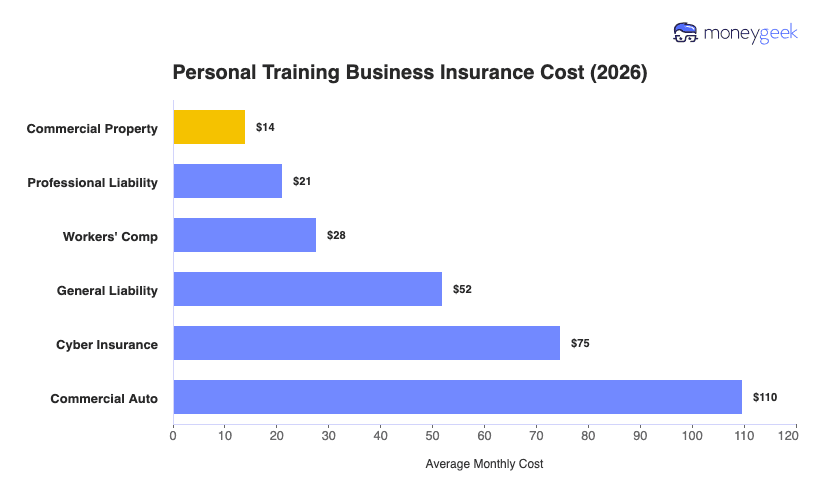
Per-coverage costs range from $14 to $110 per month, with commercial property at the low end because most trainers rent studio space rather than own a building. Commercial auto sits at the high end, though it only applies if you drive to client locations for business. 

The table below gives you a starting benchmark, though your actual premium will shift based on your specific profile.

Commercial Property$14$16789%25
Professional Liability$21$25263%11
Workers' Comp$28$33275%89
General Liability$52$623-58%111
Cyber Insurance$75$89610%214
Commercial Auto$110$1,31633%109

We analyzed quote data from major U.S. commercial insurance providers and modeled standardized premium estimates across business profiles representing around 95% of the market. Results are designed to provide a consistent national benchmark showing how premiums vary by key baseline factors including business size, restaurant profession type, location and vehicle type for operations that use commercial vehicles.

Dataset Scope and Assumptions

Our cost modeling uses standardized inputs for consistent comparisons across businesses.

  • Total estimates modeled: just over 6 million standardized pricing estimates
  • Providers analyzed: 10 major insurance providers
  • Geography: all U.S. states including Washington, D.C.
  • Employee count bands: solo practitioners, one to four, five to nine, 10 to 19, and 20 to 49 employees
  • Vehicle types studied: Sedans, SUVs, pickup trucks, vans, taxis, limousines, tractors, food trucks, semi-trucks (non-HAZMAT and HAZMAT), tanker trucks (non-HAZMAT and HAZMAT), buses, box trucks, dump trucks, flatbed trucks
  • Policies studied: general liability, workers' comp, professional liability, commercial auto, commercial property, and cyber insurance
    • General liability: $1 million per occurrence and $2 million aggregate
    • Workers' comp: state required coverage
    • Professional liability: $1 million per claim and $1 million aggregate
    • Commercial auto: minimum coverage
    • Commercial property: personal property coverage limits personalized to industry, business size and state
    • Cyber insurance: $1 million per occurrence and $1 million aggregate

How We Calculated Average Personal Training Business Insurance Costs

Our published averages represent modeled premiums for standardized business profiles and were aggregated in two ways.

  • National benchmark average: The national average cost reflects the modeled premium for a standardized one to four employee business across all and states included in our dataset for a standard policies
  • Segment averages: To show how costs vary, we calculated average modeled premiums for our national base profile and isolated for variables, including:
    • Employee count (business size ranges)
    • Vehicle types (for commercial auto)
    • States (including Washington, D.C.)

Segment averages were produced by aggregating modeled pricing trends across the full dataset so readers can compare how premiums shift across coverage types and regions.
See our full business insurance methodology.

Use our personal training business insurance cost calculator below for more personalized estimates and to compare rates.

Estimate Average Business Insurance Costs for Your Personal Training Business

Plug in your coverage type, state, employee count and vehicle type (if you need commercial auto coverage) to get a cost estimate built around your operation. No personal information is required, and workers' comp estimates are calculated per employee.

Select Coverage Type
Select State
Select Employee Count
Select Vehicle Type
Monthly Rate Estimate—

How Much Does General Liability Insurance Cost for Personal Trainings?

General liability is the coverage most gym contracts and studio rental agreements require personal trainers to carry before working with clients on-site. It responds to third-party bodily injury and property damage claims, covering situations your professional liability policy won't touch. The average cost of general liability varies more by state than most trainers expect.

North Dakota sits at the low end at $40 per month, while California reaches $76, nearly 91% higher. That gap reflects litigation frequency and legal environment more than the nature of the work itself. If you operate in California, New York or Florida, general liability will likely absorb the largest share of your insurance spend, while trainers in lower-cost states can keep this coverage well below the national average.

Alabama$45$538
Alaska$62$744
Arizona$55$663
Arkansas$44$531
California$76$907
Colorado$57$688
Connecticut$61$732
Delaware$53$638
District of Columbia$60$725
Florida$67$800
Georgia$52$625
Hawaii$65$781
Idaho$41$494
Illinois$59$713
Indiana$48$581
Iowa$43$519
Kansas$46$556
Kentucky$47$569
Louisiana$48$574
Maine$49$588
Maryland$60$719
Massachusetts$63$750
Michigan$50$600
Minnesota$54$644
Mississippi$44$525
Missouri$48$575
Montana$44$525
Nebraska$46$550
Nevada$56$675
New Hampshire$53$638
New Jersey$64$763
New Mexico$44$525
New York$72$863
North Carolina$51$613
North Dakota$40$475
Ohio$50$594
Oklahoma$46$549
Oregon$57$688
Pennsylvania$54$650
Rhode Island$54$644
South Carolina$45$544
South Dakota$41$488
Tennessee$51$606
Texas$52$625
Utah$47$569
Vermont$53$631
Virginia$55$656
Washington$58$700
West Virginia$40$475
Wisconsin$49$588
Wyoming$41$494

How Much Does Professional Liability Insurance Cost for Personal Training Services?

Personal trainers who deliver programming, nutritional guidance or corrective exercise advice carry professional liability exposure regardless of whether a session ends in physical injury. A client who claims your programming caused harm, even without an incident on the floor, can file against you. The average cost of professional liability is the most geographically stable of the six coverage types.

Maine sits at the low end at $18 per month, while Washington, D.C. reaches $25. With a difference of just $7, it shows that your state has less influence over your premium than almost any other factor. What you offer and the credentials you hold carry more pricing weight than where you operate.

Alabama$21$246
Alaska$19$226
Arizona$20$239
Arkansas$20$239
California$23$281
Colorado$21$249
Connecticut$23$274
Delaware$22$269
Florida$23$271
Georgia$21$256
Hawaii$22$261
Idaho$20$239
Illinois$23$276
Indiana$20$244
Iowa$20$239
Kansas$20$244
Kentucky$19$234
Louisiana$24$284
Maine$18$219
Maryland$20$239
Massachusetts$22$264
Michigan$20$236
Minnesota$20$236
Mississippi$21$251
Missouri$21$249
Montana$21$249
Nebraska$20$236
Nevada$24$286
New Hampshire$21$249
New Jersey$24$284
New Mexico$21$254
New York$24$291
North Carolina$18$219
North Dakota$18$219
Ohio$19$234
Oklahoma$20$236
Oregon$19$234
Pennsylvania$24$289
Rhode Island$23$276
South Carolina$22$259
South Dakota$20$236
Tennessee$20$244
Texas$21$254
Utah$20$239
Vermont$20$241
Virginia$19$229
Washington$24$286
Washington DC$25$296
West Virginia$22$264
Wisconsin$21$246
Wyoming$19$234

How Much Does Workers’ Comp Insurance Cost for Personal Trainings?

If you hire staff, workers' compensation covers their medical costs and lost wages when they're injured on the job, whether from a pulled muscle during a demonstration or strain from assisting a client through a movement. Most states require it once you bring on employees. The average cost of workers' comp shows the widest state-level variation of any coverage type here.

Texas sits at the low end at $20 per employee per month, while California reaches $60, three times higher. High base wages, active labor regulation and elevated claim costs drive California's premium. Texas does not mandate workers' comp, giving you the option to opt out if you operate there. North Dakota, Ohio, Washington and Wyoming run state-funded monopoly systems where private insurers don't write policies, so no private coverage data exists for those states.

Alabama$22$259
Alaska$42$503
Arizona$22$268
Arkansas$21$255
California$60$717
Colorado$26$311
Connecticut$47$564
Delaware$31$372
District of Columbia$54$654
Florida$24$286
Georgia$24$283
Hawaii$32$382
Idaho$22$260
Illinois$32$388
Indiana$20$244
Iowa$21$257
Kansas$21$256
Kentucky$22$267
Louisiana$25$301
Maine$24$290
Maryland$28$335
Massachusetts$42$509
Michigan$26$312
Minnesota$26$310
Mississippi$23$274
Missouri$23$273
Montana$24$284
Nebraska$22$259
Nevada$23$281
New Hampshire$27$320
New Jersey$45$537
New Mexico$22$269
New York$49$593
North Carolina$22$266
Oklahoma$24$291
Oregon$24$288
Pennsylvania$32$389
Rhode Island$28$332
South Carolina$25$298
South Dakota$21$247
Tennessee$22$259
Texas$20$243
Utah$21$256
Vermont$25$295
Virginia$21$256
West Virginia$25$296
Wisconsin$23$277

How Much Does Commercial Property Insurance Cost for Personal Trainings?

Personal trainers who lease a dedicated studio space or own equipment used across multiple locations carry property exposure their general liability policy won't cover. Commercial property protects your gear, furniture and leasehold improvements if they are damaged, stolen or destroyed. Across states, this is one of the most affordable and geographically stable coverage types for personal training operations.

North Dakota sits at the low end at $12 per month, while New York reaches $17, a 36% difference. Real estate costs, property crime rates and natural catastrophe exposure account for most of that gap rather than anything specific to how you operate. If you rent studio time or run a single fixed location, your state has relatively little impact on what you pay for this coverage.

Alabama$13$156
Alaska$15$185
Arizona$14$167
Arkansas$13$151
California$16$194
Colorado$15$174
Connecticut$16$186
Delaware$15$175
District of Columbia$16$194
Florida$16$189
Georgia$14$166
Hawaii$16$197
Idaho$13$159
Illinois$14$173
Indiana$13$155
Iowa$12$150
Kansas$12$150
Kentucky$13$155
Louisiana$14$174
Maine$13$159
Maryland$15$180
Massachusetts$16$189
Michigan$13$160
Minnesota$14$164
Mississippi$13$153
Missouri$13$153
Montana$13$155
Nebraska$12$148
Nevada$14$171
New Hampshire$14$165
New Jersey$16$193
New Mexico$13$156
New York$17$199
North Carolina$14$167
North Dakota$12$147
Ohio$13$160
Oklahoma$13$154
Oregon$15$176
Pennsylvania$15$176
Rhode Island$15$181
South Carolina$14$164
South Dakota$12$148
Tennessee$13$160
Texas$15$177
Utah$14$164
Vermont$13$160
Virginia$14$171
Washington$15$181
West Virginia$13$152
Wisconsin$13$158
Wyoming$13$152

How Much Does Cyber Insurance Cost for Personal Trainings?

If you store client health intake forms, payment information or fitness assessments digitally, your data exposure grows with every new client you add. A breach can trigger notification requirements, legal costs and regulatory scrutiny. The average cost of cyber insurance for personal training businesses runs from $63 per month in Alaska to $92 in Washington, D.C., a 46% difference.

States with dense urban markets and higher concentrations of digital-first businesses sit consistently at the high end. For your operation, the more relevant driver is how you work: if you run an online coaching platform, store waivers and health data digitally, or process payments through third-party apps, your exposure sits closer to the high end regardless of your state.

Alabama$72$865
Alaska$63$762
Arizona$76$908
Arkansas$69$821
California$88$1,057
Colorado$81$970
Connecticut$85$1,022
Delaware$83$993
District of Columbia$92$1,107
Florida$81$969
Georgia$79$952
Hawaii$67$806
Idaho$65$779
Illinois$85$1,020
Indiana$74$889
Iowa$67$806
Kansas$71$849
Kentucky$72$865
Louisiana$72$866
Maine$67$806
Maryland$85$1,020
Massachusetts$85$1,022
Michigan$76$907
Minnesota$76$908
Mississippi$69$823
Missouri$74$892
Montana$63$761
Nebraska$67$806
Nevada$83$993
New Hampshire$67$806
New Jersey$86$1,039
New Mexico$69$823
New York$90$1,082
North Carolina$78$935
North Dakota$63$761
Ohio$76$910
Oklahoma$71$849
Oregon$78$933
Pennsylvania$78$935
Rhode Island$67$803
South Carolina$72$866
South Dakota$64$777
Tennessee$74$891
Texas$81$967
Utah$71$848
Vermont$67$804
Virginia$83$996
Washington$83$996
West Virginia$64$777
Wisconsin$74$892
Wyoming$63$761

How Much Does Commercial Auto Insurance Cost for Personal Trainings?

If your salon operates a vehicle for business purposes, commercial auto coverage applies to you: a mobile styling van you use for bridal events, a car your employees drive for supply runs between locations or a salon-owned vehicle used for client errands. The average commercial auto cost for beauty salons runs from $46 per month in Iowa, you'll pay 71% more if were in Washington, D.C.

If your operation is based in an urban market, expect to land near the top of that range. D.C., California, New York and New Jersey all average above $73 per month, reflecting higher traffic density, accident frequency and state personal injury protection requirements. If you primarily operate in a rural or mid-size area, your rate will more likely sit in the middle of the range.

Alabama
$44
$530
Alaska
$64
$767
Arizona
$48
$574
Arkansas
$44
$533
California
$67
$802
Colorado
$52
$620
Connecticut
$60
$719
Delaware
$49
$589
Florida
$61
$731
Georgia
$49
$592
Hawaii
$43
$521
Idaho
$38
$461
Illinois
$56
$672
Indiana
$47
$559
Iowa
$38
$457
Kansas
$45
$535
Kentucky
$47
$559
Louisiana
$51
$608
Maine
$49
$590
Maryland
$57
$683
Massachusetts
$60
$722
Michigan
$66
$788
Minnesota
$50
$595
Mississippi
$45
$542
Missouri
$51
$609
Montana
$42
$506
Nebraska
$43
$515
Nevada
$52
$621
New Hampshire
$43
$519
New Jersey
$62
$744
New Mexico
$43
$510
New York
$66
$792
North Carolina
$49
$584
North Dakota
$43
$523
Ohio
$53
$633
Oklahoma
$45
$542
Oregon
$50
$598
Pennsylvania
$43
$516
Rhode Island
$54
$645
South Carolina
$48
$573
South Dakota
$46
$559
Tennessee
$46
$555
Texas
$56
$675
Utah
$45
$543
Vermont
$40
$476
Virginia
$51
$617
Washington
$57
$681
Washington D.C.
$66
$795
West Virginia
$45
$536
Wisconsin
$43
$520
Wyoming
$46
$554

Factors Affecting Personal Training Business Insurance Costs

Our analysis of personal training business insurance costs points to a consistent pattern: the factors that move your premium most are largely operational. How you structure your services, where you train and how your business is staffed tend to matter more than business size alone.

    pin icon
    Training environment

    Where you work shapes your liability and property exposure directly. Leasing a private studio gives you a contained risk footprint, while training at a commercial gym, visiting clients at home or running outdoor sessions introduces location-specific exposure that shifts with every setting.

    towels icon
    Services offered

    Expanding your services beyond in-person sessions into nutrition coaching, online programming or wellness consulting broadens your professional liability exposure. Advice you deliver remotely or in writing carries the same potential for harm claims as anything you do in the gym, and insurers price that wider scope into your premium.

    threeDots icon
    Certifications and credentials

    Holding a recognized certification from an accredited body signals to insurers that you meet an established professional standard, which can improve your eligibility and pricing. Letting your credentials lapse or working without recognized certification can narrow your coverage options and push your rates higher, especially on the professional liability side.

    smallBusiness icon
    Client volume and session format

    The more clients you train and the larger your average group size, the broader your exposure to injury claims. Running six individual sessions a day gives you less simultaneous exposure than leading group classes of ten or more, where a single incident can generate claims from multiple participants at once.

    users icon
    Staffing structure

    Whether you operate solo, hire employee trainers or bring in independent contractors, your staffing structure shapes your coverage requirements and costs differently in each case. Employees trigger workers' comp in most states; contractors introduce misclassification risk and coverage gaps that can undermine the reliability of your protection.

How to Lower Personal Training Business Insurance Costs

When we look at what actually moves personal training insurance costs down, the methods that take effect fastest tend to be structural, while the ones with the most lasting impact are built into how you run your operation. Because personal training gives you more direct control over your risk profile than most service businesses, finding affordable business insurance means looking at both timelines.

    vsDocuments icon
    Compare quotes using the same coverage limits

    Your quotes for personal training insurance can land hundreds of dollars apart annually, even for identical coverage, because providers use different defaults for policy limits and deductibles. Specifying the same limits on every request, typically $1 million per occurrence and $2 million aggregate, keeps your comparison focused on actual pricing rather than structural differences.

    uninsured icon
    Right-Size Your Coverage

    If you're running a solo operation out of a single location, you may be paying for coverage limits sized for a much larger business. Review what you carry against what your current operation genuinely requires. Paying for limits built around a profile you've outgrown or never matched is one of the more common ways trainers overspend on insurance.

    shoppingBag icon
    Bundle policies with the same provider

    You likely carry at least two policies, general liability and professional liability, and may have added commercial property once you opened a dedicated studio space. Placing those policies with a single provider typically reduces your total premium and simplifies renewals, certificates of insurance and claims coordination, which matters more as your coverage stack grows.

    calendarV2 icon
    Pay annually instead of monthly

    If you have a clean claims history and your operation runs relatively low day-to-day risk, carrying a higher deductible can reduce your annual premium meaningfully. Your profile fits best if you run a solo operation, have reserves to absorb the deductible and your primary exposure is professional liability rather than frequent property or vehicle claims.

    stackOfBooks icon
    Invest in risk management practices

    Your documentation habits shape how insurers assess your operation's risk, and that view influences what you pay at renewal, particularly on your highest-exposure coverage lines. When you build a consistent paper trail around waivers, equipment and session procedures, you reduce your exposure and, over time, your premium.

    • Collect your clients' signed liability waivers and health intake forms before their first session, and keep those records current as their health changes.
    • Log your equipment inspections and document every repair so you have a record of reasonable care if a client injury claim involves your gear.
    • Your CPR and first aid certification should stay current and documented. Some insurers require it, and a lapse can elevate your risk profile at renewal.
    • Write down your session protocols, including how you screen clients for contraindicated movements, so your process is documented if a programming decision is ever disputed.

Personal Training Business Insurance Cost: Bottom Line

Personal training business insurance averages around $50 per month across coverage types, though that figure spans a wide range of profiles. What you pay reflects your trade focus, staffing and location.

These questions can help you put a quote in context:

  1. Where do you fall in the distribution? Start by identifying where your profile fits. If you work independently at a single location, you will typically land below the average, while running a multi-service operation across multiple locations or states tends to put your costs above it.
  2. Is your quote consistent with your risk profile? If your quote sits noticeably above or below the benchmarks for your profile, examine that gap before acting. A high quote may reflect your specific risk mix, while a low one may signal narrower coverage than you expect.
  3. Which cost drivers apply to your business? Not every cost driver here shapes your operation the same way. If you run corporate wellness programs across multiple sites, your exposure differs from running fixed-location, one-on-one sessions. Identify which factors apply before comparing quotes.

The gap between the benchmark on this page and the quote in your inbox usually comes down to a small number of factors specific to how your business is set up. Use these figures to set your expectations, then look at what's driving your number before making coverage decisions.

Personal Training Business Insurance Cost: Next Steps

If you're still working out which coverage types apply to your situation, what your actual exposure looks like, or whether a gym contract requires specific limits, those questions are worth settling before you focus on price.

If you're ready to move forward, the next step is comparing quotes from providers that specialize in fitness and wellness, then using the cost-lowering methods on this page to pressure-test each option against your actual operation.

If you still have questions about your personal training business insurance, these frequently asked questions may help:

Does my gym require me to carry my own coverage?

Does my policy cover the online programming I deliver?

Does training clients at home change my coverage needs?

Why would my quote land above the benchmarks here?

About Connor Bolton


Connor Bolton headshot

Connor Bolton is Senior SEO and Content Manager at MoneyGeek, where he leads the business and pet insurance editorial teams. As editorial lead for both verticals, Connor sets the research framework, data standards, and content structure that his writers execute, directly authoring in-depth guides himself and reviewing all team content for accuracy and practical value before it goes live. With over four years evaluating insurance products across personal, commercial, and specialty lines, he brings cross-vertical knowledge to every guide the team produces.

Connor architected MoneyGeek's insurance research infrastructure across all major verticals including auto, home, renters, life, health, business, and pet, building systems for pricing analysis, provider-level research, customer experience evaluation, and coverage analysis with AI support. The infrastructure includes over 6 million data points for business insurance across 408 industry areas, all 50 states, and 16 vehicle types, and over 5 million pet insurance profiles across 18 major providers and hundreds of breed and age combinations. Connor's insurance cost research and his team's work has been cited by the U.S. Chamber of Commerce, Allstate, Liberty Mutual, CBS News, Forbes and LegalZoom.

Beyond the data, Connor stays connected to how the market actually operates, drawing on direct conversations with underwriters and carrier liaisons at Ethos, The Hartford, NEXT Insurance, Nationwide, and State Farm, and monitoring business and pet owner communities including Reddit, to inform how he interprets findings and frames guidance for real buyers.

He is the direct editorial contact for methodology questions at connor@moneygeek.com and can be found on LinkedIn.