
How To Get a Cleaning Business Bonded and Insured

Most cleaning businesses need both a janitorial surety bond and cleaning business insurance, which are two separate products purchased through different channels for different reasons. A solo residential cleaner and a commercial janitorial company with 20 employees are not shopping for the same thing. Your operation and your clients determine the policies you carry and the bond amount you need, based on whether you clean homes or commercial facilities, how many employees enter those spaces, and what clients require before they hand over access. 

The six steps below cover each of those decisions in order, so you know what applies before you shop.

1. Research state and local requirements for your cleaning business

External requirements set your minimum before you make any choices. A janitorial surety bond is not legally mandated in any state, but commercial clients like office building managers, property management companies and school districts require one before awarding a contract. State law sets a separate floor on the insurance side: workers' compensation is required for businesses with employees in nearly every state, though the employee-count threshold that triggers the requirement varies.

If your business operates company-owned vehicles like a carpet cleaning van or a fleet of janitorial trucks, commercial auto requirements apply, and city or county business licenses may add their own insurance conditions. Cleaning companies that rent storage space for equipment or lease office space may also find coverage requirements written into those agreements. Confirm what clients and contracts already demand before you purchase anything. That's where your minimum starts.

2. Identify Your Cleaning Business’s Biggest Risks

Cleaning businesses manage risk on two fronts: risks that set your bond amount and risks that set which insurance policies apply. The type of spaces you clean, for example, affects both. A carpet cleaning company working in corporate offices carries different risks than one servicing residential homes, and that gap changes both the bond amount clients require and the policies you need. Other types of exposures, however, only affect one track or the other.

Build a checklist covering both bond amount and insurance types using these factors before you get quotes:

Cleaning Business Risks
bond icon
What Affects Your Bond
  • Who your clients are: Commercial clients like property management companies and government facilities set bond minimums before awarding contracts. The more formal the client, the higher the required amount
  • Value of property accessed: Employees working in high-end homes or facilities with expensive equipment raise the stakes of a theft claim, which may warrant a higher bond amount
blueCheck icon
What Affects Your Insurance
  • What employees do on the job: Pressure washing, high-rise window cleaning and post-construction cleanup carry different liability exposure than standard housekeeping
  • How employees get to job sites: Personal vehicles used for work are not covered under a standard business insurance policy. A technician driving between appointments needs hired and non-owned auto coverage
  • Employee count: Businesses with multiple employees need workers' compensation and carry higher general liability exposure than solo operators

3. Choose What Insurance Coverage Types Your Cleaning Business Needs

Most cleaning businesses need more than one insurance policy, and the right coverage types depend on the risk profile you built in Step 2.

    falling icon
    General Liability:

    Protects against third-party bodily injury and property damage claims, including a client slipping on a wet floor or a damaged hardwood surface during a cleaning job. Essential for every cleaning business and required by most commercial clients.

    injury icon
    Workers' Compensation:

    Required in nearly every state for businesses with employees. Pays for work-related injuries and illnesses, including a cleaner hurt moving furniture or exposed to chemical fumes on the job.

    rideshare icon
    Commercial Auto:

    Covers vehicles your business owns and uses for work. Applies if your cleaning company operates a van or truck loaded with equipment like industrial floor buffers, carpet extractors or pressure washers to reach job sites.

    car icon
    Hired and non-owned auto (HNOA):

    Covers liability when employees use personal vehicles for work. Personal auto policies do not cover business use, so technicians driving their own cars between appointments need this coverage.

    smallBusiness icon
    Business owner's policy (BOP):

    Bundles general liability and commercial property coverage in one policy, typically at a lower cost than buying each separately. Cleaning businesses that store chemicals, floor machines or specialty equipment off-site are the most likely fit.

signupBonus icon
HOW CLIENTS AND CONTRACTS DETERMINE THE NECESSARY COVERAGE TYPES

Commercial clients and some lease agreements may require specific policy types or minimum limits as a contract condition. This is separate from and in addition to any bond they are already asking for. Match your coverage types to your checklist rather than buying the minimum and adding later, since gaps mid-contract can void client agreements.

4. Determine the Necessary Bond Amount

Cleaning businesses have surety bond requirements that most service industries never see, and selecting the right bond amount is a separate decision from choosing insurance. The janitorial surety bond amount sets the ceiling on what a client can recover if an employee theft claim is filed. It is not a deductible or a premium, and it does not work like an insurance policy limit.

Your bond amount depends on who you serve and what those clients require. Residential and small-space cleaners generally fall in the $10,000 to $25,000 range, while commercial, government or large-facility clients typically require $50,000 to $100,000. Many commercial clients will state a required minimum in the contract before they sign, so check any pending or target contracts for that figure before selecting a coverage tier and account for the types of spaces and clients your business is actively pursuing.

5. Get Quotes and Purchase Your Cleaning Business Coverage

The bond and insurance are typically purchased separately and through different channels. A janitorial surety bond is purchased directly through a surety provider or an online bond marketplace, and the process is fast. Most purchases take minutes, with same-day coverage and digital confirmation typically issued the same day.

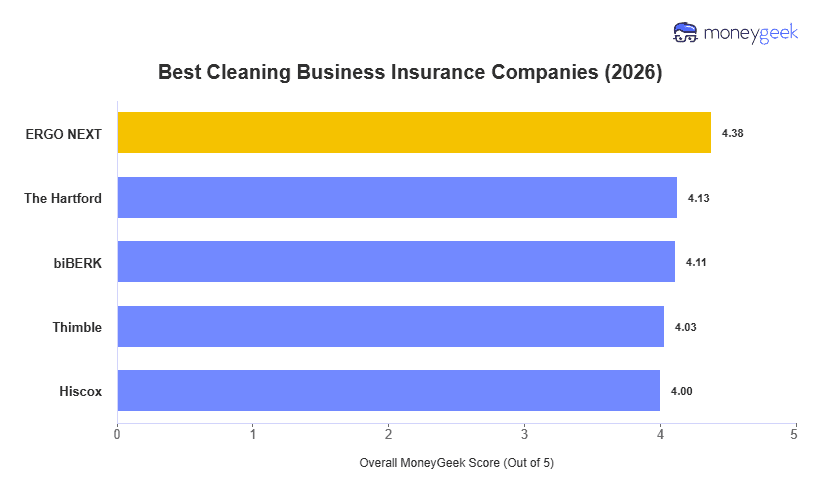
Business insurance takes more assessment than a bond purchase. An independent agent is the better path for cleaning businesses with multiple employees, commercial clients or mixed residential and commercial work, while an online marketplace works well for solo operators or small teams. Review the cost of cleaning business insurance to get a realistic price range before you start comparing. Request quotes using the same details, such as limits, employee count and revenue figures, to see which carrier offers the cheapest cleaning business insurance rates.

Price is one input, but not the whole decision. The best cleaning business insurance companies balance affordability with coverage options, service quality and claims support. Some client contracts require both the bond and insurance to be in place before work begins, so purchase both at the same time to avoid delays when a client asks for documentation before the first job.

6. Obtain and Share Proof of Coverage for Your Cleaning Business

The bond certificate and the certificate of insurance (COI) are the two documents your cleaning business needs to sign contracts and start work. Your surety provider typically emails the bond certificate at the same time as payment confirmation, while most insurers issue a COI immediately upon purchase. Request both at the time of purchase and store them digitally so you can send them quickly when a client asks.

Commercial clients and property managers will ask for both documents before work begins. Some will also require being named as an additional insured on your insurance policy, which is a separate request made directly to your insurer and has no effect on the bond. A janitorial company onboarding a new office building client may need to produce both documents within hours of signing a contract. Store them somewhere accessible since waiting on paperwork is one of the most common reasons a new cleaning job gets delayed.

How to Get a Cleaning Business Bonded and Insured: Bottom Line

Most industries need business insurance to protect against claims and losses, but cleaning companies have an additional requirement: a janitorial surety bond. The two tracks work differently: business insurance covers operations and liability, and a janitorial surety bond gives commercial clients a financial recovery option if an employee theft claim is filed. The bond amount is set by your clients and the spaces you clean, while your state, your employees and how you run your business determine the insurance policies you need. Working through both tracks before you shop is what produces the right combination for your business, not a generic checklist.

Insurance and Bonding for Cleaning Businesses: Next Steps

If you know what coverage applies to your cleaning business, cost is the next decision to work through. If you are still sorting out the details, the scenarios below point you toward the right resources for your specific situation. Either way, the goal is the same: the right bond and insurance for the way your cleaning business actually runs.

If you are just starting your cleaning business and are not sure what you need

If a client or contract is asking for proof of insurance or a bond

If you are hiring employees for the first time

If you are moving from residential cleaning into commercial work

About Connor Bolton


Connor Bolton headshot

Connor Bolton is Senior SEO and Content Manager at MoneyGeek, where he leads the business and pet insurance editorial teams. As editorial lead for both verticals, Connor sets the research framework, data standards, and content structure that his writers execute, directly authoring in-depth guides himself and reviewing all team content for accuracy and practical value before it goes live. With over four years evaluating insurance products across personal, commercial, and specialty lines, he brings cross-vertical knowledge to every guide the team produces.

Connor architected MoneyGeek's insurance research infrastructure across all major verticals including auto, home, renters, life, health, business, and pet, building systems for pricing analysis, provider-level research, customer experience evaluation, and coverage analysis with AI support. The infrastructure includes over 6 million data points for business insurance across 408 industry areas, all 50 states, and 16 vehicle types, and over 5 million pet insurance profiles across 18 major providers and hundreds of breed and age combinations. Connor's insurance cost research and his team's work has been cited by the U.S. Chamber of Commerce, Allstate, Liberty Mutual, CBS News, Forbes and LegalZoom.

Beyond the data, Connor stays connected to how the market actually operates, drawing on direct conversations with underwriters and carrier liaisons at Ethos, The Hartford, NEXT Insurance, Nationwide, and State Farm, and monitoring business and pet owner communities including Reddit, to inform how he interprets findings and frames guidance for real buyers.

He is the direct editorial contact for methodology questions at connor@moneygeek.com and can be found on LinkedIn.