Auto Insurance Study

Study: Drivers in Less-White Zip Codes Pay More for Auto Insurance

Joel Hall - headshotJH
By Joel Hall

Updated: December 29, 2025

Advertising & Editorial Disclosure

Hand covering a car on top of coins

MoneyGeek's Analysis of Auto Insurance Premiums By ZIP Code

Structural inequality in America often financially penalizes communities of color. Across the country, many Black and Latino citizens pay more for services and expenses, including home loans, property taxes and even car insurance, based on location.

To learn more about how disparities in car insurance costs impact people of color, MoneyGeek analyzed 1,648 ZIP codes in 69 cities across the U.S., comparing demographics and auto insurance premiums. The study found that drivers living in predominantly white ZIP codes often pay less for car insurance than people living in the same cities in ZIP codes with a lower proportion of white residents.

Among 69 cities with more than 10 ZIP codes available for analysis, 52 (75%) have a negative correlation (stronger than -0.60) between auto premiums and the percentage of white people in a ZIP code. Much like temperatures drop as elevation increases, car insurance prices fall as the ZIP code’s proportion of white residents increases.

Key Takeaways
blueCheck icon

Auto insurance premiums are higher in ZIP codes with fewer white residents.

blueCheck icon

Drivers in less-white ZIP codes may pay up to $891 more annually for insurance compared to predominantly white areas.

blueCheck icon

Cities with the strongest correlations between race and premiums: Oakland, New Orleans and Milwaukee.

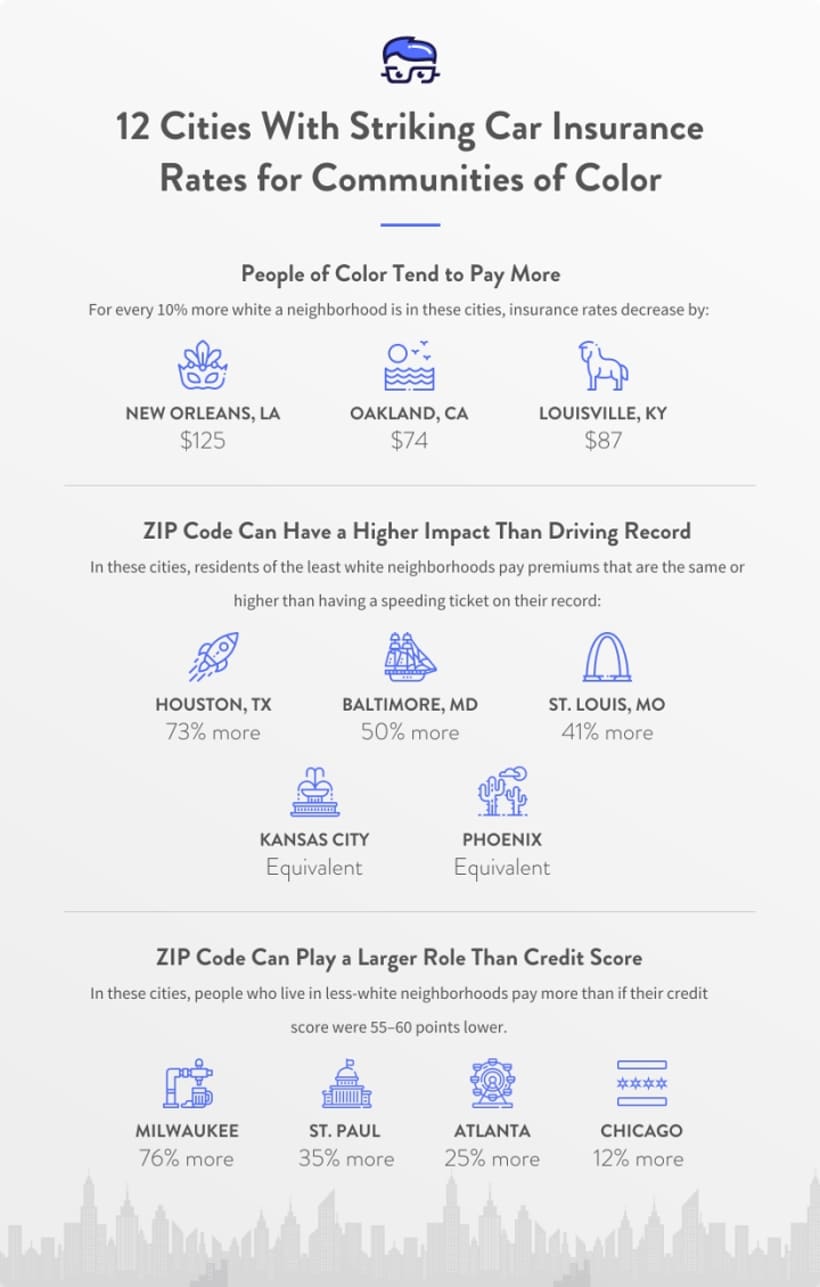
MoneyGeek identified 12 cities across the country where premiums vary the greatest. Depending on the city, you could pay up to $130 more for car insurance for every 10 percentage points less white your ZIP code is.

Organizations, activists and academics have long questioned pricing variations in many industries that negatively impact consumers of color. On July 23, 2020, the National Association of Insurance Commissioners (NAIC) announced the formation of a special committee designed to examine current practices in the insurance industry that potentially disadvantage people of color. While insurance providers use a combination of factors to determine individual rates, the NAIC’s research will reveal how and if these practices negatively or disproportionately impact minorities. The committee is dedicated to making recommendations based on its findings by the end of the year.

Whiter ZIP Codes and Lower Rates Are Correlated

Auto insurers follow state specific-rules and regulations to set ZIP-code-level premiums that are based on the frequency and severity of claims, where severity refers to the cost of paying a claim. The more expensive and more frequent the claims, the higher the premium prices. MoneyGeek’s analysis compared rates across the country, utilizing a consistent driver profile to examine the pricing differences when ZIP code is the only variable changed. The demographics of each ZIP code were researched to calculate the correlation of a ZIP code’s auto insurance premium to the percentage of the ZIP code’s population that is white.

In cities across America, there is a correlation between a driver’s proximity to white populations and what they pay in car insurance. However, this correlation may be surprising for many drivers given that advertising often claims to reward safe driving and emphasizes that rates are based on good behaviors and customer loyalty.

However, in many cities across the United States, where a driver lives plays a large role in determining car insurance rates. Oakland, California, had one of the strongest negative correlations between white population percentage and annual car insurance rates among big cities (-0.925) in MoneyGeek’s study. People living in the five ZIP codes with the highest insurance rates pay an average of $360 more a year than people living in the five ZIP codes with the lowest rates, which have populations that are, on average, 42% more white.

In some cities like New Orleans, Louisiana, which has a -0.809 correlation between white population percentage and car insurance rates, the same discrepancy among ZIP codes that pay more and ones that pay less is a difference of $891 a year, on average.

Based on the analysis, ZIP codes with a smaller percentage of the population that is white tend to pay more for car insurance.

Structural Inequality and Auto Insurance

12 Cities Rank Highest for ZIP Code Premium Variations

Among all of the locations MoneyGeek analyzed, 12 cities (ranked in order of strongest negative correlation between white population percentages and car insurance rates) stand out as having extreme price variations in annual car insurance premiums based on ZIP codes.

Strongest Link Between Non-White ZIP Codes and Higher Premiums

City
Correlation
Premium Increase

Oakland, CA

-0.925

$360

Milwaukee, WI

-0.916

$364

St. Louis, MO

-0.895

$439

Chicago, IL

-0.884

$257

Baltimore, MD

-0.884

$570

Atlanta, GA

-0.872

$365

Kansas City, MO

-0.861

$231

Louisville, KY

-0.858

$656

Houston, TX

-0.847

$267

Phoenix, AZ

-0.83

$344

New Orleans, LA

-0.809

$891

St. Paul, MN

-0.806

$348

These 12 cities all have pricing discrepancies greater than $230 a year, on average, when comparing the annual insurance costs of the five ZIP codes in each city charged the most versus the five ZIP codes charged the least. They represent a cross section of America, spanning the West Coast, Midwest, Southwest, South and East Coast — illustrating that the problem is not isolated to one particular region of the country.

While cities like St. Louis, Missouri; Chicago, Illinois; and Atlanta, Georgia have high levels of ZIP-code-based segregation, that difference is not always the determining factor.

A common factor between the 12 cities is at least a 34 percentage point difference in white population between the more diverse ZIP codes that pay the most and the less diverse ZIP codes that pay the least.

In ZIP codes where premiums are more expensive, drivers are charged more not because of their personal driving history, but because of a higher frequency and severity of claims in the area.

3 Cities Experience the Highest Financial Impact

Three cities — New Orleans, Louisville, and Baltimore — have the highest auto premium disparities. While other cities in the top 12 fall within the $230–400 range for pricing variations, diverse ZIP codes in the three aforementioned cities pay much higher rates. In New Orleans, Louisville and Baltimore, average annual insurance rate differences between higher and lower-paying ZIP codes are $891, $656 and $570, respectively.

In New Orleans, the ZIP codes with the lowest premiums, where whites make up about 79% of the population, pay about $2,000 annually. Three clustered ZIP codes with white populations of about 5% pay the highest premiums — around $3,200 annually.

In Louisville, people living in the lowest-paying ZIP code cluster, with white populations ranging from 75–80%, pay around $1,300 for their annual premium. The two ZIP codes with the highest premium of about $1,950 have white populations ranging from 5–10%.

In Baltimore, the ZIP code paying the lowest premium has the highest population of white residents (79%). People in this ZIP code pay an annual premium of about $1,450. The two ZIP codes charged the highest premiums of around $2,150 have populations that are less than 10% white.

Location Can Cost as Much as a Speeding Ticket or Lower Credit Score

In some cities, living in a more diverse ZIP code can weigh as negatively on your car insurance payment as having a 16–20 mile-per-hour speeding violation or a 55–60 point drop in your credit score. This means that even with a spotless driving record, people living in ZIP codes with a higher Black and Latino population are often penalized despite their personal driving record.

The following table shows the observed premium differences and compares that difference to the cost of having a speeding ticket and credit score difference.

Insurance Costs of ZIP Code vs. Driving Behavior

City
ZIP Code Penalty vs. Speeding Ticket Penalty
ZIP Code Penalty vs. Credit Score Penalty

Oakland, CA

55.7%

*

Milwaukee, WI

101.2%

176.2%

St. Louis, MO

140.6%

163.0%

Chicago, IL

80.8%

111.5%

Baltimore, MD

150.4%

125.0%

Atlanta, GA

77.4%

124.9%

Kansas City, MO

97.0%

100.1%

Louisville, KY

199.7%

152.5%

Houston, TX

173.3%

78.4%

Phoenix, AZ

103.2%

105.9%

New Orleans, LA

103.4%

115.2%

St. Paul, MN

98.2%

135.1%

*California does not allow pricing based on credit score.

In Houston, your premium may be 73% higher because of your ZIP code than a driver with a speeding ticket who happens to live in a ZIP code with a large white population. In Milwaukee, your premium may be 76% higher based on your ZIP code than a driver whose credit rating went from good to fair in a ZIP code with a higher white population.

Expert Insight on Car Insurance Rates and Equality

MoneyGeek engaged academic thought leaders with expertise in structural inequality advocacy and economics to answer pressing questions about auto insurance. The opinions and solutions expressed below are the views of the individual subject matter experts.

Loading...
David Crockett, PhD
Professor of Marketing and Moore Research Fellow, University of...
Loading...
Kalinda Ukanwa, PhD
Assistant Professor of Marketing, Marshall School of Business,...
Loading...
Douglas Heller
Independent Consultant and Recognized Insurance Expert for the...
Loading...
Vanessa G. Perry, PhD
MBA, Ph.D., Professor of Marketing, Strategic Management and Public,...
Loading...
Jerome D. Williams, PhD
Prudential Chair and Distinguished Professor–Marketing Department,...

What To Do If You Suspect Unfair Car Insurance Rates

Insurance and anti-discrimination laws vary widely from state to state. A University of Michigan study articulated that a “surprising number of jurisdictions do not have any laws restricting insurers’ ability to discriminate (based on) race, national origin, or religion.” This has led to premiums that are not always based solely on driving practices.

If you suspect that you live in a ZIP code with racially influenced car insurance rates, there are ways to speak up and find better rates.

  • File a complaint. In housing and lending, the federal government prohibits discrimination by race, color, national origin, gender, age, religion, marital status, and whether you receive income from public assistance. Car insurance regulation, however, is left to the states, so contacting your state insurance commissioner is the most direct way to have your claims addressed. You can also contact your local congressman or state legislator.
  • Contact the Federal Insurance Office (FIO). In 2016, the agency ruled that affordable auto insurance for low-income and minority communities should equal no more than 2% of the local median income. If you’re paying more than that, your insurance payment is considered unaffordable, which the FIO can investigate.
  • Learn how carriers determine auto insurance rates. A newer model sports car, for example, could cause your auto premiums to skyrocket. Understanding how car insurance companies set rates can help you improve your driving record and lower your premiums.
  • Shop around. The cost of the same type of auto insurance coverage may vary by thousands of dollars depending on where you live. Compare local auto insurance rates in your state, read reviews of insurance companies and ask other drivers in your area if they believe they are being charged fairly for insurance.
  • Ask your insurance agent about discounts. Finding the best rates for car insurance may include discounts for being a good student, owning a low-mileage vehicle, taking a defensive driving class, raising your deductible, bundling your homeowners and auto insurance and, of course, having a good driving record.

Equity in Car Insurance and Beyond

Data is a vital tool to promote social and financial equality. Car insurance keeps society accountable and reduces risk, and as such, insurance payments based on individual risk and driving history can help keep drivers safe and covered in the event of an accident. The NAIC’s formation of a committee dedicated to researching and promoting equality is one of many steps being taken to examine and improve structural discrepancies across the country.

As more communities and companies confront unequal structures that financially impact communities of color, leveraging comprehensive data can serve as a catalyst for change that promotes equality and safety for all drivers.

Full Data Set

The following table summarizes the key data of all 69 cities where the data set included 10 or more ZIP codes.

City
# ZIPs
Correlation
Premium Increase
Premium % Increase
ZIP Code vs. Speeding Ticket
ZIP Code vs. Credit Score

Baton Rouge, LA

12

-0.963

$195

9.60%

30.9%

**

Birmingham, AL

13

-0.942

$64

5.60%

24.4%

23.4%

Stockton, CA

10

-0.937

$99

7.50%

16.3%

*

Oakland, CA

12

-0.925

$360

28.70%

55.7%

*

Milwaukee, WI

25

-0.916

$364

43.60%

101.2%

176.2%

Arlington, TX

12

-0.909

$106

10.60%

78.6%

**

St. Louis, MO

27

-0.895

$439

43.70%

140.6%

163.0%

Omaha, NE

18

-0.892

$176

23.20%

123.4%

**

Chicago, IL

49

-0.884

$257

26.30%

80.8%

111.5%

Baltimore, MD

19

-0.884

$570

37.70%

150.4%

125.0%

Albuquerque, NM

15

-0.876

$106

9.30%

48.4%

48.8%

Atlanta, GA

29

-0.872

$365

30.60%

77.4%

124.9%

Tacoma, WA

10

-0.867

$48

4.40%

17.8%

**

Kansas City, MO

16

-0.861

$231

24.90%

97.0%

100.1%

Louisville, KY

24

-0.858

$656

51.70%

199.7%

152.5%

Columbus, OH

23

-0.855

$70

10.50%

34.8%

49.0%

Houston, TX

86

-0.847

$267

25.40%

173.3%

78.4%

Cleveland, OH

24

-0.833

$162

27.10%

81.1%

135.2%

Phoenix, AZ

35

-0.830

$344

33.50%

103.2%

105.9%

Colorado Springs, CO

16

-0.829

$61

6.00%

25.1%

24.4%

Tucson, AZ

27

-0.827

$114

12.80%

42.8%

38.8%

Pittsburgh, PA

18

-0.824

$93

12.00%

57.9%

51.3%

Seattle, WA

28

-0.819

$148

15.30%

53.7%

68.8%

Fort Worth, TX

26

-0.813

$87

9.00%

67.6%

31.3%

Salt Lake City, UT

19

-0.812

$108

11.80%

40.6%

36.4%

New Orleans, LA

14

-0.809

$891

38.40%

103.4%

115.2%

Richmond, VA

11

-0.806

$74

10.30%

38.3%

**

St. Paul, MN

21

-0.806

$348

35.50%

98.2%

135.1%

Philadelphia, PA

37

-0.800

$479

31.00%

124.5%

99.0%

San Francisco, CA

20

-0.792

$254

19.10%

39.4%

*

Long Beach, CA

11

-0.785

$284

20.70%

39.7%

*

Las Vegas, NV

36

-0.771

$398

26.50%

74.6%

108.5%

Austin, TX

30

-0.766

$116

12.70%

93.4%

41.7%

Fort Wayne, IN

11

-0.766

$29

4.40%

15.6%

20.4%

Toledo, OH

11

-0.765

$30

4.10%

14.0%

21.6%

Tampa, FL

23

-0.764

$447

21.90%

56.0%

79.8%

Charlotte, NC

19

-0.758

$193

24.40%

48.4%

272.6%

Minneapolis, MN

35

-0.753

$349

36.30%

96.0%

144.6%

Orlando, FL

25

-0.743

$293

18.60%

49.9%

65.8%

Buffalo, NY

17

-0.739

$260

19.70%

68.7%

**

Mesa, AZ

13

-0.738

$120

12.30%

42.1%

36.5%

Tulsa, OK

16

-0.720

$68

6.80%

18.5%

29.5%

Raleigh, NC

12

-0.716

$76

10.70%

21.7%

98.2%

Fresno, CA

13

-0.695

$96

7.70%

16.6%

*

Memphis, TN

21

-0.692

$132

13.70%

51.4%

52.0%

Portland, OR

25

-0.682

$264

25.50%

73.4%

144.1%

Dallas, TX

37

-0.663

$225

21.50%

151.3%

65.1%

Indianapolis, IN

29

-0.653

$79

11.20%

36.8%

48.1%

Nashville, TN

12

-0.643

$64

8.30%

37.4%

35.5%

Miami, FL

45

-0.642

$502

24.20%

62.0%

81.2%

San Jose, CA

24

-0.642

$206

17.60%

35.7%

*

Corpus Christi, TX

10

-0.619

$63

6.20%

48.4%

20.1%

Jacksonville, FL

21

-0.573

$96

6.40%

17.5%

21.5%

San Antonio, TX

40

-0.569

$90

8.90%

67.8%

29.7%

Wichita, KS

14

-0.568

$43

5.20%

20.8%

23.6%

New York, NY

136

-0.566

$1,816

96.90%

176.0%

145.0%

Bakersfield, CA

10

-0.566

$81

6.40%

14.2%

*

Sacramento, CA

22

-0.553

$285

22.00%

45.2%

*

Oklahoma City, OK

19

-0.541

$45

4.50%

12.9%

20.2%

Cincinnati, OH

24

-0.540

$80

12.40%

39.7%

55.6%

San Diego, CA

29

-0.479

$201

17.40%

36.8%

*

El Paso, TX

17

-0.447

$35

3.70%

29.6%

12.8%

St. Petersburg, FL

14

-0.438

$39

2.00%

5.5%

7.2%

Denver, CO

32

-0.350

$146

14.20%

58.4%

51.0%

Detroit, MI

18

-0.294

$710

19.00%

23.2%

43.6%

Spokane, WA

11

-0.175

$27

3.30%

12.9%

**

Honolulu, HI

11

0.000

$0

0.00%

0.0%

*

Lexington, KY

10

0.052

$9

0.80%

4.1%

3.3%

Los Angeles, CA

49

0.128

$699

43.80%

80.5%

*

Data Description

Correlation: ZIP code demographics vs. car insurance premiums.

Premium Increase: 5 most expensive ZIP codes vs. 5 least expensive ZIP Codes.

Premium % Increase: 5 most expensive ZIP codes vs. 5 least expensive ZIP codes.

ZIP Code vs. Speeding Ticket Penalty: The premium increase as a percentage of the increased premium associated with a speeding ticket. A 100% value means that the two are equivalent.

ZIP Code vs. Credit Score Penalty: The premium increase as a percentage of the increased premium associated with a credit score 55–60 points lower. A 100% value means that the two are equivalent.

*Indicates states where credit scores are not allowed to be utilized as a rating factor in setting car insurance premiums.

**Indicates cities where insufficient data was available to calculate the impact.

Methodology

Using data received from Quadrant, MoneyGeek analyzed 2,000 ZIP codes in 126 cities across America comparing a ZIP code’s white population and auto insurance premiums. The analysis reviewed premiums holding all other factors equal. Each ZIP code was analyzed using the scenario of a 40-year-old male with a 2010 Toyota Camry and full auto coverage (100/300/100 comprehensive and collision with a $1,000 deductible).

MoneyGeek also used data from Quadrant to analyze the increased premium costs associated with a credit score decrease or a speeding ticket for the same driver profile in these cities.

MoneyGeek utilized the most recent five-year population estimates, including demographic data by ZIP code from the U.S. Census Bureau (census.gov).

About Joel Hall


Joel Hall headshot

Joel Hall is a public relations professional, copywriter and former journalist with 20 years of writing and editing experience. He currently serves as a senior public relations account director at an Atlanta-based marketing firm specializing in kitchen, bath and building products, and has provided PR and content marketing strategy to companies like CertainTeed, Boise Cascade and Reliance Worldwide Corporation.

His previous PR roles include serving as a communications spokesperson for the Georgia Department of Public Health, as well as the U.S. dairy industry (Milk Life/Got Milk?/Fuel Up to Play 60). Prior to public relations, Joel spent a decade as a reporter for various daily newspapers, including the Clayton News-Daily, Atlanta Journal-Constitution, Atlanta Daily World, Dayton Daily News (Ohio) and Cape Argus (South Africa).

Joel has a master's degree in public relations from Kent State University and a dual bachelor's degree in journalism and music from Emory University.


sources