How Much Does a Lapse in Coverage Affect Insurance Rates?


Updated: March 13, 2026

Advertising & Editorial Disclosure

Key Takeaways
blueCheck icon

A lapse of 30 days or fewer raises car insurance rates by an average of $149 per year, about 10.6% more than drivers with continuous coverage pay, according to average insurance costs data across major insurers.

blueCheck icon

A lapse longer than 30 days costs an average of $315 more per year (a 22.4% increase). Travelers and GEICO are the cheapest car insurance companies after a long gap, at $1,418 and $1,441 annually.

blueCheck icon

Your state, age and driving history all shape how much extra you'll pay after a lapse, so the penalty varies widely by insurer and profile.

What Is a Car Insurance Lapse?

A car insurance lapse is any period in which you own a registered vehicle but carry no active policy. It can last one day. Most insurers treat gaps of up to 30 days as short and gaps of 31 days or more as long, though some won't penalize a gap under two weeks.

Common reasons a policy lapses include:

  • Missing a monthly payment
  • Forgetting to renew before the expiration date
  • Switching insurers without overlapping coverage dates
  • Canceling a policy while still owning a registered vehicle

Once the policy ends, many insurers notify the state DMV, which can trigger registration or license penalties on top of higher future rates.

Is There a Grace Period for Car Insurance?

Most car insurance companies offer a grace period of 10 to 30 days after a missed payment before canceling your policy. During that window, your coverage stays active and you won't be treated as having a lapse. State Farm, Progressive and Nationwide each include grace period provisions in their policies, though the exact length varies by insurer and state.

A grace period and a lapse are not the same thing. The grace period is the buffer between a missed payment and cancellation. You're still insured during it, and paying before it ends keeps your rate intact. A lapse begins the moment your policy is canceled. Miss the deadline and the cancellation stands; the lapse clock starts from the original cancellation date, not the day you notice the gap.

Some states set minimum grace period lengths by law. California requires at least 10 days for nonpayment cancellations. Other states leave the length to the insurer, which is why grace periods range from a few days to a full month. Call your insurer the same day you miss a payment and ask exactly how long you have.

What Happens If You Drive During a Lapse?

Driving during a car insurance lapse is illegal in nearly every state. A traffic stop while uninsured can result in:

  • Fines of $100 to $1,500 depending on your state
  • License suspension
  • Vehicle impoundment
  • Criminal charges if an accident is involved

All of that is on top of the rate increase you'll pay when you restart coverage.

An at-fault accident without coverage can cost far more than any premium savings. In at-fault states, you'd be personally responsible for the other driver's medical bills, vehicle damage and legal costs if they sue. No-fault states require drivers to claim under their own policy. Without one, you absorb all your own costs and remain liable for damage to others. A single uninsured accident can produce bills that far exceed years of premium payments.

A lapse can also trigger an SR-22 requirement in some states. An SR-22 is a certificate of financial responsibility your insurer files with the state, confirming you carry the minimum required coverage. Drivers who need one pay higher premiums for the filing period, which runs three to five years in most states. Not every insurer writes SR-22 policies, so a lapse that leads to this requirement can also shrink the pool of carriers willing to cover you.

How Much Do Rates Go Up After a Lapse?

A lapse of 30 days or fewer raises rates by $149 per year on average, a 10.6% increase over what drivers with continuous coverage pay. A gap longer than 30 days pushes that to $315 per year, or 22.4% more.

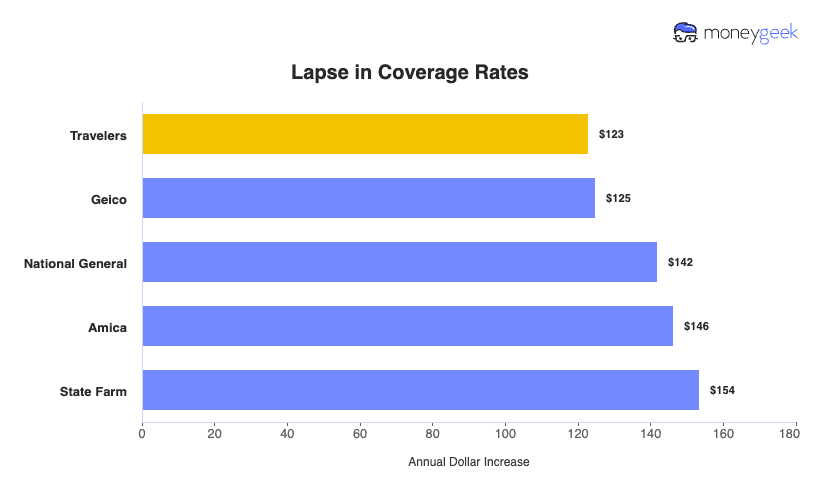
Every insurer in this dataset applied the same percentage increase regardless of base rate: 10.6% for a short gap and 22.4% for a long one. A higher-priced insurer like Kemper adds $165 more for a short lapse, while a lower-cost option like Travelers adds $123. Drivers paying less before a lapse pay less after one too.

Lapse in Coverage Rates Chart

Who Has the Cheapest Car Insurance After a Lapse?

Travelers charges $1,281 per year after a lapse of under 31 days and $1,418 after a longer gap, the lowest of the nine insurers in both categories. GEICO is close behind at $1,302 for a short lapse and $1,441 for a long one. Both sit well below the nine-insurer average of $1,553 and $1,719.

At the other end, Kemper charges $1,721 for a short-lapse driver and $1,904 after a long gap. Nationwide and The Hartford are close behind, each topping $1,870 after 31 or more days without coverage. Qualifying for continuous coverage credits or defensive driving reductions can bring the post-lapse penalty down, so ask each insurer about available discounts when you get a quote.

Travelers$1,158$1,281$1,418
Geico$1,177$1,302$1,441
National General$1,340$1,482$1,640
Amica$1,381$1,528$1,691
State Farm$1,448$1,602$1,773
Progressive$1,503$1,662$1,840
The Hartford$1,531$1,694$1,874
Nationwide$1,545$1,708$1,890
Kemper$1,556$1,721$1,904

How Long Does a Lapse Affect Your Car Insurance Rates?

A short lapse of under 30 days affects your rates for one to two years at most insurers. A longer gap of 31 days or more can follow your record for three to five years, depending on the insurer and your state. The penalty stays in your rating history until the insurer treats you as a continuously covered driver again.

Insurers weight recent history more than older gaps, so a lapse from three years ago has less impact than one from six months ago. Maintaining uninterrupted coverage after a gap is the fastest way to work the penalty down. Some insurers, including Progressive, offer a continuous insurance discount that restores once you've held a policy without a break for a qualifying period.

Which States Penalize a Lapse in Car Insurance?

Most states add penalties to a car insurance lapse on top of the rate increase your insurer charges. These range from a modest reinstatement fee to a full license or registration suspension, and many states track lapses automatically through insurer reporting to the DMV.

States with stricter enforcement, including Florida, Massachusetts and Nebraska, charge reinstatement fees of $150 to $500. A handful of states, including Montana and North Dakota, don't charge a fee for a first offense. New Hampshire doesn't require standard car insurance at all, but drivers must show proof of financial responsibility. Whatever your state's rules, the rate increase from your insurer applies everywhere, on top of any government-imposed fines.

bookshelves icon
MONEYGEEK DICTIONARY

Proof of financial responsibility is a document that shows that the at-fault driver is capable of paying for damages caused by the accident.

What to Do If Your Car Insurance Has Lapsed

Call your current insurer first. Some companies reinstate a lapsed policy with no penalty if the gap is only a few days, particularly if you have a clean payment history. If reinstatement is on offer, you'll need to pay the overdue premium plus a fee and sign a no-loss statement confirming you had no accidents or claims during the gap.

If reinstatement isn't possible, get quotes from multiple insurers before buying a new policy. The spread between the cheapest and most expensive option in the nine-insurer dataset is $440 per year for a short gap and $486 for a long one. Our guide to getting car insurance walks through what to expect when applying after a gap. Drivers who don't commute daily may also see smaller increases, since annual mileage is one factor insurers weigh alongside lapse history.

Don't let the lapse grow while you shop. Every additional day without coverage increases the penalty you'll pay once you restart. The cheapest full-coverage policy in the dataset after a long lapse is Travelers at $1,418 per year, about $118 per month, which costs far less than the liability exposure from a single at-fault accident.

How Long Can You Have a Lapse in Car Insurance?

A shorter lapse in car insurance (typically under a month) will only result in a moderate rate increase. In contrast, a lapse of over a month will result in much higher premiums. While you should always strive for continuous coverage where possible, try to keep any lapses in insurance coverage under a month if possible.

Remember
blueCheck icon
  • Going without car insurance for as little as one day counts as a lapse in coverage.
blueCheck icon
  • Even if you stop driving, you still need to be insured if you own a car.
blueCheck icon

Getting Car Insurance After a Lapse in Coverage

If you have a lapse in insurance coverage, you can still purchase car insurance coverage for your vehicle. While your rates might be higher, we recommend you buy as much insurance coverage as you can comfortably afford to protect both yourself and your vehicle.

When looking for car insurance after a lapse in coverage, be sure to shop around and compare rates. Car insurance companies penalize a lapse in coverage to differing degrees. By getting quotes from several different insurers, you can make sure that you’re getting the best possible deal.

Additionally, ask your insurance provider if they offer no down payment car insurance. This way, you can get insured with the lowest available upfront payment.

How to Avoid a Future Lapse

Most lapses are preventable. The four situations below cover the most common causes and what to do about each before coverage ends.

    carInsurance icon
    When you miss a payment

    Set up automatic payments through your insurer's online portal or your bank's bill pay system. A missed manual payment is the most common cause of a lapse, and auto-pay eliminates the risk. Most major insurers, including State Farm, GEICO and Progressive, support automatic billing for monthly or semi-annual premiums. If you do miss a payment, call your insurer the same day. You're likely still within the grace period and can reinstate without a rate increase.

    money2 icon
    When you're switching insurers

    Confirm your new policy's effective date before canceling the old one. Coverage needs to overlap by at least one day. Even a 24-hour gap counts as a lapse and triggers a rate increase. Get the new policy number in writing before you contact your current insurer to cancel.

    noBag icon
    When insurance Feels too expensive

    Don't cancel. Dropping to liability-only coverage is an option if full coverage isn't affordable, and it keeps your policy active. Some insurers also offer discounts for continuous coverage or completing a defensive driving course, which can lower your rate without dropping protection.

    car icon
    When you stop driving temporarily

    Ask your insurer about suspending your policy rather than canceling it. USAA, GEICO and several other carriers allow suspension for active military members, and some extend the option to other qualified policyholders. A suspended policy doesn't count as a lapse and won't raise your rates.

Car Insurance Lapse : Bottom Line

A car insurance lapse costs an average of $149 more per year for a short gap and $315 more for one lasting over 30 days. Travelers and GEICO have the lowest post-lapse rates of the nine insurers reviewed, at $1,418 and $1,441 annually after a gap of 31 days or more. If your policy has lapsed, get back on coverage now and compare at least three quotes. The difference between the cheapest and most expensive option after a long lapse is $486 per year.

Frequently Asked Questions

What happens if your car insurance lapses?

Is there a grace period for car insurance?

How long does a lapse affect your car insurance rates?

Can I get car insurance after a long lapse?

Does a lapse show up on my driving record?

About Mark Fitzpatrick


Mark Fitzpatrick headshot

Mark Fitzpatrick, a Licensed Property and Casualty Insurance Producer, is MoneyGeek's resident Personal Finance Expert. He has analyzed the insurance market for over five years, conducting original research for insurance shoppers. His insights have been featured in CNBC, NBC News and Mashable.

Fitzpatrick holds a master’s degree in economics and international relations from Johns Hopkins University and a bachelor’s degree from Boston College. He's also a five-time Jeopardy champion!

He writes about economics and insurance, breaking down complex topics so people know what they're buying.


Copyright © 2026 MoneyGeek.com. All Rights Reserved