
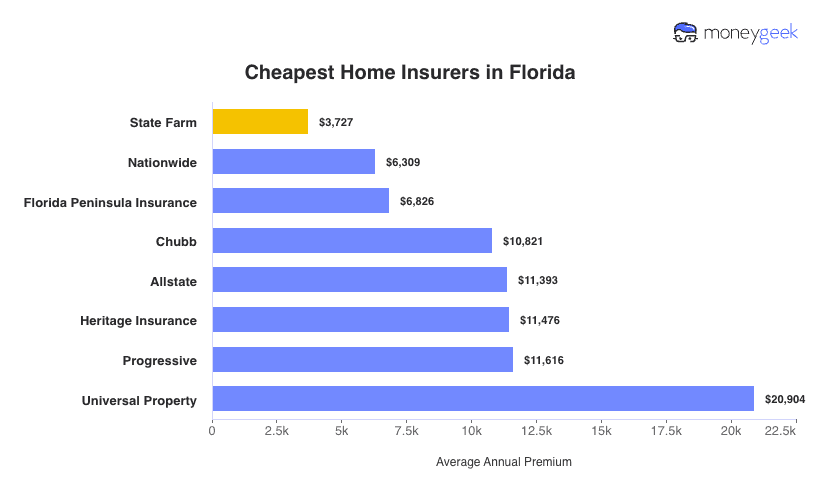
In our analysis of Florida home insurance providers, State Farm has both the highest MoneyGeek score and the lowest premium. At $3,727 annually, it costs $2,582 less than the next cheapest option in our analysis, Nationwide at $6,309. Check the table below to see how each provider's ratings and premiums compare.
Best Homeowners Insurance Companies in Florida
State Farm is the best home insurance in Florida based on our analysis, with Chubb and Nationwide as the second and third best. We've scored insurers based on a balance of cost, customer satisfaction and coverage options.
Find out if you're overpaying for home insurance below.

Updated: July 13, 2026
Advertising & Editorial Disclosure
With a 4.9 out of 5 MoneyGeek score and an average cost of $310 per month, State Farm is the best and most affordable home insurance provider in our Florida analysis.
Chubb, Nationwide, Allstate and Florida Peninsula are top options for homeowners insurance in Florida. Each offers affordable rates, dependable customer service and reliable coverage.
The best insurer for your home depends on your coverage needs, budget and preferred features like claims service or discount availability.
Our Picks for the Best Home Insurance Companies in Florida
| State Farm | 4.86 | $3,727 |
| Chubb | 4.74 | $10,821 |
| Nationwide | 4.54 | $6,309 |
| Allstate | 4.41 | $11,393 |
| Florida Peninsula Insurance | 4.22 | $6,826 |
*Our ratings consider various combinations of coverage levels, home features and homeowner details to identify the best overall options. Rankings may differ based on your profile.

State Farm
J.D. Power Customer Satisfaction Score
657/1,000From the J.D. Power 2025 U.S. Home Insurance Study, which examines customer satisfaction based on responses from 14,511 homeowners and renters. The average score is 642/1,000.Average Annual Premium
$3,727Based on our methodology's base profile of a policy with $250K in dwelling coverage, $125K in personal property coverage and $200K in liability coverage with a $1,000 deductible
- pros
5 out of 5 for affordability, the highest in our Florida analysis
4.7 out of 5 for customer experience, backed by J.D. Power ratings, complaint data and app feedback
Wind mitigation and roofing discounts built for Florida homeowners
consIdentity theft coverage costs an extra $25 per year on top of your premium
Larger homes can reach $6,502 per year, worth comparing against other providers
Affordability makes up 55% of our score, and State Farm earns a perfect 5 out of 5 there, the top result in our Florida analysis. Its 4.7 out of 5 for customer experience is drawn from J.D. Power ratings, complaint data and app feedback, giving us confidence the score reflects real performance. With a 4.6 out of 5 for coverage and Florida-relevant add-ons like water backup and wind mitigation, it's our top pick in Florida.
Newer homes and both young and senior homeowners get the best fit with State Farm. Rates for those age groups land around $3,727 annually, and newer homes average just $1,786 per year, the lowest profile rate in our Florida data. Larger homes are a different story: costs there reach $6,502 per year, so comparing other providers is worth it at that size.
Older Homes $352 $4,223 Newer Homes $149 $1,786 Young Homeowners $311 $3,727 Senior Homeowners $310 $3,722 High-Risk Fire Homes $348 $4,176 Smaller Homes $435 $5,225 Larger Homes $542 $6,502 State Farm scored 657 out of 1,000 in J.D. Power's customer satisfaction study, 15 points above the 642-point industry average, which factors into its 4.7 out of 5 customer experience score alongside complaint data and app feedback. You can file a claim online, through the mobile app or with a local agent. Florida homeowners dealing with post-storm claim volume have more ways to reach State Farm when they need to file fast.
Its discounts are built around Florida's biggest risk factors, with all three options directly relevant to homeowners in the state. If you've already made improvements to your home, there's a good chance one of these applies to you.
- Home security discount: Approved smoke detectors, fire alarms or monitored security systems qualify your home for a lower rate.
- Roofing discount: Homes with impact-resistant or class 4 roofing materials earn a rate reduction after completing State Farm's certification process.
- Wind mitigation discount: Homes that meet FORTIFIED building standards or Florida Building Code requirements qualify for savings, a useful discount given Florida's hurricane exposure.
Water damage from drain backups and system breakdowns is among the more common uncovered losses in Florida, and State Farm covers both through its 4.6 out of 5 rated add-on lineup.
- Water backup: Covers damage caused by backed-up sewers or drains that a standard home policy excludes.
- Home systems protection: Pays to repair or replace essential systems and appliances that break down due to mechanical or electrical failure.
- Identity theft: Helps cover recovery costs related to identity fraud for a $25 annual fee.
- Scheduled personal property: Provides replacement cost coverage for high-value items like jewelry, sports equipment or medical devices.
- Umbrella insurance: Extends your liability protection beyond standard policy limits for personal injury or property damage claims.

Chubb
J.D. Power Customer Satisfaction Score
677/1,000From the J.D. Power 2025 U.S. Home Insurance Study, which examines customer satisfaction based on responses from 14,511 homeowners and renters. The average score is 642/1,000.Average Annual Premium
$10,821Based on our methodology's base profile of a policy with $250K in dwelling coverage, $125K in personal property coverage and $200K in liability coverage with a $1,000 deductible
- pros
5 out of 5 for customer experience means Chubb consistently performs well across J.D. Power ratings, complaint data and app feedback
A J.D. Power score of 677 out of 1,000 puts it 35 points above the industry average, meaning fewer complaints and better claims outcomes than most competitors
Hurricane Protection coverage handles inspections, claim submission and temporary repairs automatically, so you're not coordinating the process yourself after a storm
consAt $10,821 per year on average, it's one of the most expensive options in our analysis
Older homes average $17,480 per year, a poor fit for most budget-conscious homeowners
Chubb earns a 4.7 out of 5 overall, driven by 5 out of 5 scores in both customer experience and coverage, each measuring how an insurer actually performs when something goes wrong. Customer experience accounts for 30% of our score and pulls from J.D. Power ratings, complaint data and app feedback, all of which Chubb performs well on. Its coverage score comes from one of the broadest add-on lineups in our Florida analysis, with options like extended replacement cost and hurricane protection that go well beyond what standard policies include.
Chubb makes the most sense for higher-value or newer homes where broad coverage matters more than price. Newer homes average $8,836 per year, which is more reasonable given the coverage depth, and both young and senior homeowners land around $10,821 annually. Owners of older or smaller homes should weigh the costs, $17,480 and $15,063 per year, carefully against other providers.
Older Homes $1,457 $17,480 Newer Homes $736 $8,836 Young Homeowners $902 $10,821 Senior Homeowners $901 $10,814 High-Risk Fire Homes $1,010 $12,124 Smaller Homes $1,255 $15,063 Larger Homes $1,555 $18,660 Chubb scored 677 out of 1,000 in J.D. Power's customer satisfaction study, 35 points above the 642-point industry average and the highest score among providers in our Florida analysis. That result factors into its 5 out of 5 customer experience score alongside complaint index data and app feedback.
Homeowners who have already invested in their property, whether through safety upgrades, renovations or a clean claims history, get rewarded through Chubb's discounts. Four discount options are available, and they stack well for homeowners who qualify for more than one.
- Multi-policy discount: Bundling your home policy with auto, valuables or excess liability coverage earns a lower rate.
- Protective devices and security discount: Homes with water shutoff devices, central station security systems, backup generators or fire suppression systems qualify for savings.
- New or renovated home discount: Recently built or renovated homes may qualify for reduced premiums within a set time frame.
- Loss-free discount: Policyholders who have held a Chubb home insurance policy without filing claims for several years earn a discount for maintaining that record.
Chubb's high coverage score reflects endorsements built for homeowners who want more than a standard policy provides. Several of its options are particularly relevant in Florida, where hurricane exposure and high rebuild costs make coverage depth more important than in most states.
- Extended replacement cost: Covers full repair or rebuild costs after a covered loss, even when expenses exceed your policy limit, including upgrades required by current building codes.
- Replacement cost coverage: Replaces damaged belongings at current prices without depreciation, with the option to take a cash settlement or direct replacement.
- Wildfire defense services: Year-round wildfire monitoring, prevention and mitigation through Wildfire Defense Systems, including property assessments and post-fire cleanup at no added cost.
- Hurricane protection: Covers secondary or seasonal homes damaged by hurricane-force winds, with Chubb's Property Manager service handling inspections, claim submission and temporary repairs automatically.
- GreenWise upgrade coverage: Covers rebuilding using eco-friendly materials and energy-efficient upgrades after a covered loss, up to 100% of your home's value.
- Home appliance and equipment breakdown coverage: Covers sudden mechanical or electrical breakdowns of home systems and appliances, with repair or replacement at no depreciation.

Nationwide
J.D. Power Customer Satisfaction Score
641/1,000From the J.D. Power 2025 U.S. Home Insurance Study, which examines customer satisfaction based on responses from 14,511 homeowners and renters. The average score is 642/1,000.Average Annual Premium
$6,309Based on our methodology's base profile of a policy with $250K in dwelling coverage, $125K in personal property coverage and $200K in liability coverage with a $1,000 deductible
- pros
4.8 out of 5 for affordability, with rates that consistently come in below most competitors for the same coverage
Nine available discounts, including a multi-policy option that saves an average of $1,032 per year
Dwelling replacement cost coverage pays up to twice your policy limit if rebuild costs exceed your original coverage amount
cons3.4 out of 5 for coverage is the lowest score in our Florida analysis
J.D. Power score of 641 out of 1,000 falls just below the 642-point industry average
Nationwide earns a 4.5 out of 5 overall, with its 4.8 out of 5 affordability score doing much of the work. At $6,309 per year on average, it's one of the more competitively priced options in our Florida analysis. Its nine available discounts, including a multi-policy option that saves an average of $1,032 per year, give homeowners more ways to bring that rate down further.
Newer homes and senior homeowners get a good fit with Nationwide, at $3,081 and $5,959 per year. Young homeowners land at $6,309 annually, in line with the overall average. Older homes are where costs climb most, reaching $9,858 per year, so comparing other providers is worth it if that's your situation.
Older Homes $822 $9,858 Newer Homes $257 $3,081 Young Homeowners $526 $6,309 Senior Homeowners $497 $5,959 High-Risk Fire Homes $589 $7,069 Smaller Homes $738 $8,860 Larger Homes $920 $11,035 It scored 641 out of 1,000 in J.D. Power's customer satisfaction study, one point below the 642-point industry average. For homeowners prioritizing affordability and discount availability, that one-point gap is unlikely to affect their day-to-day experience. Where Nationwide makes up for its slightly lower score is in its claims options, you can file online, by phone or through a local agent.
With nine options covering a wide range of homeowner situations, Nationwide has one of the broader discount lineups in our Florida analysis. The multi-policy discount is the most straightforward way to save, averaging $1,032 per year when bundling home and auto.
- Smart home discount: Installing smart home technology that helps prevent damage qualifies your home for a lower rate, though availability varies by state.
- Multi-policy discount: Bundling home and auto insurance with Nationwide saves an average of $1,032 per year.
- Protective device discount: Smoke detectors, fire alarms, burglar alarms and other qualifying safety devices reduce your premium.
- Claims-free discount: Maintaining a claims-free history qualifies you for lower rates over time.
- Home renovation credit: Updating your home's plumbing, heating, cooling or electrical systems earns savings on your premium.
- Roof rating discount: Your roof's age and surface type factor into a discount calculation that can lower your rate.
- Home purchase discount: Buying your home within the last 12 months qualifies you for reduced premiums.
- Prior insurance discount: Continuous coverage with your previous insurer earns savings based on how long you maintained that policy.
- Gated community discount: Living in a community with round-the-clock vehicle entrance security qualifies for a reduced rate.
Nationwide's 3.4 out of 5 coverage score reflects a more limited set of endorsements compared to other providers on this list. It still covers the options most relevant to Florida homeowners, including flood insurance and water backup, which standard policies usually exclude.
- Brand New Belongings®: Pays the depreciated value of damaged or stolen items first, then reimburses the difference once you've replaced them and submitted receipts.
- Better Roof Replacement®: After a covered loss, rebuilds your roof using stronger and safer materials than what was originally there.
- Identity theft: Covers expenses and recovery costs tied to identity theft and cybercrime.
- Dwelling replacement cost: If rebuilding costs exceed your original coverage limit after a covered loss, this pays up to twice that limit.
- Water backup: Covers damage from water backing up through sewers, drains or an overflowing sump pump.
- Earthquake: Adds protection for earthquake damage under a separate deductible.
- Flood insurance: A separate policy covering your home and belongings from flood damage, with its own deductible.
- Valuables Plus®: Extends coverage for high-value items like jewelry, watches, antiques and fine art beyond standard policy limits.
- Service line coverage: Covers damage to underground service lines bringing water, gas and electricity to your home.
- Equipment breakdown coverage: Covers repair or replacement costs when home systems and appliances break down unexpectedly.

Allstate
J.D. Power Customer Satisfaction Score
633/1,000From the J.D. Power 2025 U.S. Home Insurance Study, which examines customer satisfaction based on responses from 14,511 homeowners and renters. The average score is 642/1,000.Average Annual Premium
$11,393Based on our methodology's base profile of a policy with $250K in dwelling coverage, $125K in personal property coverage and $200K in liability coverage with a $1,000 deductible
- pros
4.5 out of 5 for affordability, with a multi-policy discount that saves up to 25% when bundling home and auto
Nine endorsements available, including some less common options like electronic data recovery and musical instruments
Windstorm mitigation discount is built specifically for Florida homeowners with verified wind-resistant features
consAt $11,393 per year on average, it's among the more expensive options in our Florida analysis
Larger homes average $19,684 per year, the highest rate for that profile in our data
A 4.5 out of 5 for affordability drives Allstate's 4.4 out of 5 overall score, with rates that work well for certain homeowner profiles. Its nine available endorsements give homeowners more ways to customize their policy, including options you won't find at most other providers on this list. The windstorm mitigation discount stands out for Florida homeowners, since it's one of the few discounts designed specifically for the state's storm risk.
Homeowners with newer properties get the best fit with Allstate, where rates average $8,260 per year. Young and senior homeowners land at $11,393 and $11,243 annually, which is in line with its overall average. Larger homes average $19,684 per year and older homes average $17,572, both worth comparing against other providers before committing.
Older Homes $1,464 $17,572 Newer Homes $688 $8,260 Young Homeowners $949 $11,393 Senior Homeowners $937 $11,243 High-Risk Fire Homes $1,064 $12,765 Smaller Homes $1,323 $15,879 Larger Homes $1,640 $19,684 It scored 633 out of 1,000 in J.D. Power's customer satisfaction study, nine points below the 642-point industry average. That gap is worth keeping in mind for Florida homeowners, where post-storm claim volume tends to put more pressure on an insurer's response times. Claims can be filed online, through the mobile app or with a local agent. That gives you options when you need to reach them quickly.
With options that cover everything from payment habits to storm preparedness, Allstate offers nine discounts. The multi-policy discount is one of the more generous on this list, cutting up to 25% when you bundle home and auto.
- Multi-policy discount: Bundling home and auto policies with Allstate saves up to 25%.
- Responsible payer discount: Maintaining a strong payment history, including paying on time or in full, earns savings.
- Claim-free discount: Switching to Allstate without a recent home insurance claim qualifies you for a lower rate.
- Welcome and loyalty discount: New customers receive savings for joining, with ongoing discounts for staying with Allstate year after year.
- Home buyer discount: Recently purchased homes or newly constructed properties qualify for a reduced premium.
- Easy Pay Plan® discount: Enrolling in automatic payments earns a discount on your premium.
- Protective device discount: Fire alarms, theft alarms and other installed safety systems qualify your home for savings.
- Early signing discount: Signing up for a new Allstate policy at least seven days before your current one expires earns a lower rate.
- Windstorm mitigation discount: Florida homeowners with verified wind-resistant features qualify for reduced premiums based on their home's storm protection.
Allstate's 4.3 out of 5 coverage score reflects a broad set of endorsements that covers both common gaps and some less typical needs. It includes Florida-relevant options like water backup alongside more specific coverage for items like musical instruments and business equipment kept at home.
- Identity theft restoration: Covers legal fees and lost wages if your identity is stolen.
- Water backup: Covers repair and cleanup costs from backed-up drains or sump pump failures.
- Scheduled personal property: Insures appraised valuables like jewelry, antiques and collectibles at full replacement cost.
- Business property: Extends coverage for business equipment and inventory kept in your home beyond standard policy limits.
- Sports equipment: Covers expensive athletic gear including golf clubs, skis and similar items.
- Green improvement reimbursement: Reimburses the extra cost of replacing damaged items with energy-efficient alternatives.
- Yard and garden: Covers landscaping, trees and riding lawn mowers on your property.
- Electronic data recovery: Restores lost computer data including photos, videos and important documents.
- Musical instruments: Covers guitars, violins and other instruments at their actual value.

Florida Peninsula Insurance
J.D. Power Customer Satisfaction Score
N/AFrom the J.D. Power 2025 U.S. Home Insurance Study, which examines customer satisfaction based on responses from 14,511 homeowners and renters. The average score is 642/1,000.Average Annual Premium
$6,826Based on our methodology's base profile of a policy with $250K in dwelling coverage, $125K in personal property coverage and $200K in liability coverage with a $1,000 deductible
- pros
Florida Peninsula, built around the risks and coverage needs of the state, is more accessible for homeowners in areas where coverage can be hard to find
Solar panel coverage is a practical endorsement for Florida homeowners, where solar adoption is higher than most states
cons3.3 out of 5 for customer experience, which reflects areas where its performance has room to improve
Only three discounts available, a limited set for homeowners who don't qualify for all three
Florida Peninsula earns a 4.2 out of 5 overall, with its 4.8 out of 5 affordability score carrying most of the weight. Its focus on the Florida market means it's built around the risks and coverage needs specific to the state, which is a real advantage for homeowners in areas where coverage can be difficult to secure. At $6,826 per year on average, it delivers solid value for a state where home insurance costs are among the highest in the country.
It works well for newer homes and both young and senior homeowners, with rates of $4,515, $6,826 and $6,822 per year respectively. Older homes land at $7,516 annually, which is reasonable given Florida's rate environment. Where costs climb most is for smaller and larger homes, reaching $9,493 and $11,752 per year. At those levels, it's worth exploring other options before committing.
Older Homes $626 $7,516 Newer Homes $376 $4,515 Young Homeowners $569 $6,826 Senior Homeowners $568 $6,822 High-Risk Fire Homes $637 $7,648 Smaller Homes $791 $9,493 Larger Homes $979 $11,752 With a 3.3 out of 5 for customer experience, Florida Peninsula has room to grow in this area. The insurer does offer 24/7 access to policy documents, a digital insurance ID card and multiple payment options, which help with day-to-day policy management. Its claims team is available to respond quickly after a loss, though homeowners who prioritize claims performance above all else may want to weigh that score carefully.
Florida Peninsula keeps its discount options simple, with three available savings opportunities that cover the most common scenarios for Florida homeowners.
- Monitored security system discount: Homes with a monitored security system qualify for a reduced premium.
- Paid-in-full discount: Paying your annual premium upfront in one payment earns savings on your rate.
- Wind mitigation discount: Homes with qualifying wind-resistant features receive a lower rate, a relevant option given Florida's hurricane exposure.
A focused set of endorsements relevant to Florida homeowners drives Florida Peninsula's 3.9 out of 5 coverage score. Solar panel coverage stands out as a practical option for a state with one of the highest solar adoption rates in the country.
- Animal liability: Covers liability claims resulting from injuries or damage caused by animals on your property.
- Equipment breakdown and service line coverage: Covers sudden mechanical or electrical breakdowns of home systems and appliances, as well as damage to underground service lines.
- Identity theft restoration: Covers expenses related to recovering from identity theft.
- Solar panels: Covers damage to solar panels installed on your home, a useful endorsement for Florida homeowners who have invested in solar energy.
Best Florida Home Insurance by City
State Farm is the top-rated carrier in 17 Florida cities, with annual premiums of $4,160 to $4,292 across markets from Jacksonville and Tampa to Cape Coral and Orlando. Chubb is top-rated in 14 cities, with premiums from $6,023 in Pensacola to $22,941 in Coral Springs and Pompano Beach. Nationwide has the best rate in Boca Raton ($5,782) and Hollywood ($5,779).
| Boca Raton | Nationwide | $5,782 |
| Brooksville | State Farm | $4,292 |
| Cape Coral | State Farm | $4,160 |
| Clearwater | Chubb | $12,239 |
| Clearwater Beach | Chubb | $12,239 |
| Coral Springs | Chubb | $22,941 |
| Fort Lauderdale | Chubb | $17,490 |
| Fort Myers | State Farm | $4,160 |
| Gainesville | State Farm | $4,292 |
| Hialeah | Chubb | $14,563 |
| Hollywood | Nationwide | $5,779 |
| Jacksonville | State Farm | $4,271 |
| Lakeland | State Farm | $4,292 |
| Lehigh Acres | State Farm | $4,160 |
| Miami | Chubb | $18,922 |
| Miami Gardens | Chubb | $14,654 |
| Naples | Chubb | $12,473 |
| Ocala | State Farm | $4,292 |
| Ocoee | State Farm | $4,292 |
| Okeechobee | State Farm | $4,160 |
| Orlando | State Farm | $4,292 |
| Oxford | State Farm | $4,292 |
| Palm Bay | State Farm | $4,160 |
| Pembroke Pines | Chubb | $9,313 |
| Pensacola | Chubb | $6,023 |
| Pompano Beach | Chubb | $22,941 |
| Port Saint Lucie | Chubb | $15,511 |
| Saint Petersburg | Chubb | $12,239 |
| Spring Hill | State Farm | $4,292 |
| Tallahassee | State Farm | $4,271 |
| Tampa | State Farm | $4,292 |
| Valrico | State Farm | $4,292 |
| West Palm Beach | Chubb | $13,220 |
Reviews of the Best Home Insurance in Florida Cities
Home insurance rates shift from city to city, so Florida homeowners can compare local pricing through our reviews of the best cheap home insurance options near you.
Cheapest Florida Home Insurance Companies
Florida homeowners pay $10,384 annually for home insurance, 200% higher than the national average of $3,467. State Farm offers the state's most affordable home insurance at $3,727 annually, 64% below the state average. Nationwide offers the second-best rates at $6,309. Costs vary among insurers. Universal Property represents the expensive end, charging 503% more than the national benchmark.
Guide to Finding the Best Florida Home Insurance Company
Quality home insurance in Florida means evaluating multiple providers based on your budget, coverage requirements and service expectations.
- Compare Quotes Strategically
Get quotes from at least three to five insurers. Premiums among top Florida providers range from $3,727 to $11,393 annually. Don't just shop by price. The cheapest policy might leave coverage gaps when you file a claim after severe weather or other covered losses.

- Check Customer Satisfaction Metrics
Review J.D. Power scores, which range from 633 to 677 among Florida's top providers compared to the 642 industry average. Check complaint ratios through the Florida Insurance and Safety Fire Commissioner's office. Read recent customer reviews focusing on claims experiences during Florida's severe weather season, not just policy shopping.

- Evaluate Coverage Needs
Consider extended or guaranteed replacement cost options since Florida's construction costs surge after hurricanes and flooding. Base your coverage on replacement cost rather than market value and review optional protections like wind/hail coverage, flood insurance and extended replacement cost that address your home's specific risks.
- Match Service Preferences to Provider Strengths
Choose insurers with local agent networks like State Farm if you want face-to-face support or digital-first insurers like USAA if you prefer online policy management. Don't pay premium prices for services you won't use.
Florida is the most hurricane-prone state in the U.S., averaging 1.5 hurricanes per year between 2018 and 2023, according to the National Hurricane Center. State law allows insurers to include hurricane deductibles in homeowners policies, calculated as 2% to 10% of your home's insured value.
Standard homeowners insurance covers hurricane wind damage but excludes flooding. You'll need separate flood coverage through your insurer or the National Flood Insurance Program.
Get the best rate for your insurance. Compare quotes from the top insurance companies.
Top-Rated Home Insurance Companies in Florida: FAQ
Here are answers to common questions about selecting a Florida home insurance provider.
Yes, Florida law allows insurers to include hurricane deductibles calculated as 2% to 10% of your home's insured value, separate from your standard deductible. These hurricane-specific deductibles apply when the National Hurricane Center declares a hurricane, making your out-of-pocket costs higher during named storms.
Home insurance covers damage to your house from fallen trees when wind, lightning, or other covered perils cause the tree to fall. Coverage excludes trees that fell due to rot or neglect, and your policy won't cover tree removal unless the tree damaged a structure. Most policies limit tree removal coverage to $500 to $1,000 per tree.
Replacement cost coverage pays to rebuild your home or replace belongings at current prices without deducting for depreciation. Actual cash value coverage subtracts depreciation from claim payments. You receive less money based on your property's age and condition. Actual cash value policies cost less up front but leave you covering more expenses out of pocket after a loss.
No, standard Florida homeowners insurance covers hurricane wind damage but excludes flooding from storm surge or heavy rains. You need separate flood coverage through your insurer or the National Flood Insurance Program.
Our Methodology: Determining the Best Florida Home Insurers
Florida's combination of hurricane exposure, tornado risk and high construction costs makes carrier selection more consequential than in most states. MoneyGeek scored Florida homeowners insurers on three factors:
- Affordability (55%): We compared rates for identical coverage across carriers and evaluated discount availability. Lower costs score higher.
- Customer satisfaction (30%): J.D. Power ratings, Trustpilot reviews and app feedback. Higher scores reflect better claims handling and service responsiveness after storm events.
- Coverage options (15%): We assessed add-on availability, including water backup and inland flood coverage. More options score higher.
Our Sample Profile
Rates reflect a homeowner aged 41-60 with good credit and no prior claims insuring a 2,500-square-foot home built in 2000. Coverage includes $250,000 dwelling coverage, $125,000 personal property coverage, $200,000 personal liability coverage and a $1,000 deductible.
Your rates will vary based on your home's age, location, claims history and credit score.
About Mark Fitzpatrick

Mark Fitzpatrick, a licensed Property and Casualty (P&C) Insurance Producer in Connecticut, is MoneyGeek's resident insurance expert. He has spent nearly a decade analyzing the market, first at LendingTree and now at MoneyGeek, where he produces original research on hundreds of carriers and millions of rates across auto, home, renters, health and life insurance.
He covers economics and insurance at MoneyGeek, and his work has been featured in The Washington Post, The New York Times and NPR, among other outlets.
Like all MoneyGeek analysts, he draws on independent cost and consumer experience data. No insurance company partnership influences his recommendations.
Mark holds a B.A. from Boston College and an M.A. in Economics and International Relations from Johns Hopkins University. He started his career in financial risk management at State Street and is also a five-time “Jeopardy!” champion.
Sources
- NOAA. "National Hurricane Center and Central Pacific Hurricane Center." Accessed July 18, 2026.


