



Homeownership is possible for people with disabilities, even when income comes primarily from Supplemental Security Income (SSI) or Social Security Disability Insurance (SSDI). Federal law bars lenders from discriminating against borrowers with disabilities, and dozens of mortgage programs, grants and nonprofit resources help with down payments, home modifications and monthly mortgage costs.
Homeownership Programs and Support for People With Disabilities
Updated: August 6, 2026
Advertising & Editorial Disclosure
The State of Homeownership for People With Disabilities
People with disabilities buy and own homes at lower rates than the general population. In 2023, about 35% of people with disabilities spent 30% or more of their income on housing, compared with about 25% of people without disabilities, according to the 2025 Annual Disability Statistics Compendium from the Center for Research on Disability. The Federal Reserve's 2024 economic well-being survey confirmed adults with disabilities are less likely to own a home and more likely to rent.
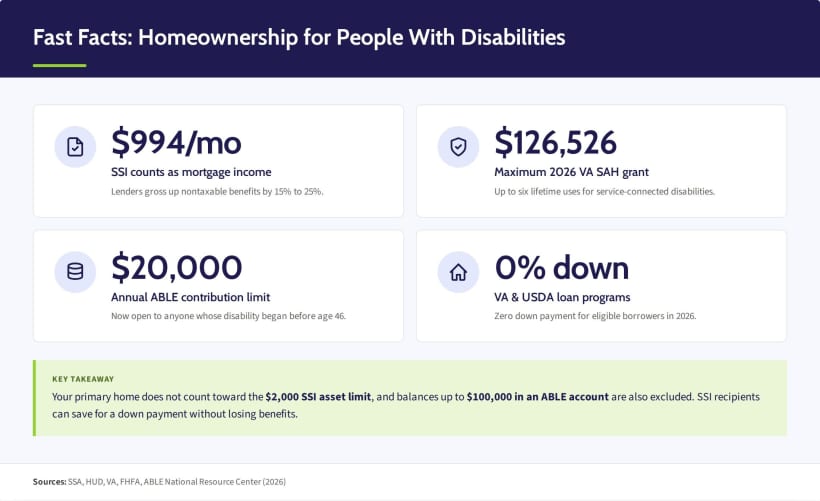
The housing affordability picture is worst for SSI recipients. People with disabilities receiving SSI can't afford an apartment at fair market rent in any housing market in the United States without additional support, according to 2024 research from the Technical Assistance Collaborative. The maximum federal SSI payment is $994 a month for an individual in 2026, and the average SSDI payment is about $1,630 a month. Federal and state programs can bridge that gap for qualified buyers.
Federal Fair Housing and Lending Protections
Four federal laws protect people with disabilities throughout the homebuying process. Each covers a different stage: mortgage applications, housing transactions and credit decisions.
- 1The Fair Housing Act
The Fair Housing Act prohibits discrimination in housing transactions based on disability, race, sex, religion, national origin and familial status. It applies to buyers and renters of both private and public housing. People with disabilities have the right to make reasonable modifications to their home for accessibility. Buildings constructed after March 13, 1991 must have accessible entrances and common areas. HUD accepts housing discrimination complaints online and by phone at (800) 669-9777.
- 2The Americans With Disabilities Act
The ADA, signed in 1990 and expanded in 2009 through the ADA Amendments Act, guarantees equal opportunity in employment, public services and public accommodations. It doesn't cover private mortgage lending, but it reinforces anti-discrimination protections in all government-connected transactions. The 2009 amendments broadened the definition of "disability," covering more physical and mental impairments.
- 3Section 504 of the Rehabilitation Act
Section 504 of the Rehabilitation Act of 1973 bars any organization that gets federal financial assistance from denying services to people with disabilities. The law covers HUD-approved housing counselors, federally insured lenders and public housing authorities. If a federally backed program denies benefits because of a disability, the applicant can file a formal complaint.
- 4The Equal Credit Opportunity Act
Enacted in 1974, the Equal Credit Opportunity Act (ECOA) requires lenders to give a written explanation when they deny a credit application. ECOA prohibits discrimination based on disability, race, sex, marital status and other protected classes. If a lender rejects a mortgage application without a written reason, the applicant can ask for one.

Buying a Home on Disability Income
SSDI and SSI are accepted income sources for mortgage qualification under FHA, VA, USDA and conventional loan programs. Lenders treat disability income the same as wages when the income is documented and expected to continue for at least three years from the application date.
 The SSI Asset Limit and Down Payments
SSI recipients must stay within a $2,000 asset limit for individuals and $3,000 for couples to keep their benefits. A primary home doesn't count toward this limit regardless of its value. Cash saved for a down payment counts as an asset until it's spent. An ABLE account sidesteps the asset limit: balances up to $100,000 don't affect SSI eligibility.
 How Lenders Treat Nontaxable Income
SSI and VA disability benefits are nontaxable, which creates an advantage in the mortgage qualification process. FHA rules let lenders "gross up" nontaxable income by 15% when calculating qualifying income. A borrower receiving $994 a month in SSI can have their qualifying income treated as about $1,143 a month. That higher figure can help a borrower qualify for a larger loan. Fannie Mae and Freddie Mac allow conventional loans to gross up nontaxable income by 25%, based on the borrower's tax bracket.
 Lender Documentation Rights and Restrictions
Lenders must ask for documentation of disability income but can't ask about the nature of the borrower's disability or whether benefits are likely to continue when no defined expiration date exists. The Consumer Financial Protection Bureau publishes guidance on protecting borrowers with disability income from lender discrimination. File complaints at ConsumerFinance.gov or by calling (855) 411-2372.
Home Purchase Guidance for Buyers With Disability Income
The mortgage process for buyers with disability income follows the same steps as any other home purchase. A few additional considerations apply to protect benefit eligibility and strengthen an application.
- 1Credit Report and Score Review
Most loan programs require a minimum credit score of 580 to 660, depending on the loan type. Derogatory marks or outstanding debts can disqualify applicants from some programs and raise the rate in others. Free credit reports are available at AnnualCreditReport.com; resolving errors before applying improves approval odds.
- 2Debt-to-Income Ratio
Lenders divide total monthly debt payments by gross monthly income. Most conventional programs cap this ratio at 43% to 50%. FHA allows ratios up to 50% with compensating factors such as cash reserves or a strong credit score. Calculating the ratio before applying shows how much room remains for a mortgage payment.
- 3Income Documentation Requirements
Required documentation includes an SSA award letter, a benefits verification letter, recent bank statements showing consistent deposits and, if applicable, Form SSA-1099. For VA disability income, a VA award letter is usually enough. Gathering these before applying speeds up the approval process.
- 4ABLE Accounts for SSI Recipients
ABLE accounts let account holders set aside money for housing costs, down payments and other disability-related expenses without losing SSI eligibility on the first $100,000 saved. The 2026 annual contribution limit is $20,000. As of Jan. 1, 2026, anyone whose disability began before age 46 may open an ABLE account, an expansion that opened eligibility to roughly 6 million more people, including 1 million additional veterans.
- 5Lender Comparison
Different lenders apply different overlays on top of standard program guidelines. One lender may decline a 600 credit score for an FHA loan; another may approve it. Comparing at least three lenders before committing improves the chance of finding favorable terms.
- 6HUD-Approved Housing Counselors
HUD-approved counselors review a buyer's full finances, identify programs they qualify for and explain the application process, often at no cost. The HUD housing counselor directory lists approved agencies by location.

How to Qualify for a Mortgage
Lenders evaluate credit score, debt-to-income ratio, down payment amount and income documentation. Disability income counts the same as employment income in this calculation.
- 1Credit Score Thresholds
FHA loans require a minimum 580 score for a 3.5% down payment, and 500 for a 10% down payment. Fannie Mae HomeReady and Freddie Mac Home Possible require at least 660. VA loans have no VA-set minimum, but most lenders require 620. A higher score means a lower interest rate on every program.
- 2Mortgage Affordability Calculators and Counselors
After calculating the debt-to-income ratio and available savings, mortgage affordability calculators estimate monthly payments at different price points, with taxes and insurance included. HUD-approved counselors and free online calculators from established lenders both work well.
- 3Prequalification
Prequalification shows a lender's offer range and tells sellers the buyer has financing in place. Most lenders accept online applications.
- 4Common Lender Questions to Anticipate
Lenders commonly ask about late payments or inquiries on the credit report and about income sources. Having the award letter and bank statements ready speeds up the review.
Recognizing and Reporting Mortgage Discrimination
Mortgage lender discrimination claims are uncommon but documented. Knowing the legal boundaries helps buyers and their advocates spot violations before closing.

MORTGAGE APPLICANT RIGHTS AND DISCRIMINATION REMEDIES
- Documentation Requirements: Lenders review the applicant's SSA benefit letter or disability award documentation. They can't ask about the nature of the disability or whether benefits are likely to stop.
- Denial Notices and Documentation: Lenders must explain any denial in writing. ECOA requires this notice within 30 days. Applicants who suspect discrimination should record key dates and keep all correspondence.
- Filing a Discrimination Complaint: File a complaint with the Consumer Financial Protection Bureau or by calling (855) 411-2372. File Fair Housing complaints with HUD or by calling (800) 669-9777. Both agencies investigate free of charge.
The Role of HUD-Approved Housing Counselors
HUD-approved housing counselors aren't required, but many buyers with disabilities find them useful. Counselors review a buyer's finances, explain program options and find down payment assistance that isn't well-publicized. The HUD counselor directory lists approved agencies. Many agencies offer the service free through HUD's Housing Counseling Program.

Federal and Government Loan Programs
Several federal mortgage programs serve buyers with disabilities, with varying credit, income and down payment requirements.
Fannie Mae HomeReady | 3% | 620 | 80% of AMI | First-time buyers with limited savings |
Freddie Mac Home Possible | 3% | 660 | 80% of AMI | Very low-income borrowers |
FHA Loan | 3.5% | 580 | None | Buyers with lower credit scores |
VA Loan | 0% | No VA min.; 620 common | None | Eligible veterans and service members |
USDA Guaranteed | 0% | 640+ | 115% of AMI | Rural and suburban buyers |
Housing Choice Voucher | Varies | Set by PHA | 50% to 80% of AMI | Voucher holders ready to buy |
Section 811 PRA | N/A (rental subsidy) | N/A | Extremely low income | Non-elderly adults with disabilities |
Fannie Mae HomeReady
HomeReady requires a minimum 3% down payment and a credit score of at least 620. Household income must be at or below 80% of the area median income (AMI) for the property location. First-time buyers with incomes at or below 50% AMI may qualify for a $2,500 lender credit. A homebuyer education course is required for first-time buyers. Co-borrowers who don't live in the home can be included on the loan, and borrowers may own other property without losing eligibility.
Freddie Mac Home Possible
Home Possible also requires a 3% minimum down payment and restricts household income to 80% of AMI. The minimum credit score is 660. Down payment funds can come from gifts, grants, employer assistance or Freddie Mac's Affordable Seconds secondary financing. The 2026 baseline conforming loan limit for one-unit properties is $832,750. The high-cost area limit is $1,249,125.
FHA Loans
FHA loans are an option when a borrower's credit score falls below conventional requirements. The minimum score is 580 for a 3.5% down payment and 500 for a 10% down payment. FHA loans require mortgage insurance premiums (MIP) for the life of the loan unless the down payment is 10% or more. FHA loans allow more flexibility on debt-to-income ratios than conventional options. The 2026 FHA loan limit for a single-family home ranges from $541,287 in low-cost areas to $1,249,125 in high-cost markets.
USDA Home Loans
The U.S. Department of Agriculture offers zero down payment loans for buyers in eligible rural and suburban areas. SSDI and disability income count toward household income for USDA purposes. The standard 2026 income limit ranges from $112,450 to $119,850 for a household of one to four people in most counties, with higher limits in high-cost areas. The USDA offers three loan types: the Section 502 Direct Home Loan for very low income, the Section 502 Guaranteed Rural Housing Loan and the Section 504 Home Repair Program. The property must be in a USDA-eligible area with a population under 35,000.
Housing Choice Voucher Homeownership Program
The Housing Choice Voucher Homeownership Program, sometimes called Section 8 homeownership, lets families with a housing voucher apply it toward monthly mortgage costs instead of rent. People with disabilities have no employment requirements, and disabled households are exempt from the 10-year to 15-year time limits that apply to non-disabled families. Availability varies by Public Housing Authority. Voucher holders who currently rent can find more on the transition in MoneyGeek's guide to renting with disabilities.
HUD Section 811 Supportive Housing
Section 811 funds rental subsidies and supportive services for non-elderly adults with disabilities at extremely low incomes (below 30% of AMI). The program covers rental housing rather than homeownership, but it gives people time to build credit and savings before applying for a mortgage. State housing finance agencies and local public housing authorities can confirm Section 811 availability.
BANK STATEMENT LOANS
Bank statement loans are an option for self-employed buyers with disabilities who can't produce traditional pay stubs. Lenders review 12 months of bank statements to verify income instead of W-2s or tax returns. Borrowers usually need a 20% down payment and a low debt-to-income ratio, with maximum loan amounts that can reach $1 million or more. These loans carry more fraud risk than government-backed programs. Research lenders carefully before applying.
State Housing Finance Agency Programs
Every state has a housing finance agency (HFA) that runs programs for low- and moderate-income buyers, including people with disabilities. These programs offer below-market interest rates, down payment assistance and, in some cases, disability-specific funds. The National Council of State Housing Agencies directory lists HFAs by state.
Pennsylvania Housing Finance Agency (PHFA)
PHFA's ACCESS Home Modification program provides a zero-interest, deferred-payment loan between $1,000 and $10,000 for accessibility modifications. The ACCESS Down Payment and Closing Cost Assistance program offers up to $15,000 at zero interest to buyers with disabilities or households with a disabled family member.
Connecticut Housing Finance Authority (CHFA)
The Connecticut Housing Finance Authority's Home of Your Own (HOYO) program provides below-market-rate first mortgages to people with disabilities and households with a disabled family member.
Maryland Mortgage Program
The HomeAbility program provides up to $45,000 in down payment and closing cost assistance for Maryland homebuyers with disabilities and their family caregivers.
Down Payment Assistance and Grants
Down payment assistance can come from federal, state, local and private sources. Most assistance targets first-time buyers, though some programs accept repeat buyers. Buyers should confirm whether the assistance is structured as a repayable second mortgage or a grant.
HUD Good Neighbor Next Door
HUD's Good Neighbor Next Door program offers a 50% discount on select HUD-owned homes to law enforcement officers, K-12 teachers, firefighters and EMTs. Buyers commit to living in the home as their primary residence for at least 36 months. Available properties are listed on HUD's website for seven days, with selection by random lottery when multiple offers arrive. The program isn't designed for people with disabilities, but qualifying professionals with disabilities can combine it with other assistance programs.
Chenoa Fund
The Chenoa Fund, managed by CBC Mortgage Agency, is a nationwide down payment assistance program that offers 3.5% to 5% of the purchase price as a second mortgage. The repayable version has no income limits and requires a minimum credit score of 600. Forgivable options are available for borrowers who meet stricter income requirements. The fund works with FHA loans and some conventional products.
Bank of America Down Payment Grant
Bank of America's Down Payment Grant provides 3% of the purchase price, up to $10,000, with no repayment required. The bank also offers up to $7,500 in closing cost assistance. The grant is available in select metro markets only, and buyers should confirm eligibility with the bank's mortgage team.
Home Modification Programs and Loans
Modification programs help cover the cost of accessibility features in an existing home, such as ramps, widened doorways, roll-in showers and stair lifts. MoneyGeek's guide to home accessibility modifications covers costs, funding sources and legal rights in more detail.
FHA 203(k) Renovation Loans
FHA 203(k) loans let buyers finance a home purchase and renovation in a single loan. The Standard 203(k) covers major structural rehabilitation, with a minimum renovation cost of $5,000 and no maximum repair limit (the total loan is capped at the FHA loan limit for the area). The Limited 203(k) covers repairs up to $75,000 and doesn't allow structural changes. Both versions require an FHA-approved appraiser and inspector.
DCU Access Loans
Digital Federal Credit Union (DCU) offers Access Loans of $1,000 to $25,000 for home modifications that improve accessibility. The borrower doesn't need to be the person with the disability, but DCU membership is required to apply. Find current APRs and terms on DCU's website.
Fannie Mae HomeStyle Renovation
The HomeStyle Renovation loan from Fannie Mae lets borrowers finance eligible home improvements in a single conventional mortgage. It requires an approved contractor and has deadlines for when work must be completed. Income limits mirror those for the HomeReady program.
USDA Section 504 Home Repair
The USDA's Section 504 Home Repair Program offers loans of up to $40,000 and grants of up to $10,000 to very-low-income homeowners in rural areas. Grants are restricted to homeowners aged 62 or older who can't repay a loan. Funds can pay for accessibility modifications, structural repairs and removing health and safety hazards. Apply through local USDA Rural Development offices.
Medicaid Home and Community-Based Services (HCBS) Waivers
Medicaid HCBS waivers can pay for accessibility modifications in some states, such as ramp installation, bathroom modifications and stair lifts. Eligibility, covered modifications and dollar caps vary by state. State Medicaid agencies and the Centers for Medicare & Medicaid Services can confirm whether a state's waiver covers home modifications. HCBS waivers are one of the easier modification funding options for SSI recipients already on Medicaid.
TAX DEDUCTIONS FOR ACCESSIBILITY MODIFICATIONS
Accessibility modifications made for medical reasons are deductible as medical expenses on federal income taxes under Schedule A (Form 1040). Homeowners can deduct the portion of eligible medical expenses exceeding 7.5% of adjusted gross income. Qualifying improvements include ramps, stair lifts, grab bars, widened doorways, roll-in showers, accessible kitchen modifications, lever-style door handles and non-slip flooring. When a modification increases the home's market value, only the cost above that value increase qualifies as a deductible medical expense. Maintaining a doctor's note, receipts and modification records supports the deduction.
Housing Help for Veterans With Disabilities
Veterans with service-connected disabilities can get grants and programs beyond the standard VA home loan. The VA offers four housing adaptation grants in 2026:
Specially Adapted Housing (SAH) | $126,526 | Major adaptations or new home construction for severe disabilities | Up to 6 |
Special Housing Adaptation (SHA) | $25,350 | Modifications for upper-body or vision disabilities | Up to 6 |
Temporary Residence Adaptation (TRA) | $50,961 (SAH) / $9,100 (SHA) | Modifying a family member's home while the veteran's primary home is being built or adapted | Counts toward SAH/SHA cap |
Home Improvements and Structural Alterations (HISA) | $6,800 service-connected / $2,000 non-service-connected | Medically necessary improvements for veterans of any disability rating | Lifetime cap |
Specially Adapted Housing (SAH)
The SAH grant covers veterans with severe service-connected disabilities, including loss or loss of use of more than one limb, blindness in both eyes, certain severe burn injuries and loss or loss of use of one lower extremity after Sept. 11, 2001 requiring mobility assistance. The 2026 maximum is $126,526. Veterans can use SAH and SHA grants up to six times over their lifetime.
Special Housing Adaptation (SHA)
The SHA grant funds modifications for veterans with specific service-connected disabilities, including loss or loss of use of both hands, certain respiratory injuries, severe burns or blindness. The 2026 maximum is $25,350. Covered modifications include bathroom adaptations, kitchen accessibility upgrades and other changes that help veterans live independently.
Temporary Residence Adaptation (TRA)
TRA grants help SAH- or SHA-eligible veterans modify a temporary residence, such as a family member's home, while their permanent home is under construction or modification. The 2026 maximum is $50,961 for SAH-eligible veterans and $9,100 for SHA-eligible veterans. TRA amounts count against the lifetime SAH or SHA cap.
Home Improvements and Structural Alterations (HISA)
HISA grants pay for medically necessary improvements whether or not the veteran's disability is service-connected. The lifetime cap is $6,800 for service-connected veterans and $2,000 for non-service-connected veterans. VA medical centers administer HISA and often pair it with SAH or SHA to cover costs those grants don't.
Homes for Our Troops
Homes for Our Troops builds and donates custom-adapted homes to post-9/11 veterans with severe service-connected injuries, including traumatic brain injury, paralysis and limb amputation. Veterans choose where they want to live. Applicants must be retired from military service, hold a VA SAH letter of eligibility and pass a background and credit check. Homes for Our Troops stays in contact after donation to help with any ongoing needs.
Nonprofit Programs for Homebuyers With Disabilities
Two nonprofits cover gaps that government programs and private lenders don't. Habitat for Humanity builds and sells affordable homes to qualifying low-income buyers. Rebuilding Together makes free safety and accessibility repairs for elderly, disabled and veteran homeowners. Both prioritize housing need over income or credit score, which can help applicants who don't qualify for conventional financing.
Habitat for Humanity
Habitat for Humanity's eligibility requirements include demonstrated housing need, enough income for an affordable mortgage and availability for sweat equity hours. Household income can't exceed 60% of area median income, though local affiliates set their own limits. Habitat follows the Fair Housing Act and doesn't screen applicants for disability, but inaccessible housing counts as a documented need. Habitat caps monthly mortgage payments at 30% of the homebuyer's gross income at closing.
Rebuilding Together
Rebuilding Together operates through local affiliates across the U.S. and provides free home repairs to eligible homeowners. Priority goes to elderly, disabled and veteran homeowners. Household income can't exceed 80% of area median income. Services range from minor repairs to roofing and electrical work. Applications open annually; find local affiliates at RebuildingTogether.org.
ABLE Accounts: Savings Without Losing Benefits
ABLE accounts are tax-advantaged savings accounts for people with disabilities. Funds grow tax-free and can be spent on housing, transportation, education, health care and other disability-related expenses without affecting SSI eligibility on the first $100,000 saved. ABLE balances don't affect Medicaid eligibility.
As of Jan. 1, 2026, anyone whose disability began before age 46 is eligible. The annual contribution limit in 2026 is $20,000 from all sources. Employed account holders who don't participate in an employer retirement plan may contribute an additional amount equal to the federal poverty guideline for a one-person household, which is $15,650 in 2026. This brings the maximum potential annual contribution to $35,650 for working ABLE beneficiaries. Most states run ABLE programs, and many accept out-of-state residents. Compare program options at ABLEnrc.org.

Planning for the Full Picture of Disability Finances
For people with disabilities, homeownership is one part of a larger financial plan. Income protection and transportation access also affect financial stability.
- Life insurance: People with disabilities can qualify for life insurance, though terms and available product types vary based on the disability. MoneyGeek's guide to life insurance for people with disabilities covers coverage types, underwriting practices and insurer accessibility.
- Transportation: A home's accessibility often depends on more than the structure itself. Vehicle modifications and adaptive driving technology affect daily independence, especially in areas without dependable public transit. MoneyGeek's guide to vehicle modifications and insurance for drivers with disabilities covers modification costs, funding sources and auto insurance rights.
Loading...
Frequently Asked Questions
Yes. Both are accepted income sources for FHA, VA, USDA and conventional loans as long as the income is documented and expected to continue for at least three years. SSI's monthly maximum is $994 for individuals in 2026. Lenders can gross up nontaxable SSI income by 15% (FHA) or up to 25% (conventional), increasing the qualifying amount. The SSI asset limits can restrict down payment savings, but a primary home doesn't count toward those limits, and ABLE accounts let recipients save without hitting the asset cap.
No. A primary residence is excluded from SSI resource calculations regardless of its value. Homeownership doesn't affect the monthly SSI payment or Medicaid eligibility. How a buyer saves toward a down payment can affect benefits. Cash in a regular bank account counts as an asset. Saving through an ABLE account avoids this issue because balances up to $100,000 don't count against the SSI resource limit.
Lenders require an SSA award letter, a proof-of-income or benefit verification letter, recent bank statements showing consistent deposits and, sometimes, Form SSA-1099 or federal tax returns. For VA disability income, a VA award letter is usually enough. Private long-term disability insurance requires policy documents confirming the benefit amount and expected duration.
ABLE accounts are tax-advantaged savings accounts that let people with disabilities save for housing costs, transportation, health care and other qualifying expenses without losing SSI eligibility on the first $100,000 saved. As of Jan. 1, 2026, anyone whose disability began before age 46 can open one. The 2026 annual contribution limit is $20,000, with up to $15,650 in additional contributions for working beneficiaries who don't participate in an employer retirement plan. Use the funds toward down payments and closing costs.
The Specially Adapted Housing grant from the VA helps veterans with severe service-connected disabilities buy, build or modify a permanent home. The maximum grant in fiscal year 2026 is $126,526. Qualifying disabilities include loss or loss of use of more than one limb, blindness in both eyes and certain severe burn injuries. Veterans can use the grant up to six times over their lifetime, up to the cumulative cap.
No. Lenders can't ask about the nature of a borrower's disability or whether disability benefits are likely to continue when no defined expiration date exists. They can request documentation of the income amount and a continuance period. Questions about a borrower's diagnosis or medical condition may violate the Fair Housing Act and ECOA. Report such questions to HUD or the CFPB.
Yes. Accessibility modifications made for medical reasons are deductible as medical expenses under Schedule A (Form 1040). Homeowners can deduct the portion of eligible medical expenses exceeding 7.5% of adjusted gross income. Qualifying improvements include ramps, grab bars, stair lifts, widened doorways and roll-in showers. When a modification increases the home's market value, only the cost above that value increase qualifies as a medical expense deduction. Maintaining a doctor's note, receipts and modification records supports the deduction.
Yes. The USDA Section 504 Home Repair Program offers loans of up to $40,000 and grants of up to $10,000 to very-low-income rural homeowners. Grants are restricted to homeowners aged 62 or older who can't repay a loan. Funds can pay for accessibility modifications, structural repairs and the removal of health and safety hazards.
Related MoneyGeek Guides
MoneyGeek covers related disability and housing topics in the following guides:
- Vehicle Modifications and Insurance for Drivers With Disabilities: Modification costs, funding programs, auto insurance rights and adaptive driving resources
- Life Insurance for People With Disabilities: Available coverage types, how underwriting works and which insurers are most accessible
- A Guide to Renting With Disabilities: Fair Housing Act rights for renters, how to find accessible properties and rental assistance programs
- Home Accessibility Modifications: 2026 Costs, Funding and Legal Rights: Full cost breakdowns, VA grants, Medicaid waivers and contractor guidance for modifying a home
- Setting Up a Home for Children With Disabilities: Room-by-room equipment, safety features and accessibility planning for families
- Driving a Child With Special Needs: Vehicle safety, transportation planning and adaptive equipment considerations for families
About Nathan Paulus

Nathan Paulus is the Senior Director of Content and SEO at MoneyGeek, where he leads content strategy and produces original data research across insurance, consumer costs, transportation safety, housing, public policy and personal finance. He also reviews published studies for methodology, source quality and factual accuracy before they reach readers.
Research and Analysis
In more than six years at MoneyGeek, Nathan has published more than 100 original studies and explanatory guides. His insurance research includes 50-state comparisons of health care outcomes, costs and access, plus an analysis of how uninsured rates track with state Medicaid expansion decisions and electoral patterns. He has analyzed full coverage auto rates across major insurers in all 50 states and tracked how premium trends relate to industry underwriting losses. The analysis draws on combined ratio data from Fitch Ratings and AM Best, plus Bureau of Labor Statistics CPI figures. Beyond insurance, his work spans vehicle pricing trends across the U.S. new car market, summer traffic fatality rates by state, homeowner underinsurance ratios using mortgage and policy data, and housing affordability across all 50 states.
His research has been cited by Bloomberg, the Los Angeles Times, Forbes, Fast Company, the San Francisco Chronicle, USA Today and NBC Los Angeles. Harvard, MIT, Stanford and Yale have referenced his work.
Career
Nathan traces his interest in personal finance back to his grandmother, who ran her household on a simple rule: spend less than you make and save the difference before anything else. That rule shows up in his work today. His writing skips jargon and complex strategy in favor of the basics that help someone living paycheck to paycheck.
He joined MoneyGeek in July 2020 as Director of Content Marketing, where he led the content team and oversaw data journalism production across insurance and personal finance verticals. A promotion to Head of Marketing and Communications followed in December 2023. The new role added digital PR and communications strategy to his scope. He has held his current position, Head of Content and SEO, since January 2025.
Before MoneyGeek, Nathan served as Director of Content Marketing and SEO at Ventrix Advertising, where he helped build two content sites from scratch, contributed to link-building programs that generated more than 1,500 unique referring domains within a year and co-managed a marketing team of more than 20 people. Two and a half years at ABUV Media preceded that role. He advanced from Marketing Research Analyst to Senior Marketing Tactics Analyst, where he developed skills in audience research, content strategy and SEO.
Sources
- ABLE National Resource Center. "The ABLE Age Adjustment Act Fact Sheet." Accessed August 6, 2026.
- ABLE National Resource Center. "What Are ABLE Accounts?." Accessed August 6, 2026.
- Center for Research on Disability. "2025 Annual Disability Statistics Compendium." Accessed August 6, 2026.
- Centers for Medicare & Medicaid Services. "Home and Community Based Services." Accessed August 6, 2026.
- Chenoa Fund. "Down Payment Assistance Guide." Accessed August 6, 2026.
- Consumer Financial Protection Bureau. "Guidance to Help Lenders Avoid Discrimination Against Consumers Receiving Disability Income." Accessed August 6, 2026.
- Digital Federal Credit Union. "Access Loans." Accessed August 6, 2026.
- Fannie Mae. "Home Possible Mortgage." Accessed August 6, 2026.
- Fannie Mae. "HomeReady Mortgage." Accessed August 6, 2026.
- Federal Housing Finance Agency. "FHFA Announces Conforming Loan Limit Values for 2026." Accessed August 6, 2026.
- Federal Register. "Loan Guaranty: Assistance to Eligible Individuals in Acquiring Specially Adapted Housing; Cost-of-Construction Index for Fiscal Year 2026." Accessed August 6, 2026.
- Federal Reserve. "Economic Well-Being of U.S. Households in 2024." Accessed August 6, 2026.
- Habitat for Humanity. "Qualifications for a Habitat Homeowner." Accessed August 6, 2026.
- HUD. "FHA Announces 2026 Loan Limits." Accessed August 6, 2026.
- HUD. "Good Neighbor Next Door." Accessed August 6, 2026.
- HUD. "Housing Choice Voucher Homeownership Program." Accessed August 6, 2026.
- IRS. "Publication 502: Medical and Dental Expenses." Accessed August 6, 2026.
- National Council of State Housing Agencies. "Find a State Housing Finance Agency." Accessed August 6, 2026.
- Pennsylvania Housing Finance Agency. "ACCESS Programs." Accessed August 6, 2026.
- Rebuilding Together. "Find Your Local Affiliate." Accessed August 6, 2026.
- Social Security Administration. "SSI Federal Payment Amounts for 2026." Accessed August 6, 2026.
- Social Security Administration. "What's New in 2026 (The Red Book)." Accessed August 6, 2026.
- Technical Assistance Collaborative. "Priced Out 2024." Accessed August 6, 2026.
- U.S. Department of Veterans Affairs. "Disability Housing Grants for Veterans." Accessed August 6, 2026.
- USDA Rural Development. "Single Family Housing Repair Loans & Grants (Section 504)." Accessed August 6, 2026.