



Choose where to jump to based on your needs:
Best Pet Insurance in Washington
Updated: September 17, 2026
Advertising & Editorial Disclosure
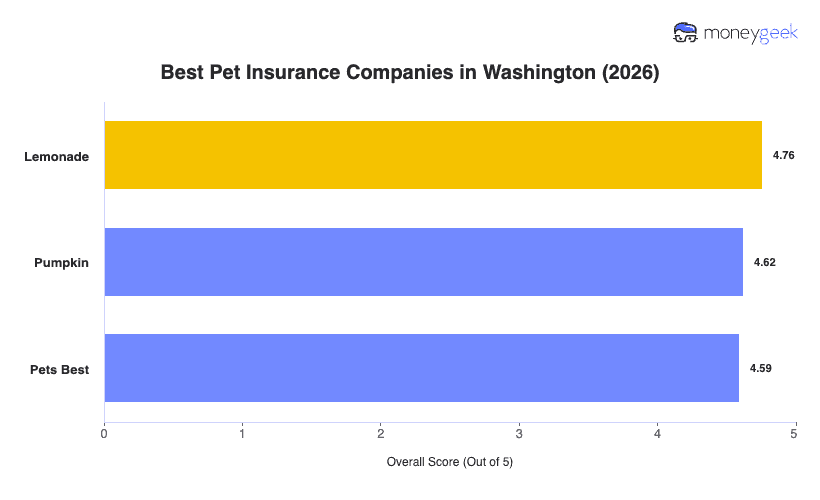
Best Pet Insurance Companies in Washington
In Washington, the best pet insurance providers are:
- Choose if you want the best value with coverage flexibility: Lemonade
- Choose if you want excellent service and expedited reimbursements: Pumpkin
- Choose if you want to lower vet costs with direct vet payment: Pets Best
I compared major pet insurers based on their coverage, including their standard plan inclusions, flexibility for customizing policies and terms for waiting periods and pre-existing conditions. I also evaluated how competitive their average rates are and how dependable their customer service is.
For our best pet insurance ratings, we evaluated affordability, customer experience and coverage across 18 major pet insurers using over 67,000 pet profiles representing mixed breeds and purebreds in Washington. Our analysis used standard profiles of a 6-year-old Labrador Retriever and 7-year-old Ragdoll with a $5,000 annual limit, $500 deductible and 80% reimbursement rate to ensure consistent comparisons across providers.
We analyzed pricing competitiveness across different breeds and locations, measured customer experience throughout the policy lifecycle from enrollment to claims and assessed coverage options and terms. Each insurer received a composite score based on affordability (50% of overall score), customer experience (30% of overall score) and coverage (20% of overall score).
For a detailed breakdown of the metrics, scoring methodology and analysis approach, see our full methodology.

Lemonade: Best Pet Insurance Overall
pros
Cheapest pet insurer in Washington
Multiple ways to customize coverage
cons
Requires add-ons for broad financial protection
COMPANY HIGHLIGHTS
Lemonade ranks as the best pet insurance overall in Washington, combining the lowest average rate in my analysis with coverage flexibility. It saves pet owners 43% in costs against the state average, and offers the widest range of deductibles, annual limits and reimbursement rates, so you can adjust your coverage to keep premiums affordable while choosing the level of financial protection you want.
However, Lemonade doesn’t cover veterinary exams, physical rehabilitation, dental illnesses, behavioral conditions and end-of-life expenses unless you purchase multiple add-ons, which can raise your monthly premium if you want broader coverage for your pet.
Learn more: Lemonade Pet Insurance Review

Pumpkin: Best Pet Insurance Customer Experience
pros
Best customer experience
Can provide same-day reimbursements
cons
Limited ways to customize policy limits
COMPANY HIGHLIGHTS
Among my top picks, Pumpkin leads for customer experience. With Pumpkin, getting a quote, understanding what's covered and completing enrollment feels guided and transparent. Billing stays predictable and renewal communications don't catch policyholders off guard. Plus, Pumpkin features Pumpkin Now, which deposits reimbursements directly into eligible bank accounts in minutes for claims over $500, so you can access funds sooner and use it to pay at the vet.
Coverage flexibility is where Pumpkin falls behind. It only offers two reimbursement rates, four deductibles and four annual limits, limiting how precisely you can adjust your coverage and premium to match your budget and your pet's specific needs.
Learn more: Pumpkin Pet Insurance Review

Pets Best: Best Pet Insurance for Direct Vet Pay
pros
Option to pay licensed vets directly
Waiver for orthopedic waiting period
cons
Add-ons for exam fee and physical therapy coverage
Less efficient claim submission process
COMPANY HIGHLIGHTS
Rounding out my top picks for Washington pet insurance, Pets Best sets itself apart by offering Vet Direct Pay. With this feature, the company can pay licensed vets directly for covered claims upon request, which removes the financial strain of bridging the gap between a vet visit and a reimbursement check. It also waives its 30-day waiting period for orthopedic issues with a physical exam, providing coverage sooner for breeds like German Shepherds and Labrador Retrievers that have a high risk of knee or ligament problems due to their size.
That said, Pets Best falters in claim submission ease, where issues often occur when additional documentation is required. You may have to spend more time gathering paperwork and responding to follow-up requests when filing a claim for your pet’s care.
Learn more: Pets Best Pet Insurance Review
Cheapest Pet Insurance Companies in Washington
If you’re focused on finding the cheapest pet insurance, consider these Washington pet insurers:
- Lemonade: Lemonade leads for affordability among Washington providers, at an average cost of $36 monthly, which is 43% below the state benchmark. It’s also the cheapest option for owners of Boxers, allowing them to save 73% compared to the breed average.
- ASPCA: Ranking as the second-cheapest pet insurer, ASPCA averages $43 monthly and provides 32% in savings against the state average. It offers the lowest rates for Welsh Springer Spaniels, Borzois and Tibetan Mastiffs.
- Pumpkin: Pumpkin costs an average of $46 per month, which is 28% less than the state benchmark. It’s the most affordable provider for Hungarian Vizslas, saving owners 38% against the breed average.
Lemonade | $36 | $437 | 43% |
ASPCA | $43 | $516 | 32% |
Pumpkin | $46 | $554 | 28% |
How Much Does Pet Insurance Cost in Washington?
At $64 per month ($765 annually), Washington has the highest average pet insurance cost in my study, 35% above the national average. This is based on aggregated pricing for a 6-year-old Labrador Retriever and a 7-year-old Ragdoll with a $5,000 annual limit, $500 deductible and 80% reimbursement rate.
By pet type, the average rates are:
- Dogs: $84 per month ($1,006 annually), 37% above the national dog average
- Cats: $42 per month ($504 annually), 31% above the national cat average
MoneyGeek's Washington pet insurance cost calculator below can help you find out the average pet insurance cost for your pet's specific profile.
Washington Pet Insurance Cost Estimate Calculator
Select Breed
Select Age
Average monthly rate—
Select Breed
Average monthly rate—
Select Age
Is Pet Insurance Worth It in Washington?
Pet insurance is worth it in Washington if you want to financially protect your budget from the high cost of veterinary care. After you pay the vet bill, your insurer can reimburse you for eligible expenses, helping offset the cost of diagnosing and treating covered accidents and illnesses. The value of a policy still depends on your pet's age, health and coverage needs, as well as how comfortably you could handle a major veterinary expense yourself.
These examples show how much treatment for common pet health conditions can cost in Washington, based on MoneyGeek’s data:
- Hip dysplasia: $3,960 to $31,680
- Periodontal disease: $468 to $3,120
- Cancer (lymphoma): $4,320 to $21,600
- Allergies: $288 to $2,880
- Chronic kidney disease: $420 to $5,040
After determining whether getting a policy is worth it, figure out your pet insurance coverage needs using the tool below. It provides a baseline recommendation for annual limits, reimbursement rates and deductibles based on your pet’s profile.
Pet Insurance Coverage Needs Calculator
Use this calculator to get pet insurance coverage recommendations by entering your pet's species, breed, state and age.

What is your pet type?
Select Pet type
Pet type
Breed
State
Pet Age
How to Choose the Best Pet Insurance in Washington
Choosing the best cheap pet insurance in Washington comes down to understanding what your pet needs before you start evaluating providers. Follow these six steps to make a decision you'll feel confident about.
- 1Start with your pet's breed, size and health history
Breed, age and veterinary history determine which policy features matter most. Labrador Retrievers carry orthopedic risks that call for different coverage priorities than the respiratory conditions common in French Bulldogs. A senior cat with a documented health history has different needs than a kitten. Work through these questions before comparing any provider:
- What health conditions are common in your pet's breed? The breed health guides from the American Kennel Club for dogs and the Cat Fanciers' Association for cats are reliable starting points for identifying conditions worth prioritizing.
- How old is your pet? Pets under 12 months are most vulnerable to accidents and ingestion emergencies. Pets eight and older are more likely to develop cancer, joint disease or organ conditions that need ongoing care.
- What do your pet's vet records show? Washington insurers can use a single documented symptom to classify a related condition as pre-existing, which affects what your policy covers going forward.
- 2Choose your priorities
Affordability, coverage depth and customer experience don't always align at the same provider. Settling your priorities before comparing options makes the tradeoffs easier to evaluate. Here are common priority combinations and who they fit:
- Broad coverage + affordable pricing: A strong fit for Washington owners of mixed-breed dogs or cats without major hereditary risks who want solid financial coverage at a manageable monthly cost.
- Broad coverage + reliable customer service: The right match for purebred owners and first-time buyers who want strong coverage terms and a claims process that doesn't add friction during a difficult situation.
- Affordable pricing + reliable customer service: Works for healthy pets with straightforward coverage needs, where low premiums and a smooth claims process matter more than maximum coverage depth.
- 3Explore pet insurance providers
Confirm which companies are actively writing pet insurance in Washington before comparing them. Beyond availability, check independent reviews, J.D. Power satisfaction data and AM Best financial strength ratings to assess how each provider holds up when policyholders file claims.
- 4Review sample policies before you commit
The terms that most affect your coverage are in the sample policy, which most major Washington pet insurers post publicly. Search for these keywords:
- Pre-existing conditions: Washington law requires insurers to disclose all pre-existing condition exclusions upfront and places the burden of proof on the insurer to show that an exclusion applies to a claim you file.
- Curable conditions: Some Washington insurers reinstate coverage for previously excluded conditions after a symptom-free waiting period, typically 180 days to 12 months. Confirm whether this applies and what the requirements are.
- Waiting periods: Washington law caps illness and orthopedic waiting periods at 30 days and prohibits waiting periods for accidents entirely. Waiting periods also cannot be applied to renewals. Some insurers allow waiting periods to be waived after a licensed veterinarian completes a medical exam after purchase.
- Hereditary and congenital conditions: Washington requires insurers to disclose any exclusions for hereditary disorders, congenital anomalies and chronic conditions. Confirm whether these are covered under the base policy or excluded before enrolling.
- Exclusions: Owners of breeds with known health risks should read this section in full before committing.
- Claims: Check documentation requirements for claims, submission deadlines after a vet visit and whether direct vet payment is available.
- 5Compare your top choices side by side
Evaluate each shortlisted provider on the same three criteria:
- Coverage: Standard inclusions and exclusions, waiting periods, annual limits, hereditary condition terms
- Pricing: Monthly premium, deductibles, reimbursement rates
- Service: Claims process, reimbursement speed, customer support availability, mobile app or web portal quality
- 6Get quotes using your pet's actual profile
Broad rate estimates give you a rough starting point, but actual pricing based on your pet's species, breed, age and Washington ZIP code often looks different once you go through the quote process. Always request quotes using identical deductibles, annual limits and reimbursement rates across every provider you're considering to compare actual price differences.
Best Pet Insurance in Washington: Bottom Line
Lemonade, Pumpkin and Pets Best are the best pet insurance companies in Washington. The right pick depends on your pet's breed, age and ZIP code. To find a policy that holds up at claim time, make sure to weigh pricing consistency, coverage depth and claims handling together rather than optimizing for any one factor.
Best Pet Insurance in Washington: FAQ
The best pet insurance providers in Washington are as follows:
- Lemonade: Best Pet Insurance in Washington Overall
- Pumpkin: Best Pet Insurance in Washington Customer Experience
- Pets Best: Best Pet Insurance in Washington for Direct Vet Pay
At $36 monthly on average, Lemonade is the most affordable pet insurance company in Washington, saving pet owners 43% against the state average.
Washington pet insurance costs an average of $64 per month, or $765 per year, based on a standard policy with a $5,000 annual limit, $500 deductible and 80% reimbursement rate. That figure can change based on factors like your pet’s breed, age at enrollment and ZIP code within the state, as well as your coverage preferences.
Pet insurance can be worthwhile in Washington, particularly if an unexpected veterinary bill could put a strain on your finances. By reimbursing part of the eligible costs you incur for covered accidents and illnesses, pet insurance can make expensive treatments more manageable when your pet needs them.
You can find the best pet insurance in Washington by evaluating your pet’s health risks and your priorities before comparing providers based on their coverage terms, customer reviews and quotes.
In Washington, pet insurance helps pay for veterinary care related to covered accidents and illnesses, including services such as diagnostics, surgery, hospitalization and prescription medications. Depending on the plan, you may also have access to optional coverage for routine or preventive care, but exclusions and coverage limits vary between providers.
Washington regulates pet insurance under Chapter 48.205 RCW, which applies to pet insurance policies sold, offered or issued to Washington residents and sets requirements for disclosures, waiting periods, policy terms and insurance producers. Notably, Washington prohibits waiting periods for accidents and limits waiting periods for illnesses or orthopedic conditions to 30 days, with provisions allowing those periods to be waived after a qualifying veterinary examination.
Get Pet Insurance Quotes in Washington
Once you're ready to compare Washington pet insurers, use our tool below to identify the top providers that match your pet's health needs and your budget.
About Ritchel Mendiola

Ritchel Mendiola is a Pet Insurance Content Writer at MoneyGeek. She produces coverage guides, provider comparisons and cost analyses so pet owners can understand their options and avoid overpaying.
Ritchel spent over four years as a News and Feature Writer at Asian Journal Publications, where she reported for the Asian Journal newspaper and Balikbayan Magazine, conducted interviews and covered media events. At MoneyGeek, she covers policy terms, exclusions, waiting periods and reimbursement structures the way she treated news facts. They're sourced, verified and reported accurately rather than summarized from marketing copy.
She joined MoneyGeek in late 2021 in the loans vertical and moved to pet insurance content, which she now leads. Her published work includes provider comparisons, breed-specific cost guides, age-specific coverage analyses and state-level pricing studies, all from the vertical's 5 million pet insurance profiles across 18 major providers and all U.S. states.
LinkedIn: https://www.linkedin.com/in/rianmendi/
Contact Email: ritchel.mendiola@moneygeek.com
Sources
- Washington State Legislature. "Chapter 48.205 RCW." Accessed September 10, 2026.