



Choose where to jump to based on your needs:
Best Pet Insurance in Tennessee
Updated: September 17, 2026
Advertising & Editorial Disclosure
Best Pet Insurance Companies in Tennessee
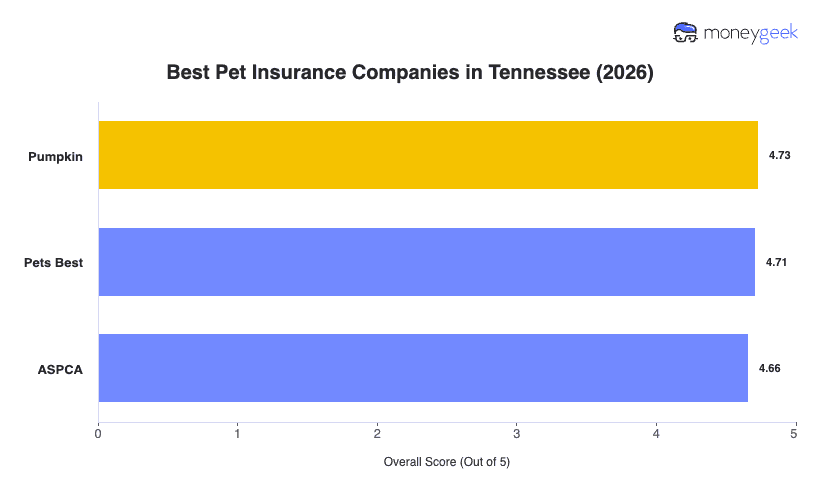
If you’re looking for the best pet insurance in Tennessee, consider the following companies:
- Choose if you want the best value with expedited reimbursements: Pumpkin
- Choose if you want to lower your vet costs with direct vet payment: Pets Best
- Choose if you want flexible policies with broad coverage options : ASPCA
I compared major pet insurers based on their overall coverage, including their standard inclusions, options for customizing policies and terms for waiting periods and pre-existing conditions. I also evaluated their affordability and customer service.
For our best pet insurance ratings, we evaluated affordability, customer experience and coverage across 18 major pet insurers using over 67,000 pet profiles representing mixed breeds and purebreds in Tennessee. Our analysis used standard profiles of a 6-year-old Labrador Retriever and 7-year-old Ragdoll with a $5,000 annual limit, $500 deductible and 80% reimbursement rate to ensure consistent comparisons across providers.
We analyzed pricing competitiveness across different breeds and locations, measured customer experience throughout the policy lifecycle from enrollment to claims and assessed coverage options and terms. Each insurer received a composite score based on affordability (50% of overall score), customer experience (30% of overall score) and coverage (20% of overall score).
For a detailed breakdown of the metrics, scoring methodology and analysis approach, see our full methodology.

Pumpkin: Best Pet Insurance Overall
pros
Most affordable pet insurer
Efficient claim submission process
Can provide same-day reimbursements
cons
14-day waiting period for accidents
Limited flexibility for adjusting coverage
COMPANY HIGHLIGHTS
Pumpkin wins as the best pet insurance company in Tennessee, combining affordability with customer experience. At $23 monthly on average, the company provides 43% savings compared to the state average. Pumpkin also offers smooth and efficient service at every stage of the policyholder experience, from buying coverage to managing policies and submitting claims.
Additionally, Pumpkin features Pumpkin Now, which can deposit same-day reimbursements into qualifying bank accounts for claims over $500 submitted at the vet, so you don’t have to pay the entire bill upfront. However, it offers few options for reimbursement rates, deductibles and annual limits, limiting the flexibility you have for customizing policies according to your budget and preferred coverage level.
Learn more: Pumpkin Pet Insurance Review
Pets Best: Best Pet Insurance for Direct Vet Pay
pros
Three-day accident waiting period
Pays licensed vets directly on request
cons
Less streamlined claim submission process
Coverage for exams and physical therapy need add-ons
COMPANY HIGHLIGHTS
Among my recommendations, Pets Best stands out for paying licensed veterinarians directly on request through Vet Direct Pay, which removes the need for Tennessee pet owners to cover a large bill upfront and wait for reimbursement. The company also has a short three-day waiting period for accidents, so your pet can be eligible for coverage if it gets injured from playing outside or ingesting something it shouldn’t after enrollment.
That said, Pets Best doesn’t have the easiest claim submission process. This can make filing a claim more time-consuming, especially when you’re already dealing with the stress of managing your pet’s care.
Learn more: Pets Best Pet Insurance Review
ASPCA: Best Pet Insurance for Coverage Flexibility
pros
Various options for customizing policy limits
Comprehensive base coverage inclusions
cons
Relatively poor mobile app experience
Less smooth billing and renewals service
COMPANY HIGHLIGHTS
ASPCA is my recommendation for Tennessee pet owners looking for coverage flexibility. It offers four deductibles, four reimbursement rates and six annual limits, so you can tailor your policy's structure and cost to better fit your budget and your pet's health care needs. ASPCA also provides a standard policy that covers veterinary exams, prescription medications, behavioral issues and alternative treatments, which gives you broad financial protection without having to pay more each month.
Where ASPCA falls behind is customer experience, with app experience, and billing and renewals as its weakest areas. You may find it less convenient to manage your policy from your phone, address billing issues or navigate the renewal process when you need assistance.
Learn more: ASPCA Pet Insurance Review
Cheapest Pet Insurance Companies in Tennessee
Tennessee pet owners can get the most affordable pet insurance from:
- Pumpkin: Pumpkin provides the lowest average rate for pet insurance in Tennessee, at $23 monthly, which is 43% below the state average. It’s also the cheapest provider for Puli owners, providing 63% savings against the breed average.
- ASPCA: At roughly $23 per month, ASPCA is the second-cheapest insurer for Tennessee pet owners, allowing them to save on costs by 42% compared to the state average. It also provides the most affordable policies to owners of Foxhounds, Scottish Terriers and Bull Mastiffs.
- Pets Best: Averaging $24 monthly, Pets Best offers pet insurance that’s 41% cheaper than the state benchmark. The company leads in affordability for Australian Terriers and Russian Blues, providing 60% and 59% savings against the breed averages, respectively.
Pumpkin | $23 | $275 | 43% |
ASPCA | $23 | $277 | 42% |
Pets Best | $24 | $285 | 41% |
How Much Does Pet Insurance Cost in Tennessee?
The cost of pet insurance in Tennessee averages $40 per month or $478 annually. This rate is aggregated for a 6-year-old Labrador Retriever and 7-year-old Ragdoll, under a policy with a $5,000 annual limit, $500 deductible and 80% reimbursement rate. Tennessee lands 16% below the national average and holds the seventh spot among the most affordable states in MoneyGeek’s dataset.
By species, the breakdown is:
- Dogs: $52 per month ($623 annually), 15% below the national dog average
- Cats: $27 per month ($323 annually), 16% below the national cat average
Use MoneyGeek's Tennessee pet insurance cost calculator to find out the average pet insurance cost for your pet.
Tennessee Pet Insurance Cost Estimate Calculator
Select Breed
Select Age
Average monthly rate—
Select Breed
Average monthly rate—
Select Age
Is Pet Insurance Worth It in Tennessee?
Pet insurance is worth it in Tennessee if a major veterinary bill would be difficult for you to pay on your own. A policy can reimburse you for eligible costs of diagnosing and treating accidents and illnesses, reducing your overall out-of-pocket expense. However, the value of coverage depends on factors such as your pet's age and health, the policy's terms and your ability to handle unexpected costs.
These common conditions show the veterinary expenses pet insurance can help you manage in Tennessee, based on MoneyGeek’s vet cost data:
- Hip dysplasia: $2,904 to $23,232
- Lymphoma: $3,168 to $15,840
- Heartworm disease: $616 to $3,696
- Periodontal disease: $343 to $2,288
- Allergies: $210 to $2,112
If you decide getting pet insurance is worth it, determine how much coverage you need using the tool below, which can provide a baseline recommendation for annual limits, deductibles and reimbursement rates based on your pet’s profile.
Pet Insurance Coverage Needs Calculator
Use this calculator to get pet insurance coverage recommendations by entering your pet's species, breed, state and age.

What is your pet type?
Select Pet type
Pet type
Breed
State
Pet Age
How to Choose the Best Pet Insurance in Tennessee
Choosing pet insurance in Tennessee takes more than finding the lowest monthly rate. The right policy matches your pet's specific health risks, fits your budget and comes from a provider that performs when a claim needs to be paid. These seven steps give you a structured way to find coverage that holds up on all three.
- 1Start with your pet's breed, size and health history
Before comparing any quotes, you need a clear picture of what your pet is likely to need from a policy. Breed, size and health history shape coverage needs more than most pet owners expect, and policies that look equivalent on a quote page can differ in how they handle the conditions your specific pet is most likely to experience. Before you start shopping, answer these three questions:
- What health conditions are most common in your pet's breed? Breed-specific resources from the American Kennel Club for dogs and the Cat Fanciers' Association for cats can help you identify conditions worth prioritizing before they appear in a vet record.
- Where does your pet fall on the age curve? Younger pets carry higher accident risk, while pets aged 7 and older have greater odds of cancer, joint disease and chronic conditions that require long-term coverage.
- What's in your pet's vet records? In Tennessee, even a single symptom note in a vet record can give an insurer grounds to exclude a related condition from coverage going forward.
- 2Choose your priorities
Getting clear on what matters most to you before you start comparing providers makes the tradeoffs between cost, coverage and service quality easier to evaluate. Without a defined priority, it's easy to end up optimizing for the wrong thing:
- Comprehensive coverage + affordable pricing: The right fit for mixed-breed owners and those with lower-risk breeds who want solid financial protection without paying for features they're unlikely to use.
- Comprehensive coverage + reliable customer service: The better choice for purebred owners and first-time buyers who need both policy depth and a claims process that works without friction when a real health event occurs.
- Affordable pricing + reliable customer service: Works best for healthy pets where the goal is keeping monthly costs manageable while having a provider that handles claims reliably when needed.
- 3Explore pet insurance providers
Not every pet insurance provider available in Tennessee is worth shortlisting. Before narrowing your options, check each provider's claims reputation using J.D. Power satisfaction ratings, AM Best financial strength scores and independent customer reviews focused specifically on claims experience. J.D. Power ratings reflect how policyholders rate the overall experience, AM Best scores confirm that a provider has the financial stability to pay claims consistently, while independent reviews identify patterns in how real customers are treated after a vet visit, which are all important details that don't show up in marketing materials.
- 4Review sample policies before you commit
Sample policies are publicly available for most major Tennessee pet insurers, and reading one before enrolling can prevent coverage gaps that only become visible when a claim is denied. Use Ctrl+F to search for these terms specifically:
- Pre-existing conditions: How broadly a provider defines this determines how much of your pet's health history can be used to deny coverage. A wide definition can exclude conditions mentioned only once in a vet note.
- Exclusions: Go beyond the summary page and read the full exclusions list. Some Tennessee providers exclude bilateral conditions, hereditary illnesses or specific treatment types that may be directly relevant to your pet's breed.
- Curable conditions: Some providers restore coverage for conditions that resolve after a symptom-free period. Confirm the qualifying timeframe to reinstate coverage.
- Waiting periods: Accident, illness and orthopedic waiting periods often run on different timeframes within the same policy. A provider may begin accident coverage within days but impose a six-month wait for orthopedic conditions, creating a gap that carries financial risk for joint-prone breeds in Tennessee.
- Hereditary and congenital conditions: Confirm these are included in the base plan, not through a paid add-on.
- Claims process: Understand exactly what documentation is required for claims, what the submission deadlines are and whether the provider offers direct vet payment.
- 5Compare your top choices side by side
Once you've narrowed to two or three options, line them up on identical terms:
- Coverage: Base plan inclusions, exclusions, waiting periods, annual limits and hereditary condition terms
- Pricing: Monthly premium at your chosen deductible and reimbursement rate
- Service: Claims submission process, average reimbursement time and dispute resolution track record
- 6Get quotes using your pet's actual profile
A Tennessee state average rate tells you what a hypothetical pet owner might pay. Your actual premium depends on your pet's breed, age, species and ZIP code, and those variables can move the number from what any average suggests. Request quotes from at least three providers using matching deductibles, annual limits and reimbursement rates so the price differences you're comparing reflect actual rate variation rather than differences in what's covered.
Best Pet Insurance in Tennessee: Bottom Line
Pumpkin, Pets Best and ASPCA are my recommendations for the best pet insurance in Tennessee, but the option that provides the most value for your household is the one whose coverage terms align with your pet's breed-specific risks, your budget and the customer service you'll need when an unexpected vet bill arrives. Pet owners who assess all three factors together, rather than optimizing for price alone, are the ones most likely to still be satisfied with their policy when a health event puts it to the test.
Best Pet Insurance in Tennessee: FAQ
In Tennessee, the best pet health insurance companies are:
- Pumpkin: Best Pet Insurance in Tennessee Overall
- Pets Best: Best Pet Insurance in Tennessee for Direct Vet Pay
- ASPCA: Best Pet Insurance in Tennessee for Coverage Flexibility
Pumpkin offers the cheapest pet insurance in Tennessee at an average cost of $23 per month, which is 43% lower than the state benchmark.
The average cost of pet insurance in Tennessee is $40 per month, or $478 per year, based on a standard policy with a $5,000 annual limit, $500 deductible and 80% reimbursement rate. What you'll actually pay depends on your pet’s breed and age at enrollment, your ZIP code within the state and your coverage preferences.
Pet insurance is worth it in Tennessee if you want a financial safety net for unexpected veterinary expenses. When your pet develops a covered illness or suffers an eligible accident, pet insurance can pay a portion of qualifying treatment costs, helping you manage bills that could otherwise strain your budget. However, policies don't cover every expense, and conditions that exist before coverage begins are generally excluded.
To choose the best pet insurer, evaluate your pet’s health profile first and determine your priorities.Then find providers in your state and compare them based on their coverage terms, customer reviews and quotes.
Pet insurance in Tennessee covers eligible vet expenses for accidents and illnesses, such as diagnostic tests, surgery, hospitalization and prescription medications. Coverage varies by provider, with routine care and pre-existing conditions generally excluded.
You should get pet insurance in Tennessee while your pet is healthy and before an accident or illness occurs. Because insurers exclude pre-existing conditions, enrolling early can give your pet broader access to coverage for conditions that develop after the policy's waiting periods.
Get Pet Insurance Quotes in Tennessee
Rates for identical coverage vary across Tennessee pet insurance providers, and the only way to know which policy delivers the best value for your pet's specific profile is to compare them directly. Use MoneyGeek's tool below to get quotes from Tennessee's top providers and find a policy that fits your budget.
About Ritchel Mendiola

Ritchel Mendiola is a Pet Insurance Content Writer at MoneyGeek. She produces coverage guides, provider comparisons and cost analyses so pet owners can understand their options and avoid overpaying.
Ritchel spent over four years as a News and Feature Writer at Asian Journal Publications, where she reported for the Asian Journal newspaper and Balikbayan Magazine, conducted interviews and covered media events. At MoneyGeek, she covers policy terms, exclusions, waiting periods and reimbursement structures the way she treated news facts. They're sourced, verified and reported accurately rather than summarized from marketing copy.
She joined MoneyGeek in late 2021 in the loans vertical and moved to pet insurance content, which she now leads. Her published work includes provider comparisons, breed-specific cost guides, age-specific coverage analyses and state-level pricing studies, all from the vertical's 5 million pet insurance profiles across 18 major providers and all U.S. states.
LinkedIn: https://www.linkedin.com/in/rianmendi/
Contact Email: ritchel.mendiola@moneygeek.com