
Average Puppy Insurance Cost (2026 Report)


How Much Does Puppy Insurance Cost?

Pet insurance costs an average of $46 monthly ($552 annually) for a puppy under 1 year of age with a $5,000 annual limit, $500 deductible and 80% reimbursement rate. 

This average is based on the analysis of over 67,000 puppy profiles across all 50 states and Washington, D.C. Premiums remain stable through the first two years, with 1-year-olds averaging $44 monthly and 2-year-olds averaging $45 monthly. This is because puppies present similar health risks before age-related conditions develop.

This national benchmark doesn't predict your quote. Puppy insurance premiums vary based on your pet's breed and your location. With this in mind, we've provided a personalized pet insurance calculator for puppies below for you to get an estimate.


We analyzed puppy insurance pricing to establish national cost benchmarks and show how premiums vary based on different factors. Our cost analysis uses standardized policy parameters for consistent comparisons across puppy profiles.  

Dataset Scope and Assumptions

  • Providers analyzed: 18 major pet insurance providers
  • Profiles analyzed: Over 67,000 puppy profiles
  • Geography: All U.S. states and Washington, D.C.
  • Breed profile: Labrador Retriever under one year old
  • Policy baseline: $5,000 annual limit, $500 deductible, 80% reimbursement rate

How We Calculated Average Puppy Insurance Costs

Our published averages reflect modeled premiums for standardized puppy profiles, calculated using two methods:

  • National benchmark average: The monthly national average shows the modeled premium for a Labrador Retriever puppy under one year old across all states in our dataset, based on baseline policy parameters.
  • Segment averages: To show how costs vary, we calculated average modeled premiums for our baseline profile while isolating individual variables, including:
    • States and Washington, D.C.
    • Annual limits
    • Deductibles
    • Reimbursement rates

Segment averages aggregate modeled pricing patterns across the full dataset so readers can compare how premiums change based on location and coverage levels.

What Factors Affect Puppy Insurance Costs?

Coverage level, breed and geographic location influence puppy insurance costs. Insurers use these to estimate claim frequency and severity. Each factor operates independently. For example, a large breed in a low-cost state with basic coverage won't pay the same as a small breed in an expensive state with comprehensive coverage.

    petInsurance icon
    Coverage selection

    These change how much financial risk the insurer assumes, which affects your premium.  

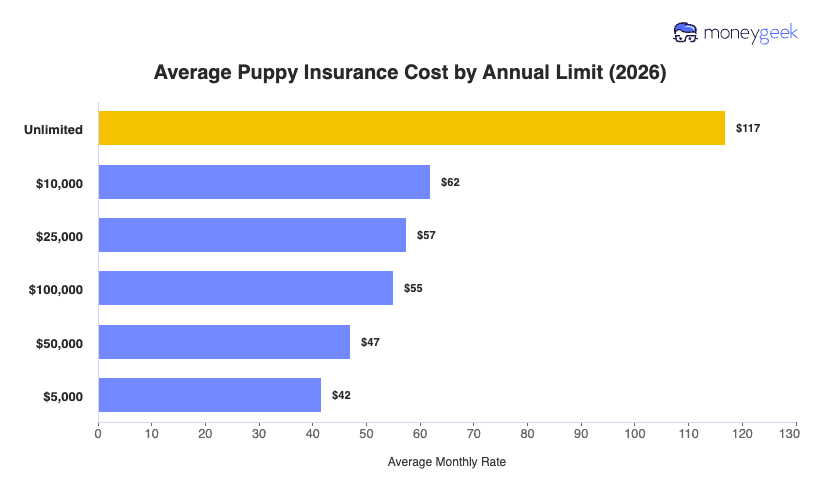
    • Annual limit: This caps the maximum amount your insurer pays per policy year. Choosing unlimited coverage over a $5,000 limit can increase premiums by 180%, reflecting the insurer's higher payout exposure for catastrophic claims like cancer treatment or major surgeries.
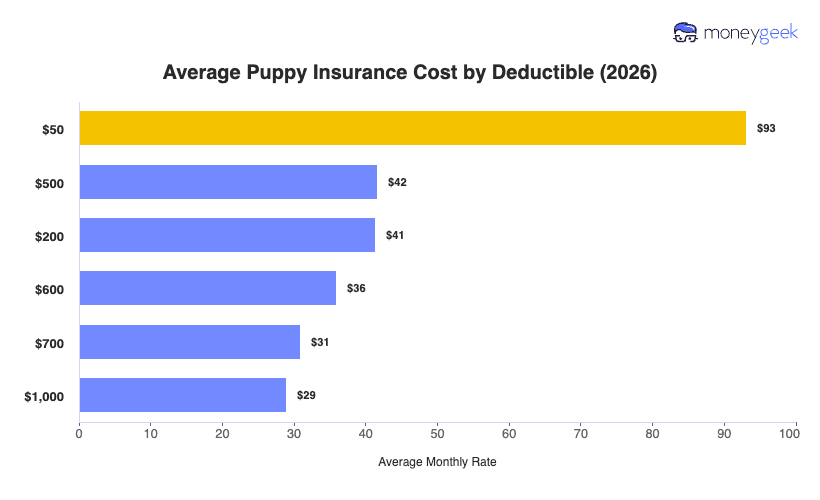
    • Deductible: This is the amount you pay out of pocket before insurance coverage begins. A $50 deductible costs 223% more than a $1,000 deductible because the insurer begins paying on nearly every claim.
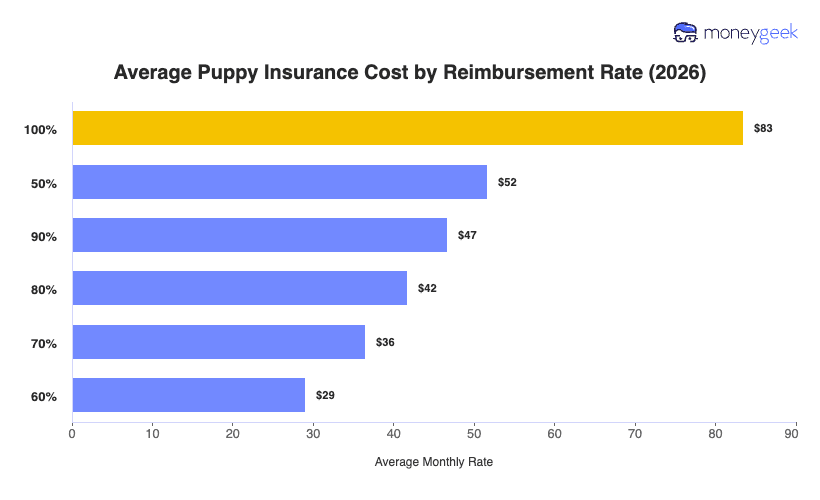
    • Reimbursement rate: This determines what percentage of covered costs the insurer pays after you meet your deductible. Premiums climb as this percentage rises, with 100% reimbursement running 186% higher than 60% reimbursement, because the insurer pays for every covered expense
    dog7 icon
    Breed

    Breed influences costs because different breeds carry hereditary health risks that insurers can predict. For instance, large breed puppies like German Shepherds and Labrador Retrievers develop hip dysplasia, French Bulldogs require frequent respiratory interventions and Cavalier King Charles Spaniels show early heart conditions.

    According to our study, Chihuahuas run 51% below the national average, while Doberman Pinschers sit 64% above it. Mixed-breed puppies cost less because they show fewer breed-specific conditions and are genetically diverse.

    locationPin icon
    Geographic location

    Coastal states and metropolitan areas with higher concentrations of specialty clinics and emergency facilities charge more for routine procedures and advanced care.

    Puppy insurance rates in Alabama are 27% below the national average, while Washington, D.C., premiums are 36% above the average.

Average Puppy Insurance Costs by Coverage Selection

Coverage selection influences premiums based on how you combine annual limits, deductibles and reimbursement rates. Average costs can range from $29 to $117 monthly, depending on the coverage you choose.

Average Puppy Insurance Costs by Annual Limit

Puppy owners selecting a $5,000 annual limit pay an average of $46 monthly since this tier caps insurer exposure to moderate claims like illness treatment or minor injuries. Premiums generally increase as limits rise, though not always proportionally. For instance, unlimited coverage averages $117 monthly (180% higher than $5,000 limits) because insurers assume uncapped financial risk for catastrophic expenses.

Pricing still varies across tiers: $50,000 limits cost $47 monthly on average, while $25,000 limits cost $57 monthly. Insurers' prices are based on their claims data and product positioning.

Jump to: Average Puppy Insurance Cost by Deductible

Average Puppy Insurance Costs by Deductible

Lower deductibles have higher premiums because insurers begin paying on nearly every veterinary visit. A $50 deductible costs $93 monthly on average compared to $29 monthly for a $1,000 deductible, showing a 223% premium difference.

Premiums decrease most between $50 and $200 deductibles, where monthly costs fall by $52. After $500, the impact is smaller, with premiums dropping only $13 monthly between $500 and $1,000 as claim frequency levels off.

Jump to: Average Puppy Insurance Cost by Reimbursement Rate

Average Puppy Insurance Costs by Reimbursement Rate

Policies with 80% reimbursement average $42 monthly, covering 80% of eligible costs after you meet your deductible.

60% reimbursement costs an average of $29 monthly, while 70% costs $36 and 90% costs $47, with increases that stay within a $6 to $11 range for each 10%-point step. However, 100% reimbursement jumps to $83 monthly on average since removing all cost-sharing raises insurer risk.

50% reimbursement costs an average of $52 monthly, which is higher than both 60% and 70% options and may reflect differences in plan design or risk pricing.

Jump to: Average Puppy Insurance Cost by Annual Limit

Average Puppy Insurance Costs by Breed

Average monthly premiums for puppies under one year old range from $22 for Chihuahuas to $75 for Doberman Pinschers across the 161 breeds analyzed, a 234% difference for the same policy setup. Insurers factor in breed to estimate hereditary risks, size-related conditions and expected claim patterns tied to lifetime vet costs.

Chihuahuas cost 51% less than the national average since they avoid many high-cost conditions seen in larger dogs. Larger breeds come with higher premiums due to known medical risks: French Bulldogs ($60 monthly) often need care for breathing issues, Great Danes ($65 monthly) deal with bloat and joint problems tied to their size, and Doberman Pinschers ($75 monthly) are more prone to heart and clotting conditions that lead to higher claim payouts.

The table below shows how average monthly and annual premiums vary by breed for puppies.

Data filtered by:
Select
Affenpinscher$34$414
Afghan Hound$41$486
Airedale Terrier$43$515
Akita$41$493
Alaskan Husky$34$410
Alaskan Malamute$41$496
American Bulldog$54$644
American Bully$54$651
American Eskimo$29$348
American Foxhound$33$395
American Hairless Terrier$31$372
American Staffordshire Terrier$43$517
Australian Cattle Dog$32$386
Australian Kelpie$34$403
Australian Shepherd$28$332
Australian Silky Terrier$27$327
Australian Terrier$30$362
Basenji$28$336
Basset Fauve de Bretagne$43$517
Basset Hound$46$548
Beagle$35$416
Bearded Collie$32$381
Belgian Shepherd Malinois$37$440
Bernese Mountain Dog$71$851
Bichon Frise$31$377
Bloodhound$54$644
Border Collie$29$350
Border Terrier$31$369
Borzoi$46$552
Boston Terrier$33$397
Boxer$53$637
Bracco Italiano$42$504
Briard$40$477
Brussels Griffon$32$379
Bull Mastiff$67$806
Bull Terrier$45$540
Bullmastiff$71$846
Cairn Terrier$33$399
Cane Corso$60$724
Caucasian Shepherd Dog$45$546
Cavachon$29$352
Cavalier King Charles Spaniel$36$430
Cavapoo$27$329
Central Asian Shepherd Dog$48$577
Chihuahua$22$269
Chow Chow$39$467
Clumber Spaniel$42$508
Cockapoo$27$323
Cocker spaniel$38$457
Collie$33$391
Corgi$37$440
Coton De Tulear$28$341
Dachshund$29$344
Dalmatian$45$546
Dingo$27$326
Doberman Pinscher$75$899
Dogue de Bordeaux$72$861
English Bulldog$66$787
English Foxhound$32$390
English Mastiff$63$750
English Pointer$40$480
English Setter$38$461
English Springer Spaniel$36$428
English Toy Terrier$28$330
Estrela Mountain Dog$45$540
Field Spaniel$37$442
Finnish Lapphund$33$399
Fox Terrier$28$340
Foxhound$34$412
French Bulldog$60$715
German Pinscher$31$374
German Shepherd$39$464
German Shorthaired Pointer$36$431
German Spitz$31$369
Golden Retriever$41$487
Goldendoodle$31$376
Gordon Setter$46$557
Great Dane$65$783
Great Pyrenees$45$538
Greyhound$43$521
Groodle$31$369
Harrier$37$448
Havanese$26$317
Hungarian Vizsla$38$450
Husky$26$311
Icelandic Sheepdog$33$399
Irish Setter$42$501
Irish Terrier$33$402
Italian Greyhound$33$393
Italian Spinone$38$459
Jack Russell Terrier$25$304
Japanese Chin$28$341
Japanese Spitz$29$346
Kangal Shepherd Dog$42$504
Keeshond$34$411
Komondor$45$541
Labradoodle$31$374
Labrador Retreiver$33$399
Labrador Retriever$42$502
Lhasa Apso$28$340
Lurcher$44$524
Maltese$28$331
Maltipoo$25$303
Miniature Bull Terrier$45$544
Miniature Dachshund$30$363
Miniature Fox Terrier$34$404
Miniature Pinscher$30$359
Miniature Poodle$27$323
Miniature Schnauzer$32$380
Morkie$26$315
Newfoundland$61$729
Norfolk Terrier$33$398
Norwegian Elkhound$33$398
Norwich Terrier$31$376
Old English Buldogge$56$674
Old English Sheepdog$42$506
Olde English Bulldogge$61$737
Papillon$27$321
Pekingese$30$357
Pembroke Welsh Corgi$35$422
Peruvian Hairless Dog$29$353
Petit Basset Griffon Vendeen$36$429
Pitbull$41$497
Pointer$33$393
Pomeranian$29$343
Portuguese Water Dog$40$474
Pug$37$440
Puggle$28$340
Puli$38$456
Rhodesian Ridgeback$45$536
Rottweiler$62$738
Rough Collie$42$501
Saint Bernard$68$815
Saluki$37$448
Samoyed$36$434
Schnoodle$29$344
Scottish Deerhound$56$671
Scottish Terrier$38$456
Shar Pei$58$701
Shetland Sheepdog$30$359
Shiba Inu$27$322
Shih Tzu$25$298
Siberian Husky$32$385
Smooth Collie$37$440
Soft Coated Wheaten Terrier$38$450
Staffordshire Bull Terrier$39$466
Standard Poodle$39$464
Standard Schnauzer$35$416
Tibetan Mastiff$59$711
Tibetan Terrier$37$449
Toy Poodle$28$338
Vizsla$37$442
Weimaraner$46$552
Welsh Corgi Cardigan$34$403
Welsh Corgi Pembroke$35$422
Welsh Springer Spaniel$31$367
Welsh Terrier$36$429
West Highland White Terrier$31$375
Whippet$33$400
Wire Fox Terrier$35$417
Yorkshire terrier$27$326

These dedicated resources cover breed-specific cost benchmarks you can explore.

Average Puppy Insurance Costs by State

Average monthly premiums for puppy insurance range from $33 in Alabama to $62 in Washington, D.C., for the same coverage. The 50 states and Washington, D.C., group into three cost tiers based on how they compare to the national average:

  • Low-cost states (10%+ below national average): Alabama, West Virginia, Indiana, Arkansas, Kentucky, North Dakota, Missouri, Tennessee, Oklahoma, Maine, New Mexico, Iowa, Montana, Nebraska, Minnesota, Rhode Island, Kansas, Mississippi, Wyoming, Louisiana, Michigan, Idaho, South Dakota, Virginia, South Carolina, Nevada and North Carolina
  • Mid-cost states (within ±10% of national average): Vermont, Ohio, Georgia, Florida, Utah, Maryland, Arizona, New Jersey, Texas, Oregon, Delaware, Alaska and Pennsylvania
  • High-cost states (10%+ above national average): New Hampshire, New York, Wisconsin, Illinois, Connecticut, Hawaii, California, Colorado, Massachusetts, Washington and Washington D.C.

We found that 78% of states fall close to or below the national average, while 22% exceed average costs by over 10%. Washington, D.C. sits at the top of the high-cost tier, driven by higher veterinary overhead, a greater concentration of specialty and emergency clinics, and a higher cost of living. Routine vet visits here average $112 for dogs, which is 45% higher than the national average vet visit cost of $77, based on CareCredit's 2024 data.

Alabama anchors the low-cost tier at 27% below the national benchmark, with routine vet visits for dogs averaging $77, reflecting lower operating costs and fewer specialty services in the state.

Alabama$33$39927%1
Alaska$45$5421%39
Arizona$42$5067%34
Arkansas$34$40226%4
California$50$601-10%47
Colorado$52$622-14%48
Connecticut$48$577-6%45
Delaware$44$5283%38
Florida$42$5028%31
Georgia$42$5018%30
Hawaii$48$580-6%46
Idaho$40$48312%22
Illinois$47$569-4%44
Indiana$33$40226%3
Iowa$37$44718%12
Kansas$39$46315%17
Kentucky$34$40626%5
Louisiana$39$47313%20
Maine$36$43421%10
Maryland$42$5058%33
Massachusetts$54$649-19%49
Michigan$40$47813%21
Minnesota$38$46016%15
Mississippi$39$46814%18
Missouri$35$42622%7
Montana$38$45018%13
Nebraska$38$45117%14
Nevada$41$49110%26
New Hampshire$46$550-1%41
New Jersey$43$5117%35
New Mexico$37$44319%11
New York$46$553-1%42
North Carolina$41$49210%27
North Dakota$34$40725%6
Ohio$42$5008%29
Oklahoma$36$43321%9
Oregon$43$5215%37
Pennsylvania$46$5470%40
Rhode Island$39$46215%16
South Carolina$41$49010%25
South Dakota$41$49010%23
Tennessee$36$42822%8
Texas$43$5205%36
Utah$42$5048%32
Vermont$41$4969%28
Virginia$41$49010%24
Washington$58$695-27%50
Washington D.C.$62$744-36%51
West Virginia$33$40227%2
Wisconsin$46$555-2%43
Wyoming$39$47014%19

You can explore our state-specific resources for more detailed information.

How to Lower Puppy Insurance Costs Without Sacrificing Coverage

Your puppy's breed, your location and the coverage limits you select impact insurance rates. Insurers offer adjustable pricing levers at quoting and renewal that let you reduce costs while maintaining enough coverage.

    giveMoney icon
    Raise your deductible to $500 or higher

    Going from a $250 to $500 deductible cuts premiums by 20% because the insurer pays fewer small claims.

    money icon
    Choose an annual limit that matches realistic claim scenarios

    A $10,000 limit covers most emergencies and illnesses without the 180% premium markup unlimited plans carry.

    discount icon
    Start with 70% or 80% reimbursement instead of 90% or 100%

    Lower reimbursement rates mean you split claim costs with the insurer, which reduces their per-claim exposure and drops your premium by 15% to 30%.

    petMedicalCheckup icon
    Skip add-ons you don't need

    Optional add-ons like wellness plans and exam fee riders increase premiums by 20% to 40% while covering predictable expenses like vaccinations and annual checkups.

    petInsurance icon
    Compare quotes from multiple insurers annually

    Puppy insurance pricing varies across carriers for identical coverage because each insurer weights breed risk, regional veterinary costs and claim history differently.

Pet Insurance Cost for Puppies: Bottom Line

Puppy insurance premiums depend on coverage selection, breed and location. Insurers assess each factor independently. Treat the $46 monthly national average as a benchmark rather than a prediction.

Evaluate your quote using these three questions and compare it to the benchmark:

  1. How does your puppy's profile compare?
  2. Which factors drive your premium?
  3. What changes would affect your cost?

Puppy Insurance Cost: Next Steps

If you’re ready to get quotes for your puppy insurance, use your pet’s breed, location and age, plus your preferred coverage limits.

If you're deciding whether to buy

If you're in a high-cost state

If you're comparing quotes

About Connor Bolton


Connor Bolton headshot

Connor Bolton is Senior SEO and Content Manager at MoneyGeek, where he leads the business and pet insurance editorial teams. As editorial lead for both verticals, Connor sets the research framework, data standards, and content structure that his writers execute, directly authoring in-depth guides himself and reviewing all team content for accuracy and practical value before it goes live. With over four years evaluating insurance products across personal, commercial, and specialty lines, he brings cross-vertical knowledge to every guide the team produces.

Connor architected MoneyGeek's insurance research infrastructure across all major verticals including auto, home, renters, life, health, business, and pet, building systems for pricing analysis, provider-level research, customer experience evaluation, and coverage analysis with AI support. The infrastructure includes over 6 million data points for business insurance across 408 industry areas, all 50 states, and 16 vehicle types, and over 5 million pet insurance profiles across 18 major providers and hundreds of breed and age combinations. Connor's insurance cost research and his team's work has been cited by the U.S. Chamber of Commerce, Allstate, Liberty Mutual, CBS News, Forbes and LegalZoom.

Beyond the data, Connor stays connected to how the market actually operates, drawing on direct conversations with underwriters and carrier liaisons at Ethos, The Hartford, NEXT Insurance, Nationwide, and State Farm, and monitoring business and pet owner communities including Reddit, to inform how he interprets findings and frames guidance for real buyers.

He is the direct editorial contact for methodology questions at connor@moneygeek.com and can be found on LinkedIn.


Sources