
Average Pet Insurance Cost in New Hampshire (2026 Report)


How Much Does Pet Insurance Cost in New Hampshire?

At $52 per month ($626 annually), New Hampshire pet insurance costs 10% higher than the national average. The state ranks 41st for affordability across all 50 states, putting it in the more expensive tier. These figures come from MoneyGeek's analysis of 67,000+ pet profiles using a 6-year-old Labrador Retriever and 7-year-old Ragdoll as the benchmark, under standardized policy terms: $5,000 annual limit, $500 deductible and 80% reimbursement rate.

The combined state average breaks down by species as follows:

  • Dogs: $68 per month ($817 annually), 11% above the national dog average
  • Cats: $35 per month ($422 annually), 9% above the national cat average

Use these state benchmarks as reference points, not price guarantees. A quoted premium shifts based on factors like breed, age and coverage selection. Two pets in the same ZIP code can price at noticeably different monthly rates once those inputs are applied.

We studied pet insurance pricing to establish New Hampshire cost benchmarks and show how premiums vary based on different factors. Our cost analysis uses standardized policy parameters for consistent comparisons across pet profiles.  

How We Calculated Average Pet Insurance Costs

Our published averages represent modeled premiums for standardized pet insurance drawn from over 67,000 pet profiles across 18 major pet insurance providers in New Hampshire. The baseline profiles used throughout our analysis are 6-year-old Labrador Retriever and 7-year-old Ragdoll with a $5,000 annual limit, $500 deductible and 80% reimbursement rate.

Averages were calculated in two ways:  

  • New Hampshire state benchmark average: The monthly state average reflects the modeled premium for a 6-year-old Labrador Retriever and 7-year-old Ragdoll in our dataset using the baseline policy parameters.
  • Segment averages: To demonstrate cost variation, we calculated average modeled premiums for our baseline profile while isolating individual variables, including:  
    • Breeds
    • Ages

Segment averages aggregate modeled pricing patterns across the full dataset so readers can compare how premiums change based on breed and age in New Hampshire.

Use MoneyGeek's New Hampshire pet insurance cost calculator to find out the average pet insurance cost for your pet.

New Hampshire Pet Insurance Cost Estimate Calculator

Use our calculator to estimate how much you'll pay monthly for pet insurance in New Hampshire based on breed and age for a standard $5,000 annual limit, $500 deductible and 80% reimbursement policy. If your pet's breed is mixed, select Mixed Breed for dogs or Domestic Shorthair for cats to get the most accurate result.

Select Breed
Select Age
Average monthly rate

What Factors Affect Pet Insurance Costs in New Hampshire?

Coverage selection, breed, age and location within the state are the four factors that shape what pet insurance in New Hampshire costs for any specific animal. Insurers weigh each one separately because they reflect different aspects of a pet's expected claim profile: how frequently claims are likely to occur and how costly they tend to be. Even pets on the same policy structure can price at different monthly rates depending on where those four inputs fall.

    petInsurance icon
    Coverage selection

    Coverage selection is the one pricing factor in New Hampshire that a policyholder can directly adjust. How the three components below are structured determines how costs are shared between the policyholder and the insurer when a claim is filed.

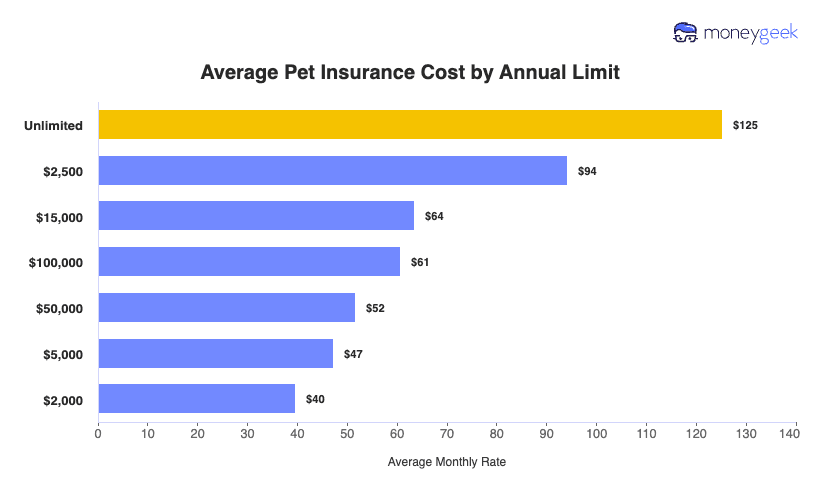
    • Annual limit: The annual limit sets the maximum amount the insurer will pay out in a given policy year. Higher limits expand the insurer's potential payout obligation, and the monthly premium reflects that added exposure. Selecting a lower limit reduces what the insurer is on the hook for, which brings the monthly cost down.
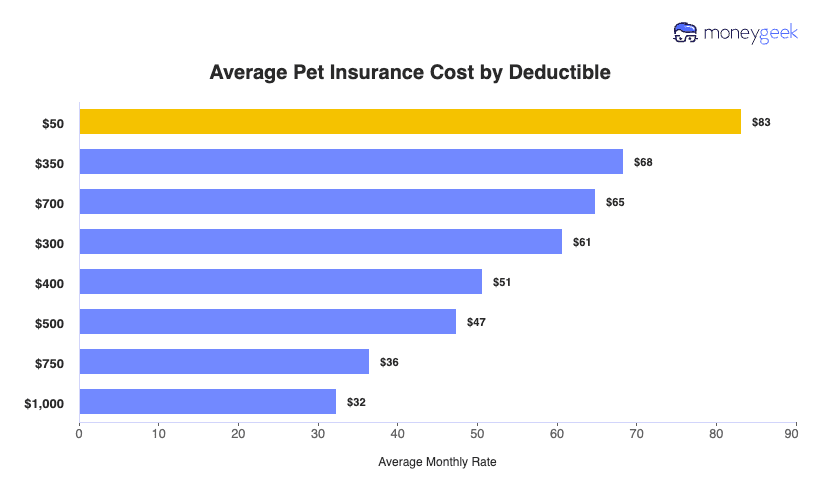
    • Deductible: The deductible is the out-of-pocket amount the policyholder pays before the insurer steps in. It resets once per policy year rather than per visit, so a single deductible applies across all claims filed in that year. A lower deductible means the insurer absorbs costs on a wider range of claims, pushing the monthly premium up. A higher deductible transfers more of that early cost to the policyholder in exchange for a lower monthly rate.
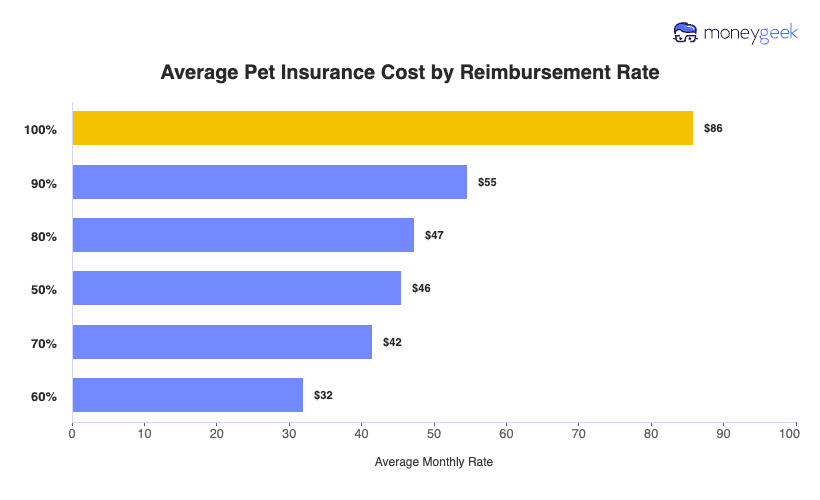
    • Reimbursement rate: The reimbursement rate is the percentage of covered costs the insurer pays after the deductible has been met. At 100%, the insurer covers all eligible claim costs and the premium reflects that full obligation. Lower tiers, such as 80% or 70%, require the policyholder to absorb a share of each claim, and the monthly premium lowers accordingly.
    pet icon
    Breed

    Insurers in New Hampshire price breed directly based on each one's documented claim history, making it the factor with the most influence on where a premium lands. Dog premiums span 354% from the cheapest breed, the Chihuahua, to the most expensive, the Olde English Bulldogge. The cat distribution is far narrower, with a 39% gap between the Bombay at the low end and the Serengeti at the high end.

    usMap icon
    Location within the state

    Where a pet lives within New Hampshire may affect its insurance premium, as veterinary costs are not uniform across the state. Urban markets like Manchester and Nashua generally carry higher operating costs for veterinary practices than rural areas, and some insurers account for those differences when calculating regional rates. The effect is typically smaller than breed or age, but location remains a variable that can nudge a premium above or below the state benchmark.

    birthday icon
    Age

    Insurers in New Hampshire price older pets higher because the likelihood of a claim, and the cost of that claim, increases as a pet ages. Our data shows a 313% difference between premiums at age 1, the lowest point in the dataset, and age 15, where costs peak.

Average Pet Insurance Cost in New Hampshire by Breed

Breed-level pricing in New Hampshire reflects how differently insurers assess claim risk across the dog and cat populations. Among dogs, monthly premiums average between $36 and $166 per month. Meanwhile, cat premiums range from $32 to $44 per month on average.

Average Pet Insurance Cost in New Hampshire by Dog Breed

New Hampshire dog insurance costs range from $36 per month for a Chihuahua to $166 per month for an Olde English Bulldogge on average. The majority of breeds in the dataset fall below the $68 state benchmark for dogs, though that figure doesn't reflect what most owners actually pay.

The American Kennel Club identifies Labrador Retrievers and French Bulldogs among the most widely owned dogs in the U.S. In New Hampshire, Labrador Retrievers price at $67 per month, essentially at the state average, while French Bulldogs reach $100 per month, 47% above it.

At the top of the distribution, large breeds and those with known respiratory or structural health issues account for most of the highest premiums. 14 breeds in the dataset exceed $100 per month, a group that includes Rottweilers, English Bulldogs, Boxers and Great Danes.

Data filtered by:
Select
Affenpinscher$56$675
Afghan Hound$67$807
Airedale Terrier$71$853
Akita$70$844
Alaskan Husky$57$689
Alaskan Malamute$69$825
American Bulldog$92$1,099
American Bully$91$1,095
American Eskimo$48$578
American Foxhound$55$662
American Hairless Terrier$49$589
American Staffordshire Terrier$72$864
Australian Cattle Dog$53$638
Australian Kelpie$59$704
Australian Shepherd$46$553
Australian Silky Terrier$50$597
Australian Terrier$50$601
Basenji$47$565
Basset Fauve de Bretagne$73$880
Basset Hound$77$927
Beagle$57$688
Bearded Collie$53$632
Belgian Shepherd Malinois$62$740
Bernese Mountain Dog$122$1,467
Bichon Frise$52$621
Bloodhound$89$1,066
Border Collie$49$589
Border Terrier$50$605
Borzoi$78$938
Boston Terrier$55$660
Boxer$89$1,067
Bracco Italiano$71$854
Briard$66$788
Brussels Griffon$52$627
Bull Mastiff$139$1,673
Bull Terrier$75$904
Cairn Terrier$55$661
Cane Corso$104$1,250
Caucasian Shepherd Dog$85$1,017
Cavachon$47$562
Cavalier King Charles Spaniel$59$709
Cavapoo$45$542
Central Asian Shepherd Dog$82$984
Chihuahua$36$438
Chow Chow$66$797
Clumber Spaniel$70$842
Cockapoo$44$527
Cocker spaniel$63$761
Collie$58$697
Corgi$69$828
Coton De Tulear$47$558
Dachshund$47$569
Dalmatian$75$898
Dingo$47$567
Doberman Pinscher$124$1,482
Dogue de Bordeaux$124$1,487
English Bulldog$111$1,328
English Foxhound$54$649
English Mastiff$110$1,323
English Pointer$70$836
English Setter$64$764
English Springer Spaniel$59$706
English Toy Terrier$47$564
Estrela Mountain Dog$77$929
Field Spaniel$60$721
Finnish Lapphund$55$662
Fox Terrier$52$619
Foxhound$56$672
French Bulldog$100$1,201
German Pinscher$52$622
German Shepherd$65$779
German Shorthaired Pointer$60$722
German Spitz$50$605
Golden Retriever$68$814
Goldendoodle$51$609
Gordon Setter$79$946
Great Dane$113$1,351
Great Pyrenees$77$925
Greyhound$73$877
Groodle$48$577
Harrier$62$741
Havanese$44$527
Hungarian Vizsla$70$835
Husky$46$552
Icelandic Sheepdog$56$677
Irish Setter$69$824
Irish Terrier$55$665
Italian Greyhound$54$653
Italian Spinone$63$762
Jack Russell Terrier$42$501
Japanese Chin$47$569
Japanese Spitz$49$587
Kangal Shepherd Dog$75$894
Keeshond$57$683
Komondor$77$929
Labradoodle$52$619
Labrador Retriever$67$805
Lhasa Apso$47$566
Lurcher$70$834
Maltese$46$553
Maltipoo$41$496
Miniature Bull Terrier$74$890
Miniature Dachshund$51$613
Miniature Fox Terrier$61$738
Miniature Pinscher$49$592
Miniature Poodle$44$530
Miniature Schnauzer$52$626
Morkie$41$492
Newfoundland$105$1,262
Norfolk Terrier$54$650
Norwegian Elkhound$56$666
Norwich Terrier$51$617
Old English Sheepdog$71$852
Olde English Bulldogge$166$1,989
Papillon$45$536
Pekingese$49$587
Pembroke Welsh Corgi$59$702
Peruvian Hairless Dog$52$622
Petit Basset Griffon Vendeen$60$722
Pitbull$71$848
Pointer$58$691
Pomeranian$47$564
Portuguese Water Dog$66$792
Pug$61$729
Puggle$46$555
Puli$66$789
Rhodesian Ridgeback$75$900
Rottweiler$107$1,278
Rough Collie$70$843
Saint Bernard$119$1,423
Saluki$63$755
Samoyed$60$715
Schnoodle$47$561
Scottish Deerhound$94$1,132
Scottish Terrier$64$768
Shar Pei$97$1,168
Shetland Sheepdog$50$596
Shiba Inu$44$529
Shih Tzu$41$487
Siberian Husky$54$647
Smooth Collie$64$766
Soft Coated Wheaten Terrier$62$739
Staffordshire Bull Terrier$64$770
Standard Poodle$64$773
Standard Schnauzer$57$690
Tibetan Mastiff$104$1,251
Tibetan Terrier$63$755
Toy Poodle$46$552
Vizsla$62$745
Weimaraner$77$927
Welsh Corgi Cardigan$57$678
Welsh Springer Spaniel$51$615
Welsh Terrier$60$714
West Highland White Terrier$52$619
Whippet$56$669
Wire Fox Terrier$56$675
Yorkshire terrier$45$543

Average Pet Insurance Cost in New Hampshire by Cat Breed

Cat insurance premiums in New Hampshire run from $32 per month for a Bombay to $44 per month for a Serengeti, with most breeds clustering tightly around the state average.

Within that range, the Serengeti stands apart from the rest. At $44 per month, it prices $1 above the Abyssinian, the next highest breed at $43 per month, and 26% above the $35 New Hampshire cat average. The remainder of the distribution sits much closer together, with most breeds falling within a narrow band around the state benchmark.

The Domestic Shorthair, widely considered the most common cat in U.S. households, prices at $33 per month in New Hampshire, just under the state average. Pedigree breeds with more defined hereditary health profiles price higher: Ragdolls average $36 per month, Persians reach $39 per month and Maine Coons come in at $41 per month.

Data filtered by:
Select
Abyssinian$43$511
Australian Mist$40$486
Balinese$39$473
Bengal$37$448
Birman$36$434
Bombay$32$382
British Longhair$38$458
British Shorthair$39$467
Burmese$36$438
Chinchilla$35$419
Cornish Rex$38$460
Devon Rex$36$432
Domestic Shorthair$33$392
Exotic Shorthair$42$498
Himalayan$37$444
Maine Coon$41$492
Munchkin$36$431
Norwegian Forest cat$35$422
Persian$39$473
Ragdoll$36$433
Russian Blue$33$400
Savannah$40$485
Scottish Fold$38$457
Serengeti$44$532
Siamese$33$395
Siberian$39$472
Snowshoe$37$441
Sphynx$42$502
Tonkinese$35$422

Average Cost of Pet Insurance in New Hampshire by Age

The monthly cost of pet insurance in New Hampshire runs from $34 at age 1 to $142 at age 15 under identical policy terms, a 313% difference that reflects how much a pet's expected claim profile changes over its lifetime.

Premiums are nearly flat in the earliest years. From under 1 year through age 3, monthly costs sit between $35 and $36, with year-over-year movement of just a dollar or two. Starting at age 4, the rate of increase picks up considerably: premiums climb from $40 at age 4 to $70 at age 9, a 75% rise concentrated in years when claim probability begins building more consistently.

From age 10 onward, costs accelerate again. Premiums move from $84 per month at age 10 to $142 at age 15, a 69% increase over five years as chronic conditions become more expected than occasional. After peaking at age 15, monthly costs pull back to $135 and remain at that figure from age 16 through age 20, suggesting insurers reach a pricing ceiling rather than continuing to adjust upward with each additional year.

Data filtered by:
Select
Under 1$35$418
1$34$411
2$35$416
3$36$433
4$40$475
5$44$530
6$50$605
7$57$680
8$63$758
9$70$834
10$84$1,009
11$97$1,166
12$111$1,335
13$120$1,444
14$134$1,609
15$142$1,698
16$135$1,621
17$135$1,621
18$135$1,621
19$135$1,621
20$135$1,621

Use our resources below to learn more about the average pet insurance cost in New Hampshire based on different age groups.

How to Lower Pet Insurance Costs in New Hampshire Without Sacrificing Coverage

Structuring a pet insurance policy thoughtfully can lower the monthly cost in New Hampshire without reducing coverage where it counts at claim time.

    vs icon
    Shop across multiple providers before committing

    Pet insurance carriers in New Hampshire don't use a shared pricing formula. Each insurer applies its own breed weightings, age adjustments and regional cost assumptions, which means two policies with identical deductibles, limits and reimbursement rates can carry different monthly costs for the same animal. Collecting quotes from at least three providers before committing gives an accurate read on where a specific pet's profile prices across the New Hampshire market.

    giveMoney icon
    Raise your deductible

    The deductible is the amount a policyholder pays before the insurer begins covering a claim, and it resets once per policy year. Selecting a higher deductible, such as $500 or $750, transfers more of the early claim cost to the policyholder in exchange for a lower monthly premium. For younger pets or breeds with lower hereditary risk, that trade-off often makes financial sense without materially reducing what the policy delivers on a real claim.

    money icon
    Match your annual limit to realistic vet costs

    Higher annual limits price the insurer's maximum payout obligation into every monthly premium, including the cost of catastrophic claim years that most pets never experience. In New Hampshire, where veterinary costs vary between urban markets like Manchester and Nashua and smaller communities, a mid-range annual limit of $5,000 to $15,000 covers the realistic scope of most illness and injury claims.

    discount icon
    Choose 80% reimbursement rate

    A 100% reimbursement rate means the insurer covers all eligible costs after the deductible, and the premium reflects that full obligation. Dropping to 80% introduces a cost-share on each claim but reduces what the insurer charges each month. For most New Hampshire pet owners, the monthly savings from an 80% rate outweigh the out-of-pocket difference on any individual claim.

    petMedicalCheckup icon
    Weigh wellness add-ons against out-of-pocket costs

    Optional wellness plans cover routine care such as annual exams, vaccinations and parasite prevention. For many New Hampshire pet owners, those are expenses already built into their household budget. Before adding a wellness plan, comparing the annual cost of the add-on against actual routine care expenses gives a clearer picture of whether bundling those costs into a monthly premium produces real savings or simply shifts when the payment is made.

Average Cost of Pet Insurance in New Hampshire: Bottom Line

New Hampshire pet insurance premiums reflect the combined effect of breed risk, a pet's age, local veterinary costs and the specific terms of the policy. The state average of $52 per month establishes a reference point, but it doesn't predict what any individual policy will cost. A pet's final premium depends on where its profile lands across all four of those factors, and two animals with the same coverage terms can price far apart once the underlying variables are applied.

Three questions place any specific quote in context with the data presented in this report:

  1. Where does your pet's breed and age fall relative to the New Hampshire benchmarks?
  2. Which of the four pricing factors has the most influence on your quoted rate?
  3. Are there policy structure changes that could bring the monthly cost down without affecting the coverage that holds up when a claim is filed?

Working through these questions against an actual quote moves the analysis from a general comparison to a more precise understanding of what's driving the number and what options exist to change it.

Pet Insurance Cost in New Hampshire: Next Steps

Use the resource below to identify which providers are worth comparing for your pet's specific profile and budget in New Hampshire:

Before shopping around, use the benchmarks in this report to set a realistic expectation for where your pet's premium should fall. When collecting quotes, use the same deductible, annual limit and reimbursement rate so the comparison reflects actual price differences rather than differences in coverage structure.

About Connor Bolton


Connor Bolton headshot

Connor Bolton is Senior SEO and Content Manager at MoneyGeek, where he leads the business and pet insurance editorial teams. As editorial lead for both verticals, Connor sets the research framework, data standards, and content structure that his writers execute, directly authoring in-depth guides himself and reviewing all team content for accuracy and practical value before it goes live. With over four years evaluating insurance products across personal, commercial, and specialty lines, he brings cross-vertical knowledge to every guide the team produces.

Connor architected MoneyGeek's insurance research infrastructure across all major verticals including auto, home, renters, life, health, business, and pet, building systems for pricing analysis, provider-level research, customer experience evaluation, and coverage analysis with AI support. The infrastructure includes over 6 million data points for business insurance across 408 industry areas, all 50 states, and 16 vehicle types, and over 5 million pet insurance profiles across 18 major providers and hundreds of breed and age combinations. Connor's insurance cost research and his team's work has been cited by the U.S. Chamber of Commerce, Allstate, Liberty Mutual, CBS News, Forbes and LegalZoom.

Beyond the data, Connor stays connected to how the market actually operates, drawing on direct conversations with underwriters and carrier liaisons at Ethos, The Hartford, NEXT Insurance, Nationwide, and State Farm, and monitoring business and pet owner communities including Reddit, to inform how he interprets findings and frames guidance for real buyers.

He is the direct editorial contact for methodology questions at connor@moneygeek.com and can be found on LinkedIn.


Sources