
Key Takeaways: Best Handyman Business Insurance

blueCheck icon

The best insurer for most handymen is ERGO NEXT, ranking first for customer experience and price.

blueCheck icon

The best handyman insurance company depends on the jobs you take and how you work. A handyman who installs fixtures, works for property managers or brings expensive tools to job sites may need stronger equipment coverage, workers’ comp or higher liability limits. If you do light residential repairs, a provider with affordable general liability and quick proof of insurance could be enough.

blueCheck icon

Handymen typically need general liability, commercial auto and tools and equipment coverage. Once you start managing jobs online or or hire more crew members, you need to add cyber insurance and workers' comp to your insurance mix.

blueCheck icon

When choosing the best handyman insurance provider, compare cost, customer experience and coverage options together. Look for insurers that perform consistently across these areas because a low rate loses value if they falls short on support, certificates of insurance or coverage for the work you do.

Best Handyman Business Insurance Companies

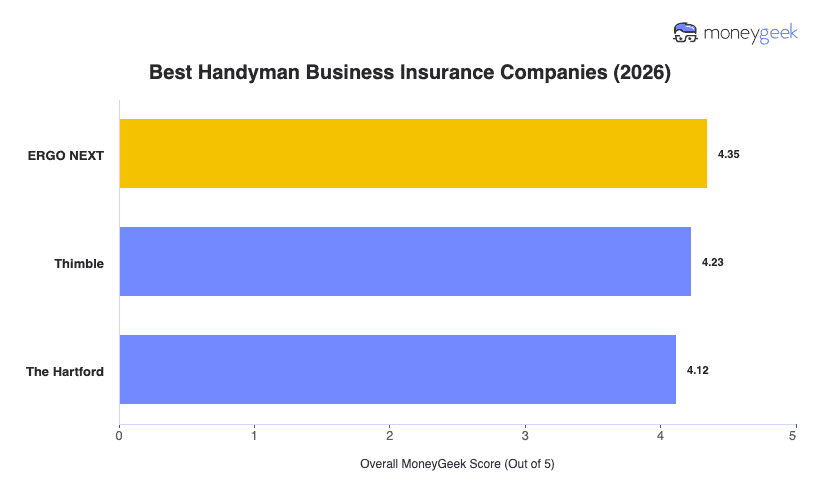
I analyzed seven providers across cost, customer experience and coverage options to identify the best handyman business insurance companies. While ERGO NEXT ranks first overall, that doesn't automatically make it the right choice for every handyman business. If you're starting out and jobs aren't regular, Thimble might be a better fit since it has short-term coverage terms. But if you have a crew working on rental-unit turns or higher-value installation jobs, The Hartford could be a better choice.

Use the table to compare provider fit against how your business actually works:

ERGO NEXT
Best for Most Handymen
4.35
$172
Same-day online coverage with instant certificates of insurance.
Thimble
Best Short-Term Coverage for Handymen
4.23
$194
Flexible coverage terms by the job, day, week, month or year, with the option to pause coverage between jobs.
The Hartford
Best for Growing Handyman Operations
4.12
$269
Has the most coverage options for handymen, with stronger claims support for growing crews.

These rankings are excellent reference points, but they should be used as a starting point, not automatic answers. ERGO NEXT or Thimble could be the better choices if you're watching your cash flow, while The Hartford might fit your handyman business better once you need more coverage in your mix and are comfortable paying a higher average premium. The provider summaries below show where each insurer is strongest and when you should consider other options.

For our overall best handyman business insurance ratings, we compared insurers across pricing, customer experience and coverage options for small handyman operations. Our ratings focus on businesses with one to four employees and include all 50 states plus Washington, D.C., while using broader industry and location data to keep comparisons consistent.

We evaluated over one million business profiles, more than 100,000 customer experience data points and coverage contracts and endorsements across 408 sub-industries. Each provider’s overall score reflects affordability (50%), customer experience (30%) and coverage options and terms (20%).

See our full methodology.

ERGO NEXT

ERGO NEXT

Best for Most Handymen
On ERGO NEXT's site

ERGO NEXT ranks first in my analysis of handyman business insurance companies, with top scores in customer experience and affordability. Its app lets you generate a certificate, add additional insureds and file claims. You don't need to speak to an agent to get your business covered, which only takes minutes. ERGO NEXT also offers the most affordable rates on average, saving most handymen $68 per month. 

While it doesn't have the widest coverage breadth among the providers in our study, it still ranks third for coverage options. You can get general liability, workers' comp, commercial auto and tools and equipment coverage in one place, though handymen doing permitted or licensed work will need to purchase a general contractor policy instead, which covers a broader scope of trade work.

Learn More: ERGO NEXT Business Insurance Review

Thimble

Thimble

Best Short-Term Coverage for Handymen

Ranking second in our study, Thimble is the only provider we analyzed that lets handymen buy coverage by the job or month and cancel without penalty. That makes it a practical fit if you work intermittently and don’t want to pay for a full year of coverage you may not use. It’s also affordable, with rates around 29% lower than the industry average.

You can buy coverage through Thimble’s app or website, or by phone if you want help from an insurance agent. Claims support, however, is a weaker point. BBB complaints often mention long resolution timelines and unanswered callbacks. Coverage options are also limited since Thimble only offers general liability, cyber insurance and inland marine insurance to handymen.

Learn More: Thimble Business Insurance Review

The Hartford

The Hartford

Best for Growing Handyman Operations
On The Hartford's site

The Hartford ranks third overall among carriers in our handyman insurance company study. It has the widest range of coverage options, with policies that specifically cater to handyman businesses. The The Hartford's General Liability Choice with Contractors' Broad Form Endorsement (HS 24 50), which adds coverage features beyond a standard general liability policy, including per-project and per-location aggregate limits, limited professional liability and extended contract-related protections. You can also get contractors' equipment coverage that's an inland marine policy that protects tools and equipment used away from your main business location.

While you can't complete all policy purchases without talking to an agent, The Hartford makes a claims team available for you with phone access and field adjusters for more complex disputes. The extra support could make a higher premium worthwhile. On average, The Hartford costs 3% lower than the industry average, which only saves about $10 per month.

Learn More: The Hartford Business Insurance Review

Best Types of Insurance For Handymen

Where you work, what you bring to the job and whether you have help changes what should be in your ideal policy mix. If you work solo and mostly do small home repairs, a lean bundle with general liability, tools coverage and the right auto coverage. But if you installs cabinets, work in rental units or bring a crew to job sites, you'll need workers’ comp, an installation floater or higher liability limits from a provider with broader coverage options.

I've put together a table that breaks this down so you see how your ideal mix and providers change:

Solo or Part-Time Residential Handymen
One-person businesses, side-gig handymen and small residential repair work like furniture assembly, drywall patching, fixture swaps and basic maintenance.
General liability, tools and equipment coverage, commercial auto if the business owns a work vehicle; HNOA if you use a personal, rented or borrowed vehicle for jobs
If you work in people’s homes, even small jobs can lead to a claim. You could scratch a floor, damage a wall, leave a tool where someone trips or lose equipment from your vehicle. This bundle keeps the focus on basic liability, tools and business driving.
ERGO NEXT or Thimble
Handyman Businesses With Employees
Small handyman crews with helpers, apprentices or regular workers who assist with repairs, hauling materials, cleanup or job-site setup.
General liability, workers’ comp, tools and equipment coverage, commercial auto if the business owns work vehicles
Once someone helps you on jobs, employee injuries become part of your insurance needs. A helper could fall from a ladder, strain their back moving materials or get hurt using a power tool. Workers’ comp is the main coverage that changes when you add employees.
The Hartford
Commercial and Property Maintenance Handymen
Repair or maintenance work for landlords, HOAs, apartment buildings, offices, shops or other business clients.
General liability, tools and equipment coverage, workers’ comp if employees help, commercial auto if the business owns work vehicles; umbrella coverage if contracts require higher liability limits
Business clients may expect more than basic proof of insurance. If you work in rental units, offices or shared spaces, one mistake can affect tenants, customers or building property. This bundle helps cover your work, tools, driving and any higher limits a contract may require.
The Hartford
Installation-Focused Handymen
Projects involving cabinets, shelves, doors, fixtures, built-ins or materials that may be moved, stored or left at the job site before completion.
General liability, tools and equipment coverage, installation floater if materials or fixtures are stored, transported or waiting to be installed; workers’ comp if employees help
Installation work can involve materials that cost more than a typical repair. If cabinets, fixtures or built-ins are damaged before the job is finished, a basic policy may not be enough. An installation floater can help cover those materials while they’re in transit, stored or waiting to be installed.
The Hartford

How Your Best Insurance Changes As Your Handyman Business Grows

More people, tools, vehicles and client requirements create new coverage needs, so policies in your mix changes as your business grows. In turn, when your bundle changes, so does the provider that best matches it. A solo handyman may only need a lean policy for customer claims, tools and business driving, but if you're handling multiple crews, you needs provider that has more coverage options and higher limits. 

I've detailed this in the table below so you can see how it all comes together.

Owner-Operated Handyman Business
You handle the work yourself, from quoting the job to buying supplies and finishing the repair. Most jobs are smaller residential repairs, maintenance tasks or minor installs.
General liability, tools and equipment coverage, commercial auto if the business owns a work vehicle; HNOA if you use a personal, rented or borrowed vehicle for jobs.
ERGO NEXT or Thimble
Handyman Business With Helpers or Employees
You still work in the field, but you now have someone helping with setup, cleanup, hauling materials or basic repair tasks. This is the point where employee injuries and payroll start affecting your insurance needs.
General liability, workers’ comp, tools and equipment coverage, commercial auto if the business owns work vehicles.
The Hartford
Established Handyman Business With Repeat Clients
Your work is steadier, and jobs may come from the same landlords, HOAs, property managers or small businesses. You may be asked for proof of insurance more often because clients rely on you for recurring repairs or maintenance.
General liability with higher limits, workers’ comp if employees help, tools and equipment coverage, commercial auto, installation floater if materials are stored or transported before installation.
The Hartford
Multi-Crew Handyman Business
You’re coordinating more than one crew, vehicle or job site at a time. At this size, tools move between workers, schedules overlap and you may need a garage, storage unit, shop or warehouse for equipment and materials.
General liability with higher limits, workers’ comp, commercial auto, tools and equipment coverage, umbrella if contracts require higher limits, commercial property if you have a dedicated business location or storage setup.
The Hartford

Best Handyman Insurance Buying Checklist

Before choosing a handyman business insurance policy, use the checklist below to sort through your coverage needs, requirements and quote details. You can also download the PDF version if you want a copy to save, print or use while comparing providers.

Download: Handyman Business Insurance Buying Checklist

  1. 1

    Assess Your Handyman Businesses’ Risks

    Start by walking through the jobs you take in a normal week. Look at where you work, what tools you bring, whether you drive for jobs and whether anyone helps you. If you’re renewing coverage, check for any changes in your business since your last quote or policy review. New helpers, a dedicated work truck, pricier tools, landlord jobs or larger installs can change the coverage your handyman business needs.

  2. 2

    Match Risks to Coverage Types

    Choose coverage based on what could actually go wrong on your jobs. General liability can help if you crack a client’s tile, damage drywall, scratch flooring or leave a tool where someone trips. Tools and equipment coverage can help replace gear like your drill set or ladder, if someone steals them from your truck or job site. 

    If you have employees, you’ll need workers’ comp for job-related injuries, such as ladder falls, cuts from tools, back strains from carrying materials or burns from repair work. Add either commercial auto or hired and non-owned auto (HNOA) to your bundle depending on whether you use a business-owned, personal, rented or borrowed vehicle for work.

  3. 3

    Check Requirements and Set the Right Limits

    Homeowners who hire you to patch drywall, mount TVs, repair screens or assemble furniture might not ask if you have insurance, but HOAs, property managers and commercial clients are more likely to require proof of coverage. These clients may also require higher liability limits before you can start work. Contracts may ask for proof of workers’ comp, additional insured wording or coverage for materials before installation. 

    Once you know your handyman business insurance requirements from state rules, contracts or clients, treat them as your minimum. Then use the risks you outlined earlier to choose limits that fit the work you take on.

  4. 4

    Compare Provider Fit

    Price is only one factor when choosing a provider. Affordable handyman insurance loses its value if your provider has limited coverage options and you have to piece together the rest of your policy elsewhere. A provider with a wider coverage mix can also create problems if you can’t reach someone when you need a policy change, certificate of insurance or claim help.

  5. 5

    Request Quotes and Review Policy Details

    Request quotes using the same business details, including your services, payroll, tool value, vehicle information and coverage limits, so you can compare providers fairly. Before buying, review what each quote excludes, not just what it covers. Check for limits or exclusions tied to stolen tools, subcontracted work, faulty workmanship or materials for installation.

Best Handyman Business Insurance: Bottom Line

ERGO NEXT, Thimble and The Hartford are the best handyman business insurance providers based on my analysis, but the right choice depends on how your business operates. Simple residential repair businesses typically prioritize affordability, fast quotes and easy proof of insurance, while handyman businesses with crews, commercial clients, vehicles or installation work need a provider with more coverage breadth and stronger claims support. Treat your requirements and risks as the starting point, then look for the provider whose coverage, service and price best fit that insurance mix.

Best Handyman Business Insurance Chart

Best Handyman Business Insurance: Next Steps

If you’re still comparing options, step back and look at whether your current policy mix matches the jobs you accept. You might find that a lower-cost policy works for small home repairs, or that tools coverage, auto coverage or workers’ comp changes the value of a bundle.

If you’re ready to buy, use the coverage types, limits and client requirements you’ve identified to compare quotes side by side. The strongest choice is the policy that fits your jobs, documents and claim risks without leaving major gaps.

If your quotes list different services

If you take larger installation jobs

If a client needs proof before work starts

If one provider cannot cover everything

About Angelique Palenzuela-Cruz


Angelique Palenzuela-Cruz, Business Insurance Writer, MoneyGeek

Angelique Palenzuela-Cruz is a Business Insurance Content Writer at MoneyGeek, where she specializes in general liability, workers’ compensation and professional liability insurance. Her work helps small business owners understand how these policies apply to coverage, including risks like customer injuries, employee injuries, professional mistakes, client contract terms and industry-specific coverage requirements.
She primarily covers service-based businesses where liability and employee coverage decisions are especially important, including cleaning, consulting, beauty and wellness, childcare, education, fitness, food service, pet care, repair and maintenance, and other professional services.
Before joining MoneyGeek, Angelique spent nearly 12 years at Guthrie-Jensen Consultants, one of Southeast Asia’s largest management training firms, where she advanced from Training Consultant to Managing Consultant. In that role, she worked with business clients to assess operational needs, develop training programs and present performance analyses to executive decision-makers. She also helped establish Gladwin Training Consultancy, where she served in learning solutions and client service roles.
Her background gives her practical context for writing about how businesses operate, manage client expectations, structure teams and make risk decisions. At MoneyGeek, she applies that experience to business insurance content, connecting coverage to actual business needs.

LinkedIn: linkedin.com/in/ma-angela-cruz

Email Contact: angelique.palenzuela@moneygeek.com