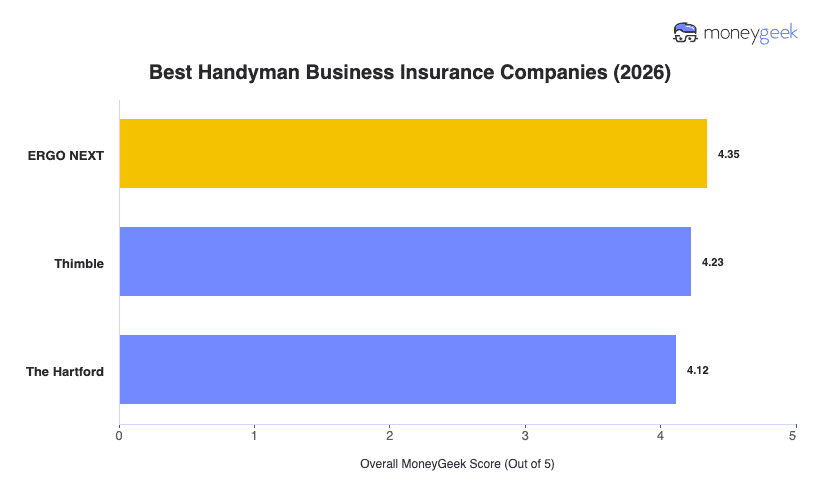

Handymen fix leaks, hang cabinets and patch walls (sometimes all in the same week). Each job brings its own risks. Here's the insurance coverage you need and how much to carry:
What Insurance Do You Need For a Handyman Business?
The types of insurance a handyman business needs most include general liability, workers' comp, tools and equipment and commercial auto.
Get matched to the top handyman business insurance companies for your needs below.

Updated: November 14, 2025
Advertising & Editorial Disclosure
General liability insurance is the most critical coverage for handyman businesses due to high property damage risks from drilling, cutting and installation work. (Read More)
Handyman businesses commonly require workers' compensation, commercial auto insurance and general liability coverage mandated by law or client contracts. (Read More)
Optional coverage handyman businesses should consider includes tools and equipment insurance, professional liability insurance and commercial property insurance.
To ensure compliance, get certificates of insurance from your insurer, submit proof to clients and licensing boards, and keep coverage active without lapses. (Read More)
What Insurance Types Are Needed For a Handyman Business?
Property damage and injuries when working inside clients' homes, like knocking over vases while carrying ladders or drilling into hidden plumbing. Protects you from claims when your work damages expensive belongings or causes injuries. | $1 million to $2 million per occurrence or $2 million to $3 million aggregate. | Your ladder slipped while installing a ceiling fan, damaging a $4,200 table, cracking $2,800 in tiles and breaking a $1,500 chandelier. Rental furniture during repairs cost $3,200. General liability covered all $18,200. | |
Power tools, hand tools, ladders and supplies at job sites, in your vehicle or in storage. Covers theft and damage to equipment you transport daily. | $15,000 to $30,000 based on tool inventory value. | Thieves stole $8,400 in power tools, $3,600 in hand tools, a $2,200 generator and $1,800 in specialty equipment from your van. You lost $2,400 in revenue during three days without tools. Insurance reimbursed $17,500 within five days. | |
Medical costs and lost wages for work-related injuries like cuts from power tools, ladder falls, back injuries or electrical shocks. Required by law in most states once you hire employees. | State-mandated amounts covering 100% of approved medical expenses and two-thirds of lost wages. | Your employee fell from a ladder while repairing gutters, fracturing his wrist and suffering a concussion. Emergency treatment, orthopedic care and physical therapy totaled $26,800, plus $9,200 in lost wages. Workers' comp covered all $36,000. | |
Accidents when driving to job sites, transporting tools or running business errands. Required by law in 49 states for business vehicles. | $1 million combined single limit with comprehensive and collision coverage. | You rear-ended another vehicle while rushing to a client appointment, causing $28,000 in medical bills, $14,500 in vehicle damage and $19,200 to repair your truck. Damaged tools cost $4,800 and legal fees added $3,500. Insurance covered all $70,000 except your $1,000 deductible. | |
Protection when clients claim your work led to mistakes, like improperly venting a bathroom fan that causes mold or installing shelving that pulls out of walls. Covers claims about workmanship quality and installation errors. | $1 million per claim or $1 million aggregate. | You installed a bathroom exhaust fan but failed to seal the ductwork properly, causing moisture damage three months later. Mold remediation cost $14,800, structural repairs totaled $8,600 and insulation replacement added $5,400. Legal fees brought the total to $41,000, which professional liability covered fully. | |
Your workshop or garage workspace, including stationary equipment like table saws and air compressors, plus stored materials and inventory. Covers property you keep at a fixed business location. | $50,000 to $300,000 based on replacement cost. | A storm dropped a tree through your workshop roof, destroying $18,500 in materials, damaging $12,300 in equipment and ruining $8,700 in inventory. Water damage added $6,400 and building repairs cost $23,600. Commercial property insurance covered all $69,500 minus your $2,500 deductible. | |
Handyman Business Insurance Requirements
Handyman businesses have insurance requirements from state laws, commercial clients and contractual obligations. Requirements vary by state, client type and whether you have employees or business vehicles.
Workers' Compensation Insurance | Required by law in most states once you hire your first employee, with penalties including fines up to $10,000 per employee, criminal charges and business license suspension. Handyman work involves high-risk activities like ladder work, power tool operation and lifting heavy materials. | Coverage amounts are determined by your state. Policies cover 100% of approved medical expenses and typically two-thirds of lost wages during recovery. |
General Liability Insurance | Most commercial clients, property managers, landlords and government contractors require proof of general liability insurance before awarding work or approving contracts. Handyman businesses need this coverage to secure better-paying commercial jobs, though it's not legally mandated by states. | Standard requirement is $1 million per occurrence and $2 million aggregate. High-value commercial properties and government contracts may require $3 million to $5 million in total coverage. |
Commercial Auto Insurance | Required by law in 49 states for business-owned vehicles, and personal auto policies exclude commercial use. Handymen transporting tools to job sites must carry commercial auto insurance or face fines, license suspension and personal liability for all accident costs. | State minimums range from 25/50/10 to 30/60/25 split liability limits. Most handyman businesses carry $1 million combined single limit to satisfy legal requirements and commercial client contracts. |
License and Permit Bonds | Many states and municipalities require bonds before issuing contractor licenses, particularly for work over specific dollar thresholds like $500 in California or $1,000 in Arizona. Bonds guarantee you'll follow building codes, complete contracted work and pay suppliers. | Bond amounts range from $5,000 to $25,000 for general handyman work. California requires $15,000, Oregon requires $10,000 to $75,000 based on project scope, and Washington requires $6,000 for registration. |
Commercial Property Insurance | Landlords require this coverage for businesses leasing workshop space, and lenders require it for financed commercial properties. Handymen must carry property insurance or face lease termination and loan default. | Coverage ranges from $50,000 to $300,000 based on replacement cost. Lenders require coverage equal to the loan balance or full replacement cost, whichever is greater. |
Contractor Bonds for Specific Projects | Commercial clients, government agencies and property management companies require project-specific performance bonds before awarding contracts. Government contracts almost always mandate bonding before work begins. | Bond amounts typically equal 50% to 100% of contract value. Residential projects require $10,000 to $25,000, commercial projects require $25,000 to $100,000, and government contracts often mandate full contract value. |
Professional Liability Insurance | Required by commercial clients contracting design-build services, engineering work or system planning beyond basic installation. General contractors and building owners mandate this when your work includes system design or code compliance consulting. | Most design-build contracts require $1 million to $2 million per claim. Government projects, healthcare, education and critical infrastructure require $3 million to $5 million in coverage. |
How To Ensure Handyman Business Insurance Requirements Are Met
Meeting handyman insurance requirements means proving your coverage to clients and keeping policies active. Below is a step-by-step guide for maintaining compliance with legal requirements, client contracts and licensing needs.
- 1Request Certificates of Insurance (COI) from your insurance provider
Request a Certificate of Insurance from each insurer immediately after purchasing policies and save digital copies on your phone. Handymen often get same-day job requests from property managers who need proof of insurance before you arrive, so having COIs readily available prevents lost opportunities.
- 2Submit proof of insurance based on client type and job value
Commercial clients like property managers, retail stores and office buildings always require COIs before you start work, while residential homeowners rarely ask. Handymen in states with licensing thresholds, like California's $500 or Arizona's $1,000, submit COIs to licensing boards only for jobs above those amounts, not for smaller repairs.
- 3Add additional insureds for property management and commercial accounts
Property management companies require being named as additional insured on your general liability policy. Handymen servicing multiple properties may need to add 10 to 20 different management companies annually, with each endorsement costing $25 to $50 and processing within 24 to 48 hours.
- 4Keep coverage active to protect tools between jobs
Pay premiums on time to maintain continuous coverage, as coverage lapses leave you personally liable when tools are stolen from your truck between jobs. Handymen juggling 5 to 10 jobs weekly face potential claims from multiple clients if accidents occur during a coverage gap.
- 5Update COIs proactively as your business grows
Request new certificates 30 to 60 days before renewals and send updated COIs to property management clients, commercial accounts and landlords. Also request new COIs when hiring your first employee, purchasing expensive equipment or landing contracts requiring higher liability limits than your current policy provides.
Get Business Insurance You Need For Your Handyman Business
You can get matched to handyman insurance providers using our tool below. Compare quotes from multiple insurers, research costs for your specific services and find providers experienced with handyman contractor coverage.
Get Matched To The Best Handyman Business Insurer For Your Needs
Select your industry and state to get a customized handyman business insurance match and get quotes.
About Mark Fitzpatrick

Mark Fitzpatrick, a Licensed Property and Casualty Insurance Producer, is MoneyGeek's resident Personal Finance Expert. With over five years of experience analyzing the insurance market, he conducts original research and creates tailored content for all types of buyers. His insights have been featured in publications like CNBC, NBC News and Mashable.
Fitzpatrick holds a master’s degree in economics and international relations from Johns Hopkins University and a bachelor’s degree from Boston College. He's also a five-time Jeopardy champion!
He writes about economics and insurance, breaking down complex topics so people know what they're buying.