


GEICO is the cheapest car insurance provider for 30-year-old drivers based on MoneyGeek’s analysis. It has an average cost of $43 per month for a state minimum, liability-only policy. But the cheapest option depends on your desired coverage. This comparison shows the best rates for 30-year-olds across coverage types.
Cheap Car Insurance for 30-Year-Olds
Updated: August 1, 2026
Advertising & Editorial Disclosure
Key Takeaways
GEICO, Travelers and National General are the cheapest car insurance providers for 30-year-olds.
Travelers is the best cheap car insurance provider for 30-year-olds who value customer service, earning a MoneyGeek score of 94 out of 100.
For 30-year-olds, a state minimum liability-only policy costs an average of $61 for males and $63 for females with good credit and a clean driving record.
Cheapest Car Insurance for 30-Year-Olds
Data filtered by:
State Minimum Liability Only
| GEICO | $43 | $522 | -35% |
| Travelers | $50 | $601 | -25% |
| National General | $50 | $605 | -25% |
| State Farm | $51 | $616 | -24% |
| Amica | $56 | $670 | -17% |
| Chubb | $61 | $728 | -10% |
| Kemper | $62 | $744 | -8% |
| Progressive | $67 | $802 | 0% |
| AAA | $69 | $822 | 2% |
| Nationwide | $71 | $852 | 6% |
| Farmers | $78 | $938 | 16% |
| Allstate | $81 | $971 | 21% |
| AIG | $81 | $972 | 21% |
| UAIC | $119 | $1,433 | 78% |
GEICO charges $43 per month. The next four providers, Travelers, National General, State Farm and Amica, all price between $50 and $56. At a difference of $7 to $13 per month, price alone may not be the deciding factor. Customer service scores and coverage options are worth comparing in that range.
Cheapest Car Insurance for 30-Year-Olds by State
The cost of car insurance for 30-year-olds varies by state. For instance, MoneyGeek found that the cheapest provider in Wyoming is GEICO, at an average monthly cost of $14, while the cheapest in Florida is Travelers, at an average monthly cost of $51.
Data filtered by:
State Minimum Liability Only
Alabama
| AIG | $22 | $268 | -60% |
Use the state filter in the table to find your state. The provider shown has the lowest average monthly rate for 30-year-olds in that state.

MONEYGEEK EXPERT TIP
Premiums vary widely by state, and some providers may not offer coverage in your area. To find the cheapest car insurance companies, compare at least three similar quotes to get the best deal. Use an auto insurance comparison tool to compare quotes quickly and easily.
Best Car Insurance for 30-Year-Olds
MoneyGeek’s analysis found that Travelers is the best car insurance for 30-year-olds if you value customer service more than affordability. Travelers balances affordability and customer service with a MoneyGeek score of 94 out of 100 and an average cost of $50 for a state-minimum liability-only policy.
Data filtered by:
State Minimum Liability Only
| Travelers | $50 | 93.54 |
| Amica | $56 | 91.4 |
| GEICO | $43 | 91.19 |
| Progressive | $67 | 90.33 |
| State Farm | $51 | 88.9 |
| Chubb | $61 | 87.93 |
| National General | $50 | 86.77 |
| Farmers | $78 | 86.26 |
| Nationwide | $71 | 85.38 |
| AAA | $69 | 83.16 |
| Allstate | $81 | 82.63 |
| AIG | $81 | 79.93 |
| Kemper | $62 | 78.9 |
| UAIC | $119 | 67.35 |

Travelers
MoneyGeek Score:
94/ 100
Overview
Travelers has written policies across home, auto and boat insurance for 165 years. It operates through a national network of agents and provides nationwide accessibility.
Travelers costs $7 more per month than GEICO for minimum coverage ($50 versus $43), but it earned a MoneyGeek score of 93.54 compared to GEICO's 91.19. For drivers who put customer service above price, Travelers is the stronger choice.
How Much Does Car Insurance Cost for 30-Year-Olds?
MoneyGeek found that it costs an average of $61 per month to insure a 30-year-old male driver with a state-minimum liability-only policy. A 30-year-old female with the same policy pays an average of $63 per month.
Coverage level, driving history, location and credit score all affect your final rate. Filter by gender, credit score and driving record to see rates for your profile.
Data filtered by:
Female
Good
Clean
| State Minimum Liability Only | $63 | $753 |
| State Minimum Liability w/ Full Cov. w/$1,000 Ded. | $75 | $902 |
| State Minimum Liability w/ Full Cov. w/$2,000 Ded. | $99 | $1,185 |
| 100/300/100 Full Cov. w/$1,000 Ded. | $126 | $1,517 |
| 50/100/50 Full Cov. w/$500 Ded. | $127 | $1,529 |
| State Minimum Liability w/ Full Cov. w/$250 Ded. | $130 | $1,561 |
| 300/500/300 Full Cov. w/$1,500 Ded. | $141 | $1,692 |
| State Minimum Liability w/ Full Cov. w/$0 Ded. | $153 | $1,836 |
At 30, gender has almost no effect on your rate. Male drivers pay $61 per month for minimum coverage. Female drivers pay $63. But a male driver moving from minimum coverage to full coverage with a $1,000 deductible jumps from $61 to $125 per month. That means the impact of choosing a higher coverage level is far larger than the cost difference between genders.
*Some states prohibit insurers from using gender in pricing. If you live in one of those states, male and female drivers with the same profile pay the same rate. Check your state's insurance department website to confirm the rules where you live.
Auto Insurance for 30-Year-Olds: Buying Guide
Insurance companies weigh age heavily for younger drivers, but that changes by 30. What moves it now is how you manage your coverage and your driving record. These tips show you where to focus to get cheap car insurance.
How to Get Cheap Car Insurance for 30-Year-Olds
Experienced 30-year-olds often pay lower car insurance rates, but there are ways to reduce premiums further.
- 1Shop Around
Get quotes from at least three insurers before buying. A car insurance comparison tool pulls rates from multiple companies at once, which is often the fastest way for 30-year-olds to find a lower premium.
- 2Maintain a Clean Driving Record
Avoiding tickets and accidents is one of the most direct ways to keep rates down. A single speeding ticket raises premiums 18% to 30%. More serious violations, reckless driving or DUIs, push rates even higher and can follow your record for years.
- 3Ask About Discounts
Many insurers offer discounts that don't require much effort to claim. Completing a defensive driving course earns a rate reduction at many insurers, and cars with anti-lock brakes or anti-theft systems often qualify for safety discounts at purchase.
- 4Bundle Policies
Adding homeowners or renters insurance to your auto policy with the same insurer usually qualifies you for a multi-policy discount. The savings vary by insurer, but bundling is one of the more reliable ways to cut your total insurance costs.
- 5Review and Update Your Policy Regularly
Moving, changing jobs or adding a driver to your household all affect your rates and coverage needs. An annual policy review catches gaps, removes coverage you no longer need and can surface discounts you've newly become eligible for.
- 6Maximize No-Claim Bonuses
Each year without a claim can earn a no-claim bonus that lowers your premium. For drivers in their 30s with clean records, these discounts add up over time and reflect a lower risk profile to insurers.
- 7Adjust Your Coverage Amount
Minimum coverage costs less but excludes comprehensive and collision, so any repair bill after an at-fault accident comes out of pocket. For older or lower-value vehicles, dropping full coverage often makes financial sense.
- 8Choose a Sedan Over a Sports Car
Sports cars and luxury vehicles carry higher insurance rates than sedans. Get quotes on any vehicle you're seriously considering before buying. The difference in annual premiums can be large enough to affect the decision.
MONEYGEEK EXPERT TIP
Car insurance quotes vary between companies because each one uses its own way of calculating risk. To get the most accurate quote, share these details so insurers can match rates to your coverage needs:
- Age
- Gender
- Location
- Vehicle information
- Driver’s license number
- Other household drivers
Car Insurance Discounts for 30-Year-Olds
Most insurers offer discounts that help lower your premium. Review what’s available before choosing a policy. Some of the most common discounts include:
 Defensive driving discount
Many insurance companies provide discounts to drivers who have completed state-approved defensive driving courses.
 Accident-free discount
Keep a clean driving record to qualify for this discount with most insurers due to lower risk.
 Multi-policy discount
Bundle different insurance policies, such as home and auto insurance, to qualify for a multi-policy discount. Insure multiple vehicles with the same carrier to qualify for an additional discount with some insurers.
 Telematics or usage-based discount
Insurance companies with telematics programs that track safe driving habits usually give discounts to drivers who participate. If you don't drive much, check if you qualify for a low-mileage discount.
 Pay-in-full discount
Insurers usually offer discounts to clients who pay their premiums upfront instead of in monthly installments.
Cheap Auto Insurance for 30-Year-Olds: Bottom Line
GEICO has the cheapest car insurance for 30-year-olds, averaging $43 per month for minimum coverage. Travelers, National General and State Farm also provide affordable options, with Travelers earning high marks for customer service.
Your state and coverage level both affect your rate, as does your driving record. Start with GEICO for the lowest price and Travelers if customer service matters more. Get quotes from multiple providers to find the best deal.
Car Insurance for 30-Year-Olds: FAQ
GEICO offers the lowest rates for 30-year-olds at $43 monthly or $522 annually for minimum coverage.
The average cost of car insurance for 30-year-olds is $61 for males and $63 for females for a state-minimum, liability-only policy. This is based on drivers with good credit and a clean driving record.
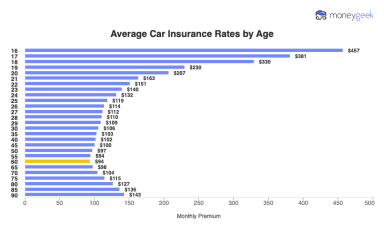
Insurance rates drop as you gain driving experience and keep a clean record. Age matters less after 25, but 30-year-olds still pay lower premiums than younger drivers because insurers see them as more experienced and less risky.
Young men pay higher car insurance rates because they have riskier driving statistics. This gap shrinks by age 30 as insurers focus more on driving history and vehicle choice than gender.
Older cars are usually cheaper to insure because their lower value decreases the potential payout in case of a claim. Safety features and theft risk can also affect premiums.
Best Car Insurance for 30-Year-Olds: Our Review Methodology
Why Trust MoneyGeek?
MoneyGeek's analysis uses data from Quadrant Information Services and state insurance departments. We evaluated rates across different driver profiles and locations to show why comparing quotes matters. Rates vary widely between insurers for the same driver profile.
Study Overview
We gathered and analyzed rate data using a sample driver profile to calculate national and state averages. Our review focused on:
- Minimum coverage insurance costs
- How minimum and full coverage rates compare
- Rate changes for high-risk drivers with accidents or tickets
Data Sources and Scope
We gathered 1,904 quotes from six insurers across 100 ZIP codes, drawing on data from state insurance departments and Quadrant Information Services.
Driver Profile
We used a sample driver profile to find the average annual insurance costs based on this profile:
- Toyota Camry LE
- Clean driving record
- 12K miles driven annually
We modified this profile by location, coverage type and amount to identify average costs for drivers across the U.S. who have different coverage needs.
Coverage Levels and Deductibles
A deductible is what you pay out of pocket before your insurer covers the rest of a comprehensive or collision claim. Adding both to your policy, known as full coverage, gives you the broadest financial protection available.
100/300/100 is shorthand for:
- $100,000 bodily injury liability per person
- $300,000 bodily injury liability per accident
- $100,000 property damage liability
50/100/50 is shorthand for:
- $50,000 bodily injury liability per person
- $100,000 bodily injury liability per accident
- $50,000 property damage liability
National averages: Calculated with 100/300/100 full coverage and a $1,000 deductible.
State-specific data: Based on 50/100/50 full coverage and a $1,000 deductible.
Liability coverage pays for damages you cause to others and does not include deductibles. It doesn't include comprehensive and collision.
MoneyGeek's full methodology explains how we weighted cost, satisfaction and coverage data to produce these rankings.
Affordable Car Insurance for 30-Year-Olds: Related Articles




About Mark Fitzpatrick

Mark Fitzpatrick, a licensed Property and Casualty (P&C) Insurance Producer in Connecticut, is MoneyGeek's resident expert in insurance and economics. He has spent nearly a decade covering the market, first at LendingTree and now at MoneyGeek, where he analyzes hundreds of carriers and millions of rates across auto, home, renters, health and life insurance.
His work has appeared in The Washington Post, The New York Times and NPR. He draws on independent cost and consumer experience data, and no insurance company partnerships affect his recommendations.
Mark studied at Boston College before earning a master's in economics and international relations from Johns Hopkins University. Before MoneyGeek, he worked in financial risk management at State Street. He's also a five-time “Jeopardy!” champion.
Sources
- GEICO. "Car Insurance Discounts." Accessed May 15, 2026.
- State Farm. "Take Control of Your Auto Insurance Discounts From State Farm®." Accessed May 15, 2026.