Compound Interest Calculator

Estimate your savings or spending through our compound interest calculator. Enter your initial amount, contributions, rate of return and years of growth to see how your balance increases over time.

After 10 years, your total balance is $29,542
After 10 years
your total balance is 
$29,542
Growth Over Time
Initial Amount
Total Contributions
Total Interest Earned

Compound Interest Calculator

Updated: July 28, 2026

Advertising & Editorial Disclosure

Compound interest means your money earns returns on both your original investment and your accumulated earnings. Your returns generate their own returns. Over time, even small amounts can grow into real wealth.

Our compound interest calculator shows exactly how your savings or debt will grow. Enter your starting amount, contributions and rate of return to see how different timeframes and compounding frequencies affect your balance. Test scenarios instantly with our free online tool.

What Is Compound Interest?

Compound interest is the interest calculated on both the initial principal amount and the accumulated interest from previous periods. This means you earn “interest on interest.” That accelerates the growth of your savings or debt the longer the money sits.

Unlike simple interest, which calculates interest only on the original principal, compound interest adds the earned interest back to the principal balance. Each new calculation uses this larger amount. This “snowball effect” means each interest payment generates more than the last, and the longer your money stays invested, the faster it grows.

The MoneyGeek Compound Interest Calculator is a free online tool. Enter a few details to see how your savings or debt might grow.

Compound Interest Formula

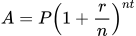
Compound interest calculates the future value of an investment or loan, including all accumulated interest. The formula is:

A = P (1 + r/n)^(nt)

What Each Variable Means

  • A = future value: the total value of your investment or loan, including all accumulated interest
  • P = principal: your starting deposit or loan amount
  • r = annual interest rate expressed as a decimal (5% = 0.05)
  • n = how many times interest compounds per year (12 for monthly, 1 for annual)
  • t = the number of years the money is invested or borrowed

How to Find Interest Earned Only

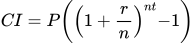
To find your interest earned, subtract your principal from the future value:

CI = P((1+r/n)^(nt)-1)

Formula for Accounts With Regular Contributions

Use this formula to calculate your balance when you make regular contributions:

A = P(1+r/n)^(nt)+c[((1+r/n)^(nt)-1)/(r/n)]
Where:

  • c = the amount of the periodic contribution

Our calculator uses these formulas automatically. If you select monthly contributions, the calculator applies monthly compounding even if the monthly contribution is zero. With annual contributions, the calculator uses annual compounding instead.

How to Calculate Compound Interest

You can run these calculations by hand, but they get complicated fast. Add regular contributions or change how often interest compounds, and you're looking at dozens of calculations for a single 10-year period.

Manual Calculation Example

Say you invest $1,000 at 5% annual interest compounded annually for three years:

Year 1: $1,000 × 1.05 = $1,050
Year 2: $1,050 × 1.05 = $1,103
Year 3: $1,103 × 1.05 = $1,158

Your investment grows to $1,158, earning $158 in compound interest.

Using the formula: A = 1,000(1 + 0.05/1)^(1×3) = $1,158

Why Our Calculator Saves Time

That manual calculation took three steps for just three years with no added contributions. Extend that to monthly deposits or monthly compounding over 10 or 20 years, and you'd need dozens of steps. The compound interest calculator at the top of this page does it automatically.

Enter your starting amount, rate of return, timeframe and contributions to run any scenario. The calculator shows year-by-year growth through bar charts and breaks your balance into a pie chart by source (principal, contributions and interest earned), with a table showing annual totals. Adjust any variable to run different scenarios instantly.

How to Use MoneyGeek’s Compound Interest Calculator

Use our calculator to estimate future interest on savings, investments or debt without working through the formulas yourself.

  1. 1
    Enter Your Initial Amount

    Start with your principal, which is your initial investment or loan amount. Enter $500, for example, to see how that starting balance grows. A higher starting balance gives compounding more to work with.

  2. 2
    Set Monthly or Annual Contributions

    Choose how much you'll add to your investment or pay toward your debt, then select monthly or annual frequency. Monthly contributions compound more often, so they build faster than the same amount contributed annually. Test different amounts to see how your final balance changes.

  3. 3
    Estimate Your Rate of Return

    Enter the annual interest rate you expect to earn or pay. Even a 1% to 2% difference changes your final balance noticeably. Test a few rates. Even a small difference in rate adds up over the years.

  4. 4
    Set the Number of Years of Growth

    Enter how long your money stays invested or how long until you pay off debt. Type “5” for a five-year period. Time matters more than any other input, so try extending your timeline to see how much your returns jump.

  5. 5
    Use the Bar Chart to Explore Growth Over Time

    The bar chart shows your balance year by year. Compound interest builds slowly at first, then accelerates as your accumulated interest begins earning returns.

  6. 6
    Examine the Totals by Source Pie Chart

    The pie chart breaks your total balance into three parts: initial principal (purple), contributions (blue) and interest earned (green). It shows how much of your balance came from growth versus what you put in.

  7. 7
    Review the Table View

    The table breaks down each year's numbers: starting balance, contributions, cumulative contributions, interest earned, cumulative interest and total balance. Use it to follow your balance at each stage.

  8. 8
    Test Different Scenarios

    Adjust contributions, rates or timeframes to compare different approaches. Try front-loading your investment versus spreading contributions over time, or test a higher rate against a lower one. Small changes can shift your final balance by thousands.

Key Calculator Features

The calculator updates results in real time as you adjust any input. Bar charts show year-by-year growth, and pie charts break down your balance by source.

Tables provide detailed annual breakdowns of contributions, interest earned and total balance. Choose monthly or annual contributions and compounding frequency.

How the Calculator Works

The calculator applies the compound interest formula to your inputs period by period. It calculates interest for each interval, adds the result to your balance, then uses that new balance for the next calculation, repeating through your full timeframe.

With monthly compounding, it divides your annual rate by 12 and runs 12 calculation cycles a year. Annual compounding applies the full rate once.

How Compound Interest Works

Compound interest affects your savings and your debt, but the math works in opposite directions.

For Savings and Investments

Compound interest works best for long-term goals like retirement or education savings. The interest you earn in early years starts earning interest of its own, so even small, regular contributions add up to real money. Growth is slow at first, then accelerates as your balance increases.

For Debt

For borrowers, compound interest works the other way. When you don't pay off your balance, interest gets added to what you owe, and the next calculation uses that higher amount. Paying down debt quickly limits how much interest builds on what you owe.

Simple Interest vs. Compound Interest

With simple interest, you earn interest only on your original principal. At 10% annually on $100, you earn $10 a year. After 20 years, you'd have $300: your $100 principal plus $200 in interest.

Compound interest adds your earnings back to the balance, so future interest is calculated on a higher amount. In the second year, you'd earn interest on $110 instead of $100. Over 20 years, that same $100 grows to $673.

The gap between the two methods widens the longer the money sits. Over short periods, the difference is small. Over decades, compound interest produces much higher returns.

Real-World Growth Example

Say you invest $500 at an 8% annual return with monthly compounding. Here's how your cumulative interest grows:

  • Year 1: $42
  • Year 2: $86
  • Year 3: $135
  • Year 4: $188
  • Year 5: $245

Your interest earnings grow each year because your larger balance generates more interest. That gap widens every year you stay invested.

Compound Interest in Cash Value Life Insurance

Permanent life insurance policies with cash value components also use compound interest. With whole life insurance, for example, cash value might grow at 2% to 5% annually with guaranteed returns.

If you pay $3,000 in annual premiums with $2,000 going toward cash value:

  • Year 1: $2,060 cash value (3% growth)
  • Year 5: $10,627 cash value
  • Year 10: $23,160 cash value
  • Year 20: $54,919 cash value

Returns are usually lower than market-based investments, but they're guaranteed and tax-advantaged. Cash value grows without market volatility, and you can access it through loans or withdrawals.

Starting earlier gives the cash value more time to grow. As the example above shows, $2,000 a year directed toward cash value reaches nearly $55,000 over 20 years. That growth helps you weigh whether a permanent life policy justifies the higher premium.

Compound Interest in Insurance Products

Permanent life insurance policies use compound interest to build cash value.

Cash Value Growth in Permanent Life Insurance

Whole life and universal life policies bundle a cash value component with your death benefit. Your premiums pay for coverage and cash accumulation. Cash value grows at rates set in your policy (2% to 5% for whole life).

Universal life policies tie returns to market indexes, so potential returns are higher but not guaranteed. Cash value grows tax-deferred, and you can borrow against it or withdraw funds during your lifetime.

How Life Insurance Cash Value Differs From Investments

Life insurance cash value provides guarantees that traditional investments don't. Your principal is protected in most cases, and policies spell out minimum growth rates in the contract. It won't match long-term stock returns, but it won't lose value either.

These policies bundle coverage with a savings component, which affects both the cost and the net return. Compare permanent life insurance to stocks and bonds based on whether you prioritize protection or growth.

Loading...

About Nathan Paulus


Nathan Paulus, Head of Content and SEO, MoneyGeek

Nathan Paulus is the Senior Director of Content and SEO at MoneyGeek, where he leads content strategy and produces original data research across insurance, consumer costs, transportation safety, housing, public policy and personal finance. He also reviews published studies for methodology, source quality and factual accuracy before they reach readers.

Research and Analysis

In more than six years at MoneyGeek, Nathan has published more than 100 original studies and explanatory guides. His insurance research includes 50-state comparisons of health care outcomes, costs and access, plus an analysis of how uninsured rates track with state Medicaid expansion decisions and electoral patterns. He has analyzed full coverage auto rates across major insurers in all 50 states and tracked how premium trends relate to industry underwriting losses. The analysis draws on combined ratio data from Fitch Ratings and AM Best, plus Bureau of Labor Statistics CPI figures. Beyond insurance, his work spans vehicle pricing trends across the U.S. new car market, summer traffic fatality rates by state, homeowner underinsurance ratios using mortgage and policy data, and housing affordability across all 50 states.

His research has been cited by Bloomberg, the Los Angeles Times, Forbes, Fast Company, the San Francisco Chronicle, USA Today and NBC Los Angeles. Harvard, MIT, Stanford and Yale have referenced his work.

Career

Nathan traces his interest in personal finance back to his grandmother, who ran her household on a simple rule: spend less than you make and save the difference before anything else. That rule shows up in his work today. His writing skips jargon and complex strategy in favor of the basics that help someone living paycheck to paycheck.

He joined MoneyGeek in July 2020 as Director of Content Marketing, where he led the content team and oversaw data journalism production across insurance and personal finance verticals. A promotion to Head of Marketing and Communications followed in December 2023. The new role added digital PR and communications strategy to his scope. He has held his current position, Head of Content and SEO, since January 2025.

Before MoneyGeek, Nathan served as Director of Content Marketing and SEO at Ventrix Advertising, where he helped build two content sites from scratch, contributed to link-building programs that generated more than 1,500 unique referring domains within a year and co-managed a marketing team of more than 20 people. Two and a half years at ABUV Media preceded that role. He advanced from Marketing Research Analyst to Senior Marketing Tactics Analyst, where he developed skills in audience research, content strategy and SEO.