
MoneyGeek analyzed data from the Bureau of Transportation Statistics and the National Highway Traffic Safety Administration (NHTSA) and found that driving at night (from sunset to sunrise) is nine times deadlier than driving during the day. We also explored how the shift from daylight saving to standard time affects evening commute safety and how night-driving danger varies by state.
Driving at Night Is 9 Times Deadlier Than Driving During the Day
Updated: July 30, 2026
Advertising & Editorial Disclosure

KEY FINDINGS
- Night driving is nine times more lethal than daytime driving, based on fatal accident rates relative to traffic volume.
- Night driving risk is highest for drivers in California and Hawaii; there, nighttime driving is 12 times more deadly than daytime driving.
- Evening commutes become 30% more hazardous from September to November, as days shorten and clocks shift from daylight saving to standard time.
Comparing the Danger of Night Driving to Day Driving
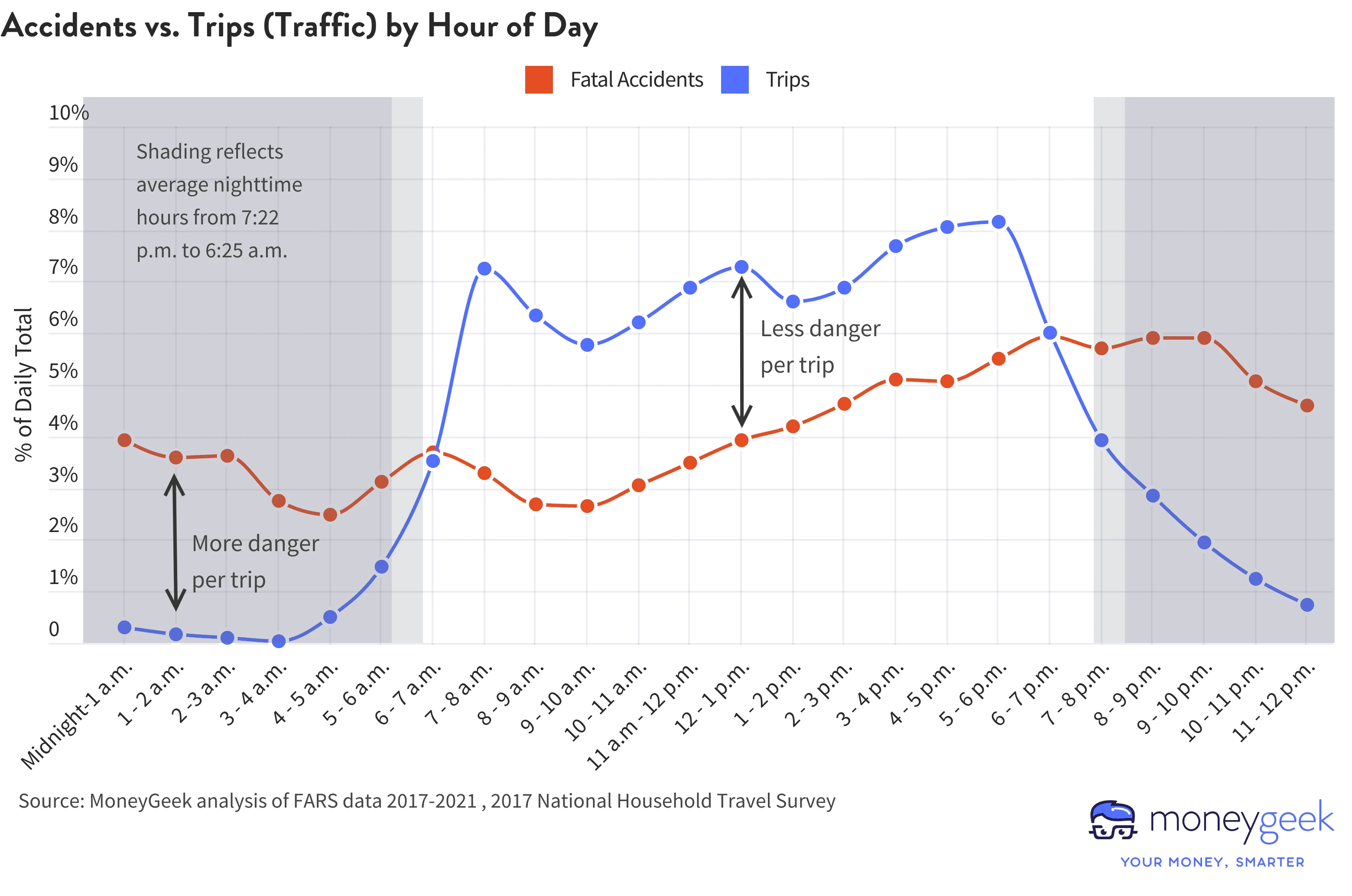
MoneyGeek's analysis found that while just 9% of driving occurs from sunset to sunrise, 49% of fatal accidents happen during this time. Day driving accounts for 83% of trips and 47% of deadly crashes. Fatal accident totals are similar day and night, but far fewer people drive after dark, making nighttime trips nine times more deadly.
Time of Day | % of Trips | % Fatal Accidents |
|---|---|---|
Dawn | 4% | 2% |
Daytime | 83% | 47% |
Dusk | 4% | 2% |
Night | 9% | 49% |
On an hour-by-hour basis, fatal accidents are at their lowest at 9 a.m. and ramp up throughout the day, peaking between 8 p.m. and 10 p.m.

WHY NIGHT DRIVING IS MORE DANGEROUS
MoneyGeek's analysis found that nighttime driving is nine times more deadly than daytime driving, but why is this? Several factors make night driving hazardous:
- Reduced Visibility. At night, reduced light cuts visibility and leaves drivers less time to react to signs, wildlife and pedestrians.
- Drowsy Driving. People get tired at night, and according to the NHTSA,
drowsy driving accidents peak between midnight and 6 a.m. - Drunk Driving. Analysis of fatal accidents found that 70% of fatal drunk driving crashes happen at night. About one in four nighttime fatal accidents involves drunk driving.
Shifting to Standard Time Coincides With Increased Driving Deaths During Evening Commutes
During the fall, weekday commutes bring a double darkness jeopardy: dwindling sunlight as the days shorten and an overnight shift back to standard time. MoneyGeek's analysis of weekday commute data found that driving fatalities surge 30% from September to November.
Falling back from daylight saving to standard time in November means evening commutes can lose up to an hour of daylight. The share of fatal accidents in darkness is 37% in October but jumps to 69% in November. MoneyGeek reviewed commute fatalities from October to November to isolate the impact of the time change and found crash deaths rose 11%, a jump tied to darker evening conditions.
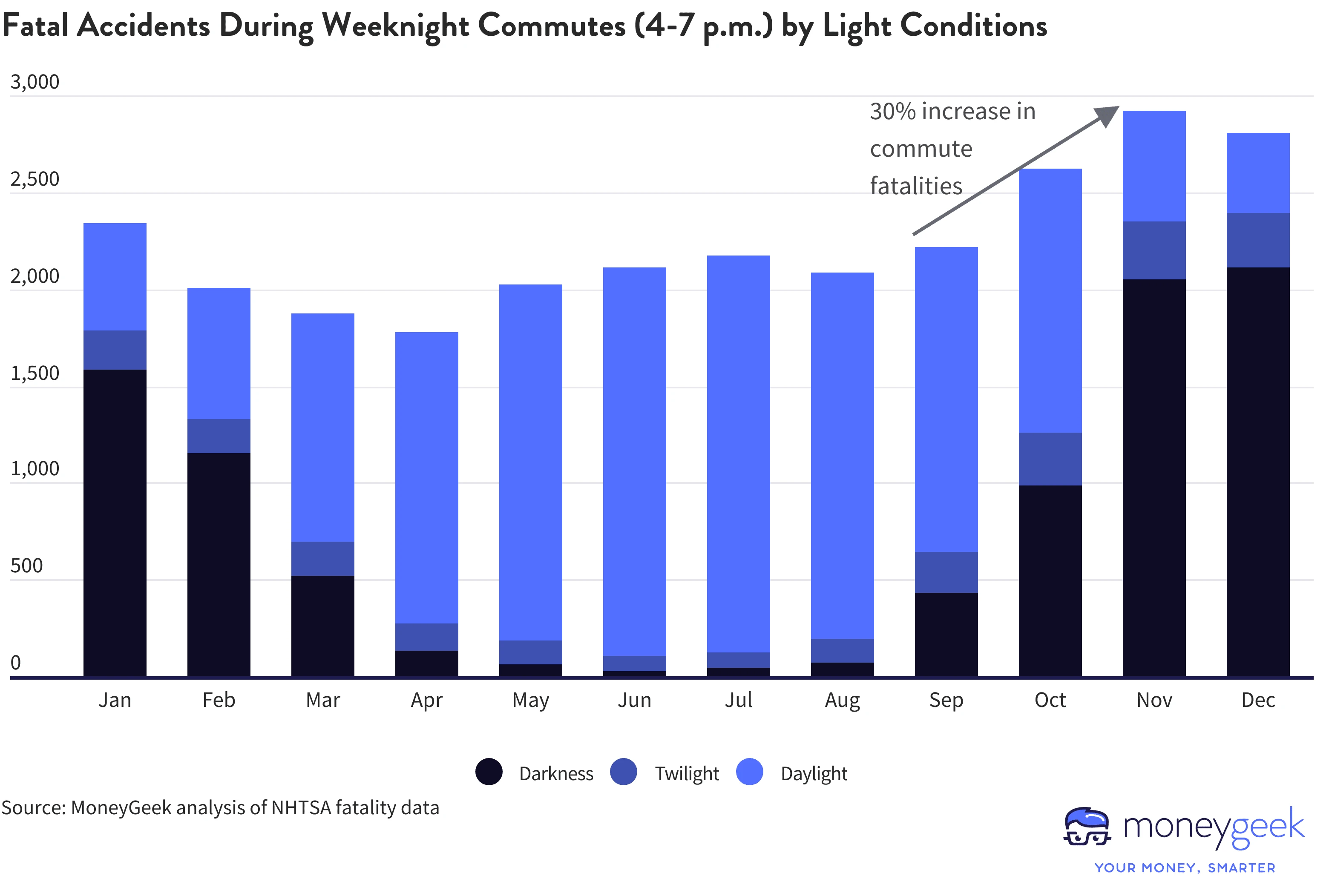
Fatal driving rates at night varied widely by state. In Arizona, a state that doesn't observe daylight saving, fatal accidents still rise 17% from September to November, showing the effect of shorter days. Florida and Texas saw fatal accidents rise more than 70% during the same period.
Night Driving Danger Varies by State
MoneyGeek also investigated whether driving at night is deadlier in some states than others. While night driving is more dangerous than day driving in every state, the risk varies widely. California and Hawaii carry the highest nighttime driving risk: driving at night there is 12 times more dangerous than during the day. Vermont has the smallest gap: nighttime driving there is 3.7 times more dangerous than daytime driving.
12 Most Dangerous States for Nighttime Driving
State | Night Driving
Increased Risk of
Deadly Accidents | |
|---|---|---|
1. | California | 12.1 |
2. | Hawaii | 12.0 |
3. | Florida | 11.2 |
4. | Texas | 10.8 |
5. | Maryland | 10.6 |
6. | Louisiana | 10.2 |
7. | New Jersey | 9.8 |
8. | South Carolina | 9.7 |
9. | Rhode Island | 9.5 |
10. | Nevada | 9.2 |
11. | Delaware | 9.2 |
12. | Connecticut | 9.2 |
Staying Safe and Protected While Driving at Night
Night driving carries far more risk than driving during the day. You can't eliminate every hazard, but these steps can help you stay safe on the road at night:
 Drive at the speed limit
More speed means less time to react. Driving at the speed limit gives you more time to respond to hazards and helps counter the reduced visibility at night.
 Check that your headlights are working
Working headlights are critical for visibility. Keep cabin lights dimmed to protect your night vision, and choose well-lit roads over unlit ones when possible.
 Drive only when you're alert
Plan ahead so you're not driving while tired. If you get drowsy, pull over and rest before continuing. Never drink and drive.
Skipping these precautions raises your crash risk and your costs. Your insurance rates could jump 67% after an accident.
Safe driving reduces your risk, but auto insurance can help cover costs if an accident occurs. Accidents caused by drowsy driving often involve drivers hitting obstacles, not other cars. While minimum coverage and liability-only policies won't cover your vehicle if you're deemed at fault, full coverage policies will.
Methodology
MoneyGeek analyzed 93,554 driving fatalities reported by the NHTSA in the Fatal Accident Reporting System (FARS) from 2017 to 2021, the most recent year of data available.
Night versus day designations in the FARS system are recorded directly in the data set as the light conditions for each accident.
Trip data was collected from the Bureau of Transportation Statistics’ 2017 National Household Travel Survey. Trip times were translated to day, night, dawn and dusk using the NOAA’s solar calculator and the population center of the United States: Hartville, Missouri. Over a full year, daylight hours are roughly equal across the United States.
About Doug Milnes, CFA

Doug Milnes is the head of marketing and communications at MoneyGeek. He has spent more than a decade in corporate finance performing valuations for Duff and Phelps and financial planning and analysis for various companies, including OpenTable. He holds a master’s degree in Predictive Analytics (Data Science) from Northwestern University and is a CFA charter holder. Doug geeks out on building financial and predictive models and using data to make informed decisions.
Sources
- Bureau of Transportation Statistics. "National Household Travel Survey." Accessed July 30, 2026.
- National Highway Traffic Safety Administration. "Drowsy Driving." Accessed July 30, 2026.
- National Highway Traffic Safety Administration. "Fatal Accident Reporting System." Accessed July 30, 2026.
- National Oceanic and Atmospheric Administration. "NOAA Solar Calculator." Accessed July 30, 2026.