



Choose where to jump to based on your needs:
Best Pet Insurance in Illinois
Updated: September 17, 2026
Advertising & Editorial Disclosure
Best Pet Insurance Companies in Illinois
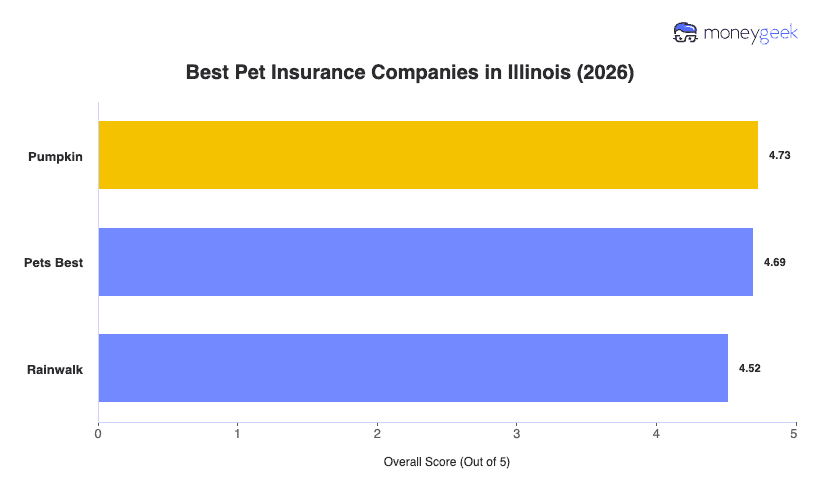
In Illinois, you can get the best pet insurance from the following companies:
- Choose if you want excellent service and expedited reimbursements: Pumpkin
- Choose if you want to lower upfront costs with direct vet payment: Pets Best
- Choose if you want the flexibility to adjust your policy limits: Rainwalk
To determine my top recommendations, I evaluated major providers based on their coverage, including their standard inclusions, options for policy customization and terms for waiting periods and pre-existing conditions. I also compared their average rates and assessed their customer service.
For our best pet insurance ratings, we evaluated affordability, customer experience and coverage across 18 major pet insurers using over 67,000 pet profiles representing mixed breeds and purebreds in Illinois. Our analysis used standard profiles of a 6-year-old Labrador Retriever and 7-year-old Ragdoll with a $5,000 annual limit, $500 deductible and 80% reimbursement rate to ensure consistent comparisons across providers.
We analyzed pricing competitiveness across different breeds and locations, measured customer experience throughout the policy lifecycle from enrollment to claims and assessed coverage options and terms. Each insurer received a composite score based on affordability (50% of overall score), customer experience (30% of overall score) and coverage (20% of overall score).
For a detailed breakdown of the metrics, scoring methodology and analysis approach, see our full methodology.

Pumpkin: Best Pet Insurance Overall
pros
Most affordable pet insurer
Top-tier customer service
Service for expedited claims
cons
Limited reimbursement rate options
Waiting period for accidents is 14 days
COMPANY HIGHLIGHTS
Pumpkin ranks as the best pet insurance in Illinois, providing the strongest balance of affordability and customer experience. At $31 per month, 42% below the state average, it's the most accessible option for Illinois pet owners who don't want to give up excellent service for a lower premium. Plus, the company features Pumpkin Now, which can deposit same-day reimbursements into eligible bank accounts while you're still at the clinic, for eligible claims over $500.
Coverage is where Pumpkin falls behind. It offers few options for deductibles, annual limits and reimbursement rates, which makes it harder to customize your policy structure as your pet ages or as health needs shift over time.
Learn more: Pumpkin Pet Insurance Review

Pets Best: Best Pet Insurance for Direct Vet Payment
pros
Direct vet pay option for lower upfront costs
Short three-day waiting period for accidents
cons
Base plan isn’t as comprehensive as competitors
Frequent issues when submitting claims
COMPANY HIGHLIGHTS
Pets Best earns its place in my recommendations for paying licensed veterinarians directly for covered claims on request. Its Vet Direct Pay feature can help remove the financial strain of bridging the gap between an emergency visit and a reimbursement check. Additionally, its three-day waiting period for accidents gets coverage in place faster than most competitors, so you can be reimbursed for injuries that happen a few days after enrollment.
Customer experience is where Pets Best performs less competitively, with claim submission ease as its weakest area. You may spend more time gathering documents or following up on your claim after a vet visit, adding extra hassle when you’re already dealing with your pet’s recovery.
Learn more: Pets Best Pet Insurance Review

Rainwalk: Best Pet Insurance for Coverage Flexibility
pros
Flexibility for customizing policy limits
Free, unlimited virtual vet visits
cons
Charges extra for exam fee and alternative therapy coverage
Sending reimbursements may take time
COMPANY HIGHLIGHTS
Rainwalk rounds out my best Illinois pet insurance recommendations, providing the widest range of options for policy customization. You can choose from three reimbursement rates, six deductibles and six annual limits, which gives you precise control over your premium, out-of-pocket costs and preferred level of coverage. Rainwalk also offers unlimited, 24/7 access to free televet services, so you can get expert guidance from the comfort of your home.
That said, the company has mid-tier customer service, with claims speed as a notable pain point. This could result in longer waits for reimbursement after a vet visit, leaving you to cover the bill yourself for longer than expected.
Learn more: Rainwalk Pet Insurance Review
Cheapest Pet Insurance Companies in Illinois
Illinois pet owners who want to save on costs can find the most affordable pet insurance from:
- Pumpkin: Pumpkin offers the cheapest pet insurance in Illinois, averaging $31 monthly, which is 42% below the state benchmark. It also provides the lowest rates for Puli owners, saving them 63% compared to the breed average.
- Pets Best: At $32 per month on average, Pets Best places second for affordability in the state, providing 40% in savings against the state average. The company is the lowest-cost option for Burmese cats and Australian Terriers, with rates 61% and 60% lower than the breed averages, respectively.
- Rainwalk: As the third cheapest pet insurer, Rainwalk costs $40 monthly on average, which translates to 25% savings compared to the state average. It’s also the most affordable option for Miniature Bull Terriers, Toy Poodles and Gordon Setters, with savings from 45% to 48% against the breed averages.
Pumpkin | $31 | $371 | 42% |
Pets Best | $32 | $384 | 40% |
Rainwalk | $40 | $483 | 25% |
How Much Does Pet Insurance Cost in Illinois?
On average, Illinois pet insurance costs $53 per month ($640 annually), which is 13% above the national benchmark and lands the state in 44th place for affordability. This rate is aggregated pricing for a 6-year-old Labrador Retriever and a 7-year-old Ragdoll, each with a $5,000 annual limit, $500 deductible and 80% reimbursement rate.
Split by pet type, the state benchmarks are:
- Dogs: $69 per month ($830 annually), 13% above the national dog average
- Cats: $36 per month ($435 annually), 13% above the national cat average
Use MoneyGeek's Illinois pet insurance cost calculator below to find out the average pet insurance cost for your pet's specific profile.
Illinois Pet Insurance Cost Estimate Calculator
Select Blreed
Select Age
Average monthly rate—
Select Blreed
Average monthly rate—
Select Age
Is Pet Insurance Worth It in Illinois?
Pet insurance is worth it in Illinois if you want to avoid paying for the full cost of unexpected veterinary treatment. A policy can reimburse part of your eligible vet bills, helping make expensive care for conditions such as hip dysplasia, ligament tears and cancer more manageable. Whether it makes financial sense for you still depends on your pet's age and health, the policy's cost and your ability to handle large veterinary bills yourself.
The examples below show how quickly treatment costs can add up for Illinois pet owners, according to MoneyGeek’s data:
- Hip dysplasia: $3,464 to $27,720
- Cruciate ligament tear: $5,670 to $13,230
- Cancer (lymphoma): $3,780 to $18,900
- Allergies: $252 to $2,520
- Periodontal disease: $409 to $2,730
If getting coverage is worth it for your situation, use the tool below to find out how much pet insurance you need based on your pet’s species, breed and age.
Pet Insurance Coverage Needs Calculator
Use this calculator to get pet insurance coverage recommendations by entering your pet's species, breed, state and age.

What is your pet type?
Select Pet type
Pet type
Breed
State
Pet Age
How to Choose the Best Pet Insurance in Illinois
The best pet insurance policy for an Illinois pet owner is found by matching coverage to your pet's actual health risks, your budget and the provider's track record when claims come in. Follow these seven steps to make a decision that holds up over time.
- 1Start with your pet's breed, size and health history
Before you compare a single provider, get clear on what your pet is most likely to need. Breed determines health risk profile, age determines vulnerability windows and veterinary history determines what Illinois insurers may classify as pre-existing. Ask yourself:
- Which conditions are most common in your pet's breed? Start with the breed-specific health guides from the American Kennel Club for dogs and the Cat Fanciers' Association for cats to identify conditions worth prioritizing.
- How old is your pet? Young pets under 12 months are most vulnerable to accidents, while pets 8 and older are more likely to develop conditions requiring ongoing care.
- What's in your pet's vet records? In Illinois, a single documented symptom can be enough for an insurer to exclude a related condition as pre-existing.
- 2Choose your priorities
The best cheap pet insurance in Illinois looks different depending on what you need most. Get clear on your priorities before comparing providers:
- Comprehensive coverage + affordable pricing: A good fit for Illinois pet owners with healthy pets and no major hereditary risk factors who want sufficient financial protection at a predictable monthly cost.
- Comprehensive coverage + reliable customer service: Best for purebred owners and first-time buyers who want coverage terms that hold up and a claims experience that doesn't create problems when they need help most.
- Affordable pricing + reliable customer service: The right balance for pets with straightforward health profiles, where rate stability and a smooth claims process matter more than maximum coverage depth.
- 3Explore pet insurance providers
Check which providers are actively writing policies in Illinois before comparing features. Independent customer reviews, J.D. Power ratings and AM Best financial strength scores give you a more complete picture of how each provider performs when claims come in, not just how competitive their rates look at enrollment.
- 4Review sample policies before you commit
Sample policies are publicly available from most major Illinois pet insurers. Before committing, Ctrl + F these terms:
- Pre-existing conditions: Vague language can exclude conditions linked to a past symptom your pet's records mention only once, which can be a gap that won't show up until you file.
- Curable conditions: Some Illinois providers will reinstate coverage for a previously excluded condition after a symptom-free period of 180 days to 12 months. Understand the terms before you enroll.
- Waiting periods: Know the accident, illness and orthopedic waiting periods for any policy you're considering. Orthopedic waits carry the most financial risk for large Illinois dog breeds.
- Hereditary and congenital conditions: Confirm these are included in the base plan for your pet's breed before signing, not available only as a paid add-on.
- Exclusions: For Illinois pet owners with breeds that carry known health risks, this section is non-negotiable reading.
- Claims: Understand what documentation is required for claims, how long you have to file after a vet visit and whether direct vet payment is an option.
- 5Compare your top choices side by side
Once you've narrowed your list, put your top providers head to head on the same terms:
- Coverage: What's included and excluded, waiting periods, annual limits and breed-specific condition terms
- Pricing: Monthly premium, deductible and reimbursement rate options
- Service: Claims submission process, reimbursement speed, support accessibility and online tools
- 6Get quotes using your pet's actual profile
The rate you see in state averages won't match what you're quoted once a provider factors in your pet's species, breed, age and Illinois ZIP code. Get quotes from at least three providers using identical deductibles, annual limits and reimbursement rates so you're comparing the actual cost difference, not coverage variations that make one policy look cheaper than it is.
Best Pet Insurance in Illinois: Bottom Line
Pumpkin, Pets Best and Rainwalk are my recommendations for the best pet insurance in Illinois, but no single provider is the right answer for every pet owner in the state. Your pet's breed, age and location within Illinois all affect which company delivers the most value for your specific situation. Evaluate pricing stability, coverage terms and the claims experience together to find a policy that performs when your pet needs care.
Best Pet Insurance in Illinois: FAQ
Those who want a strong balance of affordability, customer experience and coverage can get the best pet insurance from the following companies:
- Pumpkin: Best Pet Insurance in Illinois Overall
- Pets Best: Best Pet Insurance in Illinois for Direct Vet Pay
- Rainwalk: Best Pet Insurance in Illinois for Coverage Flexibility
The cheapest pet insurance provider in Illinois is Pumpkin, which averages $31 per month and provides 42% savings against the state average.
The average cost of pet insurance in Illinois is $53 per month or $640 per year, based on a standard policy with a $5,000 annual limit, $500 deductible and 80% reimbursement rate. Illinois pet owners pay about 13% above than the national average, but your actual premium will vary based on your pet’s breed and age at enrollment, along with your coverage selection.
Determining the best pet insurance in Illinois requires evaluating your pet’s potential health risks and deciding on your priorities among affordability, service and coverage. Then find providers that offer pet insurance in the state and check their coverage terms, customer reviews and online quotes to identify which one has the best value for your situation.
Pet insurance in Illinois can help pay for eligible vet expenses when your pet needs treatment for an accident or illness that occurs after the waiting periods, including diagnostic tests, surgery, medications and hospitalization. Depending on the plan, you may also be able to add coverage for routine services like vaccinations, wellness exams and routine teeth cleaning.
Consider getting pet insurance while your pet is young and healthy, before an illness or injury can become a pre-existing condition. Buying coverage earlier can give you access to more comprehensive financial protection, but you should still compare premiums, waiting periods, deductibles and coverage limits before enrolling.
Get Pet Insurance Quotes in Illinois
Find the top Illinois pet insurance providers that fit your pet's coverage needs and your monthly budget by comparing quotes with MoneyGeek’s tool below.
About Ritchel Mendiola

Ritchel Mendiola is a Pet Insurance Content Writer at MoneyGeek. She produces coverage guides, provider comparisons and cost analyses so pet owners can understand their options and avoid overpaying.
Ritchel spent over four years as a News and Feature Writer at Asian Journal Publications, where she reported for the Asian Journal newspaper and Balikbayan Magazine, conducted interviews and covered media events. At MoneyGeek, she covers policy terms, exclusions, waiting periods and reimbursement structures the way she treated news facts. They're sourced, verified and reported accurately rather than summarized from marketing copy.
She joined MoneyGeek in late 2021 in the loans vertical and moved to pet insurance content, which she now leads. Her published work includes provider comparisons, breed-specific cost guides, age-specific coverage analyses and state-level pricing studies, all from the vertical's 5 million pet insurance profiles across 18 major providers and all U.S. states.
LinkedIn: https://www.linkedin.com/in/rianmendi/
Contact Email: ritchel.mendiola@moneygeek.com