



Choose where to jump to based on your needs:
Best Pet Insurance in Colorado
Updated: September 17, 2026
Advertising & Editorial Disclosure
Best Pet Insurance Companies in Colorado
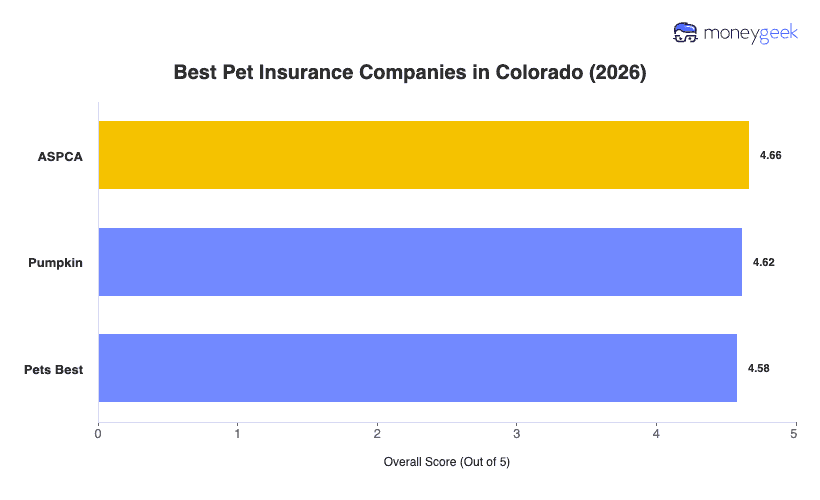
In Colorado, the best pet insurance is offered by the following companies:
- Choose if you want the best value with broad base coverage: ASPCA
- Choose if you want excellent service and expedited reimbursements: Pumpkin
- Choose if you want lower upfront costs via direct vet payment: Pets Best
I evaluated each provider’s overall coverage, from base plan inclusions and flexibility for customizing policy limits to terms for waiting periods and pre-existing conditions. I also assessed how competitive its average rates are and how reliable its customer service is.
For our best pet insurance ratings, we evaluated affordability, customer experience and coverage across 18 major pet insurers using over 67,000 pet profiles representing mixed breeds and purebreds in Colorado. Our analysis used standard profiles of a 6-year-old Labrador Retriever and 7-year-old Ragdoll with a $5,000 annual limit, $500 deductible and 80% reimbursement rate to ensure consistent comparisons across providers.
We analyzed pricing competitiveness across different breeds and locations, measured customer experience throughout the policy lifecycle from enrollment to claims and assessed coverage options and terms. Each insurer received a composite score based on affordability (50% of overall score), customer experience (30% of overall score) and coverage (20% of overall score).
For a detailed breakdown of the metrics, scoring methodology and analysis approach, see our full methodology.
ASPCA: Best Pet Insurance Overall
pros
Cheapest pet insurer in Colorado
Broad base coverage inclusions
14-day waiting period for orthopedic issues
cons
Less streamlined billing and renewals experience
Relatively poor mobile app performance
COMPANY HIGHLIGHTS
ASPCA is my pick for the best pet insurance in Colorado overall, combining affordability with broad base coverage. At $37 per month on average, it prices 37% below the state benchmark, giving budget-conscious pet owners access to a policy that doesn't require add-ons for comprehensive coverage. ASPCA’s base plan covers hereditary conditions, prescription medications, behavioral issues, alternative treatments and exam fees, so you aren't left paying out of pocket for breed-specific diseases, professional behavioral care, rehabilitation therapies or the exam fees that accumulate at every vet visit.
However, ASPCA trails behind for customer experience. Its weakest areas revolve around mobile app experience, and billing and renewals, so pet owners may find it less convenient to manage their policy through the app, keep track of billing and handle renewal-related tasks.
Learn more: ASPCA Pet Insurance Review

Pumpkin: Best Pet Insurance Customer Experience
pros
Exceptional claims service
Quicker access to orthopedic coverage
cons
Accident coverage begins after 14 days
Limited reimbursement rate options
COMPANY HIGHLIGHTS
As the second-best pet insurer in Colorado, Pumpkin excels in customer experience. It offers fast and efficient service at each stage of the policy lifecycle, from buying to managing your account and submitting claims. The company also features Pumpkin Now, an urgent pay service that expedites approvals for claims over $500 and deposits same-day reimbursements into qualifying bank accounts, so you can access the funds while still at the vet. That said, Pumpkin only offers two reimbursement rates and four deductibles and annual limits, limiting the number of ways you can tailor your policy’s coverage level and potential out-of-pocket expenses.
Learn more: Pumpkin Pet Insurance Review

Pets Best: Best Pet Insurance for Direct Vet Pay
pros
Option to pay licensed vets on request
Three-day waiting period for accidents
cons
Coverage for exams and physical therapy costs extra
Claim submission process isn't as efficient
COMPANY HIGHLIGHTS
Among my picks, Pets Best stands out for its Vet Direct Pay feature. It sends any eligible reimbursement amount directly to licensed vets once you submit a veterinarian reimbursement release form along with your completed claim, allowing you to focus on your pet’s care rather than worry about expensive vet bills. Pets Best also has a short accident waiting period, at three days, so active pets can be eligible for coverage sooner if they sustain injuries from playing rough or going outside. However, the company’s notable weak area is claim submission ease, with issues occurring when additional documents are needed, delaying the process for pet owners who want to file claims with minimal hassle.
Learn more: Pets Best Pet Insurance Review
Cheapest Pet Insurance Companies in Colorado
The cheapest pet health insurance companies in Colorado are:
- ASPCA: At an average of $37 monthly, ASPCA is the most affordable pet insurer in Colorado, providing 37% savings against the state benchmark. It also offers the cheapest rates for most dog breeds, including Pulis, Welsh Springer Spaniels and Tibetan Mastiffs.
- Pumpkin: Pumpkin offers the second-cheapest pet insurance at $45 per month on average, which is 25% below the state benchmark. The company leads in affordability for certain breeds like Norwegian Forest cats, Hungarian Vizslas English Pointers and Devon Rexes.
- Pets Best: Averaging $46 monthly, Pets Best provides the third-lowest rate for pet insurance, allowing pet owners to save by 22% compared to the state average. It’s also the cheapest option for owners of Australian Terriers and Burmese cats.
ASPCA | $37 | $446 | 37% |
Pumpkin | $45 | $536 | 25% |
Pets Best | $46 | $556 | 22% |
How Much Does Pet Insurance Cost in Colorado
Colorado pet insurance costs $59 per month ($712 annually) on average, based on aggregated pricing for a 6-year-old Labrador Retriever and 7-year-old Ragdoll with a $5,000 annual limit, $500 deductible and 80% reimbursement rate. At 25% above the national average, Colorado ranks 48th out of 50 states for affordability.
The combined figure separates by species:
- Dogs: $77 per month ($929 annually), 26% above the national dog average
- Cats: $40 per month ($480 annually), 25% above the national cat average
Use MoneyGeek's Colorado pet insurance cost calculator to find out the average pet insurance cost for your pet.
Colorado Pet Insurance Cost Estimate Calculator
Select Breed
Select Age
Average monthly rate—
Select Breed
Average monthly rate—
Select Age
Is Pet Insurance Worth It in Colorado?
Pet insurance is worth it in Colorado if you want financial protection against potentially expensive vet care. A standard accident and illness policy can help cover eligible treatments when your pet is injured or develops a condition, including diagnostic tests, prescription medications, surgery and hospitalization. The value of that coverage depends on your pet’s age, breed and health risks, as well as your ability to handle a large vet bill out of pocket.
Based on MoneyGeek’s data, these potential treatment costs show why coverage for accidents and illnesses can be valuable for Colorado pet owners:
- Hip dysplasia: $3,630 to $29,040
- Lymphoma: $3,960 to $19,800
- Bloat (GDV): $6,930 to $27,720
- Heartworm disease: $770 to $4,620
- Allergies: $264 to $2,640
If you decide that getting a policy is worth it, determine your pet insurance coverage needs with the tool below. It provides a recommendation for annual limits, deductibles and reimbursement rates based on your pet’s profile.
Pet Insurance Coverage Needs Calculator
Use this calculator to get pet insurance coverage recommendations by entering your pet's species, breed, state and age.

What is your pet type?
Select Pet type
Pet type
Breed
State
Pet Age
How to Choose the Best Pet Insurance in Colorado
Pet insurance shopping in Colorado requires more than comparing monthly premiums. Your pet's breed risk profile, Colorado's specific veterinary cost environment and the service quality of the provider you choose all determine whether a policy delivers real value over time. These seven steps give Colorado pet owners a reliable framework for finding coverage that performs when a claim needs to be paid.
- 1Build your starting point around your pet's profile
The coverage a policy needs to provide depends heavily on factors specific to your pet, and those factors are worth clarifying before you look at a single quote. Breed risk, size and health history can make two similarly priced policies perform differently when a real health event occurs. Before comparing providers, answer these three questions:
- What health conditions are most common in your pet's breed? The American Kennel Club for dogs and the Cat Fanciers' Association for cats publish breed health information that can help you identify the conditions most likely to affect your pet before they become pre-existing exclusions.
- How old is your pet? Pets under 2 years carry the highest accident risk, while those aged 7 and older are more likely to develop cancer, chronic illness and joint conditions that require sustained coverage.
- What's in your pet's vet records? Colorado insurers can use a single symptom entry in a vet note as grounds to exclude a related condition, so understanding what's documented before you enroll is worth the extra step.
- 2Choose your priorities
Knowing what you're optimizing for before you start comparing providers keeps the evaluation process focused. Without a defined priority, it's easy to end up with a policy that performs well on a dimension that doesn't matter as much in your specific situation:
- Comprehensive coverage + affordable pricing: The stronger fit for owners of mixed breeds or lower-risk dogs and cats who want dependable financial protection without paying for coverage tiers their pet is unlikely to need.
- Comprehensive coverage + reliable customer service: The better choice for purebred owners and first-time buyers who need both policy depth and confidence that the claims process will work without friction during a health event.
- Affordable pricing + reliable customer service: Best suited to healthy pets where keeping monthly premiums manageable is the primary goal and reliable claims handling is the baseline expectation.
- 3Explore pet insurance providers
Not every provider that writes pet insurance in Colorado has a claims record worth trusting. Before shortlisting any insurer, check its J.D. Power satisfaction rating, AM Best financial strength score and independent customer reviews focused specifically on claims handling.
- 4Review sample policies before you commit
Most major Colorado pet insurers make sample policies publicly available. Use Ctrl+F to check for these terms:
- Pre-existing conditions: The breadth of a provider's definition here determines how much of your pet's existing health history can be used against future claims. Broader definitions create larger exclusion windows.
- Exclusions: Read the complete exclusions list for language that could affect conditions specific to your pet's breed or size.
- Curable conditions: Policies vary on whether coverage is restored after a condition resolves. Check the exact symptom-free period required before reinstatement.
- Waiting periods: Different waiting periods apply to accidents, illnesses and orthopedic conditions within the same policy. For Colorado pet owners with joint-prone breeds, a long orthopedic waiting period can leave a significant gap in early coverage.
- Hereditary and congenital conditions: These should be included in the base plan. If they require a paid add-on, factor that cost into your premium comparison.
- Claims process: Confirm what documentation is required for claims, what the filing deadlines are and whether the insurer pays veterinarians directly for covered care.
- 5Compare your top choices side by side
Once you have your shortlist, evaluate each one on:
- Coverage: Base plan inclusions, exclusions, waiting periods, annual limits and how hereditary conditions are handled
- Pricing: Monthly premium at your selected deductible and reimbursement rate
- Service: Claims process, average reimbursement timeline and how the provider handles disputes
- 6Get quotes using your pet's actual profile
Your premium is calculated from your pet's breed, age, species and Colorado ZIP code, and those factors can move your actual rate well above or below the state average. Get quotes from at least three providers using identical deductibles, annual limits and reimbursement rates so price differences reflect what each insurer charges for the same coverage, not differences in how each policy is structured.
Best Pet Insurance in Colorado: Bottom Line
ASPCA, Pumpkin and Pets Best lead as the best pet insurance companies in Colorado, but the one that delivers the most value for your household is the one whose coverage terms match your pet's breed-specific risks, fits your monthly budget and handles claims reliably when an unexpected vet bill arrives. Colorado pet owners who weigh all three together are better positioned to choose a policy that performs when it counts.
Best Pet Insurance in Colorado: FAQ
The best Colorado pet insurance companies are:
- ASPCA: Best Pet Insurance in Colorado Overall
- Pumpkin: Best Pet Insurance in Colorado Customer Experience
- Pets Best: Best Pet Insurance in Colorado for Direct Vet Payment
ASPCA is the most affordable provider for Colorado pet owners, averaging $37 monthly and providing 37% savings against the state average.
Pet insurance in Colorado costs an average of $59 per month ($712 annually) for a standard policy with a $5,000 annual limit, $500 deductible and 80% reimbursement rate. Your actual rate will vary based on your pet’s species and breed, age at enrollment, ZIP code within Colorado and your coverage selection.
Pet insurance is worth it in Colorado if an unexpected veterinary bill could put a strain on your budget. Pets can develop costly conditions such as allergies and heartworm disease, while more serious problems like bloat, lymphoma and hip dysplasia can result in much larger treatment bills. However, coverage isn't necessary for everyone, particularly if you can comfortably set aside enough money to pay for unexpected care yourself.
To choose the best provider in Colorado, you’ll need to evaluate your pet’s health risks and determine your priorities first. Then research pet insurers in the state, looking into their coverage terms, customer reviews and quotes to determine which provides the best value for your situation.
Pet insurance in Colorado can help pay for eligible vet expenses related to accidents and illnesses, including diagnostic tests, surgery, hospitalization, prescription medications and emergency treatment. Coverage varies by provider and plan, and some policies offer additional coverage for services such as dental care or physical rehabilitation. Routine services like vaccinations and wellness exams are generally excluded from a standard accident and illness policy unless you purchase an optional wellness plan.
You should consider getting pet insurance while your pet is healthy and before any conditions develop that could be considered pre-existing. Most insurers exclude pre-existing conditions, and policies can also have waiting periods before certain benefits begin, so waiting until your pet becomes sick or injured can limit the financial protection available for that condition.
Get Pet Insurance Quotes in Colorado
Pet insurance rates in Colorado vary by provider even when the coverage terms are identical, so running quotes is the most reliable way to find the right policy at the right price. Use MoneyGeek's tool below to see what Colorado's top providers charge for your pet's specific profile.
About Ritchel Mendiola

Ritchel Mendiola is a Pet Insurance Content Writer at MoneyGeek. She produces coverage guides, provider comparisons and cost analyses so pet owners can understand their options and avoid overpaying.
Ritchel spent over four years as a News and Feature Writer at Asian Journal Publications, where she reported for the Asian Journal newspaper and Balikbayan Magazine, conducted interviews and covered media events. At MoneyGeek, she covers policy terms, exclusions, waiting periods and reimbursement structures the way she treated news facts. They're sourced, verified and reported accurately rather than summarized from marketing copy.
She joined MoneyGeek in late 2021 in the loans vertical and moved to pet insurance content, which she now leads. Her published work includes provider comparisons, breed-specific cost guides, age-specific coverage analyses and state-level pricing studies, all from the vertical's 5 million pet insurance profiles across 18 major providers and all U.S. states.
LinkedIn: https://www.linkedin.com/in/rianmendi/
Contact Email: ritchel.mendiola@moneygeek.com