
How Much Does Pet Insurance Cost on Average?


Average Pet Insurance Cost Overview

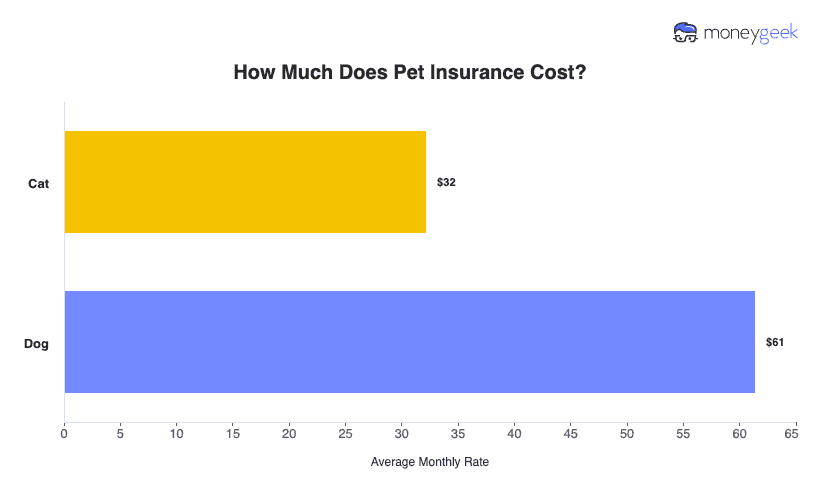
Based on my analysis of MoneyGeek’s cost data, pet insurance averages $47 monthly. This rate is aggregated pricing for a 6-year-old Labrador Retriever ($61 monthly) and a 7-year-old Ragdoll ($32 monthly), each with a standard accident and illness policy with a $5,000 annual limit, $500 deductible and 80% reimbursement rate. However, it can change depending on your pet’s species and type of pet insurance.

For instance, accident-only pet insurance costs an average of $15 monthly since it only covers veterinary expenses related to accidents and excludes illnesses. At the other end of the range, accident and illness pet insurance with a wellness plan costs $77 per month on average because it provides comprehensive coverage with additional benefits for routine and preventive care.

See the table below for the breakdown of pet insurance costs by pet type.

Dogs
$19
$61
$92
Cats
$11
$32
$61

We studied pet insurance pricing to establish national cost benchmarks and show how premiums vary based on different factors. Our cost analysis uses standardized policy parameters for consistent comparisons across pet profiles.  

How We Calculated Average Pet Insurance Costs

Our published averages represent modeled premiums for standardized pet insurance drawn from over 67,000 pet profiles across 18 major pet insurance providers in all U.S. states and Washington, D.C. The baseline profiles used throughout our analysis are 6-year-old Labrador Retriever and 7-year-old Ragdoll with a $5,000 annual limit, $500 deductible and 80% reimbursement rate.

Averages were calculated in two ways:  

  • National benchmark average: The monthly national average reflects the modeled premium for a 6-year-old Labrador Retriever and 7-year-old Ragdoll across all states in our dataset using the baseline policy parameters.
  • Segment averages: To demonstrate cost variation, we calculated average modeled premiums for our baseline profile while isolating individual variables, including:  
    • Accident-only coverage
    • Accident and illness with wellness coverage
    • Breeds
    • Ages
      • Under 1 year old for puppies and kittens
      • Three years old for younger dogs, four years old for younger cats
      • Eight and 13 years old for senior dogs, 11 to 14 years old for senior cats

Segment averages aggregate modeled pricing patterns across the full dataset so readers can compare how premiums change based on pet insurance types, breed and age. For a detailed breakdown of the metrics and analysis approach, see our full methodology.

How Much Does Pet Insurance Cost for Dogs?

On average, dog insurance costs $61 per month, but this can vary based on breed and age, with some breeds costing nearly four times as much to insure as others and premiums generally increasing as dogs get older.

Breed is the biggest factor affecting pet insurance costs for dogs, with average monthly rates ranging from $33 for a Chihuahua to $129 for an Olde English Bulldogge. Both breeds have health risks that can lead to veterinary expenses, but the types and potential costs of care can differ. Chihuahuas can develop issues such as dental disease and heart problems, whereas Olde English Bulldogges can have breathing, joint and other health problems that may require more extensive treatment. 

Age also has a significant effect on premiums. Average monthly costs range from $44 for 1-year-old dogs to $206 for 15-year-old dogs. Younger dogs generally have lower premiums because they have had less time to develop age-related illnesses and are less likely to need treatment for conditions that become more common later in life.

Use MoneyGeek’s calculator to estimate how much you’ll pay for dog insurance based on your dog’s breed and age.

Dog Insurance Cost Estimate Calculator
Select Breed
Select Age
Average monthly rate

How Much Does Pet Insurance Cost for Cats?

The average cost of cat insurance is $32 per month. That said, how much you’ll pay for coverage can change based on breed, ranging from $29 per month for Bombay cats to $42 for Serengeti cats. Bombay cats are generally considered a healthy breed with relatively few breed-specific health concerns, which can contribute to their lower rates. By comparison, insurers may charge more for breeds with greater expected health risks or claims costs, although the specific factors behind each insurer’s breed pricing can vary.

Your cat’s age at enrollment also has a large effect on your rate. Monthly premiums average $23 for cats under 1 year old, compared with $95 for senior cats ages 16 to 20, reflecting the greater likelihood of health problems and veterinary care as cats get older.

MoneyGeek's calculator below can help you estimate your pet insurance cost based on your cat's breed and age.

Cat Insurance Cost Estimate Calculator
Select Breed
Select Age
Average monthly rate

How Much Does Pet Insurance Cost for Exotic Pets?

Pet insurance for exotic pets costs an average of $29 per month. Rates can change by pet type, ranging from $10 monthly for mice to $76 monthly for ferrets.

Exotic pet insurance costs vary because different species have different veterinary needs and claim costs. Rabbits, for example, can require treatment for dental disease or gastrointestinal problems, while birds may need care for respiratory infections, injuries or nutritional disorders. However, coverage is less widely available than insurance for dogs and cats, with only a few pet insurance companies offering policies for exotic animals.

Data filtered by:
Select
Mouse$10$118
Hamster$11$132
Gerbil$12$147
Degu$19$225
Chinchilla$22$258
Turtle$23$275
Tortoise$24$289
Lizard$26$308
Guinea Pig$27$326
Sugar Glider$27$329
Hedgehog$28$331
Snake$30$363
Bird$43$510
Rabbit$53$633
Ferret$76$906

Factors Affecting Pet Insurance Costs

Pet insurance premiums vary based on factors such as breed, geographic location, age and coverage selection. Each one signals something different to insurers about the expected cost and frequency of claims. The same policy can look very different in price depending on whether you're insuring a young mixed-breed dog in a rural state or an older purebred cat in a high-cost metro.

  • petInsurance icon

    Coverage selection

    The price of a pet insurance policy reflects how the annual limit, deductible and reimbursement rate divide claim costs between you and the insurer. Adjust any one of them and the premium changes accordingly.

    • Annual limit: This sets the maximum dollar amount an insurer will pay out within a policy year. A higher annual limit generally increases your premium because the insurer may pay more toward eligible vet expenses in a policy year.
    • Deductible: This is the out-of-pocket amount you pay before the insurer covers any eligible expenses within a given policy year. A lower deductible often costs more but reduces the amount you pay before the insurer begins paying its share.
    • Reimbursement rate: This is the share of covered costs the insurer pays once your deductible is met. A higher reimbursement rate tend to increase your premium because the insurer has a larger percentage of eligible expenses.
  • pet icon

    Breed

    Breed can strongly impact pet insurance costs because some breeds are more prone to hereditary or breed-specific health conditions that may require veterinary treatment. Insurers may charge higher premiums for breeds with greater risks of costly claims, while breeds with fewer health risks may have lower rates.

  • usMap icon

    Geographic location

    Pet insurance premiums vary by state because insurers price against local veterinary costs. Markets with denser specialty and emergency care infrastructure, higher practice overhead and elevated costs of living produce higher claim costs, which feed directly into regional pricing.

  • birthday icon

    Age

    Insurers price age because older pets are statistically more likely to generate claims, and those claims tend to be more complex and costly than those filed for younger animals.

How to Lower Pet Insurance Costs Without Sacrificing Coverage

Breed, age and location all affect what you pay, but you can't change them. Coverage selection is where you have room to adjust, and the right changes can lower your premium without giving up the coverage that counts.

  • vs icon

    Compare quotes from multiple insurers

    Premiums for identical coverage can vary considerably across providers because each insurer weighs breed risk, regional veterinary costs and its own claims history differently. Getting quotes from at least three insurers using the same deductible, annual limit and reimbursement rate gives you a clearer picture of where the market sits for your specific pet.

  • giveMoney icon

    Raise your deductible

    The deductible is the amount you pay out of pocket before coverage begins and it resets once per policy year, not per claim. A higher deductible means taking on more of the initial cost if your pet needs care, but it reduces what the insurer prices into your monthly premium. For pets that don't need frequent veterinary visits, a $500 or $1,000 deductible can produce a large reduction in monthly cost.

  • money icon

    Choose an annual limit that reflects realistic claim scenarios

    Unlimited coverage costs more because the insurer prices in the possibility of catastrophic claims, such as cancer treatment, emergency surgery, prolonged hospitalization. For most pets, a mid-range annual limit covers the overwhelming majority of illness and injury claims without that added cost. The question worth asking is how much coverage you'd realistically need in a worst-case year, not the absolute maximum an insurer could ever pay out.

  • discount icon

    Stay at 70% or 80% reimbursement

    At 100% reimbursement, the insurer pays every covered dollar after your deductible and the premium reflects that fully. Dropping to 80% means covering 20% of eligible costs yourself, but it removes a disproportionate amount from your monthly premium compared to what you're giving up in coverage. The 70% tier works the same way, where you take on a larger share of each claim, but the insurer still covers the majority of covered costs while your premium stays lower.

  • petMedicalCheckup icon

    Be selective about add-ons

    Optional wellness plans increase your monthly premium while covering expenses that are predictable for most pet owners, including annual exams, vaccinations, flea prevention. Accident and illness coverage is where pet insurance provides the most financial protection against costs that can't be planned for. Add-ons that cover routine care are worth evaluating against what you'd spend out of pocket

Pet Insurance Cost: Bottom Line

Pet insurance costs depend on factors like breed, age and coverage type. The $47 monthly national average is a useful starting point, but it's based on a specific pet profile and specific coverage limits. Your actual quote could be higher or lower depending on your pet and the policy you choose.

Three questions help put your quote in context:

  1. Does your pet's breed and age put you above or below the national average?
  2. Which coverage choices are driving your premium up?
  3. What changes to your deductible, annual limit or reimbursement rate would bring it closer to where you want it?

Answering these questions can help you tell whether your premium is reasonable for your pet, identify what is driving the cost and decide which coverage changes could give you the financial protection you want at a price you can afford.

Average Pet Insurance Cost (2026) Chart

Pet Insurance Costs: FAQ

About Ritchel Mendiola


Ritchel Mendiola, Pet Insurance Writer

Ritchel Mendiola is a Pet Insurance Content Writer at MoneyGeek. She produces coverage guides, provider comparisons and cost analyses so pet owners can understand their options and avoid overpaying.

Ritchel spent over four years as a News and Feature Writer at Asian Journal Publications, where she reported for the Asian Journal newspaper and Balikbayan Magazine, conducted interviews and covered media events. At MoneyGeek, she covers policy terms, exclusions, waiting periods and reimbursement structures the way she treated news facts. They're sourced, verified and reported accurately rather than summarized from marketing copy.

She joined MoneyGeek in late 2021 in the loans vertical and moved to pet insurance content, which she now leads. Her published work includes provider comparisons, breed-specific cost guides, age-specific coverage analyses and state-level pricing studies, all from the vertical's 5 million pet insurance profiles across 18 major providers and all U.S. states.

LinkedIn: https://www.linkedin.com/in/rianmendi/

Contact Email: ritchel.mendiola@moneygeek.com