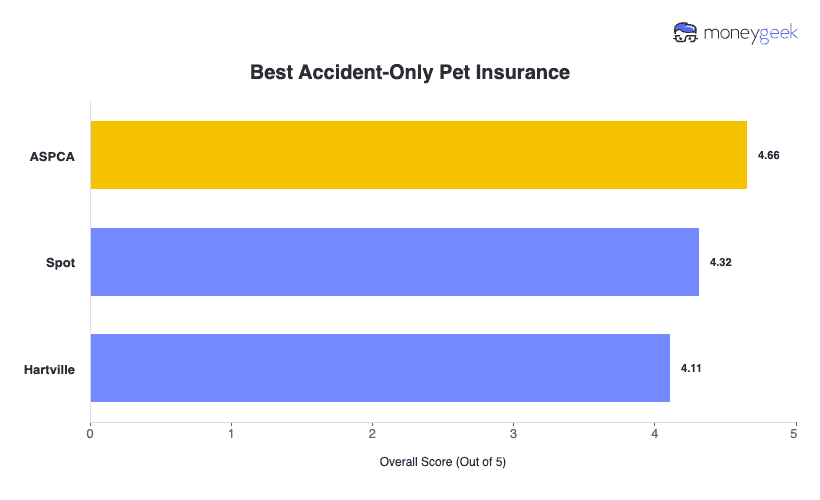

Best Accident-Only Pet Insurance


I found the best pet insurance with accident-only coverage by evaluating major providers based on their coverage, including base plan inclusions, waiting periods and pre-existing condition terms. I also analyzed how competitive each one’s average monthly rate is compared to the national average, as well as how reliable its customer service is.  

Based on my study, the best companies with strong overall performance across affordability, customer experience and coverage are:
  • Choose If You Want the Best Value With Broad Base Coverage: ASPCA
  • Choose If You Want Excellent Customer Experience: Spot
  • Choose If You Want the Lowest Average Rate: Hartville

For our best accident-only pet insurance ratings, we evaluated affordability, customer experience and coverage across 18 major pet insurers using over 67,000 pet profiles representing mixed breeds and purebreds in all 50 states and Washington, D.C. Our analysis used a base profile of a 6-year-old Labrador Retriever and 7-year-old Ragdoll with a $5,000 annual limit, $500 deductible and 80% reimbursement rate to ensure consistent comparisons across providers.

We analyzed pricing competitiveness across different breeds and locations, measured customer experience throughout the policy lifecycle from enrollment to claims and assessed coverage quality for accidents. Each insurer received a composite score based on affordability (50% of overall score), customer experience (30% of overall score) and coverage options and terms (20% of overall score).

For a detailed breakdown of the metrics, scoring methodology and analysis approach, see our full methodology.

ASPCA

ASPCA: Best Accident-Only Pet Insurance Overall

COMPANY HIGHLIGHTS

ASPCA leads as the best pet insurance for accidents overall, with the most comprehensive base plan inclusions. Its standard accident-only plan covers vet exams needed to assess an injury, medications prescribed for its treatment, rehabilitation to support recovery and alternative therapies when medically appropriate, all without requiring you to purchase add-ons like some insurers do.

However, ASPCA’s accident coverage starts after 14 days, which may not be ideal for pets that frequently chew or ingest foreign objects, spend time outdoors or participate in activities with a higher risk of injury. The company also falls behind for customer experience, with claims as its weakest area, so you may experience issues or delays when submitting claims, appealing a decision or waiting for reimbursement.

Learn more: ASPCA Pet Insurance Review

Spot

Spot: Best Accident-Only Pet Insurance Customer Experience

COMPANY HIGHLIGHTS

Spot is among my picks for the best accident-only pet insurance. It provides top-tier buying and claim service, so you can expect a smoother experience when purchasing a policy, getting fair decisions on accident-related claims and waiting for reimbursement. Spot also offers three reimbursement rates, five deductibles and seven annual limits, allowing you to adjust your policy based on your budget and the amount you can afford to pay upfront after an accident.  

However, Spot requires you to wait for 14 days before its accident coverage takes effect, which may be too long for accident-prone pets that have active lifestyles or live in urban areas with heavy traffic. It’s also the most expensive out of my recommendations, costing an average of $16 per month, which is 14% higher than the national benchmark.  

Learn more: Spot Pet Insurance Review

Hartville

Hartville: Best Cheap Accident-Only Pet Insurance

COMPANY HIGHLIGHTS

Hartville rounds out my best accident-only pet insurance recommendations. The company offers the lowest average rate of $11 per month, providing 21% savings compared to the national average. It combines affordability with an accident-only base plan that includes exam fees, prescription medications and alternative therapies, so you won’t have to pay more just to get robust coverage for accidents.

However, Hartville requires you to wait for 14 days before accident coverage can activate, so if your pet sustains an injury like a bite, wound or broken bone after enrollment, it won’t be covered. It also offers mid-tier customer service with particular weakness around claim speed, which can make it hard to get timely reimbursement when you’re already dealing with unexpected vet bills.

Learn more: Hartville Pet Insurance Review

What to Assess When Deciding Your Best Accident-Only Pet Insurance Fit

Some pet insurers offer accident-only plans, but they vary in how and when they cover accidents. Assess the terms below before enrolling to make sure the policy provides enough coverage for the accidents and treatments your pet may need and doesn't leave you with exclusions, longer waiting periods or higher out-of-pocket costs that could make a seemingly affordable plan less suitable.

Pre-existing condition rules
Whether conditions, symptoms or injuries that existed before enrollment or during waiting periods are excluded from coverage.
A narrow definition that excludes only conditions with prior signs or treatment and clearly distinguishes unrelated future accidents from pre-existing conditions.
Broad language that can exclude unrelated future injuries because of a prior condition or symptom.
Curable condition terms
Whether a condition previously considered pre-existing may become eligible again if the pet remains free of symptoms and treatment for a specified period.
A curable-condition waiting period of 12 months or less with coverage restored after the pet is symptom- and treatment-free.
Permanently excludes curable conditions even after the pet has been symptom- and treatment-free for a defined period.
How long before coverage begins for eligible accidents.

Has no accident waiting period or only imposes a short one between one and three days.

An accident waiting period longer than 14 days.
Determines whether the veterinary examination needed to diagnose or treat an eligible accident is covered.
Covered in the base accident-only plan without requiring an expensive optional add-on.
Exam fees are permanently excluded from accident coverage or require a costly add-on to be reimbursed.
Determines whether medications prescribed to treat an accidental injury are eligible for reimbursement.
Prescription medications included in base coverage when medically necessary for a covered accident.
Accident-related prescription medications are excluded from the base policy or require an expensive add-on.
Tooth extractions coverage
Determines whether removing a damaged or injured tooth following an accident qualifies for coverage.
Accident-related tooth extractions covered when medically necessary and caused by a covered injury.
Tooth extractions are excluded even when the dental injury results directly from a covered accident.
Foreign body ingestion coverage
Determines whether treatment required after a pet swallows an inedible object is considered an eligible accident.
Foreign body ingestion covered, including medically necessary diagnostic procedures and removal when applicable.
Foreign body ingestion is excluded despite being treated as an accidental injury or only covered once throughout the life of the policy.
Physical rehabilitation coverage
Determines whether rehabilitation or physical therapy needed to recover from a covered accidental injury is reimbursed.
Physical rehabilitation included in the base plan for treatment of covered accident-related injuries.
Rehabilitation is excluded from accident coverage or requires a separate add-on.
Determines how much documentation and administrative work is required to establish that an injury qualifies for coverage and how easily you can submit a claim.
A simple claims process with straightforward record requirements, easy submission and efficient review of veterinary records.
Extensive documentation requirements, difficult claim submission or a cumbersome record-review process that can make accident claims harder to resolve.

Is Accident-Only Pet Insurance Worth It?

Accident-only pet insurance is worth it if you want affordable financial protection against potentially expensive injury-related veterinary bills. It generally reimburses the cost of diagnosing and treating accidents that occur after the waiting period, including surgeries, hospitalizations, prescription medications and emergency care.

Accident-only pet insurance is more likely to be worth it if you:

  • Own a pet that has a higher risk of accidental injury because of its age, location or lifestyle.
  • Have a pet with pre-existing illnesses that would be excluded from coverage but can still qualify for accident-only plans.
  • Are focused on financially protecting your budget against a large, unexpected emergency vet bill.
  • Want a lower-cost pet insurance for a senior pet that may have fewer comprehensive coverage options.

Best Accident-Only Pet Insurance Buying Checklist

I’ve prepared a checklist you can use to work through the process of choosing accident-only pet insurance, along with a downloadable PDF that can help guide you as you collect quotes or speak with insurers. Start with your veterinarian's input, then use your pet's likely accident risks to determine how much coverage you need before comparing providers and quotes.  

Download: To follow

  • blueCheck icon

    Talk to your veterinarian

    Schedule a visit with your veterinarian and discuss which accidents your pet may be more likely to experience based on its breed, age, size and lifestyle, such as fractures in an active dog or foreign body ingestion in a pet that tends to chew or swallow objects. Ask which types of emergency treatment those accidents could require, such as diagnostic testing, surgery, hospitalization or physical rehabilitation. Knowing your pet's likely accident risks helps you prioritize providers that can provide enough accident-only coverage for your specific needs.

  • blueCheck icon

    Determine how much coverage you need

    Decide on how much coverage you need by determining a deductible you can comfortably pay after an accident, an annual limit high enough to cover a major injury and a reimbursement rate that balances your monthly premium with the amount you would pay out of pocket. As a starting point, use MoneyGeek's pet insurance coverage needs calculator to estimate an baseline coverage level, then adjust the deductible, annual limit and reimbursement rate based on your budget and your vet's assessment of your pet's accident risks. 

    Remember that a higher deductible or lower reimbursement rate can reduce your premium but leave you responsible for more of an accident-related vet bill.

  • blueCheck icon

    Research pet insurance providers

    Search specifically for pet insurers that offer accident-only plans, then read or download their online sample policies to evaluate how they define covered accidents and which treatments they reimburse. Check terms that can affect accident coverage, including the accident waiting period, pre-existing condition rules and curable condition terms. Eliminate providers who excludes treatments your pet is likely to need or require multiple expensive add-ons for a robust accident coverage.

  • blueCheck icon

    Read customer reviews

    Read recent customer reviews with particular attention to how pet insurers handle accident claims, including whether customers describe straightforward claim submission, requests for medical records, delays in reviewing claims or difficulty getting reimbursement for eligible expenses. Check multiple sources, including Trustpilot, the Better Business Bureau (BBB) and Reddit communities like r/petinsurancereviews. Customer experiences often reveal how efficient and reliable an insurer is when an emergency occurs, complementing the coverage terms you find in the policy documents.

  • blueCheck icon

    Get quotes

    Collect quotes using the same deductible, annual limit and reimbursement rate for every provider so you can compare premiums fairly. When reviewing each quote, check whether treatments such as exam fees, prescription medications or physical rehabilitation are included in the base accident-only plan or require an add-on, especially when another insurer includes the same coverage automatically. Note down each quote and the coverage terms so you can compare the total cost and financial protection side by side before choosing a provider.

Best Accident-Only Pet Insurance: Bottom Line

ASPCA, Spot and Hartville are my top picks for the best accident-only pet insurance. The best policy for your pet will depend on its age, breed, lifestyle and potential accident risks, as well as the balance you want between premiums and out-of-pocket costs. Before you enroll, review each provider's accident-specific coverage, exclusions, waiting periods and cost-sharing options to make sure you're getting enough financial protection that fits your pet and budget.

Best Accident-Only Pet Insurance Chart

Best Pet Insurance for Accidents: Next Steps

After comparing my top picks, get personalized quotes based on your pet's age, breed and location. Keep the annual limit, deductible and reimbursement rate the same for each quote, so you can compare prices fairly and determine which provider gives you the accident coverage you need at the lowest cost.

If cost is your main concern

If you want immediate coverage

If you're ready to get quotes

Compare Pet Insurance Rates

Ensure you are getting the best rate for your pet insurance. Compare quotes from the top pet insurance companies.

About Ritchel Mendiola


Ritchel Mendiola, Pet Insurance Writer

Ritchel Mendiola is a Pet Insurance Content Writer at MoneyGeek. She produces coverage guides, provider comparisons and cost analyses so pet owners can understand their options and avoid overpaying.

Ritchel spent over four years as a News and Feature Writer at Asian Journal Publications, where she reported for the Asian Journal newspaper and Balikbayan Magazine, conducted interviews and covered media events. At MoneyGeek, she covers policy terms, exclusions, waiting periods and reimbursement structures the way she treated news facts. They're sourced, verified and reported accurately rather than summarized from marketing copy.

She joined MoneyGeek in late 2021 in the loans vertical and moved to pet insurance content, which she now leads. Her published work includes provider comparisons, breed-specific cost guides, age-specific coverage analyses and state-level pricing studies, all from the vertical's 5 million pet insurance profiles across 18 major providers and all U.S. states.

LinkedIn: https://www.linkedin.com/in/rianmendi/

Contact Email: ritchel.mendiola@moneygeek.com