
Best General Liability Insurance Companies in California

I compared average rates from 10 providers across 25 industries, such as professional firms and transportation or warehousing companies, to find California’s best general liability insurers. Price was only part of the review. I also researched whether an insurer offers GL to different types of businesses and explains the policy clearly. 

Based on all this, my top picks are:

  • Choose if you offer hands-on services: ERGO NEXT
  • Choose if you an office-based business: The Hartford
  • Choose if you have lower risk: biBerk
  • Choose if you want to compare multiple coverage: Simply Business
  • Choose if you want more coverage options: Coverdash

For our California general liability insurance ratings, we analyzed pricing, coverage options, and customer experience across 408 industries within the state. Our analysis focuses on one-to-four-person businesses, which represent nearly half of small businesses, while weighting results to ensure broader industry and location representation across Los Angeles Metro, San Francisco Bay Area, San Diego and smaller markets throughout the state.

To do this, we evaluated over 20,000 business profiles, more than 11,500 customer experience data points and performed in-depth analysis of coverage contracts and endorsements to compare how insurers serve California businesses consistently across different industries and regions. We then rated each company across affordability (50%), customer experience (30%), and coverage options and terms (20%) to form an overall rating. For a detailed breakdown of the metrics, scoring methodology, and pricing analysis specific to California, see our full methodology.

95%

% of Small Businesses Covered

Over 20,000

Business Profiles Studied

11,515

Customer Experiences Analyzed

ERGO NEXT

ERGO NEXT: Best Overall, Best for Hands-on Work Industries

On ERGO NEXT's site
COMPANY HIGHLIGHTS

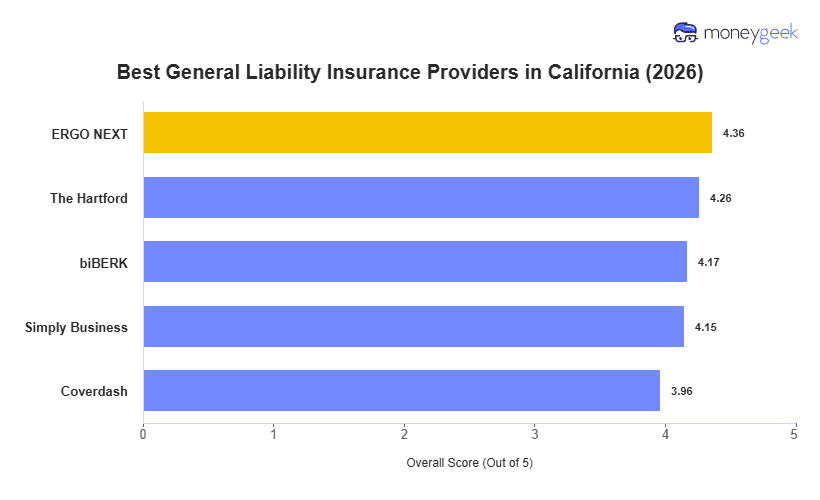
ERGO NEXT ranks first overall as the best general liability insurer in California, primarily due to its affordability and great customer experience. High-risk industries like food and beverage, manufacturing, hospitality and construction/contracting save the most with the company, with average savings of up to 36%. Its digital-first platform lets you buy a policy, get tailored recommendations and manage your coverage easily online; ideal for those in fast-paced work environments who are tight on time.

Learn More: ERGO NEXT Insurance Review

The Hartford

The Hartford: Best for Office-Based Professional Services

On The Hartford's site
COMPANY HIGHLIGHTS

The Hartford ranks second among California general liability insurance providers. Its 200-plus years in the industry mean you get service departments that specialize in your field and a claims experience that customers in our study rated as top. The company is also the second-most-affordable provider overall, with average savings of 15% compared to state benchmarks. Health care, financial and tech services save the most with the company at over 20%.

Coverage limits are higher than most competitors at this tier; standard policies go up to $2 million per occurrence and $4 million aggregate. For many businesses, that's enough to skip a separate umbrella policy. Risk management services are also included as standard, not a paid add-on, which can reduce your premiums over time.

Learn More: The Hartford Business Insurance Review

biBerk

biBerk: Best for Recreation and Low-Risk Industries

COMPANY HIGHLIGHTS

biBerk offers a good balance between affordability and service for general liability policies in California. Recreation, fitness and cleaning businesses get the most value, especially those operating without employees. The buying process is fast, with most policies bound with a certificate of insurance (COI) in under six minutes (second in our study). biBerk also has a lower general liability insurance limit than competitors, which can be attractive for low-claims-risk industries like consulting ($300,000 per occurrence and $600,000 aggregate minimum).

Learn More: biBerk Review

Simply Business

Simply Business: Best for Comparing Multiple Carriers

COMPANY HIGHLIGHTS

Simply Business ranks fourth overall for general liability insurance in California, due to its affordability (ranking third and fourth for all industry areas) and comparison platform capabilities. The buying process is slower, but it offers more customization through its partner network for endorsements such as a waiver of subrogation, additional insured and other term additions, all completed online. After buying, Simply Business doesn't manage your policy or claims, and your service varies depending on the provider you choose.

Learn More: Simply Business Review

Coverdash

Coverdash: Best Selection of Coverage Options

COMPANY HIGHLIGHTS

Coverdash is our final pick for California general liability insurance. Its unique feature is a policy management tool available on its website and mobile app, and it works regardless of the provider you choose. The company also has the largest partner network, making it easier to find the right coverage. 

Coverdash ranks fourth or fifth for affordability in only two of the 25 industry segments we studied, making it a harder sell for businesses where price is the priority.  

Learn More: Coverdash Review

What Determines the Best General Liability Insurance for California Businesses

The best insurer for you depends on how well it can support the way you work. If you hire seasonal employees in California wine country or move crews between filming locations, you need pricing and coverage that can keep up without creating problems each time your operations change.

How to Choose the Best General Liability Insurance in California

The right general liability insurer for your California business provides coverage that matches how you operate, whether navigating Los Angeles entertainment industry contracts, or scaling tech operations in the Bay Area. The steps below helps you get general liability insurance that fits your California business without overcomplicating the decision.

  1. 1
    Optimize your payment and coverage structure

    Start by identifying where you work and how customers or other members of the public interact with your business. These details help insurers understand the liability claims your operations could create.

    • Start with your work setting. A software consultant working remotely has different concerns from a coastal tour operator responsible for customers during outdoor activities.
    • Check your contracts and leases for general liability requirements. Use the highest required limits and endorsements as the minimum protection you request.
    • Choose between an annual payment and monthly installments based on your cash flow. Compare the full policy-term cost because installment fees may make monthly payments more expensive.

    A common policy setup includes a $1 million per-occurrence limit, the most it pays for one covered incident, and a $2 million aggregate limit, the most it pays for covered claims during the policy term. You might need more coverage if you often take larger California contracts, so use the figures in your agreements instead of assuming the standard setup will be enough.

    Read More: How Much General Liability Insurance Do You Need?

  2. 2
    Choose your primary priority

    Ask which type of insurer problem would affect your business most. That factor should carry the most weight when two providers seem evenly matched.

    • Affordability matters most when your income changes with visitor demand or project schedules. You’ll need a premium you can continue paying during slower periods, not just an affordable initial rate.
    • Customer experience becomes more important when a contract has a fixed start date. A production vendor or commercial contractor may need an insurer that can resolve routine requests without holding up the work.
    • Coverage options should be in the forefront when your services are changing. If you move from advice-only work into installation or product sales, your existing policy will no longer cover the range of activities you do.
  3. 3
    Shortlist two to three providers

    Don’t assume that every insurer covers your line of work. A provider comfortable insuring an office-based technology firm may decline outdoor recreation or public events. Check each insurer’s eligibility rules against your everyday work, including tasks you do away from your main location. After reviewing all this, keep two or three providers. That allows you to compare them without including insurers that aren’t realistic options.

  4. 4
    Double-check for dealbreakers before investing more time

    Even before you spend time on requesting quotes, check for terms that could rule out a provider. These could include:

    • An inaccurate business classification, such as treating hands-on installation work as office consulting, because the resulting policy might not reflect everything you do.
    • Exclusions that remove coverage for a service you regularly provide. Accepting your general industry doesn’t necessarily mean the insurer covers every activity within it.
    • Liability limits or endorsements that don’t satisfy your strictest contract. You could pay for a policy and still be unable to begin the work.
    • Subcontractor requirements you can’t reasonably meet. If you regularly use independent crews, confirm what insurance documents the provider expects from them before choosing the policy.
  5. 5
    Compare your finalists using the same three criteria

    Now look at how each finalist performs, giving extra weight to the priority you selected.

    • Affordability: Compare the total annual cost, including policy fees and installment charges, rather than focusing on the amount due when coverage begins. Ask whether the insurer could adjust your premium after reviewing your actual sales, so you know if the quoted price could change later.
    • Customer experience: Think about how clearly each insurer answered your questions and whether its time frames work for your business. Look for specific answers, since these are more useful than general claims about fast service.
    • Coverage options: Test each policy against the next change you’re likely to make. The ability to cover a new service you’re planning to offer is more valuable than coverages or limits you’re unlikely to use.
  6. 6
    Use quotes as the final confirmation step

    Give each insurer the same business details and request matching limits, then compare business insurance quotes to see whether the coverage lines up. If one quote costs much less, ask where the difference comes from. Confirm that it doesn’t leave out a required endorsement or place a restriction on work you regularly do.

Best Small Business General Liability Insurance in California: Bottom Line

ERGO NEXT, The Hartford and biBerk rank highest for California general liability coverage, but the right provider depends on how and where your business operates. A San Francisco tech consultant working remotely carries different exposure than a Los Angeles film production crew or a Napa Valley winery hosting daily tastings. Identify your specific risks, then weigh what matters most, whether that's price, service responsiveness or coverage flexibility.

Best General Liability Insurance For Small Business in California Chart
insurance2 icon
LOOKING FOR THE BEST INSURERS FOR OTHER COVERAGE TYPES?

Whether you're in the entertainment industry or part of the technology sector, you'll need more than general liability in your policy mix. I've provided resources to show you our recommended providers for other coverages that you'll need in your California business insurance policy.

About Angelique Palenzuela-Cruz


Angelique Palenzuela-Cruz, Business Insurance Writer, MoneyGeek

Angelique Palenzuela-Cruz is a Business Insurance Content Writer at MoneyGeek, where she specializes in general liability, workers’ compensation and professional liability insurance. Her work helps small business owners understand how these policies apply to coverage, including risks like customer injuries, employee injuries, professional mistakes, client contract terms and industry-specific coverage requirements.
She primarily covers service-based businesses where liability and employee coverage decisions are especially important, including cleaning, consulting, beauty and wellness, childcare, education, fitness, food service, pet care, repair and maintenance, and other professional services.
Before joining MoneyGeek, Angelique spent nearly 12 years at Guthrie-Jensen Consultants, one of Southeast Asia’s largest management training firms, where she advanced from Training Consultant to Managing Consultant. In that role, she worked with business clients to assess operational needs, develop training programs and present performance analyses to executive decision-makers. She also helped establish Gladwin Training Consultancy, where she served in learning solutions and client service roles.
Her background gives her practical context for writing about how businesses operate, manage client expectations, structure teams and make risk decisions. At MoneyGeek, she applies that experience to business insurance content, connecting coverage to actual business needs.

LinkedIn: linkedin.com/in/ma-angela-cruz

Email Contact: angelique.palenzuela@moneygeek.com