
Insurance Lapse on a Financed Car: What Your Lender Will Do


Key Takeaways
blueCheck icon

Letting coverage lapse on a financed vehicle violates your loan agreement, giving your lender the right to add force-placed insurance to the car immediately.

blueCheck icon

Force-placed insurance costs 2 to 10 times more than a standard policy and only protects the lender. It doesn't cover your liability, collision or personal protection.

blueCheck icon

Restore coverage as quickly as possible. Every additional day of lapse adds more force-placed insurance costs directly to your loan balance.

A car insurance lapse on a financed vehicle is a breach of your loan agreement since nearly all auto loan contracts require the borrower to maintain full coverage car insurance for the life of the loan. Most lenders specify minimum coverage levels, typically 100/300/100 liability, combined with collision and comprehensive protection. Unlike a lapse on a paid-off vehicle where only the driver's own financial exposure is at risk, a lapse on a financed car puts the lender's collateral in jeopardy, giving the lender both the contractual right and strong financial motivation to act immediately. Learn how to get car insurance that meets your lender's requirements.

This situation most commonly affects borrowers who miss a premium payment and let their policy cancel for non-payment, those who voluntarily drop coverage during financial hardship, or drivers who switch insurers and allow a gap between policies. Regardless of the reason, your lender sees any gap as a violation.

What a Lapse on a Financed Car Takes Away From You

Here's exactly what changes when your coverage lapses on a financed vehicle:

    carAccident icon
    Collision Coverage Is Gone

    Any damage to your vehicle during the lapse period is entirely out of pocket. The lender's force-placed policy protects only the lender's financial stake — it does not cover your repair costs or vehicle replacement.

    shield icon
    Comprehensive Protection Is Gone

    Theft, fire, flood, hail or any other weather-related damage that occurs during the lapse becomes your sole financial responsibility. Force-placed insurance does not step in to cover these losses for you.

    scale icon
    Your Refusal Rights Over Coverage Terms

    Force-placed insurance is selected entirely by the lender — you cannot choose the insurer, set the coverage limits or negotiate the deductible. You pay for a policy you had no role in designing.

    money icon
    Protection From Total Loss Underpayment

    Without your own standard policy or gap insurance, a total loss during the lapse could leave you owing significantly more on the loan than the car is worth with no coverage to bridge the difference.

    clock icon
    Lender Notice Rights and Quick Removal

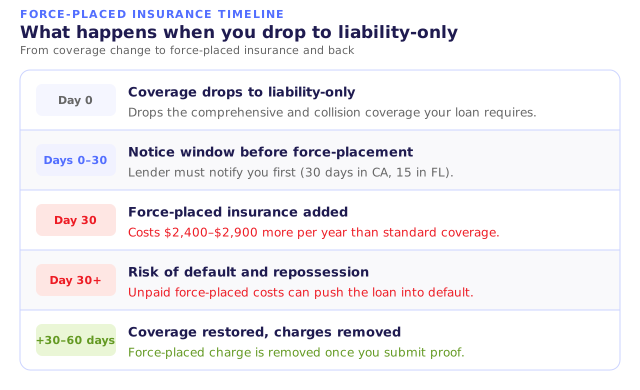
    Once force-placed insurance is added to your loan, it typically remains until you provide documented proof of active coverage. Removal after you restore your own policy can take 30 to 60 days, and the charges may accrue throughout that period.

Note: If your lender places force-placed insurance, your own collision and liability coverage is still not restored. You must purchase a separate standard policy to be protected as a driver.

Legal and Financial Consequences of a Coverage Lapse

The immediate consequences of a lapse on a financed car extend well beyond losing your own protection. Your lender will add force-placed insurance to your monthly loan payment at rates 2 to 10 times higher than a standard market policy. If the added premium causes your total monthly loan obligation to exceed what your loan terms allow, some lenders classify the account as in potential default. In states with continuous coverage requirements — including Virginia, North Carolina and New Hampshire — your lender or insurer may be obligated to notify the DMV of any coverage gap, which can trigger license or registration suspension.

From an insurance perspective, a lapse on a financed car signals high-risk borrower behavior to future insurers. Expect surcharges of 20% to 50% on your next policy, depending on the length of the lapse and the state. These elevated rates typically persist for 3 to 5 years at most insurers. Drivers with prior lapses should review high-risk car insurance options to find the most competitive rates available after reinstatement.

carInsurance icon
FORCE-PLACED INSURANCE COSTS CAN EXCEED $3,000/YEAR

In some states, force-placed insurance placed by your lender can exceed $3,000 per year for minimum coverage — compared to a national average standard policy of $1,202 per year. This cost is added directly to your loan balance and accrues interest. Restoring your own policy even one week sooner can save hundreds of dollars.

How Lapse Rules Vary by State

State rules on coverage lapses and force-placed insurance vary, and where you live determines how quickly your DMV is notified and how fast your lender can act.

State
Continuous Coverage Requirement
Lender Force-Placed Insurance Timing

Virginia

Yes — DMV notified immediately upon lapse; uninsured vehicle fee of $600 applies

Lender may act immediately upon lapse

North Carolina

Yes — DMV receives electronic notice within 30 days; registration suspended on lapse

Lender may act after 10-day borrower notice

New Hampshire

No minimum liability required, but lender loan covenants still apply; state notified of lapse by insurer

Lender may act immediately per loan contract terms

California

No automatic DMV reporting, but lenders may place force-placed insurance immediately upon lapse notice

Lender must provide 30-day notice before adding force-placed insurance costs

Florida

Yes — 30-day notice required from insurer to DMV; lenders can place force-placed insurance after 15-day notice to borrower

Lender must provide 15-day written notice to borrower before force-placing

How to Resolve an Insurance Lapse on a Financed Car

Every day of lapse adds force-placed cost to your loan. Here's how to stop it.

  1. 1
    Contact Your Insurer or a New Insurer Today

    Reinstate your existing policy or purchase a new full coverage policy immediately. Don't wait for the lender to contact you. The longer you delay, the more force-placed insurance accrues on your loan balance. Learn how to reinstate your car insurance if your original insurer offers a reinstatement option.

  2. 2
    Notify Your Lender That Coverage Is Restored

    Send proof of insurance — specifically the declarations page showing your lender as the loss payee — directly to the lender's loss payee or insurance tracking department. This is the key step that officially stops the force-placed insurance process. Most lenders have a dedicated fax number or upload portal for insurance documents.

  3. 3
    Request Removal of Any Force-Placed Charges

    If force-placed insurance was already added to your loan balance, submit a written request to the lender to remove the charges retroactively, effective from the date you restored your own policy. Many lenders will refund force-placed premiums that overlap with a period covered by your reinstated policy — but you must ask in writing.

  4. 4
    Check Your Credit Report

    A lapse-related loan default, missed force-placed insurance premium or delinquency may have been reported to one or more credit bureaus. Pull your reports from all three bureaus and dispute any inaccuracies immediately. Derogatory marks from this type of incident can lower your score by 30 to 100 points depending on your credit profile.

  5. 5
    Set Up Autopay to Prevent Future Lapses

    The most common cause of a lapse is a missed premium payment. Enroll in automatic payments with your insurer so your policy renews without interruption. If cost was the reason for the lapse, compare rates from multiple insurers now — even as a high-risk driver, there are significant price differences between providers. Understand what happens if you don't pay car insurance to fully grasp the downstream consequences of another lapse.

Frequently Asked Questions

What is the most common misunderstanding about what happens when coverage lapses on a financed car?

How long does a lapse on a financed car affect your insurance rate?

Does any existing coverage survive a lapse on a financed car?

What should you do if you can't afford coverage on a financed car?

Are lenders in any state required to notify borrowers before placing force-placed insurance?

What's the difference between a lapse on a financed car vs. a leased car?

MoneyGeek evaluated lender obligations, state regulations and insurance cost data to produce actionable, state-specific guidance on coverage lapses for financed vehicles.

What We Assessed

State DMV Rules

Continuous coverage requirements and reporting obligations across key states

Force-Placed Cost Data

Published insurer filings and consumer finance disclosures on force-placed insurance premiums

Lender Notification Rules

State-specific timelines governing how quickly a lender can place force-placed insurance

Rate Impact Research

Industry survey data on insurance surcharges applied to drivers with prior coverage lapses

This page is reviewed and updated regularly to reflect current state insurance department rules, force-placed insurance rate benchmarks and lender notification requirements.

About Mark Fitzpatrick


Mark Fitzpatrick headshot

Mark Fitzpatrick, a Licensed Property and Casualty (P&C) Insurance Producer in Connecticut, is MoneyGeek's resident insurance expert. He has analyzed the insurance market for almost a decade, first with LendingTree and now with MoneyGeek, conducting original research on hundreds of insurance companies and millions of insurance rates for insurance shoppers. 

He writes about economics and insurance on MoneyGeek, breaking down complex topics so people can have confidence in their purchase. Like all MoneyGeek analysts, Mark collects and analyzes independent cost and consumer experience data on insurance companies to provide objective recommendations in our content that are independent of any of MoneyGeek's insurance company partnerships. 

His insights on products ranging from car, home and renters insurance to health and life insurance have been featured in The Washington Post, The New York Times and NPR, among others. 

Mark holds a master’s degree in economics and international relations from Johns Hopkins University and a bachelor’s degree from Boston College. He started his career working in financial risk management at State Street before transitioning to the analysis of the personal insurance market. He's also a five-time Jeopardy champion!