When the Subsidy Cliff Hit: What the 2026 ACA Premium Surge Cost the 1.57 Million Who Got No Help

Updated: March 13, 2026

Advertising & Editorial Disclosure

A pile of hundred dollar bills with a stethoscope on top

The renewal notices started arriving last November. For millions of Americans who buy health insurance on their own, self-employed workers, early retirees and small business owners too young for Medicare, the math was straightforward and bad. The Enhanced Premium Tax Credits that had held their premiums down since 2021 were expiring. Their 2026 rates would reflect the full, unsubsidized cost of coverage.

For roughly 92% of marketplace enrollees, federal subsidies absorbed most of that shock. But 1,570,304 people (about 7% of effectuated enrollees) had no buffer. This group is distinct from the 22 million subsidy recipients whose premium increases are covered in MoneyGeek's analysis of the broader uninsured crisis: these enrollees never received federal assistance to begin with. They earn above the subsidy income threshold, which means every dollar of the 2026 premium surge lands directly on their household budget. MoneyGeek analyzed its premium dataset for all 50 states and Washington, D.C. to find out where the damage was worst, how many people are in that position in each state and what, if anything, their state did to help.


KEY TAKEAWAYS
  • Arkansas absorbs the largest unsubsidized premium shock in the country: a $3,948 annual increase (+66.6%) for a 40-year-old on a Silver benchmark plan, paid entirely out of pocket with no federal offset.
  • Eleven states impose annual premium increases above $2,000 on unsubsidized enrollees, based on Silver benchmark plan rates for a 40-year-old. Five states cross $2,500: Arkansas ($3,948), New Mexico ($3,708), Wyoming ($2,760), Tennessee ($2,568) and Florida ($2,544).
  • 1,570,304 unsubsidized marketplace enrollees absorb these increases without federal relief, roughly 7% of 23.4 million total effectuated enrollees as of February 2025.
  • Eight states offer no Medicaid expansion, no reinsurance and no state-based marketplace (a 0/3 policy protection score). All eight rank in the top 31 for annual dollar increase.
  • Alaska is the only state with a premium decrease: unsubsidized enrollees there saw a $360 annual reduction in 2026.
  • The Urban Institute projects 4.8 million newly uninsured Americans from subsidy expiration. State-level projections from that model show Texas with the largest absolute increase and Mississippi with the worst proportional outcome: a +65% rise in uninsured residents.

Which States Got Hit Hardest

MoneyGeek's 50-state and D.C. ACA premium analysis ranks states by percentage change. The table below uses a different lens: the raw annual dollar increase an unsubsidized enrollee pays, paired with how many people are in that position and whether their state built any infrastructure to cushion the impact.

1
Arkansas
$3,948
11,359
2/3
2
New Mexico
$3,708
8,684
3/3
3
Wyoming
$2,760
1,650
0/3
4
Tennessee
$2,568
22,882
0/3
5
Florida
$2,544
92,677
0/3
6
Georgia
$2,436
66,836
2/3
7
Mississippi
$2,424
2,595
0/3
8
Texas
$2,412
100,538
0/3
9
Connecticut
$2,328
15,420
2/3
10
Nebraska
$2,316
5,871
1/3
11
Delaware
$2,172
4,248
2/3
12
Arizona
$1,968
38,737
1/3
13
Nevada
$1,956
13,663
3/3
14
Michigan
$1,860
41,035
1/3
15
Louisiana
$1,800
7,394
1/3
16
Maine
$1,776
8,829
3/3
17
Kansas
$1,644
10,001
0/3
18
West Virginia
$1,644
1,216
1/3
19
North Carolina
$1,632
36,109
1/3
20
Utah
$1,620
14,982
1/3
21
Montana
$1,584
7,502
2/3
22
Alabama
$1,536
10,016
0/3
23
Indiana
$1,512
32,951
1/3
24
Oklahoma
$1,512
8,486
1/3
25
Virginia
$1,428
48,462
3/3
26
Minnesota
$1,404
56,246
3/3
27
Missouri
$1,368
20,004
1/3
28
New Hampshire
$1,368
19,223
2/3
29
Colorado
$1,332
50,125
3/3
30
Wisconsin
$1,332
31,622
1/3
31
South Carolina
$1,320
20,610
0/3
32
Pennsylvania
$1,260
60,497
3/3
33
Iowa
$1,212
14,569
1/3
34
Rhode Island
$1,200
4,950
3/3
35
Kentucky
$1,164
10,730
3/3
36
Ohio
$1,164
47,476
1/3
37
Oregon
$1,020
25,505
3/3
38
New Jersey
$900
47,303
3/3
39
California
$888
201,417
3/3
40
Massachusetts
$852
53,950
2/3
41
Vermont
$792
2,168
2/3
42
Maryland
$780
49,804
3/3
43
Hawaii
$672
3,631
2/3
44
North Dakota
$672
3,518
2/3
45
Idaho
$660
15,497
3/3
46
Washington, D.C.
$576
8,901
2/3
47
Illinois
$540
42,042
1/3
48
South Dakota
$444
2,619
1/3
49
Washington
$348
78,568
3/3
50
New York
$240
84,073
2/3
51
Alaska
-$360
3,113
2/3

Source: MoneyGeek analysis of CMS QHP Landscape and Rate Public Use Files and State-Based Marketplace filings. Policy Score reflects Medicaid expansion, reinsurance program and state-based marketplace status. Unsubsidized enrollee counts derived from CMS February 2025 effectuated enrollment data. Annual increases reflect Silver benchmark plan rates for a 40-year-old adult.

Arkansas leads New Mexico by $240 annually. Despite scoring 2/3 on policy protections (Medicaid expansion and a reinsurance program), its underlying rate structure produced the country's largest subsidy cliff impact.

New Mexico ranks No. 2 despite a full-replacement backfill program and a 3/3 policy score. Its placement shows how large the underlying rate surge was: insurer pricing decisions drove a $309 monthly increase that outran even its comprehensive state infrastructure. Wyoming ($2,760) scores 0/3, leaving its 1,650 unsubsidized enrollees to absorb the full increase with no state cushion. Tennessee ($2,568) and Florida ($2,544) both score 0/3; Florida's 92,677 unsubsidized enrollees each pay $212 more per month.

The policy protection pattern holds across the full ranking. Every one of the eight states scoring 0/3 falls in the top 31 for annual dollar increase. States with comprehensive policy infrastructure cluster toward the lower half: Washington (3/3) ranks 49th at $348 per year; New Jersey (3/3) ranks 38th at $900; California (3/3) ranks 39th at $888. Washington, D.C. (2/3) ranks 46th at $576. Alaska is the one outlier in the opposite direction, with a $360 annual decrease and a 2/3 score.

Who Are the 1.57 Million Unsubsidized ACA Enrollees?

These 1,570,304 enrollees paid their premium and held an active policy as of February 2025, which is the most precise available measure of who actually bears the 2026 cost increase. (The figure differs from plan selection counts, which include auto-re-enrollees who may not have paid.) Many are self-employed workers or early retirees earning above 400% of the federal poverty level: freelancers, consultants and small business owners who left employer-sponsored coverage before Medicare eligibility at 65. They earn enough to clear the subsidy income threshold but not enough to absorb the increases shown in the table above without strain.

The five largest exposed populations by count of unsubsidized marketplace enrollees follows:

    california icon
    California - 201,417

    The largest unsubsidized population in the country by count of unsubsidized marketplace enrollees, despite a 3/3 policy score. California's state backfill covers enrollees below 165% of the federal poverty level; those above that threshold absorb the full $888 annual increase. The sheer size of its marketplace explains why it still tops the population list.

    texas icon
    Texas - 100,538

    Zero policy protections and a $2,412 annual increase.

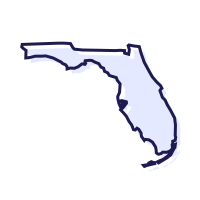
    florida icon
    Florida - 92,677

    A 0/3 policy score and $2,544 in annual increases with no state backstop.

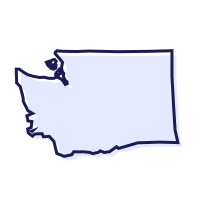
    washington icon
    Washington - 78,568

    A 3/3 policy score and only a $348 annual increase, the clearest example in the dataset of how state infrastructure limits the damage.

    georgia icon
    Georgia - 66,836

    A 2/3 policy score, but a $2,436 annual increase lands without a state backfill.

For the 92,677 unsubsidized Floridians or 100,538 unsubsidized Texans, 2026 isn't an abstraction. It's a $201 to $212 per month out-of-pocket increase with no state backstop.

How Does the Policy Protection Score Affect What Unsubsidized Enrollees Pay?

MoneyGeek scored each state and Washington, D.C. on three binary dimensions, producing a 0 to 3 policy protection score: Medicaid expansion (1 point), a state reinsurance program (1 point) and a state-based marketplace (1 point). States that accepted Medicaid expansion cover adults up to 138% of the federal poverty level, which lowers the pool of marketplace-dependent residents. States with Section 1332 reinsurance waivers pay claims for high-cost enrollees, pulling down premiums for everyone else. States running their own marketplace have more control over rate review and plan standards.

The eight states scoring 0/3 are Wyoming, Tennessee, Florida, Mississippi, Texas, Kansas, Alabama and South Carolina. All eight fall in the top 31 for annual dollar increase. Their unsubsidized enrollees enter 2026 with no Medicaid safety net, no reinsurance suppressing their premium baseline and no state marketplace providing enhanced oversight.

States scoring 3/3 cluster consistently toward the bottom of the annual increase ranking. New Mexico is the one exception, for the reasons described in the table section above.

Which States Created Their Own Subsidy Programs

Four states moved to partially replace federal subsidies: California, New Mexico, Colorado and Maryland.

New Mexico created the most comprehensive backfill, covering all lost federal tax credits for enrollees below 400% of the federal poverty level and capping premiums at 8.5% of household income above that threshold. The state still ranks No. 2 nationally because the backfill helps enrollees who qualify but doesn't suppress underlying premium rates. Those above the income cap still pay a $3,708 annual increase.

Maryland backfilled 100% of lost credits for enrollees below 200% of the federal poverty level, with partial replacement between 200% and 400% FPL. It ranks 42nd ($780 per year), benefiting from its 3/3 policy score alongside the backfill. California capped its program at 165% of the federal poverty level, leaving its 201,417 unsubsidized enrollees above that threshold with the full $888 annual increase. Colorado provided up to $80 per month for eligible enrollees, covering roughly 40% of lost federal assistance, and ranks 29th ($1,332 per year). Washington retooled its Cascade Care Savings program to provide up to $250 per month for enrollees not receiving federal subsidies; combined with its 3/3 policy score, this helps explain why it ranks 49th despite being among the larger unsubsidized populations.

State policy infrastructure matters, but it works at the margin of what are ultimately large, nationally driven rate increases.

The Coverage Fallout

The Urban Institute projects Enhanced Subsidy expiration will produce 4.8 million newly uninsured Americans nationally (a 21% increase), with 7.3 million leaving the marketplace entirely. These projections measure net coverage outcomes from the full cost increase to enrollees, including both subsidy loss and premium increases, and complement MoneyGeek's analysis of gross premium changes for unsubsidized enrollees. State-level projections show damage concentrated at the top of the annual dollar increase ranking:

  • Texas: Largest absolute increase in newly uninsured of any state; 39% projected rise in uninsured residents
  • Florida: 29% projected increase in uninsured residents; 1,080,000 projected to leave the marketplace
  • Georgia: 39% projected increase; 694,000 projected to leave the marketplace
  • Tennessee: 41% projected increase; 270,000 projected to leave the marketplace
  • South Carolina: 50% projected increase; 330,000 projected to leave the marketplace

Mississippi has the worst proportional outcome: a +65% projected increase in uninsured residents, the largest of any state, driven by its 0/3 policy score and a $2,424 annual premium increase for the unsubsidized. These are Urban Institute model projections and will be updated as full 2026 enrollment data becomes available.

Methodology

MoneyGeek calculated the annual dollar impact of 2026 ACA premium increases on unsubsidized enrollees using CMS QHP Landscape and Rate Public Use Files and State-Based Marketplace filings for all 50 states and Washington, D.C. Premiums reflect Silver benchmark plans for a 40-year-old adult. Annual cost increases equal (2026 monthly premium minus 2025 monthly premium) × 12. This analysis covers gross premium changes for unsubsidized enrollees; Urban Institute coverage loss projections cited in this study reflect net cost changes across the full enrollee population, including subsidy recipients. For percentage change rankings and full premium detail, see MoneyGeek's 50-state ACA premium analysis.

Unsubsidized enrollee counts were derived from the CMS Effectuated Enrollment: Early 2025 Snapshot, calculated as total effectuated enrollment minus APTC enrollment by state as of February 2025. This reflects enrollees who paid their premium and held an active policy, the most precise available measure of who actually bears the 2026 cost increases. Plan selection counts (which include auto-re-enrollees who may not have effectuated) are higher and represent a different metric.

The policy protection score (0 to 3) was sourced from KFF Medicaid expansion status and KFF Section 1332 waiver tracking. Backfill program identification used KFF state-based subsidy tracking published January 21, 2026. Urban Institute coverage loss projections come from its Health Insurance Policy Simulation Model (September 2025) and model a scenario of full Enhanced PTC expiration without congressional extension, which is consistent with the subsidy expiration reflected in 2026 state rate filings used in this analysis.

About Nathan Paulus


Nathan Paulus headshot

Nathan Paulus is the Head of Content at MoneyGeek, where he conducts original data analysis and oversees editorial strategy for insurance and personal finance coverage. He has published hundreds of data-driven studies analyzing insurance markets, consumer costs and coverage trends over the past decade. His research combines statistical analysis with accessible financial guidance for millions of readers annually.

Paulus earned his B.A. in English from the University of St. Thomas, Houston.


sources
Copyright © 2026 MoneyGeek.com. All Rights Reserved