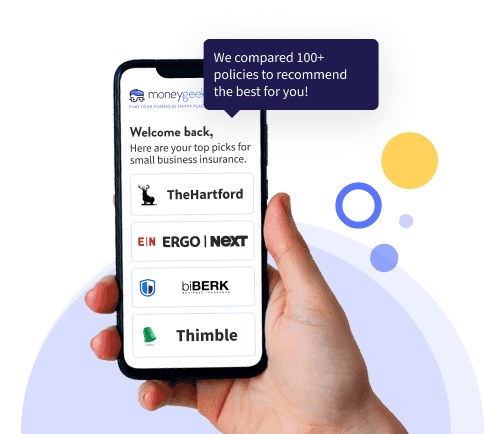



Based on my analysis, these companies are the best small business insurers for bakeries:
Best Bakery Business Insurance
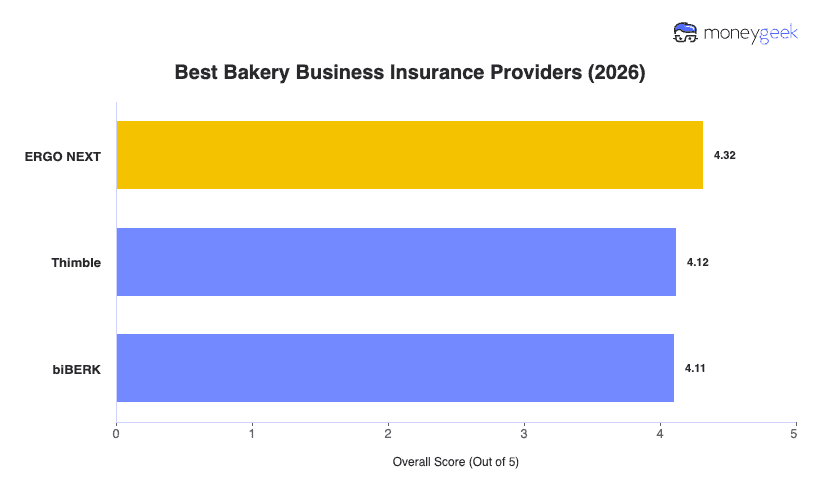
The best insurance for bakeries is offered by ERGO NEXT and Thimble.
MoneyGeek helps you compare the best bakery insurers, coverage types and costs, so you can find the protection your bakery needs.
Ready to shop? Use our tool below to get matched with your top provider and start your bakery insurance quote.
Select state
Updated: September 22, 2026
Advertising & Editorial Disclosure
Best Business Insurance Companies For Bakery
Bakery insurance looks simple until you realize how many ways a commercial kitchen, a retail counter and a delivery route each create different exposures. My rankings are built on three things: what you'll actually pay, what happens when you need help and whether the coverage holds up when it counts. I scored each provider across affordability (50%), customer experience (30%) and coverage options (20%), weighted that way because cost determines what a small bakery can sustain month to month, but the cheapest policy is worthless if it fights you on a grease fire claim or can't issue a COI before a weekend farmers market.
This is what made up my analysis of popular insurers, which was assisted (not run) by AI:
- Affordability: I pulled quotes isolating pricing factors across food and beverage sub-industries, all 50 states (plus DC), employee count (5 ranges from 0 to 49), 16 vehicle types and six of the most common coverage types, extrapolating 500,000+ estimates to build a full pricing picture for bakeries specifically.
- Customer Experience: 300,000+ reviews, forum conversations and industry research were aggregated and manually parsed to identify the patterns that made customers enjoy and dislike service from each insurer. I also went through what an actual bakery owner would go through for all providers analyzed, testing their quoting experiences and policy management tools (excluding claims due to limitations).
- Coverage Options: I read the fine print of policy terms, isolated the exclusions and hidden costs that affect bakeries (like food spoilage carve-outs, product liability sub-limits and equipment breakdown endorsement availability), and documented every option available for all providers to determine which has the best coverage for your operation now and as it grows.

ERGO NEXT: Best Overall, Best for Small and Budget-Conscious Bakeries
pros
Lowest bakery rates at 16% below average
Top-ranked customer experience for bakeries
Instant COIs through mobile app
cons
Coverage options rank third among top providers
Cyber insurance underwritten by Coalition, not in-house
Limited customization for complex bakery operations
COMPANY HIGHLIGHTS
I recommend ERGO NEXT for most bakeries because it pairs the lowest rates in this business category with the smoothest buying and management experience I tested. It runs 16% below the average bakery insurer, and that gap holds whether you're a solo home baker or running a small storefront with a few employees. The mobile app lets you pull COIs on the spot, which matters when a farmers market or event venue needs proof of coverage before you can set up.
The tradeoffs show up when your bakery gets more complex. Product liability is bundled into general liability rather than offered as a standalone policy with adjustable limits, so wholesale operations distributing to multiple retailers may find the coverage ceiling too low. Cyber runs through Coalition rather than ERGO NEXT's own underwriting, and there are no food-industry-specific agents available if you need guidance on something like spoilage endorsements or equipment breakdown riders.
Read Our Review: ERGO NEXT Business Insurance Review

Thimble: Best for Pop-Up and Event-Based Bakeries
pros
Coverage available by the job or month
Second-ranked affordability and customer experience
No long-term commitment required
cons
Weakest coverage options among top three
Less suited for permanent brick-and-mortar bakeries
No in-house workers' comp in all states
COMPANY HIGHLIGHTS
Thimble works best for bakeries where the schedule changes week to week. If you're setting up at a Saturday farmers market, catering a wedding next month and taking December off, paying for a full annual policy wastes money on months you're not operating. Thimble's by-the-job and by-the-month structure lets you match your coverage window to your actual work calendar, and at $121 per month it still comes in 10% below the bakery average when you do need it.
Where Thimble falls short is depth. Its coverage options rank last among the top three, which means fewer endorsement choices and less flexibility to build out a policy as your bakery grows. If you move from weekend pop-ups into a permanent retail location with employees and commercial ovens, you'll likely need to switch carriers for the workers' comp, commercial property and equipment breakdown coverage that a full-time operation demands.
Read Our Review: Thimble Business Insurance Review

biBERK: Best for Bakeries Consolidating Multiple Coverages
pros
Workers' comp, auto and umbrella all in-house
Berkshire Hathaway financial backing on claims
No broker commissions built into pricing
cons
Customer experience ranks sixth in dataset
Digital tools lag behind ERGO NEXT and Thimble
Fewer food-specific endorsements than larger carriers
COMPANY HIGHLIGHTS
biBERK is the only provider in the top three that writes workers' comp, commercial auto, general liability and umbrella coverage all under its own paper. For a bakery with a kitchen crew pulling early morning shifts, a van running wedding cake deliveries and enough liability exposure to need an umbrella on top, keeping all of that with one carrier simplifies renewals, audits and claims when multiple policies overlap on the same incident.
The tradeoff is a rougher experience getting there. biBERK's quoting and policy management tools feel a generation behind the digital-first competitors, and its customer experience ranks sixth in the bakery dataset. COI turnaround and mid-term adjustments take longer than they would with ERGO NEXT or Thimble. There are also fewer bakery-specific endorsements available, so food spoilage or equipment breakdown coverage may require a separate rider or policy altogether.
Read Our Review: biBerk Business Insurance Review
What Types of Insurance Do Bakery Need?
General liability should be the first policy any bakery buys because it covers the two things that generate claims fastest in a commercial kitchen environment, which are customer injuries on your premises and foodborne illness from your products. Product liability is typically bundled into GL, so the same policy that pays when someone slips on your floor also responds when an unlabeled allergen sends a customer to the hospital. Workers' compensation is next because bakeries are physically demanding workplaces where burns, cuts and repetitive strain injuries happen regularly, and most states require it the moment you hire your first employee.
As your operation grows into a permanent location with equipment, delivery routes or higher-limit contracts, commercial property, commercial auto, a business owner's policy (BOP) and umbrella coverage all come into play. The table below summarizes the most common types of business insurance that bakeries need to meet requirements and cover financial risks.
Third-party injury and property damage claims, including product liability for foodborne illness and allergen reactions caused by your baked goods | Every bakery should carry this before serving a single customer | A customer slip-and-fall at a bakery can generate $75,000 in combined medical, legal and defense costs, and food poisoning investigations can exceed $50,000 regardless of fault. | |
Employee medical bills, lost wages and rehabilitation after work injuries including burns from ovens, repetitive strain from decorating and slips on flour-dusted floors | When you hire your first employee in most states, including part-time or seasonal bakers brought on for holidays | Burn injury claims in food service average $15,000 to $40,000 depending on severity, and bakeries see these regularly from hot sheet pans, steam and commercial fryers. | |
Damage or loss to your ovens, mixers, refrigeration, display cases, inventory and buildout from fire, theft or covered weather events | If you lease or own a commercial kitchen or retail space, or work from home with business equipment | Cooking equipment causes over 60% of fires in eating and drinking establishments, generating $165 million in annual property damage nationally. | |
Injuries and vehicle or property damage from work-related driving, including deliveries, catering runs and supply pickups | If your bakery owns a vehicle or employees regularly drive for business purposes | Personal auto policies typically exclude business-use claims, so a delivery driver in an accident on the way to drop off a wedding cake leaves your bakery fully exposed. | |
Bundles general liability with commercial property and often business interruption coverage into a single policy at a lower combined premium | Small bakeries that need both GL and property coverage and want to simplify their insurance | A BOP protects against both customer injury claims and losses to your own equipment and inventory in one policy, and typically costs less than buying each coverage separately. | |
Costs from data breaches, ransomware attacks and regulatory penalties when customer payment data or personal information is compromised | Any bakery that processes credit card transactions, takes online orders or stores customer information digitally | A single POS system breach can trigger notification costs, forensic investigation fees and potential fines that easily reach five figures for a small retail operation. | |
Extra liability protection that kicks in after your primary GL, auto or workers' comp policy reaches its limit | When a contract, venue or wholesale client requires limits above your base policies | A wholesale contamination incident affecting multiple restaurants can generate claims that blow past standard $1M or $2M primary limits quickly. | |

WHY GETTING BAKERY INSURANCE IS IMPORTANT
Bakeries pack more risk per square foot than most small businesses realize. Between a commercial kitchen running at high temperatures, perishable inventory that spoils the moment refrigeration fails and baked goods that carry allergen exposure with every sale, the claims potential is constant. One wholesale bakery's contaminated product generated $129,000 in combined medical expenses, restaurant revenue losses and legal fees from a single incident. Meanwhile, the average bakery insurer in my dataset charges $132 per month. That means roughly 18 months of premiums would cover a claim that could otherwise shut your doors permanently.
How Much Does Bakery Business Insurance Cost?
Bakery insurance costs average $132 per month across all coverage types for a small operation, with commercial property running as low as $80 per month and commercial auto reaching $203 per month at the high end. What you actually pay depends on your bakery type, whether you operate a retail storefront or a wholesale production facility, how many employees you have and how much allergen-heavy product you move.
Here's an overview of costs for common coverage types:
- General Liability: $114 monthly ($1,368 annually)
- Workers' Comp: $176 monthly ($2,108 annually)
- Commercial Property: $80 monthly ($961 annually)
- Commercial Auto: $203 monthly ($2,438 annually)
- Cyber Insurance: $88 monthly ($1,063 annually)
What Are These Costs Based On?
The costs presented are for a 1 to 4-person business aggregated across all 50 states plus D.C. Assumptions by coverage type are as follows.
- Coverage limits for workers' comp and commercial auto represent state-required coverage.
- General liability is for a $1 million per occurrence and $2 million aggregate policy.
- Commercial property assumes an average estimated property value across all professions.
- Cyber assumes a $1 million limit policy.
Use our business insurance calculator below to estimate your bakery’s insurance costs and find providers that match your needs.
Bakery Insurance Cost Calculator
Select Coverage Type
Select Employee Count
Select Vehicle Type
Select State
Average Monthly Cost—
Select Coverage Type
Average Monthly Cost—
Select Employee Count
Select Vehicle Type
Select State
How To Buy The Best Bakery Business Insurance
I've outlined the buying process below step by step. If you want something to take with you while gathering quotes, download the bakery business insurance buying worksheet to keep everything organized across providers.
- 1
Identify Required Coverages
Start with your lease agreement and any vendor or venue contracts you've signed. Most commercial landlords require general liability with minimum limits before you can occupy a space, and farmers markets, wedding venues and wholesale clients often have their own coverage requirements on top of that. If you hire employees, check your state's workers' comp mandate since most states require it at the first hire. When a contract calls for additional insured status, that must be added through your carrier as a policy endorsement. Handing over a certificate of insurance (COI) alone only proves coverage exists, it does not extend your protection to the other party.
Read More: Business Insurance Requirements
- 2
Map Your Bakery's Risks to Coverage
Walk through your actual operations and test which policy would respond to each scenario. A customer bites into a cookie containing undisclosed tree nuts and goes into anaphylaxis. That is a product liability claim handled under your GL policy. A mixer motor burns out during a holiday rush and you lose two days of production along with $3,000 in perishable inventory. That requires commercial property with equipment breakdown and spoilage endorsements. If you cannot name the policy that would pay for a specific loss, you have a gap.
- 3
Set Limits That Match Your Actual Exposure
Your limits should reflect the worst realistic claim your bakery could face, not just the cheapest option available. A retail bakery selling directly to walk-in customers has a different ceiling than a wholesale operation distributing to dozens of restaurants across a metro area. If one contamination event could trigger claims from multiple businesses and their customers simultaneously, a $1M per occurrence limit may not be enough.
Read More: How Much Business Insurance Do I Need?
- 4
Research Providers That Understand Food Businesses
Not every insurer writes coverage for bakeries, and those that do vary widely in how they handle food-specific risks. Some carriers include product liability and food spoilage in their standard GL or BOP. Others exclude spoilage entirely or cap equipment breakdown at limits too low for a commercial kitchen full of ovens and refrigeration. Before requesting quotes, confirm that each insurer on your list actually covers bakeries and offers the endorsements your operation needs.
- 5
Compare Quotes With Identical Terms
Look up what bakery insurance typically costs for your size and type of operation so you have a baseline going in. Then request quotes using the same limits, deductibles and endorsements across every provider. A policy that looks cheaper per month but excludes food spoilage coverage or caps equipment breakdown at $10,000 is not a real savings when your walk-in freezer fails overnight.
- 6
Review Your Policy Before Signing
Read the actual policy language before you commit, not just the quote summary. Confirm that product liability is included in your GL and not carved out as a separate purchase. Check whether food spoilage and equipment breakdown are covered or require additional endorsements. Make sure the named insured matches your bakery's legal business name exactly, because a mismatch can void coverage or create problems when a landlord or venue checks your COI.
- 7
Reassess Coverage When Your Bakery Changes
Adding employees, switching from retail to wholesale, starting a delivery route or moving into a larger space with more expensive equipment all change what coverage you need. Taking on a wholesale contract that distributes your products to grocery stores across a region dramatically increases your product liability exposure compared to selling from a single counter. Don't wait for renewal to discover your policy no longer matches how your bakery actually operates.
Bakery Insurance: FAQ
Here are answers to other common questions bakery owners have about business insurance.
Bakery business insurance is a set of policies designed to cover the specific ways a commercial baking operation creates financial risk. General liability responds when a customer gets hurt on your premises or claims your product made them sick. Workers' comp pays for employee injuries from burns, cuts and repetitive strain. Commercial property covers your kitchen equipment and inventory. The right combination depends on whether you run a retail storefront, a wholesale production facility, a home-based cottage operation or some mix of all three.
It depends on your state, your business structure and whether you have employees. Workers' compensation is legally mandated in most states the moment you hire your first worker, though a handful of states set the threshold higher. General liability is not required by statute, but most commercial landlords, farmers markets and wholesale buyers will refuse to work with you unless you carry it. Your lease and vendor agreements often function as de facto requirements even when no law exists.
Most states with cottage food laws allow home-based bakers to sell certain products without a commercial kitchen, but that does not exempt you from liability if someone gets sick from your food. Homeowners insurance typically excludes business activity, so a product liability claim from a bake sale or online order would come out of your own pocket. A basic GL policy covers this gap and is often required to sell at farmers markets or through online platforms.
Most farmers markets require at minimum $1 million per occurrence in general liability coverage and a COI naming the market or venue as an additional insured. Wedding venues and event spaces often require $2 million in coverage. Some wholesale clients and grocery chains set their own minimums that can reach $5 million depending on distribution volume. Check requirements before buying so your policy limits actually satisfy the contracts you plan to sign.
Product liability is almost always bundled into a standard general liability policy rather than sold separately. It covers claims when your baked goods cause illness, injury or an allergic reaction. If a customer has an anaphylactic response to an undisclosed allergen in your product, product liability pays for their medical costs and your legal defense. The FDA requires disclosure of nine major allergens under the Food Allergen Labeling and Consumer Protection Act and the FASTER Act, and failing to label correctly increases both your legal exposure and your claims risk.
Start with your state's department of health for food safety and cottage food licensing rules, since those often specify liability minimums. Check your state's department of insurance or workers' compensation board for employee coverage mandates. If you operate under a commercial lease, the insurance section of your lease agreement will list its own requirements separately from anything the state mandates. Not every requirement lives in the same place, so check all three before assuming you have the full picture.
Your coverage needs typically shift when you hire your first employee, move from a home kitchen into a commercial space, start making deliveries, expand into wholesale distribution or begin selling at events that require higher limits. Taking on a wedding cake contract that involves transporting a $2,000 product in your vehicle introduces commercial auto exposure that did not exist when you were selling cookies from a counter. Revisit your coverage before any major operational change takes effect, not at renewal.
Best Bakery Business Insurance: The Bottom Line
You now know which providers scored highest for bakeries, what coverage types your operation actually needs and what to expect on pricing. The most important thing to remember when comparing quotes is that two policies at the same monthly cost can look very different underneath. One might include product liability and food spoilage in the base GL policy while the other carves them out as paid endorsements. One might write workers' comp in-house while the other routes it through a third party you've never heard of. Those differences only matter when something goes wrong, which is exactly when you need them to be right.
Before you compare, these are my top picks overall for bakeries.
Get Bakery Business Insurance Quotes
Use the tool below to find insurance providers that match your bakery. You can then compare quotes and coverage directly with each provider.
About Angelique Palenzuela-Cruz

Angelique Palenzuela-Cruz is a Business Insurance Content Writer at MoneyGeek, where she specializes in general liability, workers’ compensation and professional liability insurance. Her work helps small business owners understand how these policies apply to coverage, including risks like customer injuries, employee injuries, professional mistakes, client contract terms and industry-specific coverage requirements.
She primarily covers service-based businesses where liability and employee coverage decisions are especially important, including cleaning, consulting, beauty and wellness, childcare, education, fitness, food service, pet care, repair and maintenance, and other professional services.
Before joining MoneyGeek, Angelique spent nearly 12 years at Guthrie-Jensen Consultants, one of Southeast Asia’s largest management training firms, where she advanced from Training Consultant to Managing Consultant. In that role, she worked with business clients to assess operational needs, develop training programs and present performance analyses to executive decision-makers. She also helped establish Gladwin Training Consultancy, where she served in learning solutions and client service roles.
Her background gives her practical context for writing about how businesses operate, manage client expectations, structure teams and make risk decisions. At MoneyGeek, she applies that experience to business insurance content, connecting coverage to actual business needs.
LinkedIn: linkedin.com/in/ma-angela-cruz
Email Contact: angelique.palenzuela@moneygeek.com
Sources
- The Coyle Group. "Bakery Insurance in 2025 - Your Guide." Accessed October 2, 2026.
- Denton Business Insurance. "Texas Workers Compensation for Bakeries." Accessed October 2, 2026.
- Ansul. "Two NFPA restaurant fire stats you should know." Accessed October 2, 2026.