
How Much Does Cyber Insurance Cost?

Small businesses pay $83 per month ($999 annually) on average for cyber insurance. This national benchmark comes from analysis of business insurance costs for over 400 industries across all 50 states and Washington, D.C.

Keep in mind that this is only an estimate, and you quote is based on your industry, the type and amount of information you store, where you operate, and how many employees have access to your systems.

We analyzed quote data from major cyber insurance providers and modeled standardized premium estimates across common business profiles.

Dataset scope:

  • 10 major providers analyzed
  • 408 industries covered
  • 51 geographies (all U.S. states plus Washington, D.C.)
  • 5 employee count bands (0, 1-4, 5-9, 10-19, 20-49)
  • Policy baseline: $1 million aggregate with a $1,000 deductible

How we calculated averages:

The national benchmark ($83/month) is the modeled premium for a one to four-employee business averaged across all industries and states. Segment averages isolate individual variables to show how premiums shift by business size, industry, or location.

What Affects Cyber Insurance Costs?

Most business insurance prices physical danger, but cyber insurance prices data value. The more sensitive information you store, the more you pay. Three factors mainly drive your premium: industry (what data you hold), employee count (how many access points you create), and location (how much breaches cost to resolve in your state).

Below, we'll break down how each of these items affect your pricing and what sub-factors they're the source of.

    smallBusiness icon
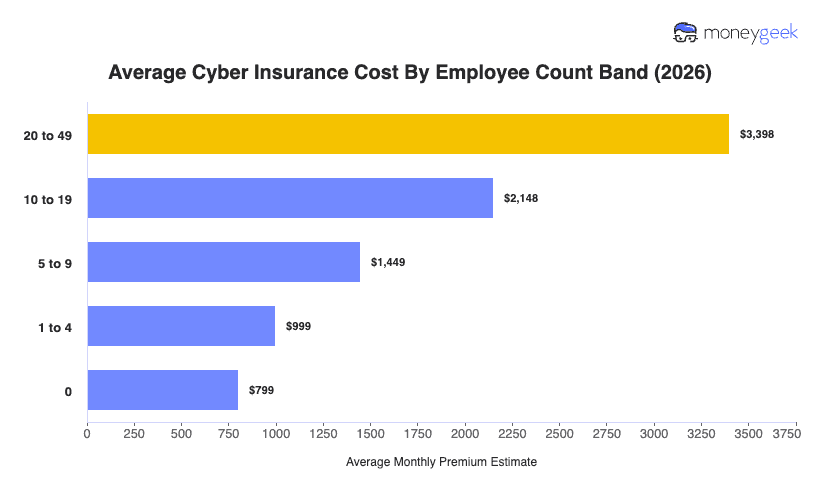
    Your employee count multiplies your attack surface

    The size of your business is the most influential factor affecting cyber insurance costs at it directly determines the amount of people that have hands on sensitive data and the amount you have. 60% of breaches involve human error, and more employees means more error. This results in an exponentially increasing insurance cost as any business grows. 

    When comparing opposite ends of the employee count spectrum, a 20-to-49-person business has 325% higher cyber insurance costs than a sole proprietor.

    hammer icon
    Industry area

    Your industry is the second most influential factor that affects your cyber insurance costs due to it determining what type of digital information is at risk. For example, a small beauty salon will have less risk of losses than a retail shop due to a lower frequency of digital transactions. Tech and IT companies pay the most at around 88% above the national average and recreation/sports related businesses pay the least at 38% below average.

    pin icon
    Location of operations

    Your state where you operate is the least influential of the cyber insurance pricing factors and costs range anywhere from 15% lower than average (Wyoming and Alaska) to up to 24% higher (Washington D.C.) than national benchmarks. Locations with strict privacy laws, aggressive regulators, and plaintiff-friendly courts cost more to defend while those with looser regulations and lower legal costs allow insurers to charge lower premiums.

Average Cyber Insurance Costs by Business Size

Use this table to find your size band and see how much you're paying above or below baseline. If you're between bands, budget for the higher one before you grow into it.

Cyber Insurance Cost Chart

Average Cyber Insurance Costs by Industry

Unlike other coverage types, cyber insurance costs by general industry area are more normally distributed:

  • Low-risk (20%+ below average): Cleaning services, transportation & logistics, recreation & sports, nonprofits & associations, agriculture & natural resources
  • Mid-risk (Within 20% of average): Wholesale & distribution, (arts, media and entertainment), manufacturing, childcare services, education, construction & contracting, fitness services, pet care services. real estate & property services, repair & maintenance, (beauty, body and wellness services), food & beverage, retail & product rental, marketing & communications, other professional services (event planners, lawyers, security guards)
  • High-risk (20%+ above average): Consulting services, (hospitality, travel and tourism), financial services, healthcare & medical, tech/it

Tech companies, healthcare providers, and financial services firms pay 37% or more above average because due to the industries often having high value transactions and highly sensitive information involved in them. Even though these industries are especially expensive, most are not above average, and 68% are below national benchmarks.

Find your industry below to see where you fall, then look at the risk tier to understand whether you should prioritize security investments or shop harder for competitive rates.

Data filtered by:
Select
Agriculture & Natural Resources$52$62138%1
Arts, Media & Entertainment$71$85514%7
Beauty, Body & Wellness Services$82$9832%17
Childcare Services$73$88112%10
Cleaning Services$65$78322%5
Construction & Contracting$75$89810%11
Consulting Services$100$1,197-20%21
Education$73$88012%9
Financial Services$114$1,365-37%23
Fitness Services$76$9149%12
Food & Beverage$81$9762%16
Healthcare & Medical$116$1,395-40%24
Hospitality, Travel & Tourism$107$1,283-28%22
Manufacturing$72$86214%8
Marketing & Communications$96$1,146-15%19
Nonprofit & Associations$57$67932%3
Other Professional Services$97$1,166-17%20
Pet Care Services$77$9228%14
Real Estate & Property Services$76$9148%13
Recreation & Sports$56$67532%2
Repair and Maintenance$79$9525%15
Retail & Product Rental$89$1,073-7%18
Tech/IT$157$1,882-88%25
Transportation & Logistics$60$72428%4
Wholesale & Distribution$68$81319%6

Average Cyber Insurance Costs by State

Location matters less in cyber than in other business insurance, but it's still worth checking. The gap between the cheapest state Wyoming ($71) and most expensive area of Washington D.C. ($103) is only $32 a month because cyber-attack risk is not directly tied to your location.

Similar to industry, state risk is more normally distributed and cyber insurance pricing follows with an even more clear bell curve:

  • Lower-cost (10%+ below average): Idaho, Montana, North Dakota, Alaska, Wyoming.
  • Mid-cost (Within 10% of average): Colorado, Texas, Florida, Georgia, North Carolina, Oregon, Pennsylvania, Michigan, Ohio, Minnesota, Arizona, Tennessee, Missouri, Wisconsin, Indiana, Alabama, South Carolina, Kentucky, Louisiana, Utah, Kansas, Oklahoma, New Mexico, Mississippi, New Mexico, Mississippi, Arkansas, Hawaii, Rhode Island, Maine, New Hampshire, Iowa, Vermont, Nebraska, West Virginia, South Dakota,
  • Higher-cost (10%+ above average): Washington D.C (District of Columbia), New York, California, New Jersey, Connecticut, Illinois, Maryland, Massachusetts, Delaware, Nevada, Virginia, Washington.

California and New York are the only states/territories that sit 20% above the national average for cyber insurance costs due to stricter notification timelines, more aggressive attorneys and juries that award larger settlements. That vast majority of states are close to the average with 65% falling within 10% of national benchmarks.

Data filtered by:
Select
Alabama$80$9653%24
Alaska$71$84915%2
Arizona$85$1,013-2%29
Arkansas$76$9178%15
California$98$1,177-18%49
Colorado$90$1,081-8%39
Connecticut$95$1,139-14%45
Delaware$92$1,109-11%40
District of Columbia$103$1,235-24%51
Florida$90$1,080-8%37
Georgia$88$1,061-6%36
Hawaii$75$89710%14
Idaho$72$86813%5
Illinois$95$1,139-14%46
Indiana$83$9941%25
Iowa$75$89710%10
Kansas$79$9465%19
Kentucky$80$9653%22
Louisiana$80$9653%21
Maine$75$89710%12
Maryland$95$1,138-14%44
Massachusetts$95$1,139-14%47
Michigan$85$1,013-2%32
Minnesota$85$1,013-2%30
Mississippi$76$9178%16
Missouri$83$9941%27
Montana$71$84915%4
Nebraska$75$89710%8
Nevada$92$1,110-11%43
New Hampshire$75$89710%11
New Jersey$96$1,158-16%48
New Mexico$76$9178%17
New York$101$1,206-21%50
North Carolina$87$1,042-4%35
North Dakota$71$84915%3
Ohio$85$1,013-2%31
Oklahoma$79$9465%18
Oregon$87$1,042-4%34
Pennsylvania$87$1,042-4%33
Rhode Island$75$89710%13
South Carolina$80$9653%23
South Dakota$72$86813%6
Tennessee$83$9941%28
Texas$90$1,081-8%38
Utah$79$9465%20
Vermont$75$89710%9
Virginia$92$1,109-11%42
Washington$92$1,109-11%41
West Virginia$72$86813%7
Wisconsin$83$9941%26
Wyoming$71$84915%1

California and New York are expensive because breach response there costs more: stricter notification timelines, more aggressive attorneys general, and juries that award larger settlements.

How To Lower Cyber Insurance Costs

Unlike other business insurance, you can directly reduce your cyber premium by improving your security. Missing basic controls like MFA or EDR can add 25% to 50% to your quote or disqualify you entirely. Strong security does the opposite: it signals lower risk and earns better rates. 

Prioritize the required controls first to qualify for coverage, then add discount-earning controls if the math makes sense for your risk level.

Cyber Insurance Cost: Bottom Line

Cyber insurance costs vary based on how insurers estimate your breach likelihood and potential claim size. Your premium moves most based on industry, employee count, and state. Use the $83 monthly national average as a benchmark, not a prediction.

Apply this report by considering context, not a single price:

  1. Where do you fall compared to average? (industry + state + employee count)
  2. What's driving your cost? (data sensitivity vs. security posture)
  3. What would meaningfully change your price? (MFA, EDR, backup procedures, and shopping multiple insurers)

Unlike other business insurance, you have direct control over cyber premiums through security investments. Strong controls can reduce your quote by 20-30% or make the difference between approval and denial.

Cyber Insurance Cost: Next Steps

Where you go next depends on where you are in your buying process.

Ready to compare providers? You know what you need and want to see who offers the best combination of price and coverage.

  • Best Cyber Insurance Providers
  • Cheapest Cyber Insurance Providers

Get Personalized Cyber Insurance Quotes

Select your industry and state to get a customized cyber insurance quote.

Industry
State

Still researching coverage?

Looking at your full coverage picture?

About Blest Papio


Blest Papio headshot

Blest Papio is a Content Producer at MoneyGeek specializing in small business insurance. With five years of experience in insurance and finance writing and hands-on perspective as a former business counselor, he understands the risks that come with running a business and what it takes to protect against them.

Blest focuses on commercial auto, cyber, property and specialty business insurance. He digs deep into policy details, regulations and provider offerings so businesses can find the coverage they need and avoid financial fallout. His goal is to translate technical insurance language and insurer offerings into guides you can act on.

Whether you're insuring company vehicles, managing cyber liability or protecting your commercial property, Blest aims to guide you through your risks to help you find coverage you truly need, not sell you a policy.


Copyright © 2026 MoneyGeek.com. All Rights Reserved