
When to Drop Collision and Comprehensive Coverage


Rules of Thumb: When Should You Drop Full Coverage?

Should you drop comprehensive and collision? The answer depends on three things: your car's value, what you pay for insurance, and whether you have the savings to replace it. The reality is that most drivers should have full coverage, but these are the circumstances when you should drop collision and comprehensive: 

Rules of thumb for when to drop full coverage:

  1. 10% rule: Your annual premium for collision and comprehensive exceeds 10% of what your car is worth. If your car is worth $6,000 and you pay $900 a year, that's 15% of the vehicle's value. Drop it.
  2. Car value rule: Your car is worth less than $7,500. The old benchmark was $5,000, but premiums now cost $200 to $250 a month and repair costs have climbed. A car worth $7,500 or less often doesn't justify the coverage cost.
  3. Savings rule: You have enough in emergency savings to cover a large repair bill on your own.
  4. Ownership rule: Your car is paid off. Lenders require comprehensive and collision if you're financing or leasing. You can't drop either until the loan is gone.

All four need to apply before dropping makes sense. If even one doesn't fit, keep the coverage.

When to Drop Collision and Comprehensive Coverage

You don't have to drop both at once. Collision and comprehensive serve different purposes, and the right call on each one may differ. Driving habits affect collision risk. Location affects comprehensive risk. Drop one, keep the other if that's what your situation calls for.

  1. 1

    When You Should Drop Collision

    Drop collision when your driving risk is low and the premium doesn't justify the protection.

    • You meet all four rules of thumb above.
    • You have a clean record. Most drivers haven't had an at-fault accident in the past three years.
    • You drive infrequently or stick to local roads. 5,000 miles a year on local streets is lower risk than a 40-mile highway commute every day.
    • Your car is paid off and you have emergency savings to cover a large repair bill.
    • Your annual collision premium exceeds 10% of your car's value.

    Don't drop collision if you're a new or high-mileage driver, or if your car is financed or leased. Lenders require it.

  2. 2

    When You Should Drop Comprehensive

    Drop comprehensive when regional risks are low and you can cover the loss yourself.

    • You meet all four rules of thumb above.
    • You park in a secure garage and live in a low-crime area.
    • Your region has no significant history of hail, flooding or severe storms.
    • You can afford to replace the car if it's stolen or totaled.
    • Your car is paid off. Lenders require comprehensive if you're financing or leasing.

    Don't drop comprehensive if you don't have emergency savings. It costs $200 to $400 a year but covers catastrophic losses like theft or major weather damage.

mglogo icon
MONEYGEEK TIP: INCREASING DEDUCTIBLE VS REMOVING FULL COVERAGE

Before dropping collision or comprehensive entirely, consider raising your deductible instead. This is a smart middle ground between full coverage and no coverage.

Raising your deductible from $500 to $1,000 saves $100 to $200 per year on collision. That's less savings than dropping it completely, but you still have coverage. The tradeoff: if you have a claim, you pay $1,000 out of pocket instead of $500.

What You Lose When You Drop Comprehensive & Collision

Before deciding if you should drop collision, comprehensive, or both (full coverage), understand exactly what you're giving up in terms of protection.  You will lose coverage for repairs to your car and this is why you need to make sure you have savings.

  1. 1
    If you drop collision coverage:

    You're no longer covered for accidents you cause or single-vehicle crashes. Hit another car, a tree, a guardrail. That's on you. You pay 100% of repair costs out of pocket.  Liability coverage (required by state law) still protects the other driver, but your own car damage? You pay for it.

  2. 2
    If you drop comprehensive coverage:

    You lose protection against events beyond your control including hail damage, theft, animal damage, weather damage, and vandalism. You will need to pay for damage caused by these events.

Savings When You Drop Collision and Comprehensive

Knowing what you lose when you drop collision and comprehensive is important. But so is understanding what you save when you drop coverage.

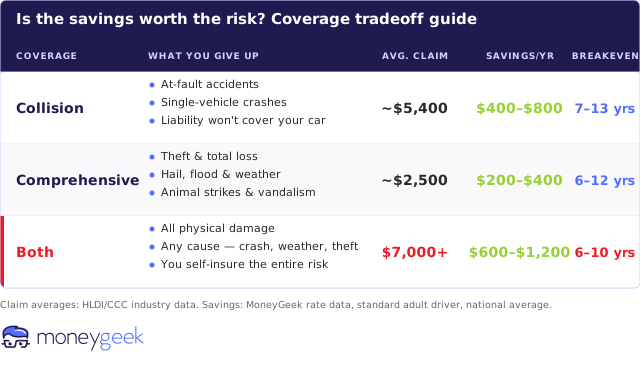
The matrix below will help you determine the financial tradeoffs of dropping one or both coverages. Keep in mind there is always an element of risk involved in this decision.

Image showing a tradeoff matrix of dropping comprehensive and collision coverage.
coins2 icon
HOW TO DETERMINE A CAR'S ACTUAL CASH VALUE

You will need to know the Actual cash value (ACV) of your car when deciding if you drop comprehensive and collision.  

Don't rely on one source:

  • Kelley Blue Book: Provides conservative estimates often used by insurers
  • Edmunds: Uses market data and tends to show higher values
  • NADA Guides: Reflects dealer pricing, usually in the middle
  • Local listings: Check sites like AutoTrader to see what cars are actually selling for

Do You Need Comprehensive and Collision Coverage: FAQ

Should I drop collision insurance on a 10-year-old car?

What if I can't afford to replace my car if it's totaled?

What about my liability coverage? Can I drop that?

What about expensive repairs like windshield replacement on new cars?

Can classic or collector cars follow the same dropping rules?

If I drop coverage, can I add it back later?

Collision and Comprehensive Insurance: Related Articles

About Mark Fitzpatrick


Mark Fitzpatrick headshot

Mark Fitzpatrick, a Licensed Property and Casualty (P&C) Insurance Producer in Connecticut, is MoneyGeek's resident insurance expert. He has analyzed the insurance market for almost a decade, first with LendingTree and now with MoneyGeek, conducting original research on hundreds of insurance companies and millions of insurance rates for insurance shoppers. 

He writes about economics and insurance on MoneyGeek, breaking down complex topics so people can have confidence in their purchase. Like all MoneyGeek analysts, Mark collects and analyzes independent cost and consumer experience data on insurance companies to provide objective recommendations in our content that are independent of any of MoneyGeek's insurance company partnerships. 

His insights on products ranging from car, home and renters insurance to health and life insurance have been featured in The Washington Post, The New York Times and NPR, among others. 

Mark holds a master’s degree in economics and international relations from Johns Hopkins University and a bachelor’s degree from Boston College. He started his career working in financial risk management at State Street before transitioning to the analysis of the personal insurance market. He's also a five-time Jeopardy champion!


Sources