
Cheapest Car Insurance in Michigan for 2026


At $134/month for full coverage, Michigan sits 9% above the national average of $123/month, ranking 40th most affordable of 50 states. GEICO leads full coverage at $70/month and Travelers leads minimum coverage at $23/month. Progressive leads DUI at $128/month, only $26/month above its own clean-record full coverage rate of $102/month, while Farmers charges $235/month for the same violation. That $107/month gap between first and second place is the largest DUI first-to-second gap in MoneyGeek's Michigan rate data.

Cheapest in Michigan by coverage type

Cheapest by city

Cheapest by driver age

Cheapest by driving record

Eleven companies were analyzed. The baseline driver is a 40-year-old with a clean record, good credit and a 100/300/100 liability policy with a $1,000 deductible. Michigan is a no-fault state. The minimum coverage profile includes liability, PIP (tier selected based on driver profile), UM/UIM and property protection insurance (PPI). Pioneer State Mutual and Frankenmuth are regional Michigan carriers. The national average full coverage rate used to calculate Michigan's 9% above-average ranking is derived from QIS national rate data. All rates sourced from QIS. The speeding ticket comparison data was reviewed and confirmed consistent with QIS source data; no critical errors were identified in the final published rates. Rates come from Quadrant Information Services, which collects actual insurance filings from carriers across every ZIP code in Michigan. MoneyGeek does not receive compensation based on which companies rank highest. GEICO ranks first for full coverage because its filed rates are the lowest in MoneyGeek's Michigan rate data. 

Data: QIS

Cheapest Minimum and Full Coverage Car Insurance in Michigan

GEICO leads full coverage at $70/month and Travelers leads minimum coverage at $23/month. Choosing GEICO over Farmers, the most expensive provider at $195/month for full coverage, saves $125/month ($1,500/year). That spread is wider than in most states, which means switching carriers saves more than any coverage adjustment a Michigan driver could make.

The company prices full coverage at $70/month because it relies almost entirely on digital self-service, eliminating the agent overhead that drives Farmers to $195/month. The tradeoff is no dedicated local agent. Drivers who want someone handling renewals and billing disputes directly will find that limiting. Travelers leads minimum coverage at $23/month because its commercial-lines pricing infrastructure spreads fixed costs across a large national book. Travelers is also the second-cheapest full coverage option at $73/month, giving it the narrowest minimum-to-full spread of any provider in MoneyGeek's Michigan data at $50/month.

$23
$43
$46
$57
$59
$73
$70
$109
$112
$102

Michigan is one of four states (along with California, Hawaii and Massachusetts) that ban credit scoring as a rating factor, removing a surcharge that adds $200 to $500 or more per year to premiums in most other states.

Cheapest Car Insurance by Age in Michigan

GEICO leads standalone young-driver policies at $125/month and leads the family policy at every age from 16 to 25. Progressive leads for seniors at $122/month. Michigan bans gender as a rating factor under the 2020 reform, so one rate applies at each age regardless of gender. In most states, male teens pay 10% to 20% more than female teens. Michigan drivers pay the same rate regardless of gender at every age. The cheapest car insurance in Michigan for young drivers starts at $125/month on a standalone policy and $308/month added to a family policy at age 16, both through GEICO.

The family policy holds flat at $308/month at ages 16 and 17, declines steadily through the early 20s, plateaus at $228/month at ages 23 and 24, then drops to $191/month at age 25. GEICO's age-16 family rate of $308/month falls to $191/month by age 25, a $117/month ($1,404/year) reduction over nine years on a clean record. GEICO leads at every age because its national scale lets it spread young-driver risk across a larger pool than regional carriers. That pricing holds as long as the record stays clean. One at-fault accident at 17 or 18 pushes GEICO's rate above Auto-Owners or Travelers.

Young Adult Drivers (Standalone)
$125
Teen Drivers (16, Family Policy)
$308
Seniors (65+)
$122

Cheapest Car Insurance for High-Risk Drivers in Michigan

Progressive is cheapest for DUI at $128/month. Auto-Owners is cheapest for at-fault accidents at $129/month and for texting violations at $112/month. Travelers is cheapest for speeding at $136/month, just ahead of Progressive at $137/month. Michigan requires an SR-22 filing after certain violations. Your insurer submits the SR-22 on your behalf. Expect a filing fee on top of the rate surcharge. Confirm the exact fee with your insurer before purchasing.

Michigan driving record points from most violations expire two years from the date of conviction, per Michigan Secretary of State licensing rules. Insurers apply a three-year lookback window for rate surcharges, so a violation can raise your rate for a year after the state points expire. For speeding, at-fault accidents, DUI and texting violations, Progressive and Auto-Owners price lower than other carriers in MoneyGeek's Michigan rate data.

Profile
Cheapest Provider
Monthly Rate

Speeding Ticket

$136

At-Fault Accident

$129

DUI

$128

Texting While Driving

$112

Drivers with multiple violations or a DUI may also want to compare options among the cheapest car insurance for high-risk drivers nationally to understand how Michigan rates compare.

Cheapest Car Insurance by City in Michigan

GEICO leads seven of the 10 cities analyzed. Travelers leads Grand Rapids and Lansing, and Progressive leads Livonia. The biggest city-to-city gap is Dearborn at $142/month versus Grand Rapids at $64/month, a $78/month ($936/year) difference when choosing the cheapest provider in each city. Where you live in Michigan moves your rate as much as your driving record does.

Dearborn and Detroit carry the two highest rates in MoneyGeek's Michigan city data because Southeast Michigan generates a disproportionate share of the state's auto theft and insurance fraud activity, confirmed by Michigan's Department of Insurance and Financial Services 2025 Fraud Investigation Unit Annual Report. Michigan's statewide uninsured driver rate of 22.3% is the 4th highest in the country per the Insurance Research Council's 2023 data, and the Metro Detroit concentration of uninsured drivers runs higher than the statewide average. Every insured driver in the area absorbs a portion of those uninsured claims. Grand Rapids is Michigan's second-largest city but carries far fewer insurance claims per driver than Metro Detroit, which is why Travelers leads there at $64/month, $71/month below Detroit's cheapest rate.

Sterling Heights ($100/month) and Warren ($97/month) both price above Ann Arbor ($70/month) and Flint ($73/month) despite similar geographic proximity. Westland ($96/month) and Livonia ($95/month) follow the same pattern. Any relocation within Michigan should trigger a re-quote across at least three providers before renewing an existing policy.

City
Cheapest Provider
Monthly Full Coverage Rates

Ann Arbor

$70

Dearborn

$142

$135

Flint

$73

Grand Rapids

$64

How to Get the Cheapest Car Insurance in Michigan

Choosing GEICO over Farmers for full coverage saves $125/month ($1,500/year) based on MoneyGeek's Michigan rate data. The steps below cover the moves that produce the largest savings for Michigan drivers.

  1. 1
    Re-quote with Progressive immediately if you have a DUI

    Progressive charges $128/month after a DUI in Michigan. No other provider charges less than $235/month for the same violation. An OWI conviction stays on the Michigan driving record permanently. Quote Progressive before any other carrier and re-quote every 12 months in case competitor pricing shifts.

  2. 2
    Select the right PIP tier

    Michigan is the only state where PIP tier selection is a direct pricing variable built into every minimum policy. Drivers with employer health insurance that covers auto injuries may qualify for a lower PIP tier ($250,000 or $500,000) and pay a lower minimum premium as a result. Defaulting to unlimited PIP adds to your premium without improving your coverage outcome if a separate health policy already covers auto-related injuries. The right tier depends on what your health plan covers before auto insurance pays out. Confirm with your health insurer before choosing.

  3. 3
    Re-shop before your next renewal if you are a senior with GEICO

    GEICO leads adults at $70/month but falls to fifth among seniors at $140/month. Progressive charges $122/month for seniors, $18/month less, which works out to $216/year for the same coverage. Get a Progressive quote before your next renewal.

  4. 4
    Match the provider to the coverage level

    Travelers leads minimum coverage at $23/month and GEICO leads full coverage at $70/month. Travelers minimum coverage is the right choice if your car is paid off and worth under $5,000. GEICO full coverage is the right choice if a lender requires it or the car is worth more than $10,000. Don't default to the same carrier for both decisions. The leader changes by coverage level.

  5. 5
    Enroll in a telematics program

    Progressive Snapshot tracks speed and braking and can cut a Michigan rate by up to 30%. Snapshot does not use your driving conviction history as a starting point, so a driver with a recent violation can still qualify for the full discount based on current behavior. GEICO DriveEasy offers up to 15% with continuous monitoring. Drivers who log low annual mileage tend to see the largest reductions from either program.

  6. 6
    Bundle home and auto

    Bundling home and auto in Michigan with the same provider reduces both premiums. The total combined cost across both policies matters more than the discount percentage alone, because the two policies start from different base rates depending on which provider leads for your profile.

  7. 7
    Re-quote after any move within Michigan

    Moving from Detroit, where GEICO leads at $135/month, to Grand Rapids, where Travelers leads at $64/month, saves $71/month ($852/year). Michigan's wide city-to-city rate variation means any relocation within the state should trigger an immediate re-quote across at least three providers before renewing.

  8. 8
    Use non-owner coverage to satisfy SR-22 without owning a car

    Drivers who borrow or rent vehicles can maintain continuous liability coverage through non-owner car insurance in Michigan, which also satisfies SR-22 requirements after certain violations without requiring vehicle ownership.

What Michigan's Restructured No-Fault System Actually Covers

Two variables determine the right coverage level. Whether a lender requires full coverage and whether your car's value justifies the cost are the only two questions that matter. Choose minimum coverage if your car is paid off and worth under $5,000. Full coverage makes sense when a lender requires it or the car is worth more than $10,000.

Michigan's minimum coverage includes PIP, UM/UIM and property protection insurance, which makes it more complete than most states' bare minimums. It still leaves the driver's own vehicle unprotected for collision damage and total loss. The statewide average gap between minimum ($64/month) and full coverage ($134/month) is $70/month ($840/year). If your car is worth $6,000 and your deductible is $1,000, full coverage protects up to $5,000 in vehicle value at a cost of $840/year. That breaks even in six years. For a car worth under $5,000 after the deductible, minimum coverage is the better financial choice.

The state's minimum policies vary in cost because PIP tier selection is built into the coverage package. MoneyGeek's Michigan rate data shows the statewide average for a bare minimum policy with no comp/coll is $64/month. The full coverage baseline, which carries 100/300/100 liability limits and a $1,000 deductible, averages $134/month. The right minimum tier depends on what your health plan covers before auto insurance pays out. A driver with employer health insurance that covers auto injuries may qualify for a lower PIP tier and a lower minimum premium.

For Travelers, the minimum-to-full gap is $50/month ($23 minimum vs. $73 full coverage, a $600/year difference). A paid-off car worth $4,000 takes five years of Travelers full coverage premiums to break even after the $1,000 deductible. Minimum coverage is the better financial choice for that vehicle.

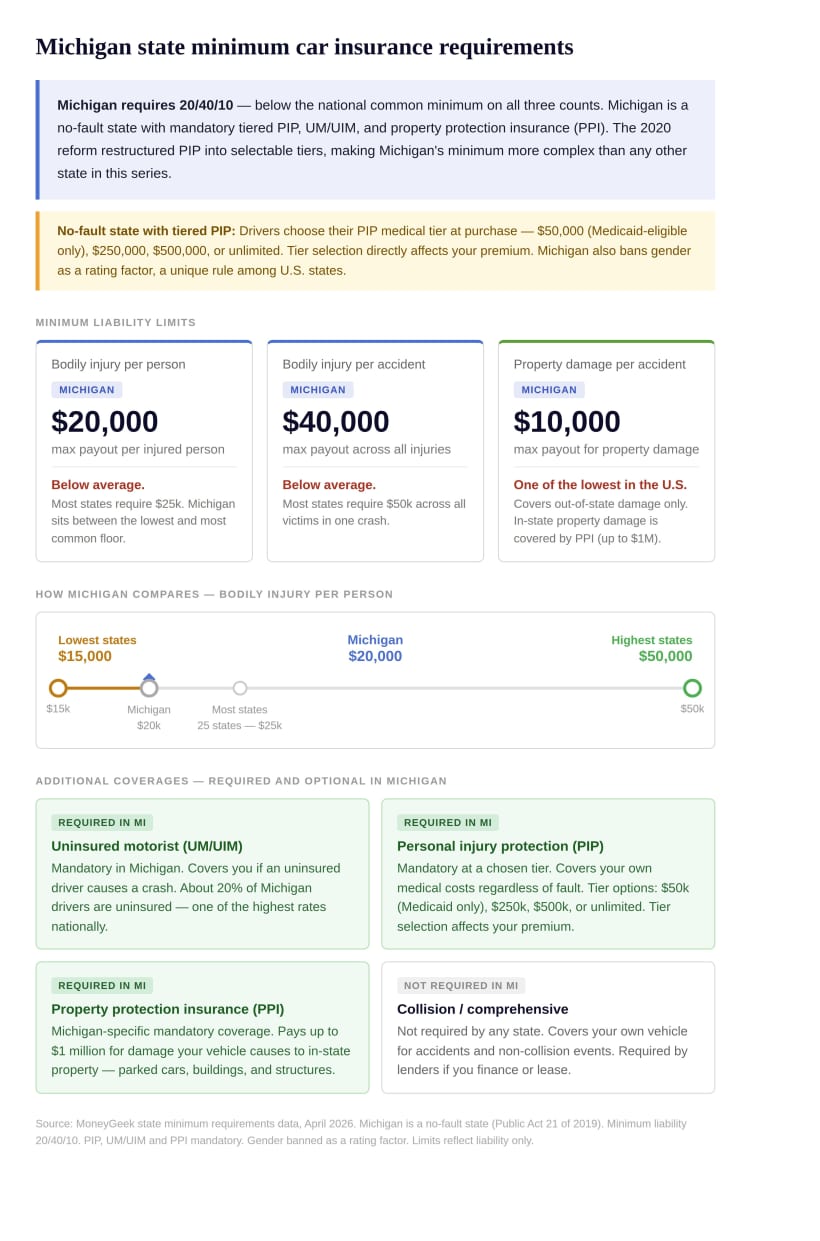
An image showing how Michigan’s state minimum coverage compares to other states and an explanation of what is covered and where you are left unprotected.

Eleven companies were analyzed. The baseline driver is a 40-year-old with a clean record, good credit and a 100/300/100 liability policy with a $1,000 deductible. Michigan is a no-fault state. The minimum coverage profile includes liability, PIP (tier selected based on driver profile), UM/UIM and property protection insurance (PPI). Pioneer State Mutual and Frankenmuth are regional Michigan carriers. The national average full coverage rate used to calculate Michigan's 9% above-average ranking is derived from QIS national rate data. All rates sourced from QIS. The speeding ticket comparison data was reviewed and confirmed consistent with QIS source data; no critical errors were identified in the final published rates. Rates come from Quadrant Information Services, which collects actual insurance filings from carriers across every ZIP code in Michigan. MoneyGeek does not receive compensation based on which companies rank highest. GEICO ranks first for full coverage because its filed rates are the lowest in MoneyGeek's Michigan rate data. 

Data: QIS.

About Mark Fitzpatrick


Mark Fitzpatrick headshot

Mark Fitzpatrick, a Licensed Property and Casualty (P&C) Insurance Producer in Connecticut, is MoneyGeek's resident insurance expert. He has spent nearly a decade analyzing the market, first at LendingTree and now at MoneyGeek, where he has produced original research on hundreds of carriers and millions of rates across auto, home, renters, health and life insurance.

He writes about economics and insurance on MoneyGeek so people can make coverage decisions with confidence. His insurance insights have been featured in The Washington Post, The New York Times and NPR, among other media outlets.

Like all MoneyGeek analysts, he draws on independent cost and consumer experience data, and no insurance company partnership influences his recommendations.

Fitzpatrick earned his degrees from Johns Hopkins University (M.A. Economics and International Relations) and Boston College (B.A.) and began his career in financial risk management at State Street. He's also a five-time Jeopardy champion!