



Choose where to jump to based on your needs:
Best Pet Insurance in Florida
Updated: September 20, 2026
Advertising & Editorial Disclosure
Best Pet Insurance Companies in Florida
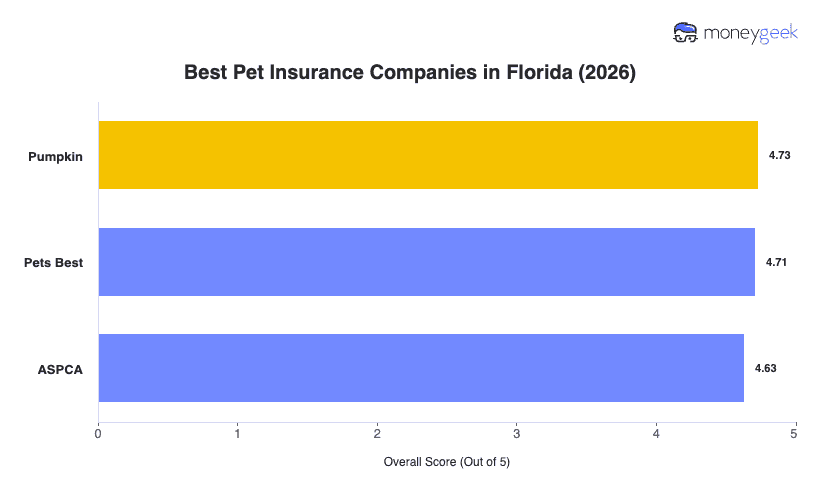
Florida pet owners can get the best pet insurance from the following companies:
- Choose if you want the lowest rates and excellent service: Pumpkin
- Choose if you want to lower upfront costs with direct vet pay: Pets Best
- Choose if you want the best flexibility to customize your policy: ASPCA
I evaluated each major provider’s base plan inclusions, flexibility for policy customization and terms for waiting periods and pre-existing conditions to find the best options in Florida. I also compared the insurers based on their average rates and customer service.
For our best pet insurance ratings, we evaluated affordability, customer experience and coverage across 18 major pet insurers using over 67,000 pet profiles representing mixed breeds and purebreds in Florida. Our analysis used standard profiles of a 6-year-old Labrador Retriever and 7-year-old Ragdoll with a $5,000 annual limit, $500 deductible and 80% reimbursement rate to ensure consistent comparisons across providers.
We analyzed pricing competitiveness across different breeds and locations, measured customer experience throughout the policy lifecycle from enrollment to claims and assessed coverage options and terms. Each insurer received a composite score based on affordability (50% of overall score), customer experience (30% of overall score) and coverage (20% of overall score).
For a detailed breakdown of the metrics, scoring methodology and analysis approach, see our full methodology.

Pumpkin: Best Pet Insurance Overall
pros
Most affordable option for Florida pet owners
Best customer service from buying to claims
Can expedite claim approvals and reimbursements
cons
Limited options for customizing policy limits
COMPANY HIGHLIGHTS
As my pick for the best pet insurance overall in Florida, Pumpkin provides the best combination of affordability and customer experience. You get exceptional service at every stage of the policyholder experience, from buying to managing your policy and submitting claims, while saving 46% on costs compared to the state average. This makes Pumpkin ideal for Florida pet owners who don't want to trade service quality for a lower monthly premium.
However, Pumpkin's policy structure is less flexible than some competitors, with fewer options to adjust deductibles, reimbursement rates and annual limits to fit your budget or your pet's specific health profile.
Learn more: Pumpkin Pet Insurance Review

Pets Best: Best Pet Insurance for Direct Vet Pay
pros
Option to pay vets directly for covered claims
Waiver for orthopedic condition waiting period
cons
Requires add-ons for exam fees and physical therapy
Frequent issues around claim submission process
COMPANY HIGHLIGHTS
Pets Best is another strong option for the best pet insurance in Florida, specifically due to its Vet Direct Pay. This feature allows the company to pay licensed vets directly for covered claims on request, so you only have to pay your deductible, co-insurance and non-covered items at the clinic. Pets Best also allows you to waive its 30-day waiting period for orthopedic conditions through a physical exam, which is valuable for breeds like Labrador Retrievers and Rottweilers that are prone to knee or ligament issues.
That said, Pets Best only covers exam fees and physical therapy through optional add-ons, requiring you to pay more to get coverage for routine evaluations and recovery care. As for customer experience, Pets Best ranks last for claim submission ease, with issues often occurring when additional documents are required, extending or delaying the process.
Learn more: Pets Best Pet Insurance Review

ASPCA: Best Pet Insurance for Coverage Flexibility
pros
Comprehensive base coverage
Flexibility for customizing policies
cons
Not the most affordable provider
Less competitive for billing and renewals
COMPANY HIGHLIGHTS
Rounding out my Florida pet insurance recommendations, ASPCA offers excellent coverage. Its base plan is broad enough to cover veterinary exams, behavioral issues, dental illnesses and alternative therapies that some insurers exclude or require add-ons for, allowing you to have comprehensive coverage without paying more. It also has a wide range of deductibles, annual limits and reimbursement rates for customizing your policy to balance your out-of-pocket costs with coverage for your pet's health needs.
Where ASPCA falters is customer experience. It ranks 16th out of 18 providers, with billing and renewals as its weakest areas, which may leave pet owners needing to contact customer support for clarification about renewal communications, premium changes or coverage updates.
Learn more: ASPCA Pet Insurance Review
Cheapest Pet Insurance Companies in Florida
The most affordable pet insurance providers in Florida are:
- Pumpkin: Pumpkin averages $26 monthly and saves Florida pet owners 46% against the state average, placing it as the cheapest provider in the state. It also offers the lowest rates for the widest range of dog breeds, from small mixed breeds like Maltipoos to large and giant breeds like Great Danes and Rottweilers, as well as a select group of cat breeds including Ragdolls and Norwegian Forest Cats.
- Pets Best: At $27 per month on average, Pets Best is the second-cheapest insurer for Florida pets, providing 44% in savings compared to the state average. The company also leads in affordability for toy and small dog breeds like Chihuahuas and Yorkshire Terriers, as well as cat breeds such as Domestic Shorthairs, Siamese and Maine Coons.
- ASPCA: ASPCA is among the lowest-cost options in Florida for pet insurance, costing $28 per month on average, which translates to 42% savings against the state benchmark. It’s also the most affordable option in the state for Foxhounds and Bull Mastiffs.
Pumpkin | $26 | $308 | 46% |
Pets Best | $27 | $319 | 44% |
ASPCA | $28 | $330 | 42% |
How Much Does Pet Insurance Cost in Florida?
Pet insurance costs an average of $47 per month ($569 annually) in Florida, based on a 6-year-old Labrador Retriever and a 7-year-old Ragdoll with a $5,000 annual limit, $500 deductible and 80% reimbursement rate. Florida ranks 29th nationally for affordability and prices at the national average.
The state benchmark splits by pet type:
- Dogs: $62 per month ($739 annually), at the national dog average
- Cats: $32 per month ($386 annually), at the national cat average
Use MoneyGeek's Florida pet insurance cost calculator below to find out the average pet insurance cost for your pet's specific profile.
Florida Pet Insurance Cost Estimate Calculator
Middle-aged dog who is a labrador retriever that is located in California.
Select Breed
Select Age
Average monthly rate—
Select Breed
Average monthly rate—
Select Age
Is Pet Insurance Worth It in Florida?
Pet insurance is worth it in Florida if you want help managing the cost of unexpected accidents and illnesses that can require expensive veterinary treatment. Florida's heat, wildlife and prevalence of conditions such as heartworm can expose pets to health risks that may result in costly emergency or ongoing care. Whether a policy is worthwhile for you depends on your pet's health and lifestyle, the coverage you choose and how much you could afford to pay out of pocket.
MoneyGeek's vet cost data shows how much treatment for several common conditions can cost Florida pet owners:
- Hip dysplasia: $3,300 to $26,400
- Cancer (lymphoma): $3,600 to $18,000
- Toxin/poison ingestion: $1,200 to $7,500
- Heartworm disease: $700 to $4,200
- Heatstroke: $1,200 to $7,500
After determining whether pet insurance is worth it, find out how much coverage you need using the tool below. It provides a baseline recommendation for annual limits, reimbursement rates and deductibles based on your pet’s profile.
Pet Insurance Coverage Needs Calculator
Use this calculator to get pet insurance coverage recommendations by entering your pet's species, breed, state and age.

What is your pet type?
Select Pet type
Pet type
Breed
State
Pet Age
How to Choose the Best Pet Insurance in Florida
Choosing the best pet insurance policy in Florida takes more than picking the lowest monthly premium. These six steps will help you narrow down your options and commit to a policy with confidence.
- 1Start with your pet's breed, size and health history
Understand what your pet actually needs before you start comparing providers. A French Bulldog's respiratory risks in Florida's heat look nothing like the joint vulnerabilities common in Golden Retrievers, and a young kitten's coverage priorities look nothing like those of a 10-year-old cat with a documented health history.
Ask yourself these three questions:
- Does your pet's breed come with known health predispositions? The American Kennel Club for dogs and the Cat Fanciers' Association for cats publish breed-specific health information that can help you spot conditions worth prioritizing before your next vet visit.
- Where does your pet fall on the age spectrum? Pets under 12 months face the highest risk for accidents and ingestion-related emergencies. Pets 8 and older are more likely to develop joint disease, organ conditions or cancer.
- What does your pet's vet history show? A single mention in your pet's records can lead Florida insurers to classify a condition as pre-existing, which can quietly limit coverage for related conditions down the road.
- 2Choose your priorities
Affordability, customer experience and coverage depth rarely align with the same provider. Get clear on your priorities first, and the tradeoffs get easier to accept.
- Complete coverage + affordable pricing: A good fit for mixed-breed owners without major hereditary concerns who want coverage against major costs without a high monthly commitment.
- Complete coverage + reliable customer service: Worth prioritizing for purebred owners and first-time buyers who want thorough coverage and a claims process that doesn't add stress to an already difficult situation.
- Affordable pricing + reliable customer service: The practical choice for healthy pets with uncomplicated needs, where keeping costs down and having a smooth experience matter more than maximum coverage depth.
- 3Explore pet insurance providers
Not every pet insurer operates in all states, and availability alone doesn't tell you much about performance. Look past marketing materials. Customer satisfaction scores, independent reviews and financial strength ratings give you a more honest picture of how a provider holds up when claims need to be paid.
- 4Review sample policies before you commit
Every major pet insurer publishes sample policies online, and the terms that most affect your coverage are rarely the ones featured in the summary. Before you commit to any provider, Ctrl + F the document for:
- Pre-existing conditions: In Florida, insurers can exclude pre-existing conditions but must disclose those exclusions clearly. The burden of proving an exclusion applies falls on the insurer instead of you. Ask whether conditions your pet had previously but recovered from can become eligible for reimbursement after a symptom-free period, since the answer varies by provider.
- Waiting periods: Florida state law caps waiting periods at 30 days for illnesses, diseases and orthopedic conditions not resulting from an accident, and insurers must disclose these timelines before you buy. Ask each provider for its exact waiting period by condition type, since some impose shorter windows for accidents and longer ones for orthopedic conditions like hip dysplasia.
- Hereditary and congenital conditions: Insurers must disclose whether hereditary disorders, congenital anomalies and chronic conditions are covered in the base plan, required as an optional add-on or excluded entirely. Get this confirmed in writing before enrolling, especially for purebreds prone to orthopedic, respiratory or spinal conditions.
- Exclusions: A full list of what the policy won't pay for. This is essential reading for any Florida pet owner with a breed that has known health risks.
- Claims: Outlines how to file claims, what documentation is required, submission deadlines after a vet visit and whether direct vet payment is an option.
- 5Compare your top choices side by side
Once you've narrowed your list, evaluate your finalists using the same evaluation criteria:
- Coverage: What's included, what's excluded, waiting periods, annual limits and how hereditary conditions are handled
- Pricing: Monthly premium, deductible choices, reimbursement rates and how costs change as your pet ages
- Service: Claims process, reimbursement speed, customer support availability and app or portal quality
- 6Get quotes using your pet's actual profile
Quotes tied to your pet's exact species, breed, age and Florida ZIP code show pricing differences that general estimates smooth over. Run those quotes with the same deductible, reimbursement rate and annual limit across every provider. Without that consistency, you're not comparing prices. You're comparing different policies.
Best Pet Insurance in Florida: Bottom Line
Pumpkin, Pets Best and ASPCA lead as the best pet insurance providers in Florida, but the best choice depends on your pet's breed, age and ZIP code within the state. Getting quotes from your top choices using identical deductibles, annual limits and reimbursement rates, and evaluating them based on affordability, customer experience and coverage breadth is the most reliable way to find the policy that fits your pet's actual situation.
Best Pet Insurance in Florida: FAQ
In Florida, the best pet insurance companies are the following:
- Pumpkin: Best Pet Insurance in Florida Overall
- Pets Best: Best Pet Insurance in Florida for Direct Vet Pay
- ASPCA: Best Pet Insurance in Florida for Coverage Flexibility
The cheapest pet insurance in Florida is offered by Pumpkin, costing an average of $26 per month and saving owners 46% compared to the state average.
On average, pet insurance costs $47 monthly ($569 annually) for a policy with a $5,000 annual limit, $500 deductible and 80% reimbursement rate. However, how much you’ll pay can vary based on factors like your pet’s breed and age at enrollment, as well as your coverage selection.
Pet insurance is worth it in Florida if a large veterinary bill would be difficult for you to handle on your own. The state's hot climate and exposure to wildlife can increase the chance of emergencies and illnesses that require costly treatment. Still, the value of coverage varies based on your pet's age, breed and health, as well as the policy's premium, deductible and coverage limits.
To determine the best provider for you in Florida, evaluate your pet’s profile and determine your top priorities across affordability, service and coverage. Find pet insurers that offer coverage in your state and compare them based on their policy terms, customer reviews and quotes.
Unlike auto insurance, Florida doesn’t require pet owners to purchase insurance for their dogs or cats. Pet insurance is optional coverage that can help reimburse veterinary expenses related to eligible accidents and illnesses, so whether to buy it depends on your pet's health risks, expected veterinary costs and your ability to pay for care out of pocket.
Florida regulates pet insurance under House Bill 655, requiring insurers to disclose key policy details, including exclusions for pre-existing, hereditary, congenital and chronic conditions, and whether premiums or coverage can change based on factors such as claims, the pet's age or the policyholder's location. It also prohibits waiting periods for accidents, caps waiting periods for illnesses and non-accident orthopedic conditions at 30 days and gives policyholders at least 30 days to rescind a policy.
Get Pet Insurance Quotes in Florida
Pet insurance makes sense when you want coverage for accidents and illnesses that can cost hundreds or thousands of dollars in Florida where outdoor hazards, year-round heat and a high concentration of specialty veterinary clinics all affect what you'll pay. The guidance below helps you move forward based on your specific situation.
About Ritchel Mendiola

Ritchel Mendiola is a Pet Insurance Content Writer at MoneyGeek. She produces coverage guides, provider comparisons and cost analyses so pet owners can understand their options and avoid overpaying.
Ritchel spent over four years as a News and Feature Writer at Asian Journal Publications, where she reported for the Asian Journal newspaper and Balikbayan Magazine, conducted interviews and covered media events. At MoneyGeek, she covers policy terms, exclusions, waiting periods and reimbursement structures the way she treated news facts. They're sourced, verified and reported accurately rather than summarized from marketing copy.
She joined MoneyGeek in late 2021 in the loans vertical and moved to pet insurance content, which she now leads. Her published work includes provider comparisons, breed-specific cost guides, age-specific coverage analyses and state-level pricing studies, all from the vertical's 5 million pet insurance profiles across 18 major providers and all U.S. states.
LinkedIn: https://www.linkedin.com/in/rianmendi/
Contact Email: ritchel.mendiola@moneygeek.com
Sources
- The Florida Senate. "HB 655: Pet Insurance and Wellness Programs." Accessed September 3, 2026.