




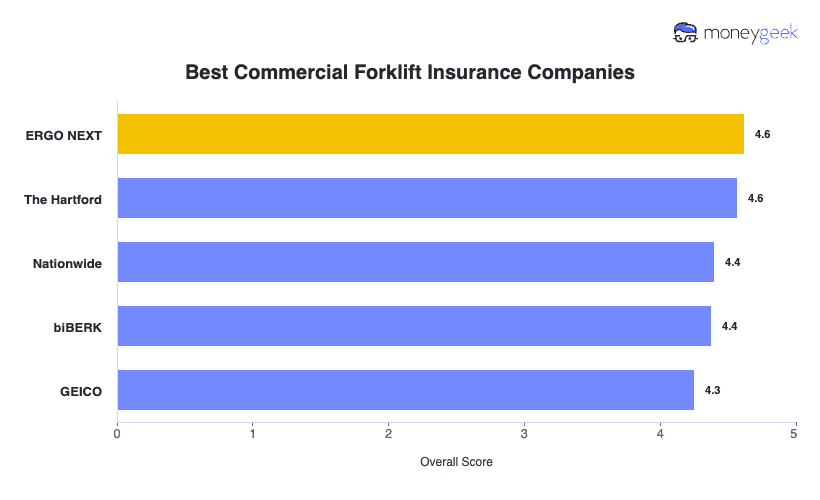
ERGO NEXT and The Hartford separate themselves from the pack, but for different reasons. ERGO NEXT delivers the lowest rates for budget-conscious warehouse operators, while The Hartford justifies its slightly higher cost with superior claims handling and coverage flexibility.
Best Cheap Commercial Forklift Insurance (2026 Picks)
NEXT Insurance offers the best cheap forklift insurance at $316 per month, combining top affordability with strong coverage for warehouse and industrial operations.
Get matched with top forlift insurers today.
Select state
Updated: June 18, 2026
Advertising & Editorial Disclosure
Commercial Forklift Insurance: Key Takeaways
NEXT offers the best cheap forklift insurance, ranking first for affordability and second for coverage. The Hartford follows with top marks for customer experience and coverage flexibility.
NEXT charges $316 per month ($3,790 annually), saving businesses about $286 per year compared to the provider average.
Commercial forklift insurance runs $344 per month on average, or $4,124 per year. State rates range from $227 monthly in Maine to $530 in New York.
Compare quotes from at least three insurers, document operator OSHA certifications and bundle forklift coverage with general liability for discounts up to 20%.
MoneyGeek scored forklift insurers on affordability (55%), customer experience (30%) and coverage options (15%). Premiums reflect 100/300/100 liability with a $1,000 deductible for comprehensive and collision. Customer experience draws from satisfaction surveys and complaint data; coverage scores reflect policy flexibility and endorsement availability.
Best Commercial Forklift Insurance Companies
| ERGO NEXT | 4.62 | $371 | 4.27 | 4.97 |
| The Hartford | 4.57 | $399 | 4.63 | 4.98 |
| Nationwide | 4.40 | $411 | 4.43 | 4.69 |
| biBERK | 4.38 | $468 | 4.39 | 4.87 |
| GEICO | 4.25 | $411 | 4.16 | 4.48 |
Data Disclaimer
Rates reflect average monthly premiums for $1,000,000 CSL liability coverage with $1,000 deductible for comprehensive and collision. Actual rates vary by location, fleet size and claims history. Data collected November 2025.

ERGO NEXT
Cheapest Overall
MoneyGeek Rating
4.6/ 5
4.7/5Affordability
4.3/5Customer Experience
4.9/5Coverage Points
Average Cost
$316/monthlyOur Survey: Claims Process
4.3/5Our Survey: Likely to Recommend
4.6/5

The Hartford
Best Value for Comprehensive Coverage
MoneyGeek Rating
4.6/ 5
4.4/5Affordability
4.6/5Customer Experience
5/5Coverage Points
Average Cost
$337/monthlyOur Survey: Claims Process
4.6/5Our Survey: Likely to Recommend
4.7/5
Data Disclaimer
ERGO NEXT and The Hartford rates and features are based on MoneyGeek's analysis of policy offerings and customer surveys conducted in October 2025. Individual rates may vary based on location, driving history, and the selected coverage. Contact providers directly for a personalized quote.
Best Commercial Forklift Insurance by State
ERGO NEXT dominates most states due to its pricing advantage, but The Hartford and Nationwide outperform in specific regions where their local underwriting delivers better value. The table shows the top-rated insurer for each state based on our combined scoring of affordability, customer experience and coverage:
| Maryland | GEICO | 399.85 | 4.21 | 4.48 |
| New Jersey | GEICO | 426.8 | 4.16 | 4.48 |
| Alaska | ERGO NEXT | 343.37 | 4.27 | 4.97 |
| Arizona | ERGO NEXT | 361.55 | 4.27 | 4.97 |
| California | ERGO NEXT | 425.77 | 4.27 | 4.98 |
| Colorado | ERGO NEXT | 383.93 | 4.27 | 4.97 |
| Connecticut | ERGO NEXT | 408.73 | 4.27 | 4.97 |
| Florida | ERGO NEXT | 460.19 | 4.27 | 4.97 |
| Georgia | ERGO NEXT | 322.07 | 4.27 | 4.97 |
| Hawaii | ERGO NEXT | 272.16 | 4.27 | 4.97 |
| Idaho | ERGO NEXT | 254.35 | 4.27 | 4.97 |
| Illinois | ERGO NEXT | 389.9 | 4.27 | 4.97 |
| Indiana | ERGO NEXT | 309.49 | 4.27 | 4.97 |
| Maine | ERGO NEXT | 227.09 | 4.27 | 4.97 |
| Massachusetts | ERGO NEXT | 409.58 | 4.27 | 4.97 |
| Michigan | ERGO NEXT | 440.16 | 4.27 | 4.97 |
| Minnesota | ERGO NEXT | 370.34 | 4.27 | 4.97 |
| Mississippi | ERGO NEXT | 322.27 | 4.27 | 4.97 |
| Missouri | ERGO NEXT | 391.9 | 4.27 | 4.97 |
| Nevada | ERGO NEXT | 375.02 | 4.27 | 4.97 |
| New Hampshire | ERGO NEXT | 239.3 | 4.27 | 4.97 |
| New Mexico | ERGO NEXT | 319.35 | 4.27 | 4.97 |
| New York | ERGO NEXT | 539.05 | 4.27 | 4.97 |
| North Carolina | ERGO NEXT | 299.72 | 4.27 | 4.97 |
| Ohio | ERGO NEXT | 323.17 | 4.27 | 4.97 |
| Oregon | ERGO NEXT | 338.95 | 4.27 | 4.97 |
| Pennsylvania | ERGO NEXT | 362.8 | 4.27 | 4.97 |
| Rhode Island | ERGO NEXT | 428.79 | 4.27 | 4.97 |
| South Carolina | ERGO NEXT | 327.65 | 4.27 | 4.97 |
| Texas | ERGO NEXT | 402.96 | 4.27 | 4.97 |
| Utah | ERGO NEXT | 285.08 | 4.27 | 4.97 |
| Virginia | ERGO NEXT | 337.05 | 4.27 | 4.97 |
| Washington | ERGO NEXT | 414.35 | 4.27 | 4.97 |
| Iowa | Nationwide | 265.3 | 4.51 | 4.75 |
| Kansas | Nationwide | 298.13 | 4.5 | 4.69 |
| Nebraska | Nationwide | 283.6 | 4.5 | 4.69 |
| South Dakota | Nationwide | 379.32 | 4.42 | 4.69 |
| Vermont | Nationwide | 228.11 | 4.42 | 4.69 |
| Wisconsin | Nationwide | 312.54 | 4.48 | 4.69 |
| Alabama | The Hartford | 280.81 | 4.62 | 4.98 |
| Arkansas | The Hartford | 315.06 | 4.62 | 4.98 |
| Delaware | The Hartford | 338.83 | 4.62 | 4.98 |
| Kentucky | The Hartford | 328.73 | 4.62 | 4.98 |
| Louisiana | The Hartford | 502.68 | 4.62 | 4.98 |
| Montana | The Hartford | 292.38 | 4.62 | 4.98 |
| North Dakota | The Hartford | 258.77 | 4.62 | 4.98 |
| Oklahoma | The Hartford | 298.16 | 4.62 | 4.98 |
| Tennessee | The Hartford | 344.2 | 4.62 | 4.98 |
| West Virginia | The Hartford | 316.18 | 4.62 | 4.98 |
| Wyoming | The Hartford | 294.3 | 4.62 | 4.98 |
Data Disclaimer
Best company determined by overall MoneyGeek score combining affordability, customer experience and coverage. Rates reflect state averages for $1,000,000 CSL liability with $1,000 deductible.
Cheapest Commercial Forklift Insurance Companies
ERGO NEXT offers the cheapest forklift insurance at $316 per month, saving businesses nearly 7% compared to the average provider. The Hartford comes in second at $337 monthly, proving that affordable coverage doesn't require sacrificing quality.
| ERGO NEXT () | $316 | $3,790 |
| The Hartford | $337 | $4,048 |
| GEICO | $352 | $4,221 |
| Nationwide | $353 | $4,237 |
| biBERK | $400 | $4,802 |
Data Disclaimer
Premium data reflects average rates for 100/300/100 liability coverage with a $1,000 deductible. Your actual premium depends on factors including fleet size, operator experience and claims history.
How Much Does Commercial Forklift Insurance Cost?
The $344 monthly national average varies widely by region. Businesses in low-cost states like Maine and Vermont pay 30% to 34% below average, while operations in New York and Louisiana should budget 44% to 54% above it.
National Average (Monthly) | $344 |
National Average (Annual) | $4,124 |
Lowest State Average (Maine) | $227/mo |
Highest State Average (New York) | $530/mo |
Cheapest Provider Average | $316/mo (ERGO NEXT) |
Most Expensive Provider Average | $400/mo (biBERK) |
High-cost states share common traits: heavy commercial activity, dense urban areas and frequent litigation. Maine, New Hampshire and Vermont have the lowest rates, a reflection of lower population density and fewer claims.
Commercial Forklift Insurance Requirements
The forklift class determines your coverage baseline. Class I through IV indoor warehouse units require standard liability limits, while Class VII rough-terrain models on construction sites typically require higher limits and specialized endorsements.
Class I (Electric Sit-Down) | 3,000-12,000 lbs | $1,000,000 CSL | No | Warehouse liability |
Class II (Electric Narrow Aisle) | 3,000-5,500 lbs | $1,000,000 CSL | No | Rack damage coverage |
Class III (Electric Pallet Jack) | 4,000-8,000 lbs | $1,000,000 CSL | No | Basic liability only |
Class IV (IC Cushion Tire) | 3,000-15,500 lbs | $1,000,000 CSL | No | Fire/combustion coverage |
Class V (IC Pneumatic Tire) | 3,000-36,000 lbs | $1,000,000 CSL | Varies | Outdoor operation endorsement |
Class VI (Electric/IC Tow Tractor) | 4,000-50,000 lbs | $1,000,000 CSL | Varies | Trailer liability |
Class VII (Rough Terrain) | 5,000-50,000+ lbs | $2,000,000 CSL | Often | Construction site endorsement |
Forklifts operated on public roads require commercial auto insurance meeting state minimums, though $1,000,000 combined single limit (CSL) is the industry standard for commercial operations. Private property use has fewer legal mandates, but landlord and customer contracts typically require $1 million in liability coverage regardless of equipment class.
Factors That Affect Flatbed Truck Insurance Costs
Location, equipment type and lifting capacity drive most of your premium, but you can't change those. Focus instead on the controllable factors below, where operator training, safety equipment and bundling can reduce costs 15% to 30%.
 Forklift Type
Electric forklifts used indoors cost less to insure than propane, diesel or rough terrain models. Outdoor forklifts face greater exposure to accidents, weather damage and theft. Rough terrain forklifts carry the highest premiums due to their use on uneven surfaces and construction sites.
 Lifting Capacity and Equipment Value
Higher lifting capacity means higher premiums. Insurers base coverage costs on the replacement value of your equipment, so you'll pay more for a $50,000 forklift than a $15,000 model. Upgrading to higher-capacity machines raises your insurance costs.
 Indoor vs. Outdoor Use
Warehouse forklifts operating indoors have lower accident rates and theft risk. Outdoor operations expose equipment to weather, traffic and more variable conditions. Expect higher premiums if your forklifts work outside regularly.
 Fleet Size
Larger fleets qualify for volume discounts, but more forklifts also mean more potential claims. A five-unit fleet costs less per forklift than insuring a single unit. Your final rate reflects the balance between discount eligibility and total risk exposure.
 Operator Certification and Training
OSHA-certified operators with clean safety records lower your insurance costs. Companies with documented training programs and regular refresher courses qualify for discounts. A well-trained team signals lower risk, which translates to lower premiums.
 Hours of Operation
Forklifts running multiple shifts face more wear and accident exposure. Part-time operations with limited hours cost less to insure. You'll answer questions about daily and weekly usage when getting a quote.
 Materials Handled
Moving hazardous materials, fragile goods or high-value inventory increases liability exposure. Standard warehouse goods carry lower risk. What your forklifts transport directly affects your premium.
 Leased vs. Owned Equipment
Rental companies require specific coverage minimums for leased forklifts. Owned equipment gives you more flexibility in structuring your policy. You'll often pay more for leased forklifts when mandatory coverage requirements exceed what you'd otherwise carry.
How to Get Commercial Forklift Insurance
The process takes 30 to 45 minutes with proper documentation. Having your fleet inventory, OSHA certifications and business records ready before requesting quotes speeds up approval and often results in better rates.
- 1
Gather Your Information
Collect your EIN, years in operation and annual revenue. Document each forklift in your fleet: make, model, age, lifting capacity, power source and replacement value. You'll also need operator certification records showing OSHA compliance and training dates.
- 2
Request Quotes from Multiple Providers
Contact at least three insurers, including ERGO NEXT and The Hartford. Use the same coverage specs for each: $1,000,000 CSL liability with a $1,000 deductible for comprehensive and collision. You can request quotes online or by phone during business hours.
- 3
Review Coverage Details
Compare policy documents, not just prices. Check liability limits, deductibles and exclusions, and verify coverage extends to all locations where your forklifts operate, including customer sites. Confirm the policy covers your specific forklift types.
- 4
Provide Required Documentation
Submit your business license, EIN verification and operator certification records, along with forklift titles or lease agreements. Some insurers also require photos of equipment or facility safety documentation.
- 5
Pay Your Premium
Choose monthly or annual payment. Annual billing often saves 5% to 10% compared to monthly, so setting up autopay is worth considering to avoid coverage lapses.
- 6
Add Certificate Holders
Request certificates of insurance for any landlords, customers or lessors who require proof of coverage. Most insurers provide COIs within 24 to 48 hours through online portals.
Commercial Forklift Insurance: Bottom Line
ERGO NEXT offers the best value at $316 per month with strong coverage scores. The Hartford costs more but leads for claims support. Get quotes from at least three providers to find your best rate.
Related Resources:
Forklift Insurance: FAQ
These questions cover the basics of forklift coverage, legal requirements and cost factors that warehouse and distribution operators ask about:
Forklift insurance protects businesses against financial losses from forklift accidents. Policies include liability coverage for injuries or property damage, collision coverage for equipment damage and comprehensive coverage for theft or fire. Most businesses buy this through commercial auto or inland marine policies.
Yes, if you operate forklifts commercially. Liability coverage protects you if a forklift damages property or injures someone. Lease agreements and customer contracts often require proof of insurance. Coverage shields your operation from repair costs, legal fees and injury claims.
Standard policies cover liability for bodily injury and property damage, collision damage to equipment and comprehensive losses like theft or fire. Options include attached equipment coverage, loading operations protection and temporary replacement equipment. Exclusions include intentional damage and operation by uncertified operators.
Forklifts on public roads need commercial auto insurance meeting state minimums. Private property use has fewer legal mandates, but lease agreements and customer contracts often require coverage. OSHA workplace safety rules also support maintaining proper insurance for material handling equipment.
Commercial forklift insurance costs $344 per month on average, or $4,124 per year. Rates range from $227 monthly in Maine to $530 in New York. Your cost depends on forklift type, lifting capacity, fleet size, operator certifications and claims history.
Yes. Rental companies typically require you to buy their damage waiver or show proof of coverage meeting their specs. Your commercial auto or inland marine policy may extend to rentals with proper endorsements. Verify requirements before signing rental agreements.
Key factors include forklift type and power source, lifting capacity, indoor versus outdoor operations, fleet size, operator certifications, materials handled and claims history. Location plays a major role, with urban areas and high-litigation states charging more than rural regions.
About Connor Bolton

Connor Bolton is Senior SEO and Content Manager at MoneyGeek, where he leads the business and pet insurance editorial teams. He sets the research framework, data standards and content structure for his team. All content goes through his accuracy review before publication. Connor also writes in-depth guides and has spent more than four years covering insurance products across personal, commercial and specialty lines.
The research infrastructure Connor built covers auto, home, renters, life, health, business and pet insurance across pricing analysis, carrier research, customer experience and coverage evaluation. It includes over 6 million data points for business insurance across 408 industry areas, all 50 states and 16 vehicle types. The pet insurance side covers over 5 million profiles across 18 major providers, 100+ breeds and ages up to 20 years. Connor’s insurance research and his team's work has been cited by the U.S. Chamber of Commerce, Allstate, Liberty Mutual, CBS News, Forbes and LegalZoom.
Connor also talks with underwriters and carrier liaisons at Ethos, The Hartford, ERGO NEXT, Nationwide and State Farm, and monitors business and pet owner communities on Reddit. Those sources shape how his team evaluates carriers, structures rate analysis and writes for human buyers rather than search engines.
For questions about MoneyGeek's business and pet insurance content, contact him at connor@moneygeek.com or on LinkedIn.