

The United States is dealing with a housing affordability problem unlike anything seen in recent decades. Homelessness hit an all-time high in 2024, affordable housing supply continues to shrink, and rising costs are pushing more families to the financial edge.
Fighting Housing Insecurity in the US
Updated: May 7, 2026
Featured Experts:
 TR
TR EG
EG KM
KM RK
RK MP
MPAdvertising & Editorial Disclosure
What Is Housing Insecurity?
Housing insecurity describes a range of challenges that threaten a person's ability to keep stable, safe and affordable housing: inability to pay rent or a mortgage, substandard living conditions, eviction and imminent risk of homelessness.
For most housing researchers and federal agencies, housing insecurity is defined primarily by how much of a household's income goes toward housing costs:
- Severe: Housing costs exceed 50% of household income.
- Moderate: Housing costs fall between 30% and 50% of household income.
The U.S. Department of Housing and Urban Development (HUD) considers households "cost-burdened" when they spend more than 30% of income on housing. That leaves less for food, health care, transportation and other necessities.
The Effects of Housing Instability
Housing instability affects nearly every part of a person's life, not just where they live. People dealing with housing insecurity are at higher risk for food hardship, poor physical health and mental health challenges such as anxiety and depression. Research has linked homelessness with accelerated aging, higher rates of falls and cognitive decline.
The U.S. Interagency Council on Homelessness says people who experience homelessness die nearly 30 years earlier than the average American, often from treatable conditions. Among the lowest-wage households, 70% spend more than half their income on rent, with almost no buffer for unexpected expenses such as car repairs, medical bills or job loss.
The financial toll compounds. Severe rent burden crowds out savings, makes it harder to keep insurance and leaves households one setback from losing housing entirely.
Housing stability and insurance are directly linked. Research following Hurricane Katrina found that homeowners were far more likely to return to their pre-disaster homes than renters, largely because homeowners insurance gave them the financial resources for recovery. Renters, especially those in subsidized housing, were most exposed to permanent displacement. That connection matters more as climate-related disasters increase in frequency and cost.
The Housing Affordability Crisis Today
The current housing crisis is structural, rooted in a long-term shortage of affordable homes rather than a temporary economic shock. Contributing factors:
- Insufficient affordable housing construction over the past two decades.
- The end of COVID-era rental assistance programs: Treasury's Emergency Rental Assistance program ended in September 2025.
- Median rents up 18% since 2020.
- A growing renter population competing for a shrinking supply of lower-cost units.
- Federal budget uncertainty: the proposed FY2026 budget includes a 44% cut to HUD programs.
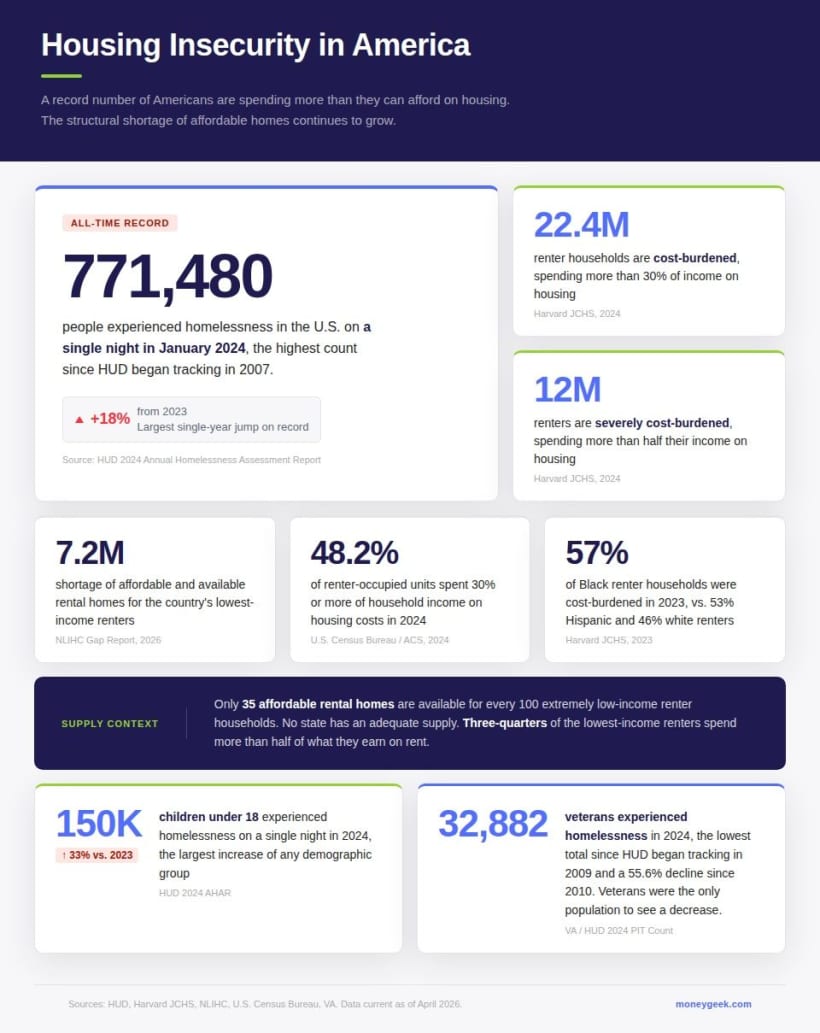
The 2026 Gap Report from the National Low Income Housing Coalition found no state has an adequate supply of affordable rental housing for the lowest-income renters. Three-quarters of renters with extremely low incomes spend more than half their income on rent.
Rising property insurance premiums are adding a second layer of pressure to the supply crunch. Seventy-five percent of affordable housing landlords reported premium increases of 10% or more in 2023. When property owners can't absorb those increases, they cut maintenance, reduce coverage or convert units to market-rate. The affordable supply shrinks further as a result.
Rising Insurance Costs as an Affordable Housing Driver
Rising property insurance premiums are now a direct driver of the affordable housing problem, not a concern limited to individual homeowners.
The average annual home insurance premium nationwide reached $2,948 at the end of 2025, up 12% in a single year, and is projected to hit $3,057 by the end of 2026. That's roughly $900 more a year than in 2021. State-level increases have been steeper: Minnesota's average rose 34%, Colorado's climbed 33% and Florida's hit $8,292, nearly three times the national average.
Three groups feel the pressure directly:
- For prospective homebuyers: Thirty-seven percent of people who shopped for a home in 2025 considered moving elsewhere because of insurance costs, and 16% backed out of a purchase entirely.
- For renters in affordable housing: When landlords in rent-restricted buildings can't pass on premium increases through higher rents, they reduce services, defer maintenance or exit the affordable housing market. The affordable supply shrinks as a result.
- For low-income homeowners: Residents in ZIP codes with the highest climate-related risk saw insurance costs outpace inflation by nearly 15 percentage points between 2018 and 2022.

THE RENTERS INSURANCE GAP
Only about 55% of renters carry renters insurance, compared to 95% of homeowners. That leaves nearly half of all renters without coverage for personal property loss, liability or additional living expenses (ALE) if a fire or other covered event forces displacement. For renters already at the financial edge, a policy worth $15 to $25 a month can determine whether displacement is temporary or permanent. MoneyGeek tracks renters insurance rates by state.
Finding Housing Assistance
Federal agencies and nonprofits operate programs that help low-income households find or keep affordable housing, ranging from rental assistance and eviction prevention to emergency shelter and homeownership pathways. Eligibility depends on income, household size and location.
Public Housing Programs
HUD oversees the country's public housing program, which provides rental housing for low-income families through locally managed housing agencies. Local agencies set rents at levels families can afford; HUD funds the difference.
Eligibility is based on income, age, disability status and U.S. citizenship or immigration status. Income limits vary by location. Local Public Housing Agency (PHA) offices administer requirements and applications.
Housing Choice Vouchers (Section 8)
The Housing Choice Voucher (HCV) program, widely known as Section 8, helps low-income families, older adults, veterans and people with disabilities afford housing in the private market. Participants can rent any eligible unit as long as the landlord agrees to participate. The government pays the difference between the actual rent and what the family can afford, usually 30% of household income. About 2,000 local PHAs administer the program nationwide.
Demand for vouchers far exceeds supply. Many PHAs have closed their waitlists due to budget constraints, and some are in "shortfall status," meaning program costs exceed their allocated funding. Those with open waitlists use a lottery system and accept only a fraction of applicants. Waitlist status varies by local housing authority.
Qualifying households usually have incomes at 30% or less of the local area median income. Local HUD offices publish current income thresholds.

SECTION 8 AND RENTERS INSURANCE
Many landlords who accept Section 8 vouchers require tenants to carry renters insurance as a condition of the lease. Even when it isn't required, a basic renters policy covers personal property and temporary housing costs if a unit becomes uninhabitable. The average policy costs $15 to $25 a month. MoneyGeek's renters insurance guides cover options and rates by state.
Temporary Housing Assistance Programs
HUD's Continuum of Care (CoC) program funds local services to quickly rehouse people and families experiencing homelessness or at imminent risk. Programs are locally administered and vary by location.
- Dialing 2-1-1 connects callers to local social services.
- HUD's Find Shelter tool at hud.gov/findshelter locates CoC programs by address.

FY2026 FUNDING UNCERTAINTY
The Trump administration's FY2026 budget proposal includes cuts to CoC funding and Permanent Supportive Housing programs. Congress will determine final funding levels. Local agency availability should be confirmed directly, as funding changes may affect current service offerings.
Mortgage Assistance and Foreclosure Prevention
Homeowners struggling with mortgage payments should contact their lender before missing one. Lenders can restructure payments, add missed amounts to the back of the loan or offer a temporary forbearance period. Options narrow once payments are missed.
Federal mortgage and foreclosure mediation programs are available through local cities and states. HUD's free foreclosure counseling tool connects homeowners with HUD-approved counselors. The Consumer Financial Protection Bureau (CFPB) also offers a HUD-approved housing counseling agency locator.
Challenges to Getting Assistance
Access to housing assistance comes with real barriers. The most common:
- Long waitlists: In high-demand areas, waiting years for a voucher is common.
- Limited eligibility windows: Many waitlists open for only a few days at a time, via lottery.
- Internet access: Many programs have shifted to online applications, which is harder for people without reliable connectivity. Public libraries remain a useful alternative.
- Rural access: Residents in rural areas often travel long distances to reach local housing agencies, and some regions have no nearby office at all.
Applicants should document every contact with housing agencies, including dates, names and conversation details. Those on waitlists should stay in regular contact and identify a point of contact for updates.
State-Level Rental Housing Resources
Most housing assistance programs are locally run. Resources vary by city, county and state. The National Low Income Housing Coalition (NLIHC) maintains an interactive map and searchable database tracking rental assistance programs by location, with funding and availability updates.
Loading...
Common Groups in Need of Housing Assistance and Resources
Housing insecurity data shows several groups experience homelessness and cost burden at higher rates than the general population. Many federal and nonprofit programs target these groups.
Low-Income Families and Single Parents
Most low-income renters with children spend more than half their income on rent, according to the Center for Economic Policy and Research. That rent burden raises the risk of financial hardship, debt and eviction. Family homelessness rose 39% between 2023 and 2024. Nearly 150,000 children experienced homelessness on a single night in 2024, up 33% from 2023.
Housing Programs
- HUD: Provides low-income housing tax credits through state and local agencies. Local housing agencies administer Emergency Solutions Grants, Section 8 and family-specific shelters.
- Habitat for Humanity: Builds affordable homes for families using a "sweat equity" model in which future homeowners contribute labor toward construction. Waitlists can be long.
- Rural Housing Services (USDA): Offers home loans and payment assistance in communities with fewer than 35,000 residents.
- CoAbode: A nonprofit home-sharing program that pairs single mothers for co-rental arrangements to reduce housing costs.
Housing Resources
- Family Promise: A national nonprofit addressing family homelessness through prevention resources and emergency shelter.
- Single Mother Grants: Contact details for grants helping low-income families and single mothers with housing, utilities, food and education.
- National Women's Shelter Network: A nationwide network of shelters for women, including emergency shelters, transitional housing, domestic violence shelters and family shelters.
Seniors
Older adults are now the fastest-growing segment of the homeless population in the United States. People aged 50 and older have grown from roughly 10% of the homeless population to nearly half, according to recent federal data. More than 104,000 people experiencing homelessness in 2024 were between 55 and 64. Over 42,000 were older than 64; nearly half of them lived unsheltered. That count is on track to nearly triple by 2030. (Sources: HUD 2024 AHAR; LeadingAge)
Seniors on fixed incomes are also disproportionately exposed to rising insurance costs, which take an increasing share of a fixed housing budget.
Housing Programs
- HUD programs for seniors (Section 202): HUD provides low-income housing tax credits, Section 8 vouchers and Section 202, a program designed specifically for older adults. Local housing agencies identify available services.
- HUD FHA Reverse Mortgage for Seniors (HECM): Homeowners who have built equity can access a reverse mortgage to cover living expenses without selling their home.
Veterans
Veterans were the only population to see a decline in homelessness in 2024. The number of veterans experiencing homelessness fell 7.5%, from 35,574 in 2023 to 32,882 in 2024. That's the lowest total since HUD began tracking in 2009 and a 55.6% decline since 2010. The progress is largely attributed to the HUD-VA Supportive Housing (HUD-VASH) program and related VA housing investments. (Source: VA Point-in-Time Count)
Nearly 13,900 of them remained unsheltered that night, and budget pressures in 2026 put program funding at risk.
Housing Programs
- HUD-VA Supportive Housing (HUD-VASH): HUD and the Department of Veterans Affairs jointly provide rental vouchers and case management to eligible veterans. At the end of FY2024, nearly 90,000 veterans were under lease through this program.
- Supportive Services for Veteran Families (SSVF): For veterans with very low incomes, this program helps prevent housing loss or find more suitable housing quickly.
- VA Grant and Per Diem (GPD) Program: Locally managed grants providing transitional housing, including short-stay bridge housing, for homeless veterans.
Housing Resources
- National Call Center for Homeless Veterans: The center (1-877-424-3838) offers 24/7 access to VA services for veterans at risk of homelessness.
- Veterans.gov: Employment resources including job listings, local career center locations and self-assessment tools.
- Community Resource and Referral Centers (VA): Offer permanent housing, mental health services, health care, career development and access to VA and non-VA benefits.
- A Guide to Housing Benefits for Veterans: MoneyGeek's resource guide covers VA home loan eligibility, rental assistance and housing grants for veterans and service members.
Youth and College Students
An estimated 4.2 million young people in the United States experience some form of homelessness each year, according to Covenant House. Many youth experiencing homelessness have histories of abuse, human trafficking or severed family relationships. Between 2023 and 2024, the number of unaccompanied youth experiencing homelessness rose 10%.
Housing Programs
- Covenant House: Operates in 31 cities to provide care and protection for youth experiencing homelessness.
- Youth Homelessness Demonstration Program (YHDP): HUD's program to systematically reduce youth homelessness. Applications go through local housing agencies.
- LGBTQ+ Youth Homelessness Prevention Initiative: Works to prevent housing loss among young people due to sexual orientation or gender identity.
Housing Resources
- National Runaway Safeline: A confidential 24/7 hotline and online crisis services for young people at risk of homelessness: 1-800-786-2929.
- Scholarships for Students Who Experience Homelessness (NCHE): Curated scholarships to help homeless youth access higher education.
- The Resource Guide for Students Who Are Homeless or Have a Low Income (NCHE): Covers scholarships, federal aid, shelters, food assistance and medical resources.
- Sublet.com: A searchable database of furnished and unfurnished rentals by state, region and city.
- American Campus Communities: A searchable directory of student apartments by college location, state or community.
People Experiencing Domestic Violence
On a single night in 2019, homeless service providers set aside more than 48,000 beds for domestic violence survivors, according to the National Alliance to End Homelessness. Multiple programs help survivors access safe housing.
Housing Programs and Resources
- Department of Justice Funded Coalitions: A state-by-state list of federally funded coalitions providing housing assistance and survivor services.
- DomesticShelters.org: A searchable database of more than 3,000 domestic violence shelters, programs and hotlines across the U.S. and Canada.
- National Domestic Violence Hotline: Advocates available 24/7 by call, chat or text to help survivors find safe housing. Phone: 1-800-799-SAFE (7233). Text: "START" to 88788.
People With Disabilities
Federal law requires that people with disabilities be given a choice in the support services they receive, including housing. Those who qualify for housing assistance must be offered the option to adapt their current home or find a different living situation better suited to their needs.
Housing Programs and Resources
- A Guide to Homeownership Programs for People With Disabilities: MoneyGeek's guide covers rights for people with disabilities and financial assistance for home purchases, including loans and Section 8 vouchers.
- HUD's Office of Multifamily Housing: Federal funding provides rental housing and supportive services for adults with disabilities.
- Non-Elderly Disabled (NED) Voucher: Helps people with disabilities access housing developments traditionally reserved for seniors.
- ILRU Directory of Centers for Independent Living: State and local centers that help people with disabilities build skills for independent living.
- USA.gov — Disability Services: A directory of federal programs assisting people with disabilities.
- HUD Fair Housing: Housing discrimination based on disability is illegal under the Fair Housing Act and the Americans with Disabilities Act.
People With Substance Use or Mental Health Disorders
Stable housing is important for people working through recovery from substance use or a mental health disorder. Housing instability can trigger relapse, and housing support is a central part of long-term recovery.
Resources
- SAMHSA Treatment Locator: Finds treatment facilities, support groups and community-based organizations by location. SAMHSA National Helpline: 1-800-662-4357 (free, confidential, 24/7).
- HUD Exchange — Homelessness Assistance Programs: Local housing agencies can help with Emergency Solutions Grants, Section 8 and shelters with substance use support services.
Frequently Asked Questions About Housing Assistance
Reporters and researchers commonly ask about housing assistance eligibility, program access and what steps households can take when they lose income.
Renters should contact their landlord immediately to request a temporary reduction or deferral. For homeowners, the first call goes to the mortgage servicer: forbearance delays payments without eliminating them. Local social services offices can identify programs to help cover housing costs. HUD's Resource Locator and 2-1-1 are also useful referral tools.
In most cases, yes. Assistance isn't restricted to one program. Food, utilities and housing assistance can be used at the same time.
Local agencies are the best starting point for immediate referrals. The HUD Exchange locates homeless service providers by area. Dialing 2-1-1 connects callers to local social services anywhere in the country.
No. A landlord's policy covers the building structure, not tenants' personal property. If a unit is damaged, destroyed or becomes uninhabitable, the tenant is responsible for replacing belongings and covering temporary housing costs out of pocket, unless they carry renters insurance. A basic renters policy costs $15 to $25 a month and covers personal property, liability and additional living expenses.
When landlords in high-risk areas can't recover premium increases through rent-restricted units, they often cut coverage, defer maintenance or convert units to market-rate. Local housing authorities can identify alternative assistance programs, and any changes in lease terms or housing conditions should be documented.
Rural residents can apply for USDA Rural Housing Service loans and assistance. The Housing Assistance Council focuses on building affordable housing for low-income rural Americans. Dialing 2-1-1 connects callers to local referrals; the HUD Exchange identifies programs by region.
Additional Resources for Housing Assistance
HUD is the primary federal starting point, but dozens of organizations offer additional assistance depending on household type and location.
- National Alliance to End Homelessness: Links people to local service providers and offers a step-by-step guide for those at risk of homelessness.
- HUD Find Shelter Tool: Locates housing, shelter, health care and clothing resources by location.
- HUD Exchange Homelessness Assistance Programs: An interactive map of shelters, health care, housing and other services by location.
- Homeless Shelter Directory: Locates the nearest emergency shelter by address.
- Housing Assistance Council: A national nonprofit building affordable housing for low-income rural Americans.
- National Coalition for the Homeless: A one-stop directory for resources for people on the brink of homelessness.
- National Low Income Housing Coalition: Tracks state and city-funded rental housing programs and affordable housing policy updates.
- United Way / 2-1-1: Thousands of local United Way locations provide housing and utility assistance, reachable by dialing 2-1-1 or visiting 211.org.
- CareerOneStop (Dept. of Labor): Job search tools, unemployment benefits guidance and housing cost resources for displaced workers.
- Consumer Financial Protection Bureau: Locates HUD-approved housing counseling agencies by ZIP code.
- Need Help Paying Bills: Links to multiple agencies that help with rent, mortgages and utilities.
- Eviction Support and Resources for Tenants: MoneyGeek's guide to tenant rights, legal resources and emergency assistance for renters at risk of eviction.
About Danielle Kiser

Danielle Kiser is an Emmy Award-winning producer and a professional journalist with over 15 years of experience. She writes finance content for MoneyGeek, sharing her knowledge of state regulations, insurance and real estate.
Kiser earned her broadcast journalism degree from the University of Missouri’s School of Journalism.
Sources
- Americans for Financial Reform / Financial Security for All. "Rising Property Insurance Premiums: The Uneven Risks to Households." Accessed September 25, 2026.
- Center for Economic and Policy Research. "Housing Affordability and Insecurity." Accessed September 25, 2026.
- Covenant House. "Homeless Youth: Causes and Our Impact." Accessed September 25, 2026.
- Family Promise. "The State of Child and Family Homelessness in the United States." Accessed September 25, 2026.
- Harvard Joint Center for Housing Studies. "The State of the Nation's Housing 2025." Accessed September 25, 2026.
- HUD User. "Worst Case Housing Needs: 2025 Report to Congress." Accessed September 25, 2026.
- Insurance Business. "Home Insurance to Top $3,000 as U.S. Affordability Crisis Deepens - Insurify." Accessed September 25, 2026.
- Insurance Information Institute. "Facts + Statistics: Renters Insurance." Accessed September 25, 2026.
- LeadingAge. "Homelessness Among Older Adults." Accessed September 25, 2026.
- National Alliance to End Homelessness. "State of Homelessness: 2025 Edition." Accessed September 25, 2026.
- National Center for Homeless Education. "Scholarships for Students Who Experience Homelessness." Accessed September 25, 2026.
- National Low Income Housing Coalition. "The Gap 2026: A Shortage of Affordable Homes." Accessed September 25, 2026.
- National Low Income Housing Coalition. "Trump Administration FY26 Budget Request." Accessed September 25, 2026.
- NPR. "Seniors Are the Fastest-Growing Group Experiencing Homelessness." Accessed September 25, 2026.
- U.S. Census Bureau. "Nearly Half of Renter Households Are Cost-Burdened." Accessed September 25, 2026.
- U.S. Department of Housing and Urban Development. "2024 Annual Homeless Assessment Report (AHAR), Part 1." Accessed September 25, 2026.
- U.S. Department of Veterans Affairs. "Point-in-Time (PIT) Count." Accessed September 25, 2026.
- U.S. Interagency Council on Homelessness. "Homelessness Data and Trends." Accessed September 25, 2026.
- U.S. Treasury Department. "Emergency Rental Assistance Program." Accessed September 25, 2026.