




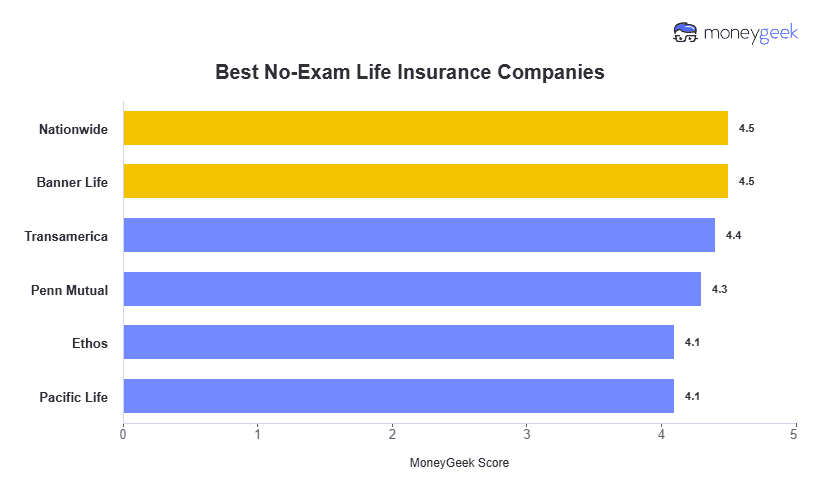
Nationwide is our best overall no-exam life insurance company, while Banner Life and Transamerica have the lowest rates in our analysis. Penn Mutual leads for high coverage, offering up to $10 million without an exam. Ethos is our top pick for instant approval, and Pacific Life is our choice for smokers.
6 Best No-Exam Life Insurance Companies (2026)
Nationwide is the best no-exam life insurance company overall in 2026, with up to $1.5 million in coverage, a fully digital application and monthly rates 9% to 10% below the national average. Banner Life has the lowest rates in our analysis at $41 for women and $50 for men at age 40 for a 20-year, $500,000 policy. Transamerica matches Banner Life's low rates and and accepts applicants up to age 80.
Compare no-exam life insurance quotes from top providers.
Select age group
Updated: September 22, 2026
Advertising & Editorial Disclosure
Key Takeaways
Nationwide is our best overall no-exam life insurance company, with coverage up to $1.5 million and a fully digital application for eligible applicants ages 21 to 55.
Banner Life and Transamerica have the cheapest no-exam life insurance rates in our analysis, averaging $41 per month for 40-year-old women and $51 for men with a 20-year, $500,000 policy.
Penn Mutual offers the highest no-exam coverage limit at $10 million, while Pacific Life accepts qualifying nicotine users for up to $2 million through its accelerated underwriting program.
No-exam doesn't mean no underwriting. Accelerated and simplified issue policies still review health information and other data. Only guaranteed issue policies eliminate both the exam and health-based approval.
Best Life Insurance Companies with No Medical Exam
Why You Can Trust MoneyGeek
We analyzed 30 no-exam life insurance companies offering accelerated underwriting, simplified issue or guaranteed acceptance coverage. We evaluated insurers based on affordability, customer experience and coverage options. Our rankings are editorially independent and aren't influenced by compensation from insurance companies. Read our full methodology.
Overall | $45 (F), $56 (M) | 21-55 | $1,500,000 | Accelerated | 4.5 | |
Cheapest Rates | $41 (F), $51 (M) | 20-60 | $4,000,000 | Accelerated | 4.5 | |
Seniors | $41 (F), $51 (M) | 18-80 | $2,000,000 | Accelerated | 4.4 | |
High Coverage | $42 (F), $51 (M) | 20-65 | $10,000,000 | Accelerated | 4.3 | |
Instant Approval | $54 (F), $72 (M) | 20-65 | $3,000,000 | Accelerated / Simplified | 4.1 | |
Smokers | $42 (F), $60 (M) | 18-60 | $3,000,000 | Accelerated | 4.1 |
* Rates are based on no-exam policies for 40-year-old non-smokers with $500,000 in coverage on a 20-year term. Buyers in excellent health may qualify for lower rates.

Nationwide
Best Overall
MoneyGeek Rating
4.5/ 5
4.5/5Affordability
4.8/5Customer Experience
4.2/5Coverage
Average Monthly Rate
$45 (F), $56 (M)Ages Supported
21-55Max No-Exam Coverage
$1.5 million

Banner Life
Cheapest No-Exam Life Insurance
MoneyGeek Rating
4.5/ 5
5/5Affordability
3.7/5Customer Experience
4.4/5Coverage
Average Monthly Rate
$41 (F), $51 (M)Ages Supported
20-60Max No-Exam Coverage
$4 million

Transamerica
Best for Seniors
MoneyGeek Rating
4.4/ 5
4.8/5Affordability
3.7/5Customer Experience
4.6/5Coverage
Average Monthly Rate
$41 (F), $51 (M)Ages Supported
18-80Max No-Exam Coverage
$2 million

Penn Mutual
Best for High Coverage
MoneyGeek Rating
4.3/ 5
4.7/5Affordability
3.6/5Customer Experience
4.5/5Coverage
Average Monthly Rate
$42 (F), $51 (M)Ages Supported
20-65Max No-Exam Coverage
$10 million

Ethos
Best for Instant Approval
MoneyGeek Rating
4.1/ 5
4.2/5Affordability
3.9/5Customer Experience
4.2/5Coverage
Average Monthly Rate
$54 (F), $72 (M)Ages Supported
20-65Max No-Exam Coverage
$3 million

Pacific Life
Best for Smokers
MoneyGeek Rating
4.1/ 5
4.3/5Affordability
3.6/5Customer Experience
4.5/5Coverage
Average Monthly Rate
$42 (F), $60 (M)Ages Supported
18-60Max No-Exam Coverage
$3 million
Cheapest No-Exam Life Insurance Companies
Banner Life and Transamerica tie as the cheapest no-exam life insurance companies in our analysis, both averaging $41 per month for 40-year-old women and $51 for men with a 20-year, $500,000 policy. Penn Mutual follows closely at $42 for women and $51 for men.
Price isn't the only difference between the two lowest-cost options. Banner Life has a 0.16 NAIC complaint index compared with Transamerica's 3.86, along with an A+ AM Best financial strength rating versus Transamerica's A rating. Banner Life also has no-exam term policies with terms up to 40 years, while Transamerica's maximum is 30 years. You should compare customer experience, financial strength and policy options alongside price before purchasing a policy.
Banner Life | $41 | Banner Life | $51 |
Transamerica | $41 | Transamerica | $51 |
Penn Mutual | $42 | Penn Mutual | $51 |
Pacific Life | $42 | Nationwide | $56 |
Nationwide | $45 | Pacific Life | $60 |
Lincoln Financial | $46 | Lincoln Financial | $60 |
Prudential | $51 | Prudential | $64 |
Guardian Life | $52 | Guardian Life | $65 |
Ethos | $54 | John Hancock | $68 |
John Hancock | $55 | Ethos | $72 |
* Rates shown are for nonsmoking 40-year-olds in average health with a 20-year, $500,000 policy.
How Do No-Exam Life Insurance Companies Work?
No-exam life insurance companies let you get coverage without a medical exam. Instead of scheduling appointments with a nurse, you answer health questions online or by phone. No-exam insurers may also reference prescription databases, driving records and your application answers to assess risk and issue approval in days rather than weeks. Term life insurance is the most common policy type offered without an exam, but some companies like Ethos also offer whole life.
Types of No-Exam Life Insurance
There are three main ways to get life insurance without a medical exam: accelerated underwriting, simplified issue and guaranteed issue. They differ in how much health information the insurer reviews, how much coverage you can buy and how much you'll pay.
- Accelerated underwriting: Insurers use algorithms to review medical records and other data instead of requiring a medical exam. Approval takes days, with higher coverage limits than simplified or guaranteed issue plans. Best for healthy applicants under 60 seeking high coverage amounts. Consider Nationwide, Banner Life, Penn Mutual or Pacific Life.
- Simplified issue: Insurers ask health questions but skip the medical exam. Coverage limits are lower than accelerated underwriting but higher than guaranteed issue. Best for people with moderate health conditions or seniors seeking smaller coverage amounts.
- Guaranteed issue: Guaranteed acceptance life insurance accepts all applicants regardless of health conditions, with no medical questions or exams required. Coverage limits are the lowest among no-exam policy types, and premiums are higher to offset the insurer's risk. Most guaranteed policies include a graded death benefit: if you pass away within the first two to three years, beneficiaries receive a return of premiums paid rather than the full death benefit. Best for applicants over 45 with serious health conditions who have been declined elsewhere.
Accelerated vs. Simplified vs. Guaranteed Issue Policies
Health questions? | Yes, detailed | Yes, brief | No |
Medical exam? | No | No | No |
Third-party data reviewed? | Yes | Yes | No |
Can you be declined? | Yes | Yes | No |
Cost vs. traditional underwriting | Similar | Higher | Much higher |
Best for | Healthy buyers under 65 | Moderate health conditions | Serious health conditions, seniors over 75 |
No-Exam Life Insurance Pros and Cons
Weigh the benefits and drawbacks of no-exam plans before purchasing:
Pros | Cons |
|---|---|
Faster approval: Accelerated underwriting can provide a decision within minutes or days instead of waiting for an exam and lab results. | Not everyone qualifies: Health conditions or other risk factors can send an accelerated application to full underwriting. |
No new physical exam: Eligible applicants can avoid bloodwork, urine samples and an in-person examiner visit. | Simplified and guaranteed issue cost more: Policies using less medical information charge higher premiums. |
High coverage is available: Some accelerated programs offer millions of dollars in coverage. Penn Mutual goes up to $10 million in our comparison. | Coverage varies widely: Maximum death benefits and age limits differ greatly by insurer and underwriting type. |
Options for applicants with health conditions: Simplified and guaranteed issue coverage can provide alternatives for people with pre-existing health conditions when accelerated underwriting isn't available. | Guaranteed issue has waiting periods: Most guaranteed policies limit the death benefit for nonaccidental deaths during the first two or three years. |
How Much Does No-Exam Life Insurance Cost?
A 20-year, $500,000 policy averages $33 per month for a 20-year-old woman, $50 at age 40 and $112 at age 50. Men pay an average of $40, $63 and $149 at the same ages for the same policy.
Term length also matters. At age 40, women pay an average of $50 per month for a 20-year policy versus $93 for a 30-year policy. Men pay $63 versus $117. Buying earlier and choosing only the term length you need can help to reduce your premium.
20-Year No-Exam Term Life Insurance Cost
20 | $12 (F), $13 (M) | $21 (F), $24 (M) | $33 (F), $40 (M) | $46 (F), $55 (M) | $57 (F), $69 (M) |
30 | $12 (F), $14 (M) | $21 (F), $24 (M) | $33 (F), $40 (M) | $46 (F), $56 (M) | $58 (F), $71 (M) |
40 | $16 (F), $20 (M) | $30 (F), $37 (M) | $50 (F), $63 (M) | $71 (F), $91 (M) | $91 (F), $116 (M) |
50 | $32 (F), $41 (M) | $63 (F), $83 (M) | $112 (F), $149 (M) | $163 (F), $217 (M) | $210 (F), $282 (M) |
60 | $79 (F), $107 (M) | $165 (F), $226 (M) | $296 (F), $408 (M) | $438 (F), $613 (M) | $565 (F), $806 (M) |
30-Year No-Exam Term Life Insurance Cost
20 | $17 (F), $21 (M) | $31 (F), $39 (M) | $52 (F), $65 (M) | $75 (F), $98 (M) | $94 (F), $128 (M) |
30 | $19 (F), $23 (M) | $35 (F), $43 (M) | $59 (F), $72 (M) | $86 (F), $106 (M) | $110 (F), $137 (M) |
40 | $28 (F), $35 (M) | $54 (F), $68 (M) | $93 (F), $117 (M) | $137 (F), $174 (M) | $176 (F), $225 (M) |
50 | $63 (F), $82 (M) | $125 (F), $170 (M) | $218 (F), $302 (M) | $322 (F), $449 (M) | $413 (F), $580 (M) |
* These average monthly rates are based on term policies for non-smokers in average health. Buyers in excellent health may qualify for lower rates. Smokers and applicants with health conditions will pay higher premiums.
How to Choose the Best No-Exam Life Insurance Companies
The best no-exam life insurance company depends on your age, health profile and how much coverage you need:
 Age eligibility
Nationwide's Life Essentials platform cuts off at 55, while Transamerica accepts applicants up to 80 years old. If you're older than 55, your provider options narrow.
 Coverage limits
Penn Mutual goes up to $10 million without an exam. Nationwide caps at $1.5 million. Use our life insurance coverage calculator to find your target death benefit before comparing rates.
 Underwriting fallback policy
Banner Life and Pacific Life move declined applicants to full underwriting rather than rejecting them outright. If your health history isn't clean, that fallback matters.
 Smoker eligibility
Pacific Life's Swift Sailing program covers nicotine users up to $2 million. Most competitors cap smoker coverage lower or charge rates that make other options worth comparing.
 Application process
Nationwide and Ethos offer fully digital applications with instant decisions and same-day approvals. Pacific Life requires an agent, which adds time.
 Complaint history
Nationwide's 0.08 NAIC complaint index is among the lowest we found. Transamerica's 3.86 index means policyholders file complaints at nearly four times the industry average.
 Financial strength ratings
Nationwide, Banner Life, Penn Mutual, Pacific Life and Ethos hold A+ ratings from AM Best, which measures an insurer’s financial strength and ability to pay future claims. Transamerica earned an A rating, still strong but slightly lower, which matters for policies intended to last 20 to 30 years.
Best Life Insurance with No Medical Exam: Bottom Line
No-exam life insurance lets you apply for coverage without completing a new physical medical exam, but most policies still use health information to determine eligibility and rates. Nationwide is our best overall provider, Banner Life and Transamerica have the lowest rates in our analysis, and Penn Mutual has the highest no-exam coverage limit at $10 million. Compare several insurers because eligibility, underwriting rules and prices vary by company.
Frequently Asked Questions
Nationwide is our best overall no-exam life insurance company based on affordability, customer experience and coverage options. Banner Life and Transamerica have the lowest rates in our analysis at $41 per month for 40-year-old women and $51 for men with a 20-year, $500,000 policy.
Not always. Accelerated underwriting and simplified issue life insurance skip the physical exam but still evaluate your health. Guaranteed issue policies require neither an exam nor health questions. Traditional underwriting may require bloodwork, a urine sample, measurements and other medical information.
Yes. Accelerated underwriting and simplified issue insurers can deny your application or require traditional underwriting based on your health history and other risk factors. With guaranteed issue life insurance, however, eligible applicants can't be rejected for health reasons, although coverage amounts are much lower and waiting periods apply.
It can be. Healthy people who qualify for accelerated underwriting may receive competitive rates without completing a medical exam. The main advantage is speed and convenience. Compare an accelerated-underwriting quote with traditionally underwritten coverage before buying, since pricing varies by insurer and applicant.
Learn more: Is Life Insurance Worth It?
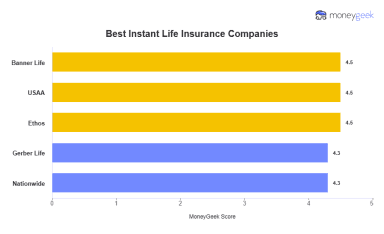
Instant life insurance companies use automated underwriting to make coverage decisions within minutes or days without a medical exam. Applicants complete an online health questionnaire, and the insurer reviews available records and third-party data. Not everyone qualifies for instant approval. Some applications require additional underwriting.
Our Methodology
We evaluated 30 life insurance companies offering coverage without a medical exam, including accelerated-underwriting term policies, simplified issue policies and guaranteed acceptance whole life policies.
How MoneyGeek scored each insurer:
- Affordability (50%): We collected thousands of quotes across age, gender, coverage amount, term length, tobacco use and health profiles to compare pricing between insurers offering no-exam coverage.
- Customer Experience (30%): We evaluated J.D. Power satisfaction scores and complaint data from state insurance regulators to identify insurers with stronger customer-service records.
- Coverage Options (20%): We compared maximum no-exam coverage amounts, age eligibility, available term lengths, policy types, riders and underwriting flexibility.
Read more in our full Life Insurance Methodology.
Related Pages








About Patrick Bryant

Patrick Bryant is the Vertical Lead for Life and Health Insurance at MoneyGeek, where he researches insurance products, writes consumer guides and oversees provider scoring methodologies that are reviewed quarterly to reflect current market conditions and carrier data. He has analyzed more than 50 life insurance carriers across multiple policy types and collected thousands of quotes nationwide to compare pricing, coverage and underwriting requirements.