
Best Cyber Insurance Companies For Small Businesses

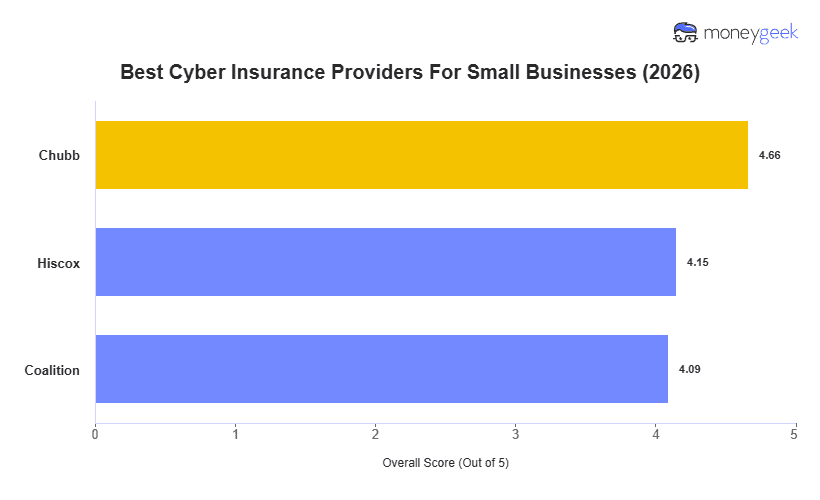
Based on our research, most small businesses can find the best cyber insurance with these providers:

  1. Chubb: Best Overall, Best for Coverage Depth and Claims Reliability
  2. Hiscox: Best for Cyber Crime and Social Engineering Protection
  3. Coalition: Best for Tech-Forward Businesses and Risk Management

These insurers balance competitive pricing, strong post-purchase support, and coverage options built for the most common cyber risks small businesses encounter. However, keep in mind that these choices are a starting point and your best cyber insurance company depends on your business's unique details like industry, location and firm size.


Chubb
4.66

Most affordable coverage for most small businesses by a large margin, a very flexible coverage selection and top service reputation for cyber insurance.

Hiscox
4.15

Best-in-class cyber crime and social engineering coverage that provide ideal protection for businesses with high exposure to funds transfer fraud and phishing attacks like consultants, accountants, lawyers and financial institutions like small banks.

Coalition
4.09

Great buying experience that matches you with a tailored policy and included cyber risk and protection services that are especially helpful for more tech-reliant or forward businesses.

For our overall best cyber insurance ratings, we analyzed pricing, coverage options, and customer experience across 408 industries and all 50 states and Washington, D.C. Our analysis focuses on businesses with up to 49 employees, which represent the vast majority of U.S. small businesses, while weighting results for broader industry and location representation.

We evaluated over one million business profiles, more than 1,000 customer experience data points, and performed in-depth analysis of coverage contracts, endorsements, and breach response terms to compare insurers consistently across industries and regions. We then rated each company across categories of affordability (50% of overall score), customer experience (30% of overall score), and coverage options and terms (20% of overall score) to form an overall rating.

For a detailed breakdown of the metrics, scoring methodology, and pricing analysis, see our full methodology.

95%
% of Small Businesses Covered
Over 300,000
Business Profiles Studied
Over 1,000
Customer Experiences Analyzed

Find The Best Cyber Insurance For Your Business

Select your industry and state to get a customized quote from your best cyber insurer match.

Industry
State
Company Image
Best Overall, Best for Coverage Depth and Claims Reliability

Chubb

Chubb earned the top spot in our cyber insurance analysis for its combination of affordability, broad coverage, and strong claims handling. It offers the lowest average premiums of any provider we studied while also ranking first for customer experience and coverage depth, making it the most well-rounded option for businesses that want reliable protection without overpaying.

Where Chubb performs best:

  • Businesses that store sensitive customer data or operate in regulated industries (healthcare, financial services)
  • Companies that prioritize claims reliability and fair settlements
  • Small businesses with 1 to 49 employees wanting the broadest first-party and third-party coverage terms
  • Industries with higher cyber risk exposure where coverage depth matters more than buying speed

Where Chubb performs less competitively:

  • Businesses looking for the fastest, fully digital buying experience
  • Companies that want built-in active risk management tools like threat scanning and vulnerability alerts
  • Sole proprietors focused purely on the lowest possible premium with minimal coverage needs

Learn More: Chubb Insurance Review

Company Image
Best for Cyber Crime and Social Engineering Protection

Hiscox

Hiscox ranks second overall in our cyber insurance analysis with an overall score of 4.15 out of 5. Its primary strength is cyber crime and social engineering coverage, where it earned the top score among all providers. For businesses where funds transfer fraud, invoice manipulation, or employee-targeted phishing are top risks, Hiscox offers the strongest policy terms in this category.

Where Hiscox performs best:

  • Businesses with high exposure to social engineering, wire fraud, and phishing attacks
  • Companies in financial services, consulting, or professional services industries
  • Those willing to pay higher base premiums for stronger cyber crime protection
  • Owners who value balanced pricing without paying the highest premiums

Where Hiscox performs less competitively:

  • Businesses needing the deepest first-party or breach response coverage and flexibility
  • Companies wanting built-in active risk management tools or threat monitoring
  • Buyers expecting the fastest or most guided digital buying experience

Learn More: Hiscox Insurance Review

Company Image
Best for Tech-Forward Businesses and Risk Management

Coalition

Coalition ranks third overall with a score and leads in two areas that set it apart from traditional cyber insurers: active risk management and the buying experience. Its coverage includes built-in threat monitoring, vulnerability scanning, and risk scoring that go beyond what a standard policy covers. 

For businesses that want ongoing cyber risk reduction alongside their insurance and more tech forward firms like those in IT or marketing, Coalition is the strongest option. However, keep in mind that the company is a brokerage and can only be purchased through partner insurance companies, not directly.

Where Coalition performs best:

  • Tech-forward businesses that want active threat monitoring and vulnerability alerts alongside coverage
  • Companies looking for the fastest, most guided digital buying experience
  • Businesses in tech/IT, marketing, and digital services where cyber risk management tools add the most value
  • Owners who prioritize prevention alongside financial protection after an incident

Where Coalition performs less competitively:

  • Indirect buying through partner insurers such as ERGO NEXT and The Hartford
  • Cost-sensitive businesses since Coalition is the most expensive provider in our study
  • Companies that prioritize claims handling above all other factors
  • Businesses with low digital exposure that won't benefit from active risk management tools

What Determines The Best Cyber Insurance For You

The best cyber insurance isn't defined by a single factor. The strongest providers balance affordability, customer experience, and coverage options across a wide range of business profiles. Three areas matter most when evaluating which insurer fits your business.

    coins2 icon

    Affordability Across Your Risk Profile

    Cyber insurance pricing varies more by industry than almost any other business coverage type, and the most affordable provider overall won't always be cheapest for your specific profile .Providers that price competitively across a wide range of industries, states, and employee counts tend to offer more pricing stability as your business grows or changes.

    talk icon

    Coverage That Matches Your Cyber Exposure

    Most small businesses need both first-party coverage (breach notification, forensic investigation, business interruption, cyber extortion) and third-party coverage (lawsuits, regulatory fines, claims from affected customers). Where providers differ most is in specialized areas:

    • Cyber crime and social engineering: Providers vary between standard inclusion, separate add-ons, or crime policy integration with sublimits of $10,000-$250,000, and differ significantly on covering wire transfer fraud, business email compromise, and authentication requirements that can exclude coverage entirely.
    • Policy strength and modern triggers: Some insurers use narrow "security failure" language covering only cyberattacks, while others include broader "system failure" terms for accidental outages and administrative errors, with additional variations in ransomware limits, business interruption waiting periods (6-12 hours), and vendor failure coverage.
    • Risk management value-add: Traditional insurers offer only post-incident response, while newer providers integrate proactive services for continuous vulnerability scanning, threat alerts, dark web monitoring, and security training directly into policies as ongoing protection rather than reactive claims processing.
    insurance2 icon

    Breach Response and Claims Support

    Cyber claims require forensic response, legal counsel, and regulatory notification within hours or days, not weeks. Businesses storing sensitive data or processing payments should weigh breach response, claims handling and proactive prevention service heavily.

    • Claims handling: Insurers differ in 24/7 hotline availability, response time commitments (some guarantee contact within 15 minutes to 24 hours), and whether they provide immediate incident guidance at zero deductible before formal claims are filed, which can significantly impact containment and recovery outcomes.
    • Incident response: Some insurers mandate use of their pre-approved vendor panels for forensics, legal counsel, and ransomware negotiation while others allow policyholder choice with panel requirements potentially limiting flexibility but often providing pre-negotiated rates and vetted expertise.
    • Proactive breach prevention services: Claims support varies from purely reactive (responding only after incidents occur) to proactive models offering breach readiness assessments, tabletop exercises, incident response planning, mobile apps with real-time threat alerts, and continuous monitoring to prevent claims before they happen.

How to Choose The Best Cyber Insurance

Choosing the best cyber insurance comes down to confirming which factors matter most for your business and understanding how insurers differ across those areas. The step-by-step process here can help you narrow your options without starting the comparison process over.

  1. 1
    Assess Your Cyber Risk Profile

    Start by identifying what types of cyber risk your business actually has. Ask yourself:

    • Do you store customer personal data, health records, or financial information?
    • Do you process credit card payments or wire transfers?
    • Do your operations depend on digital systems, cloud services, or third-party software?
    • Have you or businesses like yours been targeted by phishing, ransomware, or social engineering?
    • Do contracts, clients, or regulations require you to carry cyber insurance?

    If your business stores sensitive data and processes payments, you'll need broad first-party and third-party coverage with strong incident response. If your primary risk is funds transfer fraud or employee-targeted phishing, social engineering coverage should be a top priority. And if you have low digital exposure but need a policy for contract requirements, a standard policy with competitive pricing may be enough.

  2. 2
    Choose your primary priority

    Once your risk profile is clear, decide which factor will matter most over the next year:

    • Affordability if keeping costs predictable is your main concern
    • Customer experience if you expect to file claims, request certificates, or need fast post-breach support
    • Coverage depth if your risks are complex, regulated, or likely to change

    This priority becomes your main tiebreaker between otherwise strong providers.

  3. 3
    Shortlist Two Providers

    Based on your risk profile and primary priority, narrow your list to two providers. For most small businesses, the decision comes down to one of these pairings based on our top provider list:

    • Chubb vs. Coalition: broadest coverage at the best price (Chubb) vs. active risk management and the fastest buying process (Coalition)
    • Chubb vs. Hiscox: overall value and claims support (Chubb) vs. stronger cyber crime and social engineering terms (Hiscox)
    • Hiscox vs. Coalition: social engineering protection with mid-range pricing (Hiscox) vs. proactive threat monitoring at a higher cost (Coalition)
  4. 4
    Check for Dealbreakers Before Requesting Quotes

    Before investing more time, confirm each provider on your shortlist can meet your non-negotiables:

    • Required coverage limits for contracts or client agreements
    • Certificate of insurance and additional insured availability
    • Specific endorsements your industry or clients require (social engineering, regulatory defense, business interruption)
    • Preferred service model (fully digital, agent-supported, or hybrid)
  5. 5
    Compare Your Finalists Using the Same Three Lenses

    For the providers that remain, compare them consistently across:

    • Affordability for your specific industry, state, and employee count, not just overall averages
    • Customer experience across buying, policy management, and claims, not just one stage
    • Coverage options for the risks that match your profile, not just the total number of features
      Using the same lenses helps you avoid being swayed by one strong feature while missing a weakness that matters for your business.
  6. 6
    Use Quotes as the Final Confirmation

    Once you've identified your best-fitting providers, request quotes to validate pricing and availability for your specific business details. Quotes work best when used to confirm a good cyber insurance choice, not to decide between many unfamiliar options.

Best Small Business Cyber Insurance: Bottom Line

Chubb, Hiscox, and Coalition lead our rankings for cyber insurance, but your ideal provider depends on your industry, cyber risk profile, and coverage priorities. You'll get the best value by assessing your specific cyber risks, comparing two providers using the same coverage limits, and weighing affordability alongside breach response and coverage depth rather than focusing only on price.

Best Cyber Insurance For Small Business Chart

Best Cyber Insurance For Small Business: Next Steps

If you're choosing cyber insurance for a small business, the most effective next step is to shortlist one or two of the top providers above and confirm pricing and availability using the same coverage limits.

This helps you validate affordability for your specific business while avoiding misleading comparisons based on different policy assumptions.

If You Want to Confirm Cost Before Deciding

If You're Unsure How Much Coverage You Need

If You Want to Understand What Cyber Insurance Covers

If You're Ready to Check Quotes Now

Find The Best Cyber Insurer For Your Business

Select your industry and state to get a customized quote from your top cyber insurance match.

Industry
State

How We Chose the Best Cyber Insurance Companies

To identify the best cyber insurance companies for small businesses, we evaluated major cyber insurers across pricing, customer experience, and coverage options using a standardized, data-driven method. Our goal was not to identify the cheapest option in every scenario, but to determine which providers offer the most consistent overall value across common small business profiles.

Our best recommendations reflect insurers that perform well across multiple dimensions and remain competitive across industries, states, and business sizes. We excluded providers that did not offer transparent pricing information to avoid recommending providers with incomplete information as well.

Data and Analysis Scope

Our analysis is based on standardized estimates designed to represent the majority of U.S. small businesses:

  • Providers analyzed: 10 major cyber insurers (3 qualified for our ratings due to pricing transparency variation)
  • Industries covered: 408 industries
  • Geography: All U.S. states (including Washington, D.C.)
  • Employee counts: 0 to 49 employees (representing roughly 95% of small businesses)
  • Pricing modeled: Over 300,000 standardized estimates
  • Customer experiences analyzed: Over 1,000 data points

Modeled average revenues and payrolls were incorporated to improve pricing accuracy. Our analysis focuses on 1-to-4-person businesses, which represent nearly half of U.S. small businesses, while weighting results for broader industry and location representation.

Our Scoring Model

Each insurer received a composite score based on weighted categories as follows:

  • Affordability (50% of overall score): How competitively and consistently an insurer prices cyber insurance across all business profiles studied, measured against national benchmarks by industry, state, and employee count.
  • Customer experience (30% of overall score): How well insurers support businesses throughout the policy lifecycle, including buying (quote speed, underwriting transparency, coverage guidance), policy management (digital tools, certificate access, coverage changes), and claims (communication, resolution timeliness, dispute resolution, settlement fairness).
  • Coverage options (20% of overall score): How well insurers support common small business cyber risks and allow for flexibility, evaluated across seven sub-categories: clarity and customization, cyber crime and social engineering, first-party coverages, incident response and breach services, policy strength and modern coverage triggers included, risk management value-add, and third-party liability.

About Blest Papio


Blest Papio headshot

Blest Papio is a Content Producer at MoneyGeek specializing in small business insurance. With five years of experience in insurance and finance writing and hands-on perspective as a former business counselor, he understands the risks that come with running a business and what it takes to protect against them.

Blest focuses on commercial auto, cyber, property and specialty business insurance. He digs deep into policy details, regulations and provider offerings so businesses can find the coverage they need and avoid financial fallout. His goal is to translate technical insurance language and insurer offerings into guides you can act on.

Whether you're insuring company vehicles, managing cyber liability or protecting your commercial property, Blest aims to guide you through your risks to help you find coverage you truly need, not sell you a policy.


Copyright © 2026 MoneyGeek.com. All Rights Reserved