
Average Senior Dog Insurance Cost (2026 Report)


How Much Does Senior Dog Insurance Cost?

Pet insurance costs an average of $99 monthly ($1,186 annually) for a senior dog with a $5,000 annual limit, $500 deductible and 80% reimbursement rate. This average rate reflects MoneyGeek's analysis of 67,000+ senior dog profiles across all 50 states and Washington, D.C.

This figure is a national benchmark, not a guarantee. Senior dog insurance rates differ based on your pet’s age, breed and location, even for identical coverage.


We studied senior dog insurance pricing to establish national cost benchmarks and show how premiums vary based on different factors. Our cost analysis uses standardized policy parameters for consistent comparisons across senior dog profiles.  

Dataset Scope and Assumptions

  • Providers analyzed: 18 major pet insurance providers
  • Profiles analyzed: Over 67,000 senior dog profiles
  • Geography: All U.S. states and Washington, D.C.
  • Breed profile: 7-year-old Labrador Retriever
  • Policy baseline: $5,000 annual limit, $500 deductible, 80% reimbursement rate

How We Calculated Average Senior Dog Insurance Costs

Published averages reflect modeled premiums for standardized senior dog profiles, calculated two ways.

  • National benchmark average: Uses a 7-year-old Labrador Retriever across all states in our dataset with the baseline policy parameters above.
  • Segment averages: Show cost variation by isolating individual variables for the same baseline profile, including:  
    • States and Washington, D.C.
    • Annual limits
    • Deductibles
    • Reimbursement rates

Segment averages aggregate modeled pricing patterns across the full dataset so readers can compare how premiums change based on location and coverage levels.

Senior Dog Insurance Cost Estimate Calculator

Use our calculator to find out how much you'll pay monthly on average for pet insurance based on your senior dog's breed and age. All estimates are based on a standard $5,000 annual limit, $500 deductible and 80% reimbursement policy. If you are unsure of your dog's breed, select mixed breed for the most accurate estimate.

Select Breed
Select Age range
Average monthly rate—

What Factors Affect Senior Dog Insurance Costs?

The three main factors affecting senior dog insurance premiums are coverage selection, breed and geographic location. Insurers assess each one to estimate how likely a senior dog is to generate claims and how costly those claims are likely to be. A large breed in a high-cost state with comprehensive coverage won't have the same rate as a small mixed-breed dog in a low-cost state with a high deductible, even at the same age.

Below, we break down how each factor influences your premium.

    petInsurance icon
    Coverage selection

    There are three coverage variables that control how much financial risk the insurer carries on each claim: annual limit, deductible and reimbursement. Adjusting any one of them changes your premium, because each one shifts the insurer's expected payout.

    • Annual limit: This caps what the insurer pays per policy year. Choosing unlimited coverage over a $5,000 limit increases the average monthly premium by 238% because the insurer assumes uncapped exposure for the high-cost claims senior dogs are more likely to generate, such as cancer treatment, orthopedic surgery or chronic disease management.
    • Deductible: The amount you pay once per policy year before coverage begins. Moving from a $50 deductible to a $1,000 deductible reduces the average premium by 135%. Because the deductible resets annually, a lower threshold means the insurer begins paying on nearly every claim cycle, which is a more expensive exposure position given how frequently senior dogs need veterinary care. A higher deductible shifts that annual cost burden back to the owner and reduces the premium accordingly.
    • Reimbursement rate: This determines the insurer's share of covered costs after you meet your deductible. Premiums climb as the reimbursement percentage rises, with 100% reimbursement running 320% higher than 60% reimbursement. The jump is steeper for senior dogs because eliminating cost-sharing on a high-claim profile, where treatment for chronic conditions, cancer or orthopedic disease is more probable, exposes the insurer to substantially larger per-year payouts.
    dog7 icon
    Breed

    At the senior life stage, breed becomes a sharper pricing signal because conditions that were probabilistic risks in younger dogs are now statistically likely to generate claims. How much breed matters shows up clearly in the numbers: a senior Chihuahua sits 17% below the national average, while a senior Olde English Bulldogge runs 257% above it. Mixed-breed senior dogs price lower because broader genetic diversity reduces the insurer's ability to assign elevated breed-specific risk at this life stage.

    locationPin icon
    Geographic location

    Geographic location is the third-strongest pricing factor because it reflects veterinary cost structures that insurers cannot control. Where a senior dog receives care determines what routine visits, diagnostics and specialist referrals actually cost, and those regional differences feed directly into premium calculations.

    Based on our analysis, Washington, D.C., sits 64% above the national average, driven by elevated veterinary practice overhead, higher concentrations of specialty and emergency facilities and a higher overall cost of living. West Virginia anchors the low end at 23% below the national average, where lower regional operating costs and reduced access to specialty care keep veterinary expenditures down.

Average Senior Dog Insurance Costs by Coverage Selection

Coverage selection is the strongest factor affecting senior dog insurance costs because it directly determines how much financial risk the insurer assumes per claim. Average monthly costs can range from $60 to $335, depending on the annual limit, deductible and reimbursement you choose. The three sections below break down how each component affects your premium for senior dog coverage.

Average Senior Dog Insurance Costs by Annual Limit

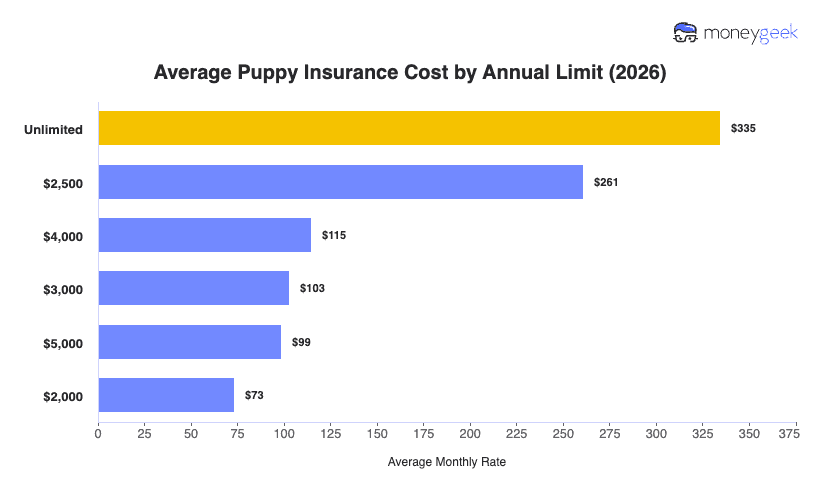
Senior dog insurance costs an average of $99 monthly with a $5,000 annual limit. Premiums rise as limits increase, reflecting the insurer's growing maximum payout exposure. For instance, unlimited coverage averages $335 monthly because uncapped liability for catastrophic senior dog claims carries substantially more pricing weight than any defined ceiling.

The curve isn't perfectly linear across all tiers, though. Carrier-specific product structures mean some higher limit prices below the lower adjacent ones. The $2,500 tier at $261 monthly, higher than the $3,000, $4,000 and $5,000 tiers despite offering less coverage, reflects this dynamic. Where the data deviates from the expected upward trend, the likely explanation is differences in how individual carriers build products at those specific limit tiers.

The table shows how average costs change based on the annual limit.

Jump to: Average Senior Dog Insurance Cost by Deductible

Average Senior Dog Insurance Cost by Annual Limit Chart

Average Senior Dog Insurance Costs by Deductible

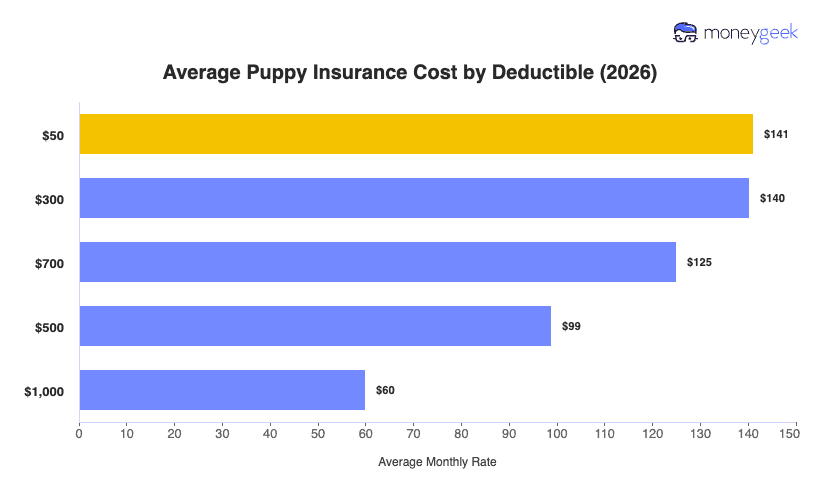
According to our analysis, a $500 deductible averages $99 monthly for senior dog insurance. Premiums generally decrease as deductibles rise, with the $1,000 deductible averaging $60 monthly, compared to $141 monthly at the $50 deductible, a 135% difference.

That said, carrier-specific product structures introduce variation that pulls some tiers away from the expected downward curve. The $300 tier at $140 monthly pricing is nearly identical to the $50 tier, and the $700 tier at $125 monthly sits well above both adjacent tiers, reflecting how individual carriers build products at specific deductible levels. 

The table below shows average costs across deductible tiers.

Jump to: Average Senior Dog Insurance Cost by Reimbursement Rate

Average Senior Dog Insurance Cost by Deductible Chart

Average Senior Dog Insurance Costs by Reimbursement

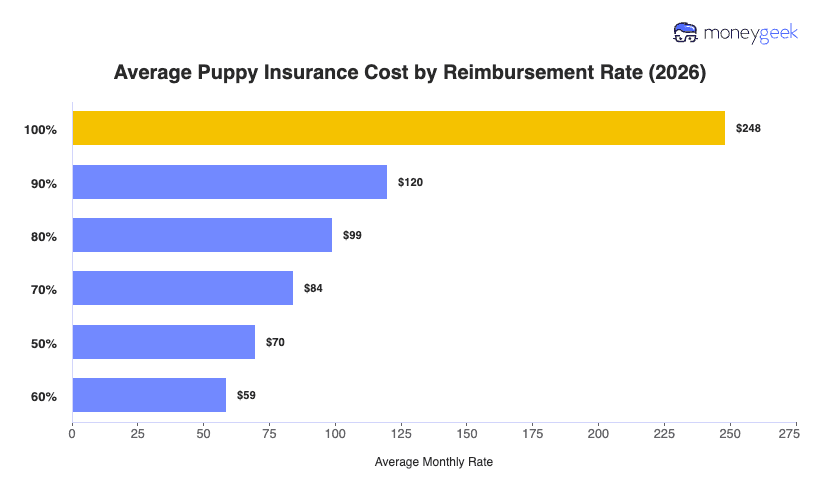
In our study, senior dog insurance with 80% reimbursement costs an average of $99 monthly. The distribution climbs predictably from 80% through 100%, with 90% averaging $120 monthly and 100% reimbursement reaching $248 monthly. That jump from 90% to 100% is the steepest in our dataset: eliminating all cost-sharing removes the pet owner's financial stake in every covered claim, which the insurer prices as a different exposure position for a senior dog profile where high-cost claims are more probable.

Below the benchmark, the reimbursement rate doesn't scale as cleanly in the lower tiers as it does at 80% and above. The 60% tier at $59 monthly is the lowest point in the distribution, but the 50% tier at $70 monthly prices above it, likely due to how different carriers structure lower-reimbursement products.

Check the table for variations in average costs based on reimbursement rate.  

Jump to: Average Senior Dog Insurance Cost by Annual Limit

Average Senior Dog Insurance Cost by Reimbursement Rate Chart

Average Senior Dog Insurance Costs by Breed

Senior dog insurance rates average between $82 monthly for a Chihuahua and $354 monthly for an Olde English Bulldogge. Below, we categorize 100+ breeds in our dataset into five cost tiers based on their average monthly premiums.

  • Lowest-cost breeds ($82–$95/month): Chihuahua, Morkie, Australian Silky Terrier, Cavapoo, Shiba Inu, Cockapoo, Shih Tzu, Jack Russell Terrier, Maltipoo, Australian Shepherd, Husky, Schnoodle, Dingo and Border Collie
  • Low-cost breeds ($96–$119/month): Dachshund, Yorkshire Terrier, Labradoodle, Goldendoodle, Pomeranian, Miniature Schnauzer, Siberian Husky, Bichon Frise, Pekingese and Miniature Dachshund
  • Mid-cost breeds ($120–$149/month): German Shepherd, Golden Retriever, Labrador Retriever, Cocker Spaniel, Beagle, Standard Poodle, German Shorthaired Pointer, Boston Terrier, Pug and Welsh Corgi Pembroke
  • High-cost breeds ($150–$199/month): Rhodesian Ridgeback, Airedale Terrier, Rough Collie, Weimaraner, Komondor, Scottish Terrier, American Staffordshire Terrier, Hungarian Vizsla, Bull Terrier, Basset Hound, Corgi, Dalmatian, Estrela Mountain Dog, Lurcher, Caucasian Shepherd Dog, Gordon Setter, Kangal Shepherd Dog, Basset Fauve de Bretagne, Bloodhound, Boxer, Scottish Deerhound, Tibetan Mastiff, American Bulldog, American Bully and Miniature Bull Terrier
  • Highest-cost breeds ($200–$354/month): Cane Corso, Newfoundland, English Mastiff, Great Dane, Saint Bernard, Rottweiler, Shar Pei, Dogue de Bordeaux, Bernese Mountain Dog, French Bulldog, English Bulldog, Bull Mastiff, Doberman Pinscher and Olde English Bulldogge

At 37% below the national average, Chihuahuas benefit from a longer senior age window (11 to 14 years) that spreads lower average claim costs across more policy years. At the other end, the Olde English Bulldogge prices 172% above the national benchmark, driven by the breed's well-documented structural and respiratory health profile, which carriers treat as a materially higher claims exposure even at the 7 to 9 year senior entry point.

Review the average monthly and annual costs of senior dog insurance based on breed in the table below.

Data filtered by:
Select
Affenpinscher$134$1,61296
Afghan Hound$135$1,62199
Airedale Terrier$151$1,808123
Akita$135$1,624101
Alaskan Husky$115$1,37548
Alaskan Malamute$142$1,705112
American Bulldog$188$2,251145
American Bully$192$2,300147
American Eskimo$99$1,18218
American Foxhound$114$1,36444
American Hairless Terrier$106$1,27227
American Staffordshire Terrier$158$1,901128
Australian Cattle Dog$111$1,32636
Australian Kelpie$129$1,55381
Australian Shepherd$93$1,12010
Australian Silky Terrier$84$1,0083
Australian Terrier$127$1,52875
Basenji$97$1,16717
Basset Fauve de Bretagne$178$2,131139
Basset Hound$162$1,945131
Beagle$135$1,61797
Bearded Collie$107$1,28130
Belgian Shepherd Malinois$130$1,55884
Bernese Mountain Dog$240$2,877159
Bichon Frise$120$1,43860
Bloodhound$181$2,177141
Border Collie$95$1,14414
Border Terrier$121$1,44761
Borzoi$148$1,771117
Boston Terrier$134$1,60795
Boxer$183$2,192142
Bracco Italiano$146$1,747115
Briard$125$1,50368
Brussels Griffon$133$1,59092
Bull Mastiff$267$3,207162
Bull Terrier$161$1,930130
Cairn Terrier$132$1,58189
Cane Corso$200$2,397150
Caucasian Shepherd Dog$173$2,070136
Cavachon$107$1,28131
Cavalier King Charles Spaniel$140$1,686108
Cavapoo$84$1,0134
Central Asian Shepherd Dog$150$1,799121
Chihuahua$82$9861
Chow Chow$138$1,657106
Clumber Spaniel$150$1,797120
Cockapoo$89$1,0646
Cocker spaniel$129$1,54980
Collie$119$1,42558
Corgi$165$1,979132
Coton De Tulear$109$1,30735
Dachshund$100$1,20521
Dalmatian$165$1,985133
Dingo$95$1,14113
Doberman Pinscher$277$3,325163
Dogue de Bordeaux$235$2,818158
English Bulldog$252$3,025161
English Foxhound$107$1,28633
English Mastiff$202$2,428152
English Pointer$145$1,740114
English Setter$131$1,57187
English Springer Spaniel$121$1,45162
English Toy Terrier$122$1,45964
Estrela Mountain Dog$166$1,988134
Field Spaniel$117$1,40654
Finnish Lapphund$115$1,37950
Fox Terrier$133$1,60093
Foxhound$118$1,41155
French Bulldog$243$2,912160
German Pinscher$108$1,29434
German Shepherd$130$1,55582
German Shorthaired Pointer$122$1,46465
German Spitz$107$1,28332
Golden Retriever$136$1,636103
Goldendoodle$107$1,28129
Gordon Setter$174$2,085137
Great Dane$208$2,499153
Great Pyrenees$127$1,52674
Greyhound$144$1,728113
Groodle$129$1,54879
Harrier$115$1,38051
Havanese$97$1,16015
Hungarian Vizsla$159$1,904129
Husky$94$1,13011
Icelandic Sheepdog$126$1,51570
Irish Setter$141$1,696110
Irish Terrier$123$1,47566
Italian Greyhound$136$1,631102
Italian Spinone$130$1,56285
Jack Russell Terrier$91$1,0938
Japanese Chin$111$1,32937
Japanese Spitz$114$1,36847
Kangal Shepherd Dog$176$2,107138
Keeshond$115$1,38452
Komondor$155$1,863126
Labradoodle$106$1,27628
Labrador Retriever$130$1,56386
Lhasa Apso$105$1,25725
Lurcher$169$2,026135
Maltese$111$1,33238
Maltipoo$92$1,1079
Miniature Bull Terrier$199$2,394149
Miniature Dachshund$118$1,41256
Miniature Fox Terrier$142$1,698111
Miniature Pinscher$114$1,36746
Miniature Poodle$100$1,19720
Miniature Schnauzer$113$1,35242
Mixed Breed$149$1,791118
Mixed Breed Large (51-90 lbs)$112$1,33940
Morkie$83$9912
Newfoundland$200$2,400151
Norfolk Terrier$127$1,52373
Norwegian Elkhound$117$1,40253
Norwich Terrier$121$1,45363
Old English Buldogge$192$2,302148
Old English Sheepdog$137$1,641104
Olde English Bulldogge$354$4,247164
Papillon$99$1,18819
Pekingese$114$1,36445
Pembroke Welsh Corgi$127$1,52171
Peruvian Hairless Dog$104$1,24323
Petit Basset Griffon Vendeen$140$1,683107
Pitbull$137$1,647105
Pointer$126$1,50969
Pomeranian$115$1,37749
Portuguese Water Dog$146$1,753116
Pug$141$1,694109
Puggle$104$1,25424
Puli$132$1,58590
Rhodesian Ridgeback$151$1,807122
Rottweiler$215$2,575155
Rough Collie$153$1,831124
Saint Bernard$210$2,521154
Saluki$128$1,53477
Samoyed$130$1,55683
Schnoodle$94$1,13312
Scottish Deerhound$184$2,203143
Scottish Terrier$156$1,875127
Shar Pei$220$2,643156
Shetland Sheepdog$105$1,26526
Shiba Inu$86$1,0265
Shih Tzu$90$1,0867
Siberian Husky$113$1,35041
Smooth Collie$132$1,58691
Soft Coated Wheaten Terrier$131$1,57588
Staffordshire Bull Terrier$150$1,795119
Standard Poodle$135$1,61998
Standard Schnauzer$119$1,43459
Tibetan Mastiff$184$2,207144
Tibetan Terrier$127$1,52976
Toy Poodle$111$1,33739
Vizsla$129$1,54678
Weimaraner$155$1,858125
Welsh Corgi Cardigan$123$1,47566
Welsh Springer Spaniel$97$1,16516
Welsh Terrier$134$1,60694
West Highland White Terrier$114$1,36343
Whippet$118$1,41757
Wire Fox Terrier$135$1,621100
Yorkshire terrier$102$1,22422

Use the dedicated resources below to find the average cost for your senior dog's breed.

Average Senior Dog Insurance Costs by State

Average monthly premiums for senior dog insurance range from $76 in West Virginia to $162 in Washington, D.C., for the same coverage. The 50 states and Washington, D.C., fall into three cost tiers based on their difference from the national average:  

  • Low-cost states (10%+ below national average): West Virginia, Indiana, Kentucky, Arkansas, Alabama, North Dakota, Missouri, Oklahoma, Tennessee, New Mexico, Iowa, Minnesota, Nebraska, Wyoming, Rhode Island, Montana, Louisiana, Kansas, Maine and Mississippi
  • Mid-cost states (within ±10% of national average): South Dakota, Florida, Nevada, Michigan, Idaho, North Carolina, Virginia, South Carolina, Vermont, New Jersey, Maryland, Georgia, Oregon, Utah, Alaska, Arizona and Delaware
  • High-cost states (10%+ above national average): Ohio, New York, New Hampshire, Wisconsin, Pennsylvania, California, Hawaii, Connecticut, Illinois, Colorado, Massachusetts, Washington and Washington, D.C.

29 of 51 jurisdictions fall at or below the national average, meaning most senior dog owners are closer to or below the $99 monthly benchmark than above it. Washington, D.C., sits furthest from the pack, 64% above the national average, reflecting elevated veterinary practice overhead, a higher concentration of specialty and emergency facilities and a higher overall cost of living. West Virginia anchors the low-cost tier at 23% below the national average, where lower regional operating costs and reduced access to specialty care keep veterinary expenses down.

Check the table below for the average costs across all 50 states and Washington, D.C.

Alabama$80$95519%6
Alaska$104$1,247-5%36
Arizona$106$1,269-7%37
Arkansas$79$95020%5
California$114$1,364-15%45
Colorado$130$1,557-31%48
Connecticut$117$1,399-18%46
Delaware$106$1,270-7%38
Florida$95$1,1404%23
Georgia$99$1,192-1%32
Hawaii$113$1,360-15%44
Idaho$96$1,1563%25
Illinois$117$1,408-19%47
Indiana$76$91823%2
Iowa$86$1,03213%13
Kansas$92$1,0997%18
Kentucky$78$93221%3
Louisiana$91$1,0987%17
Maine$92$1,1007%19
Maryland$99$1,1840%31
Massachusetts$134$1,603-35%49
Michigan$94$1,1235%21
Minnesota$85$1,02314%12
Mississippi$92$1,1017%20
Missouri$82$98217%7
Montana$90$1,0789%16
Nebraska$85$1,02214%11
Nevada$94$1,1285%22
New Hampshire$109$1,303-10%41
New Jersey$98$1,1701%28
New Mexico$84$1,00915%9
New York$108$1,298-9%40
North Carolina$97$1,1592%26
North Dakota$79$94720%4
Ohio$103$1,239-4%35
Oklahoma$83$1,00116%8
Oregon$102$1,229-4%33
Pennsylvania$112$1,339-13%43
Rhode Island$90$1,0749%15
South Carolina$98$1,1741%30
South Dakota$96$1,1523%24
Tennessee$85$1,01514%10
Texas$106$1,278-8%39
Utah$103$1,231-4%34
Vermont$98$1,1711%29
Virginia$97$1,1622%27
Washington$135$1,615-36%50
Washington D.C.$162$1,946-64%51
West Virginia$76$91023%1
Wisconsin$110$1,317-11%42
Wyoming$88$1,05911%14

You can also explore our state-specific resources below for more detailed information.

How to Lower Senior Dog Insurance Costs Without Sacrificing Coverage

Senior dog insurance costs more than a policy for younger dogs because older dogs are more likely to need veterinary care. The premium reflects that risk, but the coverage structure is still adjustable and the variables that affect your rate the most are within your control at quoting and renewal.

    petInsurance icon
    Compare quotes from at least three insurers

    Senior dog premiums vary across carriers for the same coverage because each insurer prices breed risk and regional veterinary costs differently. A 20% to 30% difference between carriers for an identical profile is common, so comparing quotes is important to find the lowest-cost option for your senior dog’s specific profile.

    giveMoney icon
    Raise your deductible to $500 or higher

    Moving from a $50 to a $1,000 deductible cuts the average senior dog premium by 135%. A higher deductible means you cover more vet costs out of pocket, but your policy still pays for the expensive claims that matter most at this life stage, like cancer treatment, surgery or chronic condition management.

    money icon
    Pick an annual limit that matches what emergencies actually cost

    Unlimited coverage averages 238% more than a $5,000 limit. A $10,000 or $15,000 limit covers most serious illnesses and emergencies without the premium that comes with uncapped coverage, and for most senior dogs, a defined ceiling rarely affects what gets paid on individual claims.

    discount icon
    Choose 70% to 80% reimbursement

    At 70% or 80%, the insurer still covers the bulk of each eligible claim; you just pay a larger share of smaller costs, which keeps the premium manageable without giving up meaningful financial protection.

    petMedicalCheckup icon
    Skip add-ons you don't need

    Optional add-ons like wellness plans and exam fee coverage can increase premiums by 20% to 40%. For senior dogs, wellness plans cover predictable routine costs (annual checkups, vaccinations) that are easier to budget for out of pocket. Accident and illness coverage is where the financial risk is highest at this life stage, so keeping the base policy intact while dropping optional riders is often where the most savings are found.

Pet Insurance Cost for Senior Dogs: Bottom Line

Senior dog insurance premiums reflect how each insurer evaluates breed risk, regional veterinary costs and coverage structure using their own claims data and pricing models. The $99 monthly national average is a benchmark. It orients your quote within the broader distribution, but it doesn't predict what a specific dog, breed and location combination will produce.  

Assess your quote by answering these three questions:  

  1. Where does your senior dog's profile sit relative to the national average?
  2. Which factors are fixed versus adjustable?
  3. What coverage changes would lower your premium, and by how much?

Use this framework to evaluate whether a quote reflects your dog's actual risk profile and your coverage priorities rather than measuring it solely against the national average.

Senior Dog Insurance Cost: Next Steps

If you're ready to get quotes for your senior dog, use your dog's breed, age and location alongside your preferred coverage limits from this report as your starting inputs. This gives you a basis for recognizing whether a provider is pricing your dog's risk profile in line with the market or charging disproportionately above it.

If you're still weighing your options, the guidance below can help you clarify your options and make an informed decision.

Compare Senior Dog Insurance Rates

Make sure you're getting the best rate for your senior dog insurance. Compare quotes from the top insurance companies.

If you're concerned about affording coverage on a tight budget

If your dog is a breed with known late-life health risks

If you live in a high-cost state

About Ritchel Mendiola


Ritchel Mendiola headshot

Ritchel Mendiola is a Content Writer at MoneyGeek specializing in pet insurance. With a journalism background and over three years of experience in personal finance writing, she brings a reporter's approach to coverage, digging into the details that actually matter when you're trying to protect your furry friends without overpaying.

Ritchel focuses on the policy terms that actually matter when your pet needs care: waiting periods that could delay coverage right when you need it, exclusions that might catch you off guard at the vet, reimbursement levels that determine your real costs, and claim scenarios that reveal how policies hold up in practice. She digs into what providers offer, checks their track records and pricing, then turns it into clear comparisons that help you decide.

Whether you're shopping for your first pet insurance policy or switching providers, Ritchel does the research for you and breaks down your options so you can protect your furry family members, without breaking the bank.


sources
Copyright © 2026 MoneyGeek.com. All Rights Reserved