
Average Senior Cat Insurance Cost (2026 Report)


How Much Does Senior Cat Insurance Cost?

The average cost of pet insurance for senior cats is $62 per month ($746 annually), based on MoneyGeek's analysis of 67,000+ senior cat profiles across all 50 states and Washington, D.C. This rate reflects a policy for a 10-year-old Ragdoll with a $5,000 annual limit, $500 deductible and 80% reimbursement rate. 

Treat this average as a baseline, not a quote. Your rate will vary based on your senior cat's breed, location and the coverage level you choose.

We analyzed senior cat insurance pricing to establish national cost benchmarks and show how premiums vary based on different factors. Our cost analysis uses standardized policy parameters for consistent comparisons across senior cat profiles.  

Dataset Scope and Assumptions

  • Providers analyzed: 18 major pet insurance providers
  • Profiles analyzed: Over 67,000 senior cat profiles
  • Geography: All U.S. states and Washington, D.C.
  • Breed profile: 10-year-old Ragdoll
  • Policy baseline: $5,000 annual limit, $500 deductible, 80% reimbursement rate

How We Calculated Average Senior Cat Insurance Costs

Our published averages represent modeled premiums for standardized senior cat profiles and were calculated in two ways:

  • National benchmark average: The monthly national average reflects the modeled premium for a 10-year-old Ragdoll across all states in our dataset using the baseline policy parameters.
  • Segment averages: To demonstrate cost variation, we calculated average modeled premiums for our baseline profile while isolating individual variables, including:  
    • States and Washington, D.C.
    • Annual limits
    • Deductibles
    • Reimbursement rates

Segment averages aggregate modeled pricing patterns across the full dataset so readers can compare how premiums change based on location and coverage levels.

What Factors Affect Senior Cat Insurance Costs?

Coverage selection, breed and geographic location drive senior cat insurance premiums. Insurers price each factor independently based on how much financial risk it adds to the policy. A senior cat's age already places it in a higher-risk pool, so these three factors determine where within that pool your premium lands.

    petInsurance icon
    Coverage selection

    Your coverage level is determined by three components: your annual limit, deductible and reimbursement rate. Each one shifts how much financial risk the insurer carries versus what you pay out of pocket, and their effects compound when combined.

    • Annual limit: This caps the maximum amount your insurer pays within a policy year. Higher limits expose insurers to larger payouts on costly conditions common in senior cats, such as cancer treatment, kidney disease management or cardiac care. Unlimited coverage costs 245% more than a $2,000 limit, reflecting the insurer's assumption of uncapped financial risk on a pet profile already more likely to generate large claims.
    • Deductible: This is the amount you pay once per policy year before coverage begins. Because a low deductible is met quickly, the insurer pays on nearly every subsequent claim for the rest of the year, which increases their total payout exposure and raises your premium. A $50 deductible costs 175% more than a $1,000 deductible because the insurer absorbs almost all covered costs once that threshold is crossed.
    • Reimbursement rate: This determines the percentage of covered costs the insurer pays after you meet your deductible. As the rate rises, the insurer absorbs a larger share of each claim, which increases their per-claim exposure. The 100% reimbursement rate costs 225% more than 70% because eliminating all cost-sharing removes the insurer's last buffer on a pet profile already predisposed to frequent and costly claims.
    cat icon
    Breed

    Breed influences premiums because certain cat breeds carry documented hereditary conditions that generate higher expected claim costs. Hypertrophic cardiomyopathy (HCM) is the most common feline cardiac disease, affecting one in seven cats, with prevalence increasing with age; breeds at higher risk include Maine Coon, Ragdoll, British Shorthair and Persian. Persian cats carry an equally well-documented risk: polycystic kidney disease affects approximately 38% of the breed worldwide, a progressive condition that leads to renal failure and requires ongoing management. Both conditions are adult-onset, meaning the claim profile concentrates in the senior years, which directly tracks with higher premiums for older purebreds.

    locationPin icon
    Geographic location

    Where you live affects what veterinary care costs, which directly influences what insurers charge. Regions with higher concentrations of specialty and emergency clinics carry higher baseline veterinary costs than rural or lower-cost states, and insurers include those regional differences in premiums.

    Based on our dataset, Washington, D.C., sits 67% above the national average, reflecting elevated veterinary practice overhead and a high concentration of specialty care facilities. West Virginia anchors the low end at 24% below the national average, where lower regional operating costs and reduced access to specialty care keep premiums closer to the floor.

Average Senior Cat Insurance Costs by Coverage Selection

Coverage selection produces the widest cost variation of any pricing factor for senior cat insurance. Average monthly rates can range between $40 and $187, depending on the annual limit, deductible and reimbursement rate you choose. The sections below show how these three coverage components affect your cost.

Average Senior Cat Insurance Costs by Annual Limit

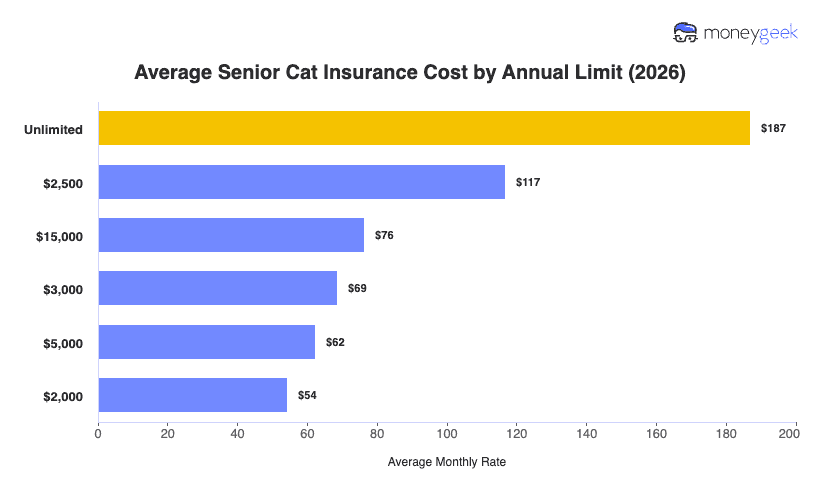
Senior cat insurance averages $62 per month for a $5,000 annual limit. Shifting that limit changes the premium, but not always in proportion: dropping to a $2,000 limit brings the average down to $54 per month, while unlimited coverage reaches $187 per month.

The progression isn't strictly linear. The $2,500 tier averages $117 per month, which is higher than every limit from $3,000 through $15,000 because insurers price specific limit tiers based on their own claims experience, risk models and product positioning rather than applying a uniform percentage increase at each level.  

The table below shows average monthly rates across different annual limits.

Jump To: Average Senior Cat Insurance Cost by Deductible

Average Senior Cat Insurance Cost by Annual Limit Chart

Average Senior Cat Insurance Costs by Deductible

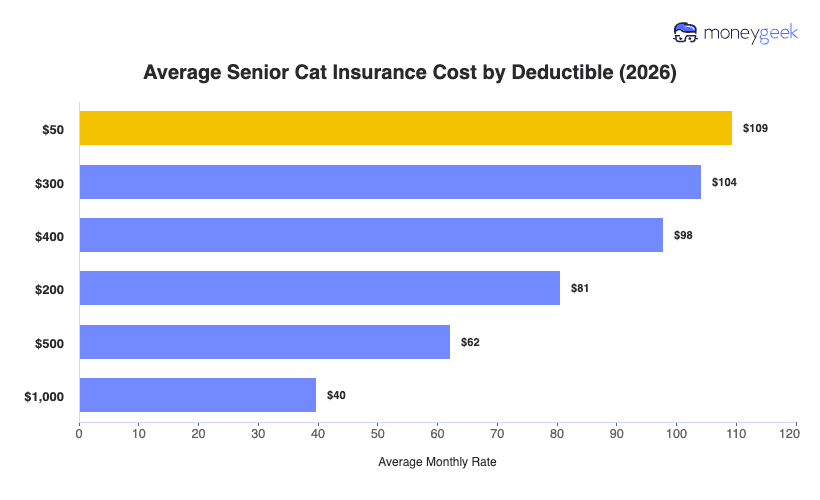
Choosing a $500 deductible produces an average monthly premium of $62 for senior cat insurance. At the low end, a $50 deductible averages $109 per month; at the high end, a $1,000 deductible drops to $40 per month. The lowest deductible costs 175% more than the highest because once a low deductible is met once for the year, the insurer pays on every covered claim that follows.  

However, the variation won’t always be linear. The $300 deductible averages $104 per month and the $400 deductible averages $98 per month, which are likely because insurers set rates for specific tiers based on their own claims experience and product positioning.

See how average monthly rates change with different deductibles.

Jump To: Average Senior Cat Insurance Cost by Reimbursement Rate

Average Senior Cat Insurance Cost by Deductible Chart

Average Senior Cat Insurance Costs by Reimbursement Rate

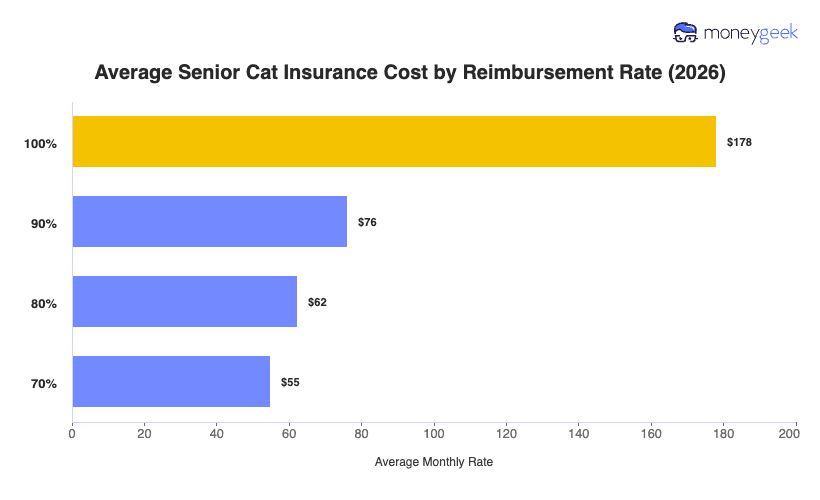
According to our analysis, senior cat insurance averages $62 per month for an 80% reimbursement rate. Moving to 70% reimbursement brings that down to $55 per month, while 100% reimbursement reaches $178 per month. That $123 monthly difference reflects how much the insurer's costs change depending on how much of each claim they're responsible for paying. At 100% reimbursement, the insurer covers every dollar of every covered claim with nothing left for the policyholder to absorb, which is why that tier costs so much more than the others.

Check the table for average costs based on reimbursement rate.  

Jump To: Average Senior Cat Insurance Cost by Annual Limit

Average Senior Cat Insurance Cost by Reimbursement Rate Chart

Average Senior Cat Insurance Costs by State

Average monthly premiums for senior cat insurance range from $48 in West Virginia to $104 in Washington, D.C., for the same coverage. The 50 states and Washington, D.C. fall into three cost tiers based on their distance from the national average:

  • Low-cost states (10%+ below national average): West Virginia, Kentucky, North Dakota, Alabama, Arkansas, Missouri, Maryland, Nebraska, Oklahoma, Iowa, Tennessee, New Mexico, Wyoming, Kansas, Rhode Island, Louisiana, Montana, Maine, Michigan, Mississippi, Nevada, Florida, South Dakota, Idaho, Virginia and North Carolina and Vermont
  • Mid-cost states (within ±10% of national average): South Carolina, Indiana, Minnesota, Oregon, Utah, Alaska, Ohio, New Hampshire, Arizona, Delaware, Texas, New York, Wisconsin, Pennsylvania, Hawaii and California
  • High-cost states (10%+ above national average): Connecticut, Illinois, New Jersey, Georgia, Colorado, Massachusetts, Washington and Washington, D.C.

More than half of states fall below the national average, with 27 landing in the low-cost tier. Only eight states exceed average costs by more than 10%, with Washington, D.C., the furthest outlier at 67% above the national benchmark. That gap reflects elevated veterinary practice overhead and a high concentration of specialty care facilities relative to the rest of the country. West Virginia anchors the low-cost tier at 24% below the national average, where lower regional operating costs keep premiums near the floor.

Alabama$50$59620%4
Alaska$65$778-4%33
Arizona$66$793-6%37
Arkansas$50$59820%5
California$71$850-14%43
Colorado$80$961-29%48
Connecticut$73$871-17%44
Delaware$66$793-6%38
Florida$58$6996%22
Georgia$78$937-26%47
Hawaii$70$839-12%42
Idaho$58$7016%24
Illinois$74$887-19%45
Indiana$60$7243%28
Iowa$53$63315%10
Kansas$55$66012%14
Kentucky$48$57323%2
Louisiana$55$66611%16
Maine$57$6898%18
Maryland$52$62017%7
Massachusetts$82$987-32%49
Michigan$58$6907%19
Minnesota$63$751-1%30
Mississippi$58$6927%20
Missouri$50$60419%6
Montana$57$6819%17
Nebraska$52$62916%9
Nevada$58$6937%21
New Hampshire$66$791-6%36
New Jersey$77$925-24%46
New Mexico$53$63715%12
New York$67$808-8%39
North Carolina$60$7164%26
North Dakota$48$57623%3
Ohio$65$780-5%34
Oklahoma$52$62716%8
Oregon$63$760-2%31
Pennsylvania$69$834-12%41
Rhode Island$55$66311%15
South Carolina$61$7352%29
South Dakota$58$6996%23
Tennessee$53$63515%11
Texas$66$790-6%35
Utah$63$762-2%32
Vermont$60$7164%27
Virginia$59$7056%25
Washington$84$1,007-35%50
Washington D.C.$104$1,250-67%51
West Virginia$48$57024%1
Wisconsin$67$810-9%40
Wyoming$54$65113%13

Explore our state-specific resources below for more detailed information.

Average Senior Cat Insurance Costs by Breed

Use the resources below to find how much pet insurance costs for your senior cat's specific breed.

How to Lower Senior Cat Insurance Costs Without Sacrificing Coverage

Senior cat insurance premiums are influenced by your cat's profile in ways that aren't fully adjustable, but the coverage structure you choose is. The methods below can help you reduce costs while keeping enough financial protection in place.

    petInsurance icon
    Compare quotes from at least three insurers

    Premiums for identical coverage can vary across carriers because each insurer weights breed risk, regional veterinary costs and claims history differently. Requesting quotes from at least three insurers for the same coverage profile gives you a clearer picture of where the market actually prices your senior cat, rather than accepting the first figure as the norm.

    giveMoney icon
    Raise your deductible to $500 or higher

    Moving from a $50 to a $500 deductible cuts your monthly premium by 43%, based on our analysis. Since you only meet your deductible once per policy year, a higher threshold still leaves the insurer responsible for covered claims once that amount is reached.

    money icon
    Choose an annual limit that reflects realistic claim scenarios

    Unlimited coverage costs 245% more than a $2,000 limit for senior cats. A $5,000 to $10,000 annual limit covers most illness and injury scenarios, including chronic condition management common in senior cats, without the steep premium that uncapped coverage carries.

    discount icon
    Select 80% reimbursement instead of 90% or 100%

    The 70% to 90% reimbursement range produces gradual premium differences of $21 per month across both tiers. Dropping from 90% to 80% reimbursement reduces your premium while still covering the majority of each covered claim, which is a meaningful cost reduction for a modest increase in your share of each bill.

    petMedicalCheckup icon
    Skip add-ons that cover predictable expenses

    Optional wellness plans increase premiums while covering expenses that are relatively predictable in cost. For senior cats where the higher financial risk is unexpected illness or injury, directing that premium toward core accident and illness coverage typically provides better financial protection.

Pet Insurance Cost for Senior Cats: Bottom Line

Senior cat insurance premiums depend on three factors: coverage selection, breed and location. Each operates independently, and their combined effect determines where your premium lands relative to the $62 national average. Treat that figure as a reference point, not a prediction.

Use these three questions to evaluate your quote against the benchmark:  

  1. How does your senior cat's profile compare?
  2. Which factors are driving your premium?
  3. What changes would affect your cost?

Senior Cat Insurance Cost: Next Steps

If you're ready to get quotes for your senior cat, use your cat's breed, age and location alongside your preferred coverage limits from this report as your starting inputs. This gives you a basis for recognizing whether a provider is pricing your cat's risk profile in line with the market or charging disproportionately above it.

If you're still weighing your options, the guidance below can help you clarify your next move.

Compare Senior Cat Insurance Rates

Ensure you are getting the best rate for your senior cat insurance. Compare quotes from the top insurance companies.

If you're concerned about affording coverage on a tight budget

If your cat is a breed with known late-life health risks

If you live in a high-cost state

About Ritchel Mendiola


Ritchel Mendiola headshot

Ritchel Mendiola is a Content Writer at MoneyGeek specializing in pet insurance. With a journalism background and over three years of experience in personal finance writing, she brings a reporter's approach to coverage, digging into the details that actually matter when you're trying to protect your furry friends without overpaying.

Ritchel focuses on the policy terms that actually matter when your pet needs care: waiting periods that could delay coverage right when you need it, exclusions that might catch you off guard at the vet, reimbursement levels that determine your real costs, and claim scenarios that reveal how policies hold up in practice. She digs into what providers offer, checks their track records and pricing, then turns it into clear comparisons that help you decide.

Whether you're shopping for your first pet insurance policy or switching providers, Ritchel does the research for you and breaks down your options so you can protect your furry family members, without breaking the bank.


sources
Copyright © 2026 MoneyGeek.com. All Rights Reserved