
Average Kitten Insurance Cost (2026 Report)


How Much Does Kitten Insurance Cost?

For kittens under 1 year old, pet insurance costs an average of $23 monthly ($272 annually) based on a $5,000 annual limit, $500 deductible and 80% reimbursement rate. MoneyGeek's study of over 67,000 kitten profiles across all 50 states and Washington, D.C., found that costs remain relatively flat during the first two years: 1-year-olds cost $22 monthly on average, and 2-year-olds cost $23 monthly, since kittens experience comparable health risks before age-related conditions appear.

Use these national averages as a baseline, not a guarantee. Your kitten's actual premium varies with breed-specific health risks and local veterinary costs, regardless of matching these coverage limits.

We analyzed kitten insurance pricing to establish national cost benchmarks and show how premiums vary based on different factors. Our cost analysis uses standardized policy parameters for consistent comparisons across kitten profiles.

Dataset Scope and Assumptions

  • Providers analyzed: 18 major pet insurance providers
  • Profiles analyzed: Over 67,000 kitten profiles
  • Geography: All U.S. states and Washington, D.C.
  • Breed profile: Ragdoll under 1 year old
  • Policy baseline: $5,000 annual limit, $500 deductible, 80% reimbursement rate

How We Calculated Average Kitten Insurance Costs

Our published averages represent modeled premiums for standardized kitten profiles and were calculated in two ways:

  • National benchmark average: The monthly national average reflects the modeled premium for a Ragdoll kitten under 1 year old across all states in our dataset using the baseline policy parameters.
  • Segment averages: To demonstrate cost variation, we calculated average modeled premiums for our baseline profile while isolating individual variables, including:  
    • States and Washington, D.C.
    • Annual limits
    • Deductibles
    • Reimbursement rates

Segment averages aggregate modeled pricing patterns across the full dataset so readers can compare how premiums change based on location and coverage levels.

What Factors Affect Kitten Insurance Costs?

Coverage selection, breed, and geographic location are the three main factors driving most premium differences in kitten insurance. These help insurers predict claim patterns and set pricing accordingly. They work in combination rather than isolation; a Persian kitten in a high-cost urban area with high coverage limits will have a different premium from a mixed-breed kitten in a rural state with low limits.

The sections below explain how each factor influences your premium.

    petInsurance icon
    Coverage selection

    Coverage selection stands as the strongest cost driver because it directly determines the insurer's maximum financial exposure per claim and per policy year. The three components below work together to set your base premium.

    • Annual limit: Your policy's annual limit caps what the insurer pays each year, with higher limits increasing premiums since the insurer accepts greater potential payout. Unlimited coverage costs 105% more than a $5,000 annual limit, reflecting the insurer's substantially higher exposure when no cap exists on yearly payouts.
    • Deductible: Lower deductibles transfer more claim costs to the insurer from the first dollar, which increases your monthly premium to offset their greater per-incident exposure. A $50 deductible costs 72% more than a $1,000 deductible because the insurer begins paying sooner and covers a larger portion of the veterinary bill.  
    • Reimbursement rate: The percentage the insurer pays on eligible expenses after you meet your deductible directly shapes premium cost. Moving from 60% reimbursement to 100% reimbursement increases premiums by 109%, as the insurer assumes responsibility for the full claim amount rather than splitting costs with the policyholder.
    cat icon
    Breed

    Breed is the second-strongest factor affecting kitten insurance costs because insurers can predict hereditary health risks with high reliability using historical claims data. Persian and Himalayan kittens, for example, develop polycystic kidney disease and respiratory complications tied to their flat facial structure, often requiring intervention before age 3. Scottish Folds show cartilage abnormalities affecting joints and ears throughout their lives, while Maine Coons exhibit hypertrophic cardiomyopathy at rates above average.

    Claims data spanning decades reveal that certain purebred kittens generate 30% to 50% higher lifetime treatment costs. Domestic shorthairs and mixed-breed kittens generally cost less to insure because they show a lower incidence of breed-specific conditions and benefit from broader genetic variation.

    locationPin icon
    Geographic location

    Geographic location ranks as the third-strongest cost driver because veterinary fees and claim frequency patterns differ across states and metro areas. Urban centers with a higher cost of living often have higher veterinary expenses. A routine exam or emergency visit in New York City costs more than the same service in rural Montana. Insurers adjust premiums to reflect these regional cost structures, which directly affect their expected payout per claim.

    MoneyGeek's analysis shows kitten insurance rates vary by as much as 37% across states. Washington, D.C., has premiums 37% above the national average, while Alabama has premiums 27% below the national average.

Average Kitten Insurance Costs by Coverage Selection

Coverage selection creates the widest premium variation in kitten insurance. Monthly premiums range from $15 to $43, depending on which annual limit, deductible or reimbursement rate you choose. The sections below further show how each component affects your cost.

Average Kitten Insurance Costs by Annual Limit

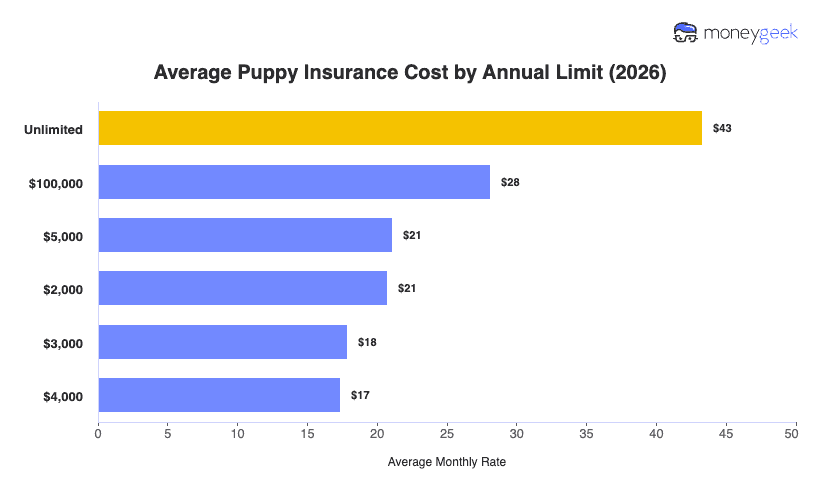
Annual limits create substantial premium variation by capping the insurer's maximum payout per policy year. A $5,000 annual limit averages $21 monthly and serves as a common benchmark. The lowest tier at $2,000 costs $21 monthly on average, while unlimited coverage reaches $43 monthly, showing a 105% increase.

Note that premium increases don't follow a perfectly linear pattern: $3,000 and $4,000 limits both cost less ($18 and $17 monthly) than the $2,000 tier ($21 monthly), despite offering more coverage. This reflects how insurers price specific limit tiers based on their claims experience, risk models and product positioning rather than applying a uniform percentage increase at each level.

The table shows how average monthly costs vary with the annual limit.

Jump To: Average Kitten Insurance Cost by Deductible

Average Kitten Insurance Cost by Annual Limit Chart

Average Kitten Insurance Costs by Deductible

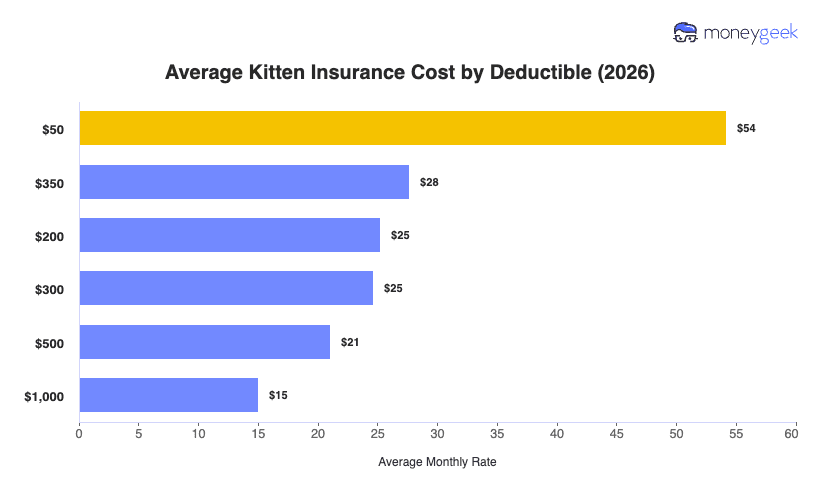
Based on our analysis, a $500 deductible produces an average monthly premium of $21 for kitten insurance, representing a mid-range cost-sharing arrangement where policyholders pay the first $500 of vet costs before coverage begins.

Lower deductibles transfer more immediate claim costs to the insurer, increasing premiums; for example, a $50 deductible averages $54 monthly (157% higher than $500) because the insurer pays from nearly the first dollar of treatment. Higher deductibles reduce premiums substantially: $1,000 deductibles drop to $15 monthly on average as policyholders shoulder more upfront veterinary expenses.

However, the cost curve shows some non-linear movement across tiers. Moving from $250 to $300 deductibles reduces premiums from $26 to $25 monthly, but $350 deductibles increase slightly to $28 monthly despite the higher out-of-pocket requirement.

See how average monthly costs vary by deductible.

Jump To: Average Kitten Insurance Cost by Reimbursement Rate

Average Kitten Insurance Cost by Deductible Chart

Average Kitten Insurance Costs by Reimbursement Rate

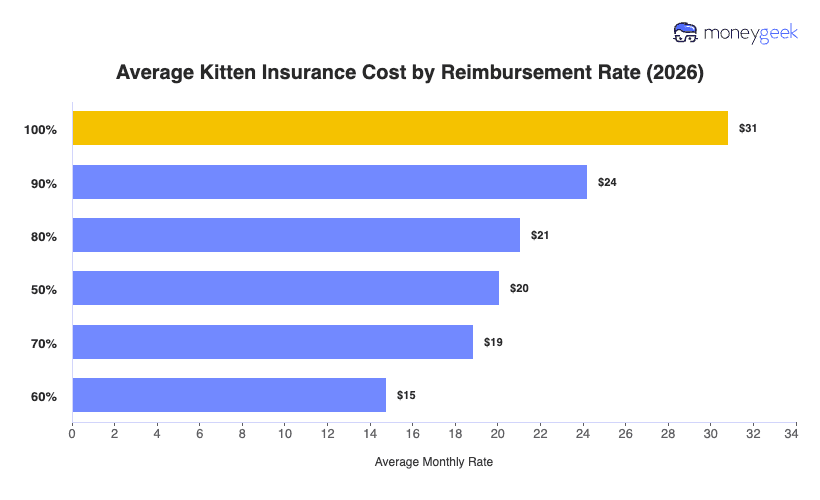
Reimbursement rate determines what percentage of eligible expenses the insurer pays after you meet your deductible, with 80% reimbursement averaging $21 monthly for kitten insurance. Increasing to 100% reimbursement raises premiums to $31 monthly (46% higher than 80%) since the insurer assumes full responsibility for post-deductible claim costs, while dropping to 60% reimbursement lowers costs to $15 monthly as policyholders cover a larger share of each veterinary bill beyond the deductible.

The pricing progression shows an unusual dip at the 60% tier, which costs less than 50% reimbursement ($15 versus $20 monthly). This non-linear pattern reflects how insurers price specific reimbursement tiers based on their claims experience and risk models rather than pure actuarial math where higher policyholder cost-sharing should consistently reduce premiums.

Check the table for variations in average costs based on reimbursement rate.

Jump To: Average Kitten Insurance Cost by Annual Limit

Average Kitten Insurance Cost by Reimbursement Rate Chart

Average Kitten Insurance Costs by State

Our kitten insurance cost study found that monthly premiums range from $17 in Alabama to $31 in Washington, D.C., a $15 difference representing 88% higher costs in the most expensive jurisdiction. The 50 states and Washington, D.C., fall into three cost tiers based on their relationship to the national average:

  • Low-cost states (10%+ below national average): Alabama, Arkansas, North Dakota, Kentucky, West Virginia, Tennessee, Missouri, Montana, Oklahoma, Maine, Rhode Island, Iowa, New Mexico, Indiana, Nebraska, Kansas, Mississippi, Wyoming, Louisiana, Michigan, Idaho, South Dakota, North Carolina, South Carolina, Virginia, Vermont, Nevada
  • Mid-cost states (within ±10% of national average): Maryland, Ohio, Minnesota, Florida, Utah, Arizona, Texas, Oregon, Pennsylvania, Delaware, Alaska, New Hampshire, New York, Georgia
  • High-cost states (10%+ above national average): Wisconsin, Illinois, Connecticut, New Jersey, Hawaii, Colorado, California, Massachusetts, Washington, Washington, D.C.

Roughly 75% of states cluster at or below the national average, while 25% exceed average costs by more than 10%. Washington, D.C., where routine vet visits cost an average of $92 based on CareCredit's 2024 data, leads the high-cost tier at 37% above the national benchmark due to elevated veterinary operating costs, higher concentrations of specialty and emergency clinics, and increased cost of living. 

Alabama lands at the bottom of the cost spectrum, 27% below the national average, where routine vet visits cost $61 for cats and lower veterinary practice overhead combined with limited specialty care infrastructure result in more affordable service pricing.

The table below shows average monthly costs across all 50 states and Washington, D.C., allowing you to compare your location against regional benchmarks.

Alabama$17$19927%1
Alaska$23$275-1%38
Arizona$21$2547%33
Arkansas$17$20027%2
California$26$313-15%48
Colorado$26$311-14%47
Connecticut$24$292-7%44
Delaware$23$2701%37
Florida$21$2537%31
Georgia$23$281-3%41
Hawaii$25$296-9%46
Idaho$20$24211%21
Illinois$24$286-5%43
Indiana$19$22617%14
Iowa$19$22318%12
Kansas$19$23016%16
Kentucky$17$20325%4
Louisiana$20$23813%19
Maine$18$21720%10
Maryland$21$2528%29
Massachusetts$27$326-20%49
Michigan$20$24112%20
Minnesota$21$2508%28
Mississippi$19$23315%17
Missouri$18$21222%7
Montana$18$21422%8
Nebraska$19$22717%15
Nevada$21$2479%26
New Hampshire$23$276-1%39
New Jersey$24$293-8%45
New Mexico$19$22617%13
New York$23$279-3%40
North Carolina$20$24510%25
North Dakota$17$20027%2
Ohio$21$2527%30
Oklahoma$18$21621%9
Oregon$22$2643%35
Pennsylvania$22$2701%36
Rhode Island$18$22219%11
South Carolina$20$24510%24
South Dakota$20$24311%22
Tennessee$18$21222%6
Texas$22$2605%34
Utah$21$2547%32
Vermont$21$2479%26
Virginia$20$24410%23
Washington$28$333-22%50
Washington D.C.$31$374-37%51
West Virginia$17$20624%5
Wisconsin$23$281-3%42
Wyoming$20$23813%18

Explore our state-specific resources below for more detailed information.

Average Kitten Insurance Costs by Breed

Learn more about breed-specific cost averages using the dedicated resources below.

How to Lower Kitten Insurance Costs Without Sacrificing Coverage

Your coverage selection, your kitten’s breed and your location drive most premium differences, but you can still influence your final cost through choices you make when getting quotes or renewing your policy. Adjusting deductibles and comparing prices across insurers can lower premiums without cutting essential coverage.

    petInsurance icon
    Compare quotes from at least three insurers

    Premium differences for identical coverage on the same kitten can vary by 20% to 40% across insurers because each company uses different claims data and pricing algorithms for specific breeds. Getting quotes from multiple providers helps identify which insurer prices your kitten's specific profile most competitively.

    giveMoney icon
    Raise your deductible to $500 or higher

    Increasing your deductible from $250 to $500 or $1,000 can reduce monthly premiums by 15% to 30%, shifting more upfront veterinary costs to you before kitten insurance kicks in. This strategy works best if you can cover routine kitten care costs (vaccinations, minor illnesses) out-of-pocket while maintaining financial protection against expensive emergencies like foreign object ingestion or serious infections.

    money icon
    Adjust coverage limits based on actual kitten health needs

    If your kitten remains healthy after the first year with no chronic conditions, consider reducing your annual limit from unlimited to $10,000 or lowering reimbursement from 90% to 80% at renewal. This maintains illness coverage while reducing premiums by 15% to 25%, though you'll pay more out-of-pocket for moderate claims.

    injuredPet icon
    Start with accident-only coverage for mixed-breed kittens

    Accident-only policies cost 40% to 60% less than accident and illness coverage because they exclude medical conditions, making them practical for mixed-breed kittens with lower hereditary disease risk. You can upgrade to comprehensive accident and illness coverage once your budget stabilizes or your kitten's health needs become clearer, though any conditions diagnosed during the accident-only period will likely be excluded as pre-existing.

    petMedicalCheckup icon
    Skip optional add-ons unless they match your kitten's needs

    Optional wellness plans and exam fee add-ons add $10 to $20 monthly but often pay out less than you contribute over the year. Evaluate whether paying out-of-pocket for predictable expenses like vaccinations, annual exams and vet exam fees costs less than adding these riders to your base premium.

Pet Insurance Cost for Kittens: Bottom Line

Kitten insurance costs differ based on coverage selection, breed and geographic location. Each insurer evaluates these factors using their own claims data and pricing models, so your quote reflects how your specific kitten profile aligns with their risk assessments. The $23 monthly national average functions as a reference point, not a guarantee of what you'll pay.

Assess your quote by answering these three questions:

  1. Where does your kitten sit relative to the benchmark?
  2. Which cost factors are fixed versus adjustable?
  3. What adjustments would affect your premium?

Apply this framework to evaluate whether a quote accurately reflects your kitten's risk profile and your coverage priorities, rather than focusing solely on how your premium compares to the average.

Kitten Insurance Cost: Next Steps

If you're ready to shop for kitten insurance, reference your kitten's breed, your state and your preferred coverage limits from this report when requesting quotes below. This preparation helps you recognize whether insurers are pricing your kitten's risk profile reasonably or charging disproportionately high premiums.

If you’re still evaluating options, our guidance below can help clarify what matters most based on your situation.

Compare Kitten Insurance Rates

Ensure you are getting the best rate for your kitten insurance. Compare quotes from the top insurance companies.

If you're deciding whether coverage fits your budget

If you own a purebred with documented health vulnerabilities

If you live where veterinary costs run high

About Ritchel Mendiola


Ritchel Mendiola headshot

Ritchel Mendiola is a Content Writer at MoneyGeek specializing in pet insurance. With a journalism background and over three years of experience in personal finance writing, she brings a reporter's approach to coverage, digging into the details that actually matter when you're trying to protect your furry friends without overpaying.

Ritchel focuses on the policy terms that actually matter when your pet needs care: waiting periods that could delay coverage right when you need it, exclusions that might catch you off guard at the vet, reimbursement levels that determine your real costs, and claim scenarios that reveal how policies hold up in practice. She digs into what providers offer, checks their track records and pricing, then turns it into clear comparisons that help you decide.

Whether you're shopping for your first pet insurance policy or switching providers, Ritchel does the research for you and breaks down your options so you can protect your furry family members, without breaking the bank.


sources
Copyright © 2026 MoneyGeek.com. All Rights Reserved