


GEICO offers the most competitive full coverage rates across all violation types for high-risk drivers in California.
For nationwide high-risk insurance options, see our guide to affordable high-risk car insurance in the U.S.
Updated: May 22, 2026
Advertising & Editorial Disclosure

GEICO offers the most competitive full coverage rates for high-risk drivers across all violation types in California. Read more.
California offers two safety nets for high-risk drivers: the CLCA program provides $244 to $966 annual coverage for income-eligible good drivers, while CAARP helps rejected drivers get state-mandated insurance.
If you have a clean driving record and limited income, California's Low Cost Automobile Insurance Program offers annual premiums from $244 to $966. High-risk drivers rejected by multiple insurers can get coverage through the California Automobile Assigned Risk Plan (CAARP). Read more.
GEICO offers the most competitive full coverage rates across all violation types for high-risk drivers in California.
For nationwide high-risk insurance options, see our guide to affordable high-risk car insurance in the U.S.
GEICO | $212 | |
GEICO | $133 | |
GEICO | $152 | |
GEICO | $153 |
GEICO offers the cheapest car insurance for California drivers with a DUI at $212 per month for full coverage, while other insurers charge up to $311. A DUI ranks among the most serious violations on your record and remains for 10 years, though most insurers consider it for rate calculations for three to five years.
See our guide to car insurance after a DUI for tips on reducing your rates.
| Geico | $212 | $2,550 |
| Progressive | $228 | $2,730 |
| Mercury Insurance | $240 | $2,879 |
| Wawanesa Insurance | $287 | $3,448 |
| Auto Owners | $311 | $3,737 |
GEICO offers the cheapest car insurance for California drivers with a speeding ticket at $133 per month for full coverage, while other insurers charge up to $192. Your rate increase depends on how much you exceeded the speed limit and whether it's your first offense. Most speeding violations remain on your driving record for three years.
| Geico | $133 | $1,601 |
| Progressive | $147 | $1,760 |
| AAA | $176 | $2,106 |
| State Farm | $185 | $2,214 |
| Mercury Insurance | $192 | $2,303 |
GEICO offers the cheapest car insurance for California drivers with an at-fault accident at $152 per month for full coverage, while other insurers charge up to $203. Insurers view at-fault accidents as a sign you'll file future claims more often, with larger increases if the accident involved injuries or major property damage. Most at-fault accidents remain on your California driving record for three years.
| Geico | $152 | $1,822 |
| Progressive | $159 | $1,904 |
| State Farm | $192 | $2,305 |
| AAA | $192 | $2,305 |
| Auto Owners | $203 | $2,437 |
GEICO offers the cheapest car insurance for California drivers with a distracted driving violation at $153 per month for full coverage, while other insurers charge up to $192. California law prohibits handheld cellphone use while driving, and violations can lead to fines and increased insurance rates. While less severe than DUI or reckless driving, a distracted driving citation still affects your premiums.
| Geico | $153 | $1,832 |
| Progressive | $159 | $1,904 |
| State Farm | $185 | $2,214 |
| AAA | $191 | $2,288 |
| Mercury Insurance | $192 | $2,303 |
California drivers with violations pay much more for car insurance than those with clean records. A DUI increases full coverage rates by 139% ($202 more per month), while at-fault accidents add 59% ($85 per month) to your premium. The table compares average monthly costs for common violation types, showing how each affects your rates compared to a clean driving record. Use the filter to toggle between full coverage and state minimum liability rates.
For clean-record rates, see the average cost of car insurance in California.
| Clean | $145 | $1,744 |
| Speeding 11-15 MPH over limit | $213 | $2,562 |
| Texting While Driving | $219 | $2,633 |
| At Fault Accident ($1000-$1999 Prop Dmg) | $230 | $2,759 |
| DUI - BAC >= .08 | $347 | $4,167 |

Your driving record affects your car insurance rates in California. Major offenses, like DUIs or reckless driving, can affect your insurance costs for up to 10 years.
Minor violations affect your rates for about three to five years after the incident. Each insurance company has its own rules on how long violations affect your rates.
Compare rates from multiple insurers to find affordable car insurance with violations on your record. Learn what makes you high risk, how to find affordable providers, and what to do if insurers deny you.
Our guide to getting car insurance after a bad driving record covers additional tips for lowering premiums with violations on file.
California insurers classify drivers as high risk for: traffic violations or at-fault accidents, DUI convictions, a suspended or revoked license, no driving experience, sports car ownership or a racing history, poor credit or coverage lapses. Drivers over 60 may also pay higher rates.
These steps cut costs on high-risk car insurance in California.
Settle on your coverage requirements before contacting any insurer. High-risk drivers can face pressure to accept whatever's on the table, so know what you need going to keep you from buying more than necessary. Factor in add-ons like rideshare coverage and roadside assistance if they apply to how you drive.
Know what high-risk drivers in California pay on average so you understand whether a quote is competitive. California-certified defensive driving courses can cut premiums by up to 10% for eligible drivers. Ask each insurer which discounts apply to your specific profile.
Pay-per-mile and usage-based programs can cut costs for high-risk drivers who log low mileage or have improved their habits. GEICO's telematics program monitors driving behavior and can cut premiums by up to 30%. These programs don't erase a high-risk designation, but they reduce what you pay while it's on your record.
High-risk rates vary more between insurers than standard rates do. Get quotes from at least three companies using the same coverage levels and deductibles. Independent brokers can access multiple carriers at once and are worth using if you've already been declined. Affordable options in California vary by violation type and driver profile.
Income-eligible drivers with clean records may qualify for California's Low Cost Automobile Insurance Program at $244 to $966 a year. If multiple standard-market insurers have declined your application, the California Automobile Assigned Risk Plan (CAARP) assigns you to a participating carrier.
California insurers can decline any application they consider too risky. Two rejections from standard-market carriers make you eligible for the California Automobile Assigned Risk Plan (CAARP). Income-eligible drivers with clean records may qualify for the California Low Cost Automobile (CLCA) Insurance Program instead.
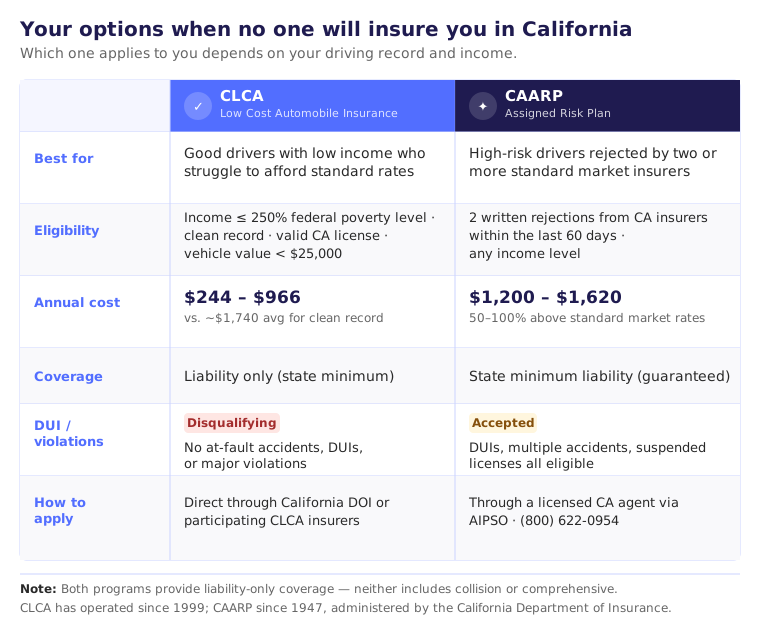
California has two programs for drivers who can't get coverage in the standard market. The CLCA program provides liability insurance to income-eligible drivers with clean records. CAARP is the fallback for high-risk drivers rejected by multiple standard-market insurers.
CLCA eligibility requires household income at or below 250% of the federal poverty level, a clean driving record with no at-fault accidents, DUIs or major violations, a valid California driver's license and a vehicle worth under $25,000.
Annual CLCA premiums are $244 to $966, which are well below standard market rates for the same coverage.
Drivers with DUIs, suspended licenses or multiple serious violations need SR-22 insurance, which is a certificate of financial responsibility filed directly with the state.
CAARP is for high-risk drivers who can't get standard market coverage and don't qualify for CLCA. Two rejections from licensed California insurers (for violations like DUIs, multiple at-fault accidents or a suspended license) make you eligible. CAARP assigns you to a participating carrier at state-approved rates for the legally required minimum liability coverage.
CAARP assigns high-risk drivers to participating insurance companies based on their market share in California. CAARP was created in 1947 and is administered by the California Department of Insurance.
California has two programs for drivers unable to get standard coverage. The CLCA program serves income-eligible good drivers, while CAARP handles high-risk drivers who have been rejected by the voluntary market. CAARP is an assigned risk pool where insurance companies licensed in California must accept a proportional share of high-risk drivers based on their market share in the state.
Once assigned through CAARP, you'll be matched with an insurer for a policy period at guaranteed rates. This helps all California drivers get the state-required minimum liability coverage regardless of their driving history.

Monday to Friday, 8:00 a.m. to 4:30 p.m. PT


(800) 622-0954

(415) 421-4013

P.O. Box 6530
Providence, RI 02940-6530
*CAARP can be reached through AIPSO (Automobile Insurance Plan Service Office), which administers the program.
CLCA program rates range from $244 to $966 per year for income-eligible good drivers, among the most affordable options in California. CAARP rates for high-risk drivers are 50% to 100% higher than comparable voluntary market policies. For example, if a clean-record driver pays $68 per month for state minimum coverage, a CAARP-assigned driver pays $100 to $135 per month for identical coverage.
Both programs are administered by the California Department of Insurance. CLCA has been operating since 1999. CAARP has been writing assigned risk coverage since 1947.
To apply for CLCA:
To apply for CAARP:
Both programs help California drivers meet the state's insurance requirements, whether through low-cost coverage for good drivers or assigned risk coverage for high-risk drivers.
GEICO has the most affordable high-risk car insurance in California across all violation types in MoneyGeek's analysis. Full coverage is $133 a month for a speeding ticket and $212 for a DUI.
Drivers with clean records who meet income requirements can access CLCA rates of $244 to $966 a year. Drivers rejected by multiple insurers can get state-mandated coverage through CAARP.
As your driving record improves, pull new quotes among the cheapest car insurance providers in California to see what standard market rates look like once violations age off your record.
GEICO offers the most affordable high-risk car insurance in California, with rates starting at $133 per month for full coverage for drivers with speeding tickets. For drivers with DUIs, GEICO's rates start at $212 per month for full coverage.
High-risk car insurance in California costs more than standard policies. A DUI increases premiums by 135% to 140%, adding $176 to $227 per month compared with a clean record for drivers aged 30 to 59.
MoneyGeek calculated average rates using full coverage car insurance policies with 100/300/100 liability insurance and comprehensive and collision coverage with a $1,000 deductible. We calculated state minimum coverage rates based on California's required 15/30/5 liability coverage.
All violation-specific profiles use this driver profile:
We analyzed rates from major insurance companies for each violation type to find the most affordable providers for high-risk drivers in California. Coverage level filters let users compare full coverage and state minimum options for their situation.

Mark Fitzpatrick, a licensed Property and Casualty (P&C) Insurance Producer in Connecticut, is MoneyGeek's resident expert in insurance and economics. He has spent nearly a decade covering the market, first at LendingTree and now at MoneyGeek, where he analyzes hundreds of carriers and millions of rates across auto, home, renters, health and life insurance.
His work has appeared in The Washington Post, The New York Times and NPR. He draws on independent cost and consumer experience data, and no insurance company partnerships affect his recommendations.
Mark studied at Boston College before earning a master's in economics and international relations from Johns Hopkins University. Before MoneyGeek, he worked in financial risk management at State Street. He's also a five-time “Jeopardy!” champion.